Key Takeaways
Option A
Aggressive Driving
The traffic infraction that escalates quietly.
Best for: Understanding when reckless habits behind the wheel cross into ticketable or chargeable territory under traffic codes.
Option B
Road Rage
The criminal act fueled by intent to intimidate or harm.
Best for: Understanding when anger behind the wheel becomes a criminal offense with serious legal and insurance consequences.
If you received a ticket for following too closely or unsafe lane changes
Aggressive Driving
These are classic aggressive driving violations — traffic infractions that typically result in fines and points, not criminal charges. Contest them in traffic court if the facts support it.
If another driver physically threatened you or used their vehicle as a weapon
Road Rage
This crosses into criminal territory. File a police report immediately, preserve any dashcam footage, and notify your insurer — this is no longer just a traffic matter.
If you're concerned about your insurance rates after an incident
Aggressive Driving
An aggressive driving citation will raise your rates less severely than a road rage criminal conviction, which insurers treat similarly to a DUI or reckless driving charge.
If you were charged after an altercation that started with a traffic dispute
Road Rage
Prosecutors often upgrade aggressive driving to road rage when there's evidence of intentional escalation. You'll likely need a criminal defense attorney, not just a traffic lawyer.
If you want to understand what behaviors to avoid on the road
Aggressive Driving
Aggressive driving is the gateway. Tailgating, excessive honking, and unsafe passing are where most incidents begin — stopping there keeps you out of criminal road rage territory entirely.
Two Different Legal Animals
Drivers often use "aggressive driving" and "road rage" as interchangeable phrases, but courts don't. Legally, they occupy distinct categories with different elements, different penalties, and very different consequences for your license, your wallet, and in some cases your freedom. Getting these terms confused can cost you — especially if you're trying to fight a charge or understand what you're actually up against.
The short version: aggressive driving is almost always a traffic offense — the kind handled in traffic court with fines and points. Road rage, by contrast, is generally prosecuted as a criminal offense — think assault, menacing, or in extreme cases, attempted murder. The same 30-second incident can be classified one way or the other depending almost entirely on what the driver intended and what actions they took outside the vehicle.
This distinction matters for insurance, too. A civil traffic violation lands differently on your record than a criminal conviction. Insurers who see a road rage charge treat it similarly to how they'd view a reckless driving charge — a serious red flag that can spike premiums or trigger non-renewal.

Understanding where the law draws the line isn't just useful trivia. It's the kind of knowledge that shapes how you react on the road, how you document an incident, and how you talk to law enforcement afterward.
How States Define Aggressive Driving
There is no single federal definition of aggressive driving. Each state writes its own statute — or doesn't. As of now, roughly half of U.S. states have specific aggressive driving laws on the books, while others prosecute the component behaviors (tailgating, improper passing, speeding) individually under general traffic codes.
Where a formal aggressive driving statute exists, it typically requires a combination of traffic violations occurring together. Florida's statute, for example, defines aggressive driving as committing two or more of the following simultaneously or in sequence: speeding, unsafely changing lanes, following too closely, failing to yield, passing on the shoulder, or running red lights/stop signs. That bundling approach is common — one bad act might just be a ticket, but a pattern of bad acts in a single driving episode becomes aggressive driving.
| Criterion | Aggressive Driving | Road Rage |
|---|---|---|
| Legal category | Traffic offense / civil infraction | Criminal offense |
| Intent required | No — reckless or negligent behavior | Yes — deliberate, targeted action |
| Typical charges | Moving violations, misdemeanor | Assault, menacing, reckless endangerment |
| Potential penalties | Fines, points, possible license course | Jail, prison, license revocation |
| Insurance impact | Moderate rate increase (15–30%) | Major increase or non-renewal (60%+) |
| Civil liability exposure | Covered under standard auto liability | May be excluded as intentional act |
| Court venue | Traffic court | Criminal court |
| Common triggers | Speeding, tailgating, unsafe lane changes | Threats, vehicle ramming, confrontations |
| Statute availability | ~25 states have specific laws | Most states prosecute under existing criminal codes |
Key behaviors that trigger aggressive driving charges across most states include:
- Tailgating — following at an unsafe distance, especially at highway speeds
- Repeated unsafe lane changes — weaving through traffic without signaling
- Excessive speeding — typically 15+ mph over the limit, though thresholds vary
- Blocking or cutting off vehicles — especially when done repeatedly
- Failure to yield — particularly at merge points or when turning
The legal exposure is real but manageable. In most states, aggressive driving is a misdemeanor or a civil infraction carrying fines of $100–$500, possible license points, and in some cases a mandatory driver improvement course. It generally does not result in jail time unless it's bundled with other charges. For a deeper look at how state traffic laws diverge on this and similar issues, see traffic law differences across state lines.
80%
Drivers who report aggressive driving
According to the AAA Foundation for Traffic Safety, 8 in 10 drivers reported engaging in aggressive driving behaviors at least once in the prior year.
56%
Road rage incidents involving firearms
Everytown for Gun Safety reported that more than half of road rage incidents in their study dataset involved a firearm being brandished or fired.
30
Deaths per day linked to aggressive driving
The NHTSA estimates that aggressive driving behaviors are a factor in approximately 56% of fatal crashes, equating to roughly 30 deaths per day.
2x
Insurance rate multiplier after road rage conviction
Insurance industry data suggests drivers with road rage or assault convictions tied to driving incidents pay roughly double the standard market rate for liability coverage.
37%
Road rage incidents that involve a physical altercation
Research published by the Violence Policy Center found that over a third of road rage incidents escalate beyond verbal confrontation to include physical contact.
What Makes Road Rage a Criminal Matter
Road rage crosses into criminal law the moment a driver acts on their anger in a way that targets another person — not just drives recklessly, but intends to threaten, intimidate, or injure. That intent element is everything. A prosecutor looking at a road rage incident isn't just asking "did this person drive badly?" — they're asking "did this person use their vehicle or their body as a weapon against someone?"
Common criminal charges tied to road rage incidents include:
- Assault or aggravated assault — making someone reasonably fear imminent physical harm (this can happen without physical contact)
- Battery — actual physical contact, including using a vehicle to strike another car intentionally
- Menacing or terroristic threats — verbal or gestural threats made with apparent ability to carry them out
- Brandishing a weapon — displaying a firearm or other weapon during a driving dispute
- Reckless endangerment — deliberately creating a risk of serious injury to others on the road

In extreme cases — and there are more of them than most people realize — road rage escalates to felony charges including aggravated assault with a deadly weapon (the vehicle itself) or even attempted vehicular homicide. Firearms are involved in an alarming number of road rage incidents annually, and those cases almost always result in felony prosecution.
The legal consequence gap between aggressive driving and road rage is substantial. A misdemeanor road rage conviction can mean up to a year in county jail. A felony road rage conviction can mean state prison time, a permanent criminal record, and in some states, the automatic revocation of your driver's license. This is in a completely different legal universe from a tailgating ticket.
It's worth noting that road rage charges don't require both parties to behave badly. If a driver perceives — even incorrectly — that another driver cut them off, and then deliberately rams their vehicle, that's road rage regardless of what the other driver did. The law focuses on the retaliatory or threatening action, not on whether the original provocation was real or justified.
State Law Variations Are Significant
Not every state uses the term 'road rage' in its statutes — many prosecute the behavior under assault, reckless endangerment, or menacing laws instead. The legal outcome may be identical, but the charge name differs. If you're researching your specific state's law, search for the underlying criminal charges (assault, menacing) rather than 'road rage statute,' as that term may not appear in the legal code.
Passenger Behavior Can Affect the Driver's Charge
In some jurisdictions, if a passenger in your vehicle makes threats or gestures during a road dispute, the driver may share legal exposure depending on the circumstances. Courts have held that a driver who enables or fails to stop a passenger's threatening behavior can be considered a party to the offense. This is especially relevant if the vehicle is used to block or pursue another car while a passenger acts aggressively.
The Intent Test: Where Courts Draw the Line
If you're trying to understand whether a specific incident would be classified as aggressive driving or road rage, ask one question: Was the behavior purposefully directed at another person with the intent to threaten or harm?
Aggressive driving — even very dangerous aggressive driving — is typically the product of impatience, distraction, or poor judgment. The driver isn't targeting anyone specifically. They're just driving badly in a way that creates risk for everyone around them. Courts and prosecutors treat that as a traffic problem.
Road rage is different because it's personal. The driver has fixated on a specific vehicle or person and is taking deliberate action — chasing, blocking, confronting, threatening. That personal targeting, especially combined with any overt act of intimidation or violence, is what converts a traffic situation into a criminal one.
Dashcam footage has become enormously important in making this distinction. Video that shows a driver simply following too close might support an aggressive driving citation. Video that shows a driver accelerating toward another vehicle after being passed, then following them off an exit ramp, then getting out and approaching the other car on foot — that's road rage evidence. If you don't already have a dashcam, it's worth the investment purely for legal documentation purposes. See also how similar intent-based distinctions work in DUI vs. DWI cases, where the nuance of legal definitions dramatically changes the charges and penalties you face.
Witness statements matter too. Multiple witnesses describing a driver as calm but erratic will support aggressive driving. Witnesses who describe a driver as visibly enraged, shouting, and pursuing another car will push the classification toward road rage.
Insurance and Liability Fallout
Both aggressive driving and road rage create insurance exposure — but at very different levels. An aggressive driving citation that results in a traffic conviction will typically add points to your license and trigger a rate increase at renewal, usually in the range of 15–30% depending on your insurer and state. That's significant but survivable.
A road rage criminal conviction is a different story. Insurers view criminal traffic convictions similarly to DUI or reckless driving convictions — high-risk indicators that justify either sharp premium increases (sometimes 60–100%+) or outright non-renewal of your policy. Some standard market insurers will decline to write coverage for drivers with road rage convictions, pushing those drivers into higher-cost non-standard or state-assigned risk markets.
Civil liability is also on the table in road rage scenarios. If your actions during a road rage incident cause injury or property damage, the victim can sue you personally — and if a court finds that your conduct was intentional rather than merely negligent, your auto liability insurance may not cover the judgment. Many liability policies exclude coverage for intentional acts. That means a road rage incident where you deliberately ram another car could leave you personally on the hook for medical bills, pain and suffering, and property damage, none of it covered by your insurer.
The research on road rage frequency and injury rates is sobering. Road rage data and de-escalation strategies show that the behavior is far more common than most drivers assume — which means insurers take it seriously even when no injury occurs.
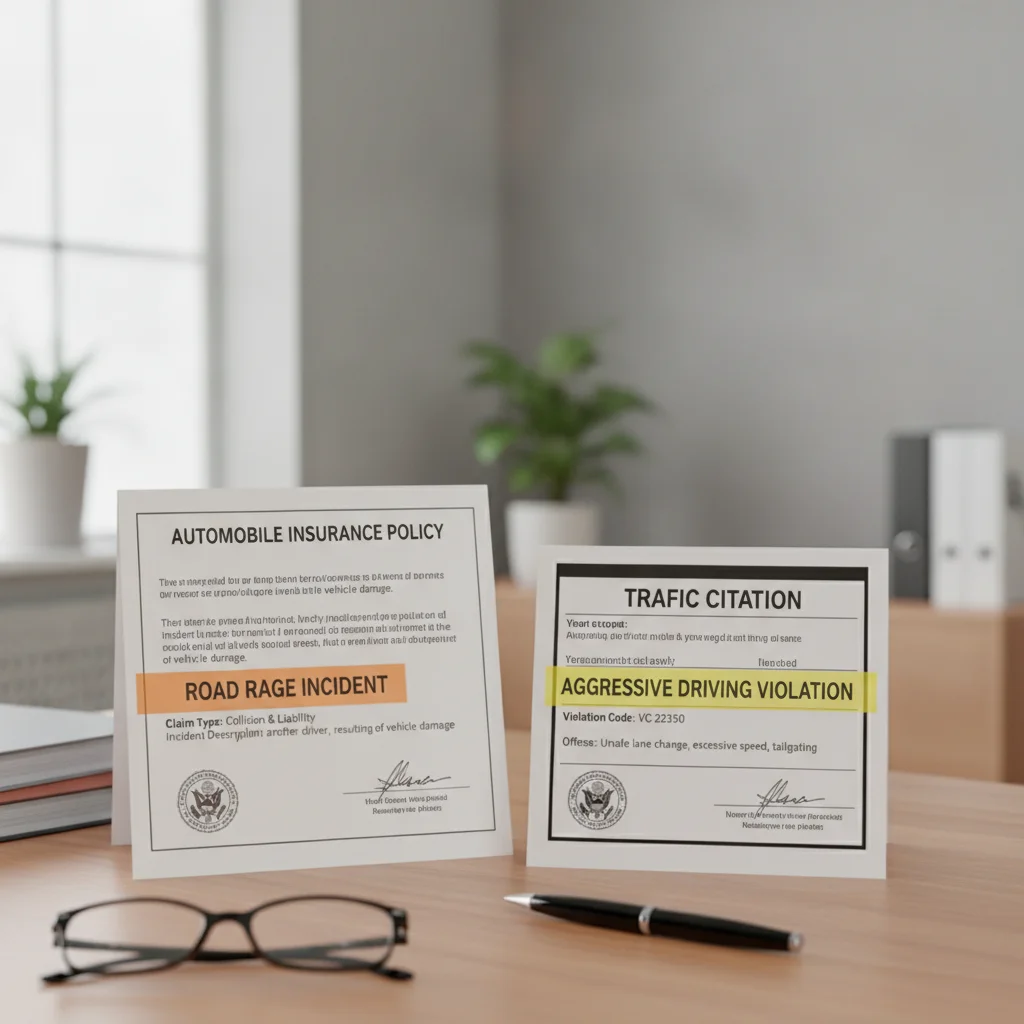
If you're the victim of a road rage incident, document everything: photos, dashcam footage, witness contact information, and a police report filed as close to the incident as possible. Your insurer needs that documentation to build a clear record that the damage or injury was caused by another party's deliberate action.
Practical Steps If You're Involved in Either
Knowing the legal categories is useful. Knowing what to do in the moment is more useful. Here's the practical breakdown:
If you're being cited for aggressive driving
- Don't admit fault at the scene. Be cooperative with law enforcement but let the facts speak for themselves.
- Request a copy of the officer's notes and any dashcam footage from the patrol vehicle.
- Consider contesting the citation in traffic court if you believe the facts don't support the charge — especially if multiple violations were bundled together.
- Complete any recommended driving course voluntarily, before court if possible — it demonstrates good faith and can influence how a judge treats the case.
If a situation is escalating toward road rage
- Do not engage. Avoid eye contact, don't gesture, don't honk in retaliation.
- Create space. Slow down, change lanes, or take an alternate route. Getting away from the other driver is always the right call.
- Do not stop unless you're in a well-lit, public place with witnesses — and only if you genuinely have no other option.
- Call 911 if you believe you're being followed or targeted. Stay on the line and narrate what's happening.
- Never exit your vehicle to confront another driver. That's the single action most likely to turn a tense situation into a criminal incident — for both of you.
If you're charged with road rage
- Consult a criminal defense attorney immediately — this is not a traffic court matter.
- Preserve any evidence that contradicts the prosecution's version of events.
- Notify your insurer, but understand that cooperation with your insurer is separate from your criminal defense strategy.
Being aware of how passing maneuvers and lane changes can trigger confrontations is also useful context — the legal reality of passing on the right explains how even technically legal moves can create friction that escalates.
Bottom line: aggressive driving is a habit to break; road rage is a legal crisis to avoid. The space between them is smaller than most drivers think, and crossing it can have consequences that follow you for years.

All claims are backed by peer-reviewed research. Sources on request.