Key Takeaways
Option A
Roundabouts
The data-backed, continuously flowing alternative to traditional intersections.
Best for: High-volume intersections where reducing severe crashes and improving traffic flow are the primary goals.
Option B
Four-Way Stops
The familiar, low-cost intersection control that most American drivers know by heart.
Best for: Lower-speed residential streets and intersections where infrastructure costs must stay minimal.
If you want the intersection type with the best injury and fatality record
Roundabouts
IIHS data shows roundabouts cut fatal and injury crashes dramatically by eliminating high-speed right-angle and head-on conflict points entirely.
If you're navigating a low-traffic residential neighborhood with budget constraints
Four-Way Stops
In low-speed, low-volume settings, four-way stops are cost-effective and familiar — the safety gap narrows considerably at slower speeds.
If pedestrian and cyclist safety is the top priority
Roundabouts
Properly designed roundabouts shorten pedestrian crossing distances and slow vehicles before conflict points, reducing pedestrian fatality risk.
If you're an unfamiliar or older driver who finds yield-based navigation confusing
Four-Way Stops
The take-turns protocol of a four-way stop is easier to learn and execute for drivers who struggle with roundabout yield rules and lane selection.
If a high-crash intersection needs a safety upgrade with proven ROI
Roundabouts
Municipalities that have converted dangerous four-way or signalized intersections to roundabouts report immediate, sustained drops in crash severity and frequency.
The Core Difference: How Each Intersection Controls Conflict
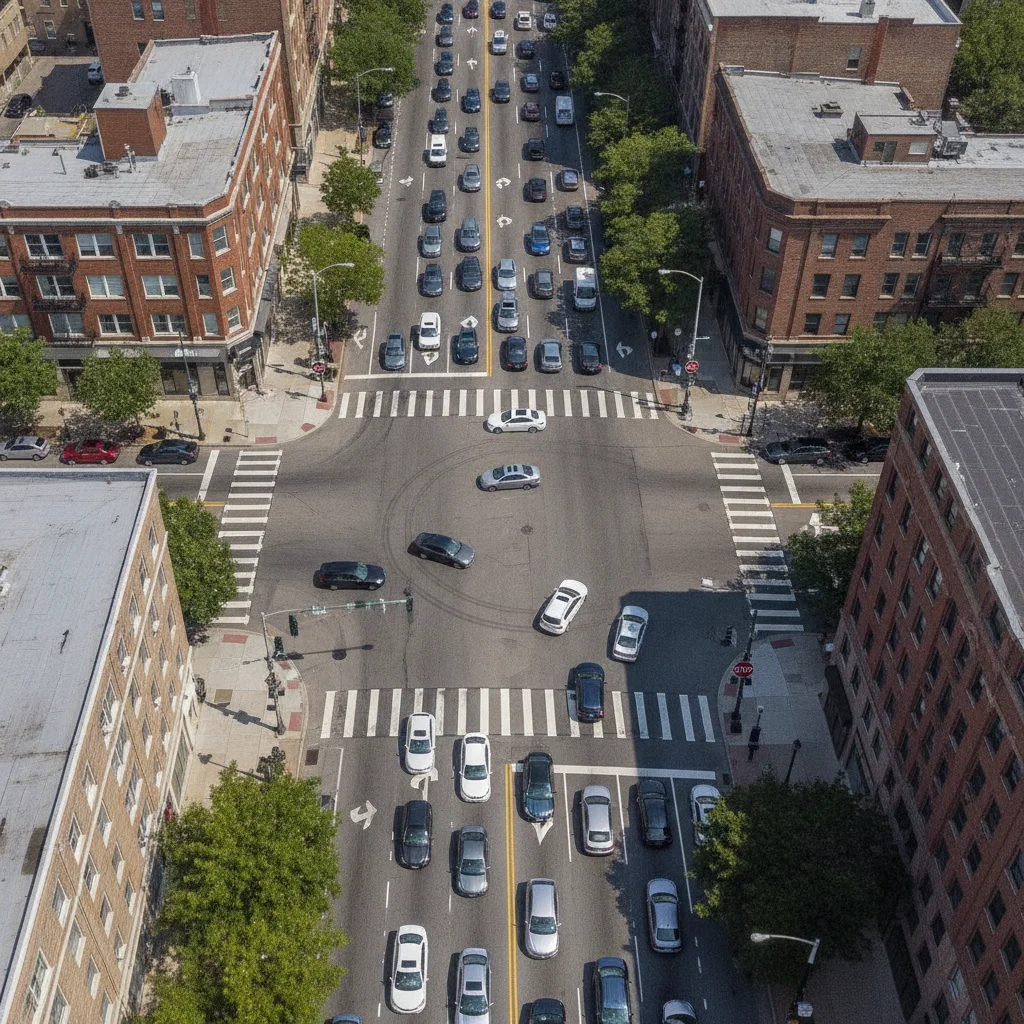
Every intersection is fundamentally a conflict-management problem. Vehicles traveling in different directions must share the same physical space, and how that sharing is organized determines how often — and how badly — things go wrong.
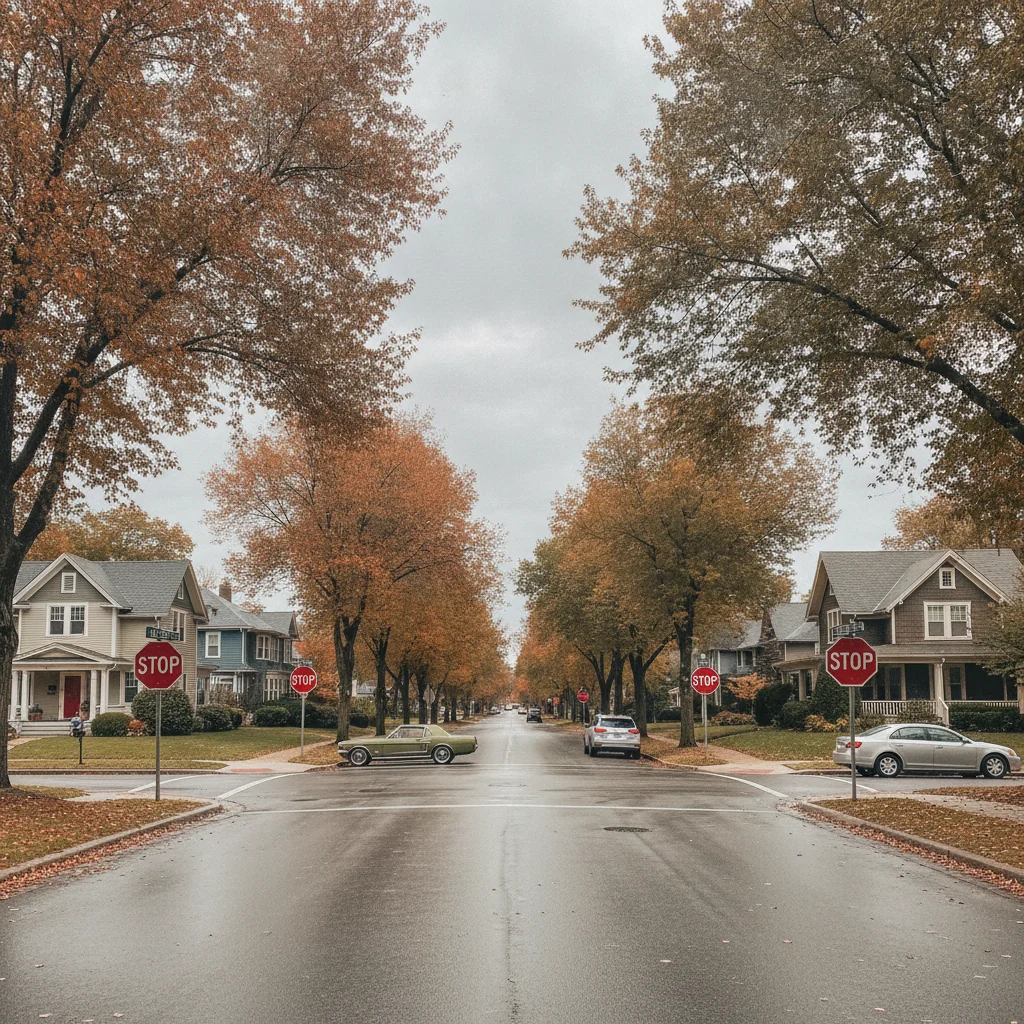
A four-way stop solves this by halting all traffic and assigning right-of-way through a first-come, first-served protocol. Drivers come to a full stop, assess the queue, and take turns proceeding. The system relies entirely on compliance and driver judgment at the moment of decision. When everyone follows the rules, it works. When they don't — whether through misreading turn order, rolling stops, or distraction — conflict points emerge at high speed.
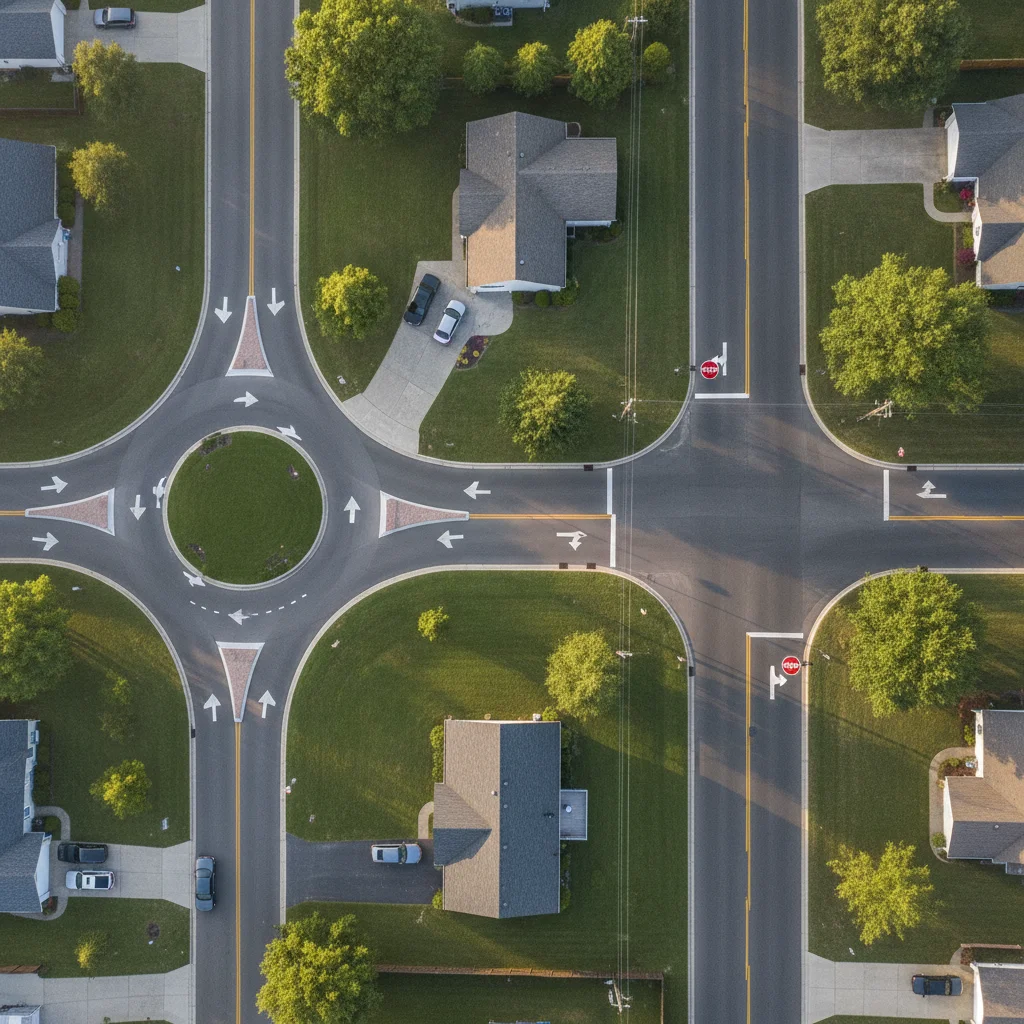
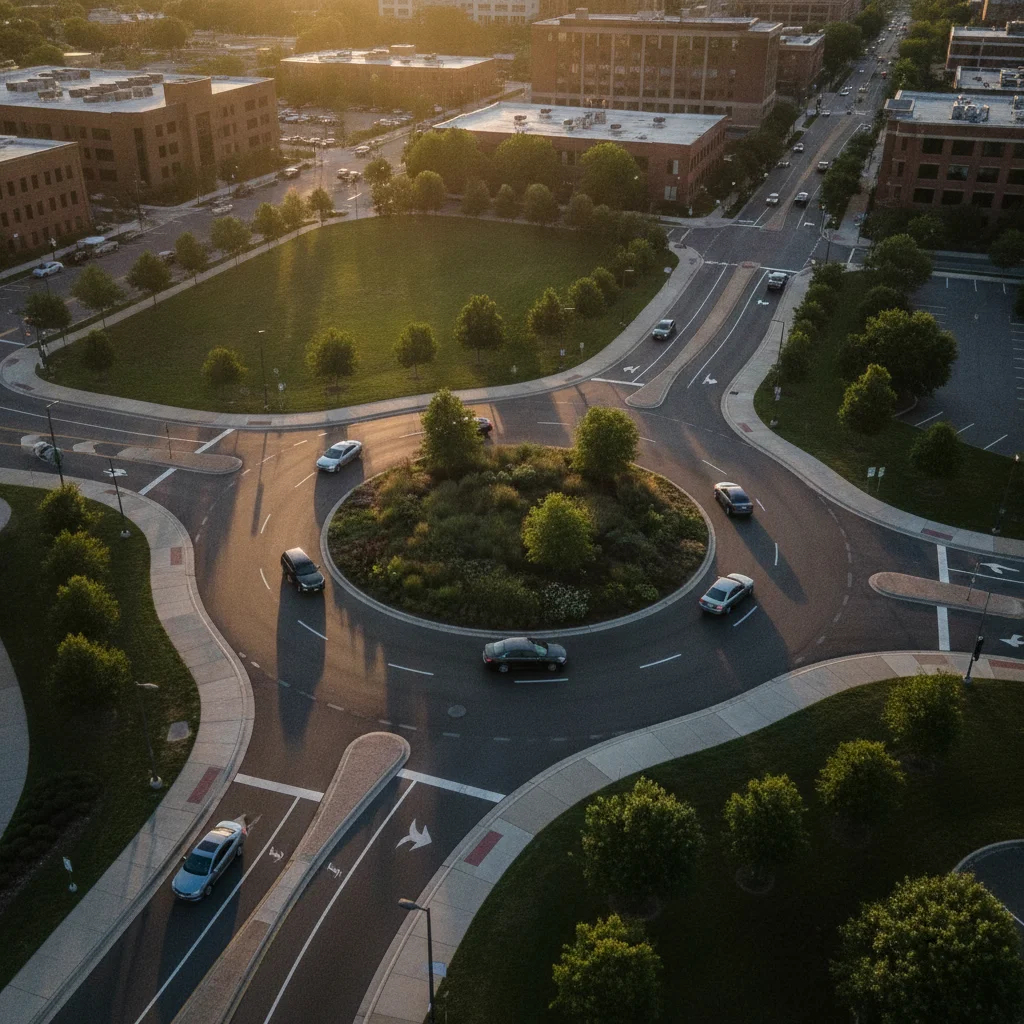
A roundabout uses geometry to solve the same problem. Vehicles enter a one-way circular flow, yield to traffic already in the circle, merge, and exit at their desired street. There are no cross-traffic conflicts, no head-on approaches, and no green-light temptation to accelerate through a gap. The circular design physically limits vehicle speeds on entry, typically to 15–25 mph, regardless of posted limits on the approach road.
That geometric constraint is the crucial distinction. At a four-way stop, a driver who rolls through at 30 mph can collide with another vehicle at a combined closing speed of 60 mph or more. In a roundabout, the entry curve makes that scenario physically impractical. The safety benefit isn't just policy — it's physics.
Right-of-way rules at four-way stops are among the most frequently misapplied in American driving, which compounds the behavioral risk already built into the stop-sign model.
What the Safety Research Actually Shows
The Insurance Institute for Highway Safety (IIHS) has studied roundabout safety extensively, and the numbers are striking. Compared to conventional stop-sign or signal-controlled intersections, roundabouts reduce:
- All injury crashes by approximately 75%
- Fatal crashes by up to 90%
- All crashes (including property-damage-only) by around 35%
These aren't marginal improvements. They represent a fundamental restructuring of crash risk at the intersection level. The reductions in fatal and serious-injury crashes are especially significant because they reflect the physics of lower-speed collisions — a 25 mph sideswipe causes categorically different injuries than a 45 mph T-bone.
75%
Reduction in injury crashes at roundabouts
According to the Insurance Institute for Highway Safety (IIHS), roundabouts reduce injury crashes by approximately 75% compared to conventional intersections.
90%
Reduction in fatal crashes at roundabouts
IIHS and FHWA studies show fatal crash reductions of up to 90% at intersections converted from stop signs or signals to roundabouts.
32 vs. 8
Vehicle conflict points: four-way stop vs. roundabout
A standard four-way intersection has 32 vehicle conflict points; a single-lane roundabout reduces that number to just 8, per FHWA intersection design data.
40%+
U.S. crashes occurring at intersections
The National Highway Traffic Safety Administration (NHTSA) reports that more than 40% of all U.S. traffic crashes occur at or near intersections.
$3M
Maximum typical roundabout construction cost
The FHWA estimates roundabout construction costs range from roughly $500,000 to over $3 million depending on size, location, and right-of-way acquisition needs.
A Federal Highway Administration (FHWA) review of 23 U.S. roundabout conversions found injury crashes dropped by an average of 76% and fatal crashes dropped by 89% at those sites. Studies from Australia, the United Kingdom, and France — countries with longer roundabout histories — show consistent results across different traffic volumes and road designs.
Four-way stops do provide meaningful safety benefits over uncontrolled intersections. Research published in the Journal of Safety Research found that converting uncontrolled intersections to all-way stops reduced injury crashes by roughly 40%. That's a real improvement — but it still falls well short of what roundabouts deliver.
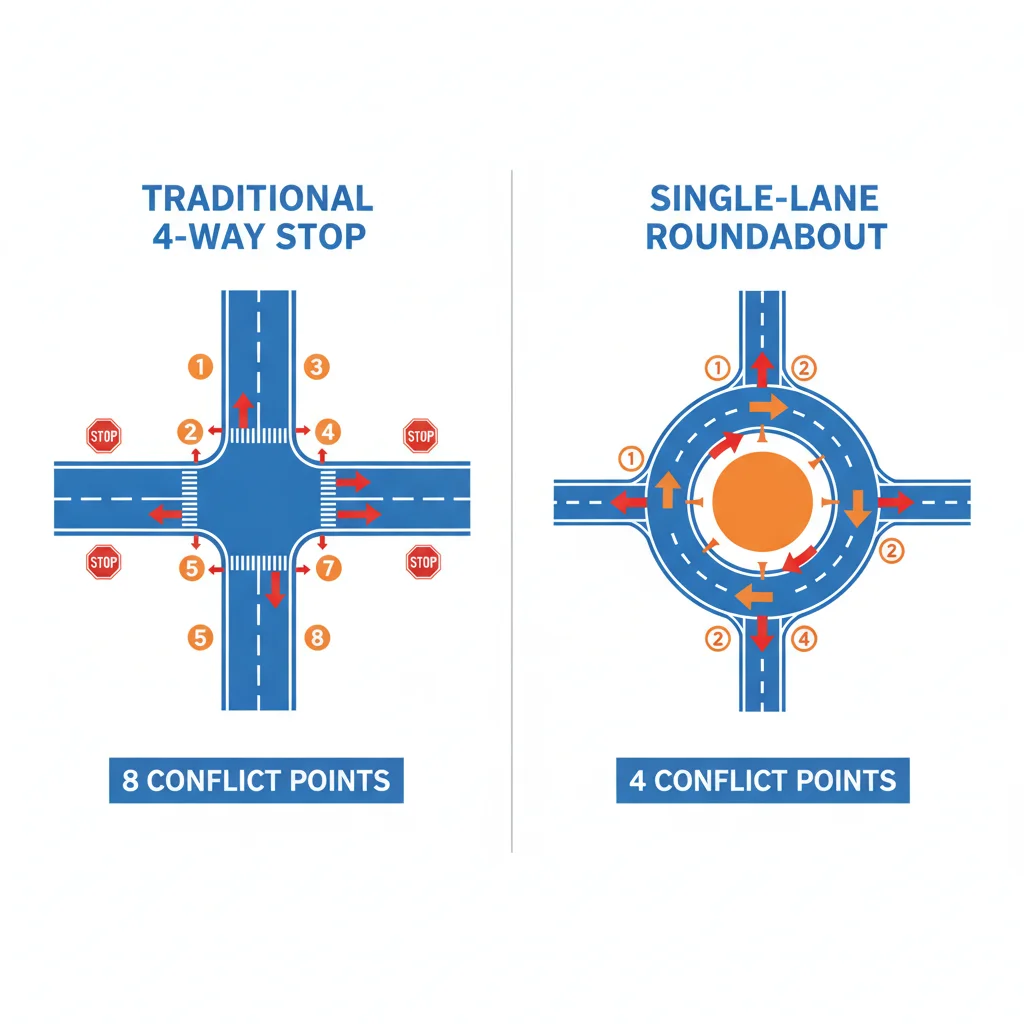
The reason for the gap comes down to conflict points. A standard four-way intersection has 32 potential vehicle conflict points and 24 pedestrian conflict points. A single-lane roundabout reduces vehicle conflict points to 8 and pedestrian conflict points to 8. Fewer conflict points, engineered at lower speeds, equals fewer crashes and less severe outcomes when crashes do occur.
Intersection crash patterns consistently point to driver inattention and right-of-way errors as the leading causes — both of which roundabouts structurally reduce by removing the decision point from the driver entirely.
| Criterion | Roundabouts | Four-Way Stops |
|---|---|---|
| Injury crash reduction | Up to 75% fewer injury crashes | ~40% fewer vs. uncontrolled |
| Fatal crash reduction | Up to 90% reduction | Moderate reduction |
| Vehicle conflict points | 8 (single-lane) | 32 |
| Operating speeds | 15–25 mph (geometrically enforced) | Depends on driver compliance |
| Installation cost | $500K–$3M+ | Low (signage only) |
| Traffic flow | Continuous; no full stops required | Stop-and-go; sequential turns |
| Driver familiarity (U.S.) | Lower; learning curve exists | Very high; universal rule knowledge |
| Pedestrian safety | Shorter crossings; lower speeds | Full roadway width; yield compliance varies |
| Best suited for | High-volume arterials, dangerous intersections | Low-volume residential streets |
Where Four-Way Stops Still Hold Their Own
Despite the lopsided safety data, four-way stops remain appropriate in specific contexts — and dismissing them entirely would be an oversimplification.
Cost and infrastructure are the most practical arguments. A four-way stop installation costs a few thousand dollars in signage. A roundabout requires significant right-of-way, grading, curb construction, and landscaping — often running $500,000 to $3 million per intersection depending on size, location, and whether property acquisition is needed. For cash-constrained municipalities managing hundreds of intersections, this cost difference is not trivial.
Low-speed, low-volume residential streets narrow the safety gap substantially. When all vehicles are traveling at 20 mph or below, the injury severity difference between intersection types shrinks. A four-way stop in a quiet subdivision where traffic is sparse and speeds are naturally low performs adequately — the risk profile simply doesn't justify roundabout construction costs.
Emergency vehicle routing is sometimes cited as a roundabout limitation. Roundabouts can slow large fire trucks and ambulances navigating tight circles, though FHWA research finds that travel time differences for emergency vehicles are generally minimal and roundabouts often reduce overall travel times even for emergency vehicles due to fewer total stops.
Roundabout vs. Traffic Circle: Not the Same Thing
Many Americans conflate roundabouts with older traffic circles or rotaries — and the distinction matters. Traditional traffic circles (like many found in the northeastern U.S.) are much larger, operate at higher speeds, and give priority to entering vehicles rather than circulating ones. Modern roundabouts, as defined by FHWA guidelines, require yield-on-entry, geometric speed control, and splitter islands. The safety data cited in this article refers specifically to modern roundabouts, not legacy traffic circles.
The Short-Term Adjustment Period Is Real
When a community converts a four-way stop to a roundabout, crash rates can temporarily increase in the first several months as drivers learn the new rules. FHWA research documents this adjustment curve but notes that within 12–24 months, crash rates settle well below pre-conversion levels. Local transportation departments typically accompany new roundabout openings with signage, public education campaigns, and sometimes temporary flaggers to ease the transition.
Insurance Implications of Intersection Type
If you're involved in a crash at a roundabout, determining fault follows yield rules — the driver who failed to yield to circulating traffic is typically at fault. At four-way stops, fault usually falls on the driver who violated stop or right-of-way rules. In both cases, your insurer will review police reports, witness accounts, and sometimes intersection camera footage. Understanding the traffic laws governing each intersection type is essential for protecting yourself in a claim dispute.
Driver familiarity bias matters in the short term. Studies show that roundabout crash rates actually spike modestly in the first few months after conversion, as drivers learn the new rules. This adjustment period is real — but temporary. Within one to two years, crash rates stabilize at significantly lower levels than the previous intersection type. The familiar four-way stop may feel safer to experienced American drivers simply because they've been doing it since they were sixteen.
Pedestrian and Cyclist Safety: A Closer Look
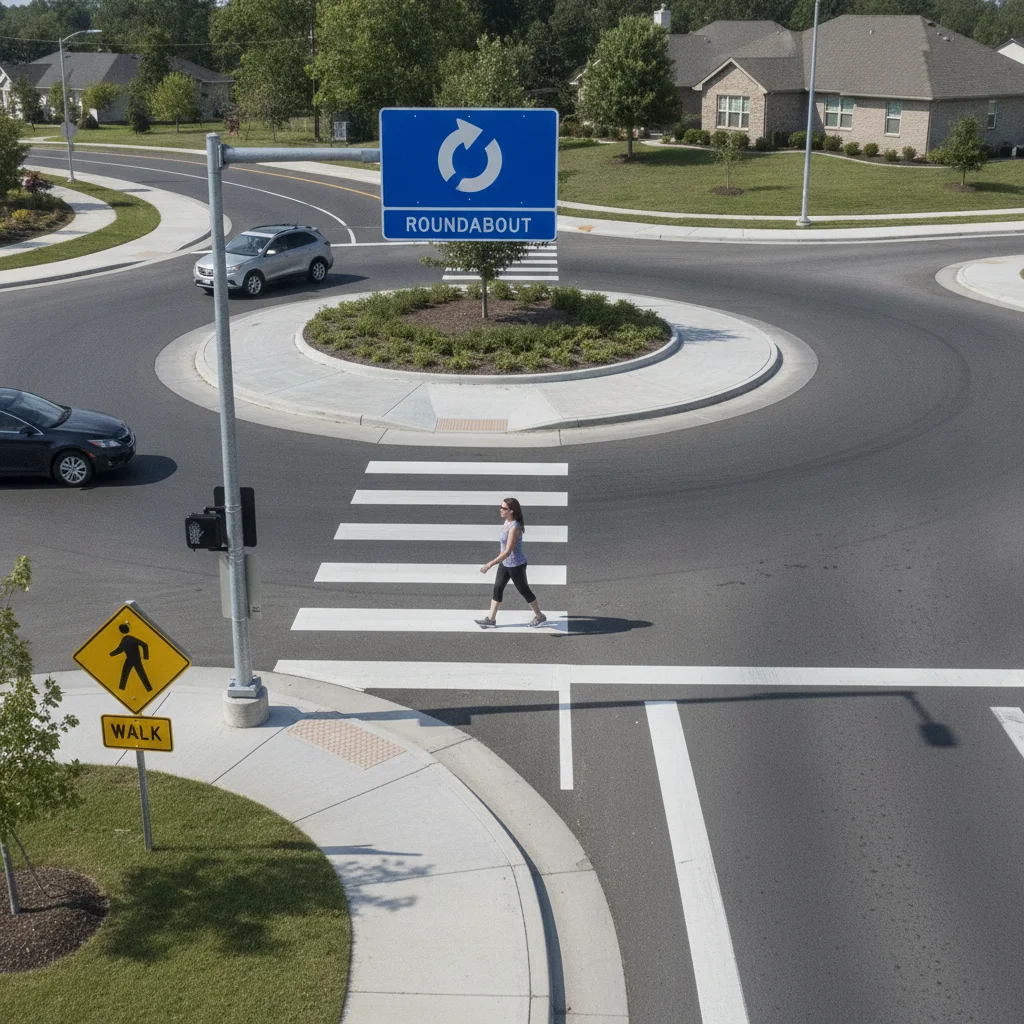
Roundabouts improve pedestrian safety in most real-world implementations, but the picture requires some nuance. When a roundabout is well-designed — with raised crosswalks, splitter islands, and clear sightlines — pedestrians benefit from:
- Shorter crossing distances (one direction of traffic at a time, with a refuge island in between)
- Lower vehicle speeds at conflict points
- The elimination of the pedestrian's most dangerous moment: crossing against a green light that a vehicle runs
However, poorly designed roundabouts — particularly those with multiple lanes, high entry speeds, or inadequate crosswalk markings — can be genuinely hazardous for pedestrians. A pedestrian struck by a vehicle entering a roundabout at 25 mph fares better than one struck at 45 mph, but the risk is not zero. IIHS data shows pedestrian crash rates at roundabouts are comparable to or modestly higher than at signalized intersections, though injury severity is lower.
For cyclists, the verdict is similar: well-designed roundabouts with dedicated bike lanes or shared-use paths work. Poorly designed ones that force cyclists into the vehicle lane create dangerous merging situations. The National Association of City Transportation Officials (NACTO) recommends protected bike lanes that bypass the circular roadway entirely at major roundabouts.
At a standard four-way stop, pedestrians face the full width of the roadway in one crossing, must trust drivers to yield (compliance is inconsistent), and remain vulnerable to right-turn-on-red vehicles who may not fully check for pedestrians. Neither intersection type is risk-free for pedestrians — design quality matters enormously for both.
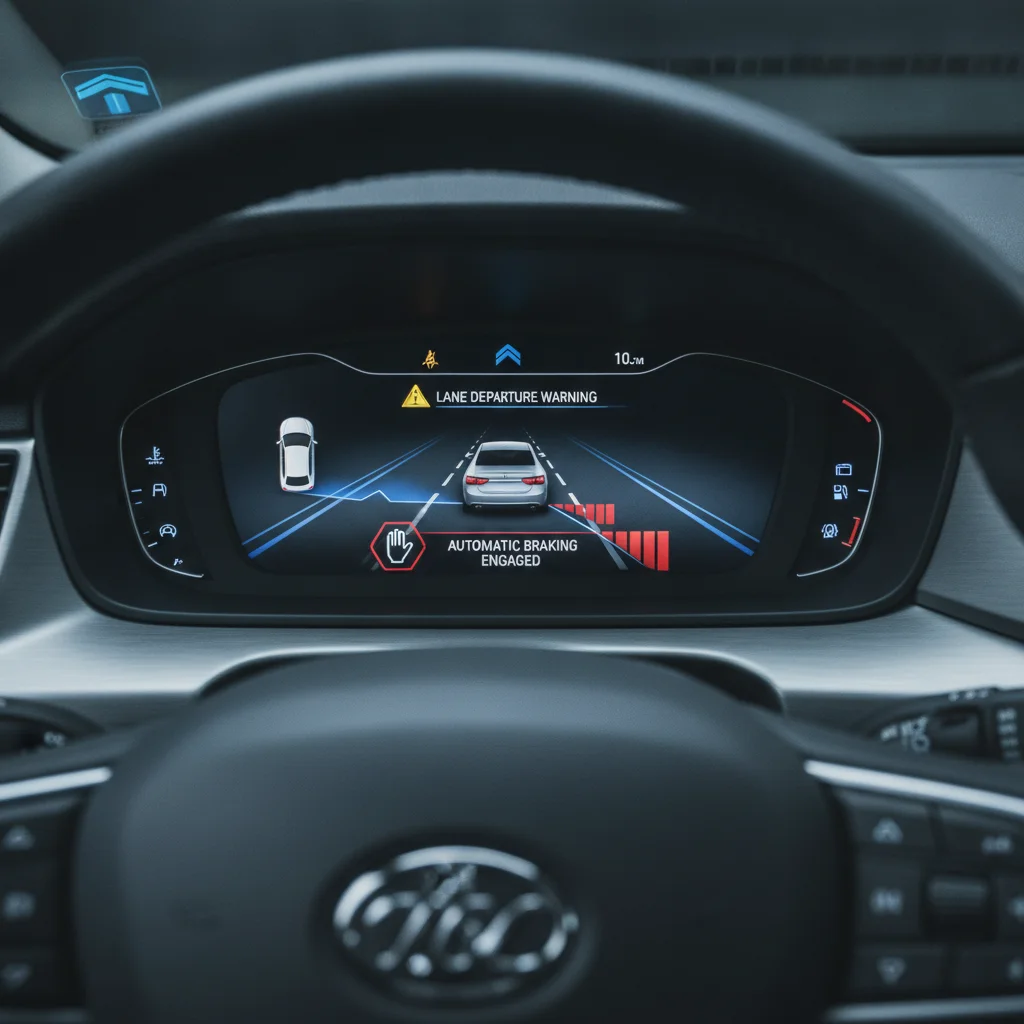
Modern vehicle safety technology like automatic emergency braking can help at either intersection type, but it does not substitute for sound intersection design.
How to Navigate a Roundabout Correctly
Much of the American public's anxiety about roundabouts stems from unfamiliarity rather than genuine complexity. The rules are straightforward once internalized:
- Slow down on approach. Reduce speed before entering. Most roundabout approaches are designed to channel drivers naturally into a slower entry arc.
- Yield to circulating traffic. Traffic already moving inside the roundabout has priority. Do not enter until there is a safe gap.
- Choose your lane before entering. At multi-lane roundabouts, use the right lane for right turns and straight-through movements in some configurations; consult lane markings. In general, right lane for exits on your right, left lane for exits past 12 o'clock.
- Do not stop inside the roundabout unless traffic in front of you is stopped. Stopping unexpectedly creates rear-end risk.
- Signal your exit. Use your right turn signal as you pass the exit before your intended one, so other drivers and pedestrians know you're leaving.
- Watch for pedestrians at crosswalks on both entry and exit. Pedestrian crosswalks are set back from the circle itself — look for them as you approach and leave.
The most common errors American drivers make at roundabouts are: failing to yield on entry, stopping inside the circle, and choosing the wrong lane at multi-lane roundabouts. All three errors decrease dramatically with experience. States that have built significant roundabout networks — notably Kansas, Florida, and Washington — show measurably faster driver adaptation.
Roundabout vs. Traffic Circle: Not the Same Thing
Many Americans conflate roundabouts with older traffic circles or rotaries — and the distinction matters. Traditional traffic circles (like many found in the northeastern U.S.) are much larger, operate at higher speeds, and give priority to entering vehicles rather than circulating ones. Modern roundabouts, as defined by FHWA guidelines, require yield-on-entry, geometric speed control, and splitter islands. The safety data cited in this article refers specifically to modern roundabouts, not legacy traffic circles.
The Short-Term Adjustment Period Is Real
When a community converts a four-way stop to a roundabout, crash rates can temporarily increase in the first several months as drivers learn the new rules. FHWA research documents this adjustment curve but notes that within 12–24 months, crash rates settle well below pre-conversion levels. Local transportation departments typically accompany new roundabout openings with signage, public education campaigns, and sometimes temporary flaggers to ease the transition.
Insurance Implications of Intersection Type
If you're involved in a crash at a roundabout, determining fault follows yield rules — the driver who failed to yield to circulating traffic is typically at fault. At four-way stops, fault usually falls on the driver who violated stop or right-of-way rules. In both cases, your insurer will review police reports, witness accounts, and sometimes intersection camera footage. Understanding the traffic laws governing each intersection type is essential for protecting yourself in a claim dispute.
For a broader look at how intersection rules work in practice, see our guide on right-of-way rules drivers most commonly misread.
The Bottom Line on Intersection Safety
The research is not ambiguous: roundabouts are safer than four-way stops by a wide margin, particularly for severe and fatal crashes. The geometric design that forces slower speeds and eliminates high-angle conflict points creates an outcome that no amount of signage compliance can fully replicate at a traditional stop-controlled intersection.
That said, the practical question isn't always roundabout versus four-way stop in isolation. It's whether the investment is appropriate for the specific location, traffic volume, available right-of-way, and community budget. A four-way stop at a quiet residential intersection with ten cars per hour is not the same risk environment as a busy suburban arterial carrying 15,000 vehicles per day.
For American drivers who encounter roundabouts regularly — or will as more municipalities convert dangerous intersections — the actionable message is simple: slow down on approach, yield before entering, and trust the geometry. The roundabout is doing most of the safety work for you. The more you use them, the more natural they become.
For drivers involved in crashes at either intersection type, understanding how fault is determined matters for insurance claims and legal liability. Crash patterns at intersections follow consistent behavioral signatures — and knowing them makes you a more defensive, aware driver regardless of what type of intersection you're crossing.
Roundabout vs. Traffic Circle: Not the Same Thing
Many Americans conflate roundabouts with older traffic circles or rotaries — and the distinction matters. Traditional traffic circles (like many found in the northeastern U.S.) are much larger, operate at higher speeds, and give priority to entering vehicles rather than circulating ones. Modern roundabouts, as defined by FHWA guidelines, require yield-on-entry, geometric speed control, and splitter islands. The safety data cited in this article refers specifically to modern roundabouts, not legacy traffic circles.
The Short-Term Adjustment Period Is Real
When a community converts a four-way stop to a roundabout, crash rates can temporarily increase in the first several months as drivers learn the new rules. FHWA research documents this adjustment curve but notes that within 12–24 months, crash rates settle well below pre-conversion levels. Local transportation departments typically accompany new roundabout openings with signage, public education campaigns, and sometimes temporary flaggers to ease the transition.
Insurance Implications of Intersection Type
If you're involved in a crash at a roundabout, determining fault follows yield rules — the driver who failed to yield to circulating traffic is typically at fault. At four-way stops, fault usually falls on the driver who violated stop or right-of-way rules. In both cases, your insurer will review police reports, witness accounts, and sometimes intersection camera footage. Understanding the traffic laws governing each intersection type is essential for protecting yourself in a claim dispute.

All claims are backed by peer-reviewed research. Sources on request.