Key Takeaways
Start here
What Defensive Driving Actually Means
Core skills
The Core Principles, Explained
Apply it
Common Situations Where It Makes the Biggest Difference
Know the limits
What Defensive Driving Is Not
Real-world impact
How It Affects Your Insurance and Legal Standing
Take action
Building the Habit: Practical Starting Points
What Defensive Driving Actually Means
The phrase "defensive driving" appears on insurance discount forms, driver's ed syllabi, and roadside billboards — but it rarely gets a rigorous definition. Most drivers assume it means going slowly or leaving a little extra space. The actual concept is considerably more structured than that.
The National Safety Council, which has been certifying driver training programs since the 1960s, defines defensive driving as "driving to save lives, time, and money, in spite of the conditions around you and the actions of others." That last clause is the key: defensive driving explicitly accounts for the fact that you cannot control other people's behavior, only your own positioning and anticipation.
Research from the National Highway Traffic Safety Administration (NHTSA) consistently finds that human error is a contributing factor in roughly 94% of serious crashes. That means the vast majority of collisions are, at least in principle, preventable — not by technology, but by the choices drivers make before a crisis develops. Defensive driving is the systematic approach to making better choices earlier.
The distinction that matters most for everyday drivers: defensive driving is a proactive system, not a reactive one. A driver who slams the brakes when a car cuts them off is reacting. A driver who noticed that car drifting two lanes back, created space preemptively, and was already prepared for the lane change is practicing defensive driving. The outcome may look the same from outside the vehicle, but the mental process — and the margin for error — are entirely different.
Defensive driving
A structured set of driving skills designed to reduce crash risk by anticipating hazards before they become emergencies, even when other drivers behave unpredictably.
SIPDE
A five-step mental process — Scan, Identify, Predict, Decide, Execute — used to continuously evaluate road conditions and make safer driving decisions.
Smith System
A set of five driving habits focused on seeing ahead, maintaining situational awareness, and always keeping an escape route available around your vehicle.
Following distance
The gap between your vehicle and the car ahead, measured in time rather than feet. The standard minimum is three seconds, meaning you should reach any fixed object at least three seconds after the vehicle ahead passes it.
Target fixation
A dangerous tendency to stare at a specific hazard — like a stopped car or a pothole — which actually steers you toward it. Defensive driving counters this by training the eyes to look where you want to go.
Blind spot
The area alongside and slightly behind your vehicle that mirrors do not cover. Any vehicle traveling in your blind spot is invisible unless you physically turn to check over your shoulder.
Covering the brake
Hovering your right foot over the brake pedal without pressing it, reducing your reaction time when approaching a potential hazard such as a busy intersection or unpredictable pedestrian.
Right of way
A traffic rule establishing which driver legally has priority at an intersection or merge point. Defensive drivers understand that legal right of way does not guarantee physical safety and may yield it strategically.
The Core Principles, Explained
Two frameworks dominate professional defensive driving instruction in the United States. Understanding them gives structure to what might otherwise feel like a vague collection of tips.
The Smith System
Developed in the 1950s by Harold Smith and still widely used in commercial fleet training, the Smith System organizes safe driving into five habits:
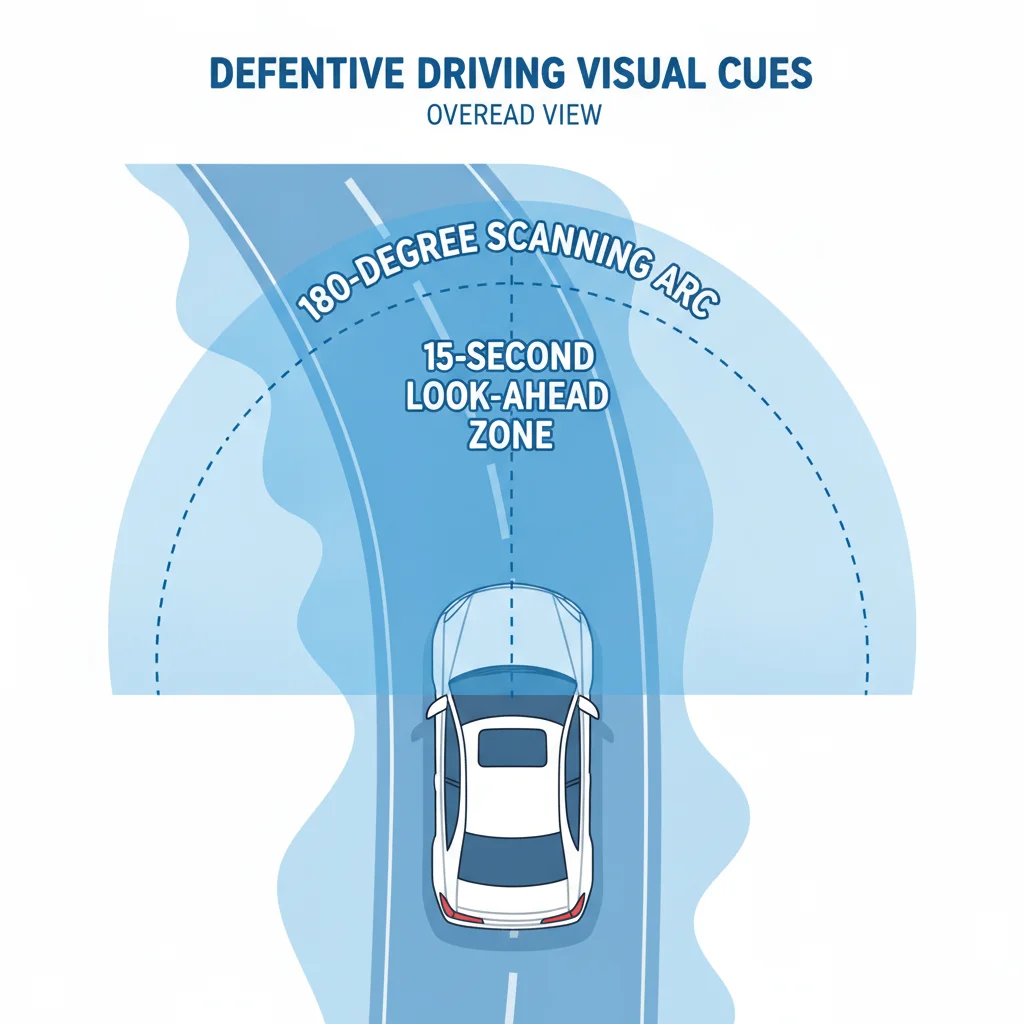
- Aim High in Steering: Look at least 15 seconds ahead — roughly one city block at urban speeds, or a quarter mile on highways — rather than at the car directly in front of you. This expands your reaction window and reduces target fixation.
- Get the Big Picture: Continuously scan a 180-degree field of view, not just the lane ahead. Check mirrors every five to eight seconds. Know what is happening on all sides of your vehicle.
- Keep Your Eyes Moving: Avoid staring at any single point. Eyes fixed in one direction for more than two seconds begin to lose peripheral awareness. Constant movement catches developing hazards earlier.
- Leave Yourself an Out: Always manage the space around your vehicle so you have somewhere to go if a threat materializes. Avoid traveling in other drivers' blind spots or boxing yourself in during highway driving.
- Make Sure They See You: Use eye contact at intersections, maintain consistent positioning so your vehicle is predictable, and use your horn and headlights as communication tools — not just as regulations require.
The SIPDE Process
SIPDE — Scan, Identify, Predict, Decide, Execute — is the cognitive loop that defensive driving runs on continuously. Where the Smith System describes what to perceive, SIPDE describes how to think about what you perceive.
- Scan the full environment ahead, behind, and to both sides.
- Identify specific hazards: a pedestrian near the curb, a truck merging, brake lights forming ahead.
- Predict what each hazard is likely to do: the pedestrian may step off the curb, the truck may cut across your lane.
- Decide on a response: slow down, change lanes, cover the brake.
- Execute the decision smoothly and early enough that it doesn't create a new hazard.
Most drivers already do a rough version of this automatically. The defensive driving difference is doing it continuously and consciously, rather than only when something obvious triggers attention.
Practice SIPDE on Low-Stakes Drives First
Try running the full SIPDE loop consciously during a familiar, low-traffic commute before applying it in complex urban or highway environments. Familiarity with the route frees mental bandwidth to focus on the cognitive process rather than navigation. Most drivers find the loop becomes semi-automatic within two to three weeks of deliberate daily practice.
Check Your Course Approval Before Enrolling
Not all defensive driving courses qualify for insurance discounts or point reduction. Before paying for a course, call your insurer with the course name and provider to confirm it meets their requirements, and check your state DMV's approved provider list if you're seeking a point reduction. Completing an unapproved course provides neither benefit.
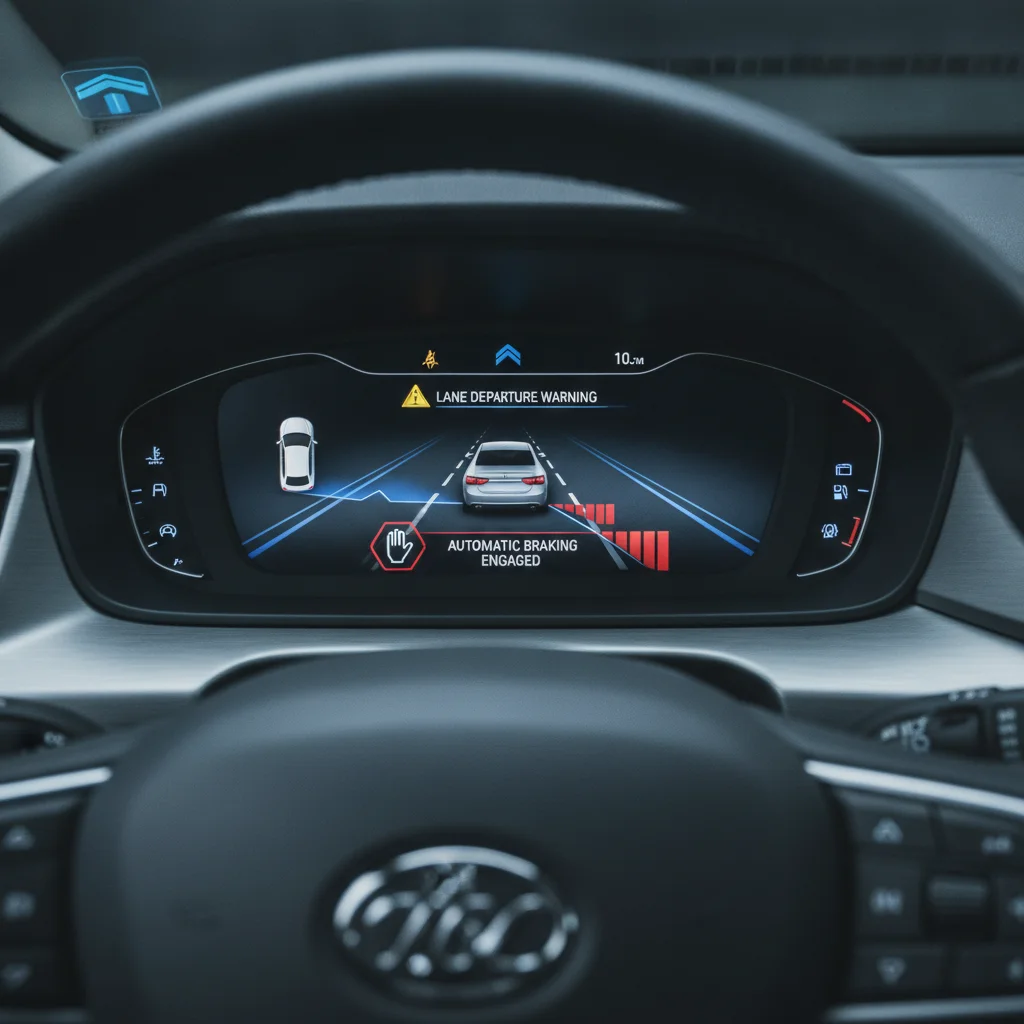
It's also worth understanding how these principles interact with the growing suite of driver assistance technology in modern vehicles. As reported in our coverage of road safety tech that actually reduces crashes, systems like automatic emergency braking can reduce rear-end collisions — but they operate in the same reactive space that defensive driving is designed to exit. Technology extends your margin; it doesn't replace the anticipation that creates margin in the first place.
Common Situations Where It Makes the Biggest Difference
Defensive driving principles apply everywhere, but certain driving environments produce a disproportionate share of preventable crashes. Here is where the evidence shows the highest payoff.
Intersections
NHTSA data attributes approximately 40% of all crashes to intersections. The defensive approach is to treat every green light as a permission to proceed with verification, not as a guarantee of safety. Before accelerating through a green, scan left-right-left for vehicles running the cross street. Cover your brake — foot hovering, not pressing — when approaching any intersection with limited sightlines.
Highway Merges and Lane Changes
The "blind spot zone" extends from roughly the B-pillar of your vehicle backward at an angle other drivers cannot see in their mirrors. Defensive drivers avoid traveling in that zone for other vehicles and signal three to four seconds before moving — not simultaneously with the move. Checking mirrors, then the blind spot over the shoulder, then mirrors again before committing is the correct sequence.
Following Distance in Traffic
The three-second rule is the baseline; four to six seconds is the appropriate buffer in rain, fog, or heavy traffic. Rear-end crashes are one of the most common collision types in the U.S. and are almost entirely attributable to following too closely at the time a lead vehicle slows. Increasing following distance doesn't just give you braking room — it also increases your forward sightline, feeding better information into the SIPDE loop.

Night Driving
Fatal crash rates per mile driven are roughly three times higher at night than during daylight, according to NHTSA. Headlights illuminate only about 160 to 250 feet ahead; at 60 mph you need roughly 300 feet to stop. Defensive night driving means reducing speed so stopping distance matches headlight range — what engineers call driving within your headlights — and increasing following distance further to compensate for reduced visual information.
Driving Near Large Trucks
Commercial trucks have four substantial blind zones: directly ahead of the cab, directly behind the trailer, and along both sides. They also need 20% to 40% more stopping distance than passenger vehicles. Defensive positioning means passing trucks quickly and decisively, avoiding prolonged travel alongside them, and never cutting in front of one without leaving several car lengths of clearance.
Large Truck Blind Zones Are Larger Than You Think
The rear blind zone of a semi-trailer extends up to 200 feet behind the vehicle — meaning the truck driver cannot see you at all if you're within that distance. If you cannot see the truck driver's mirrors, they cannot see you. Never follow a commercial truck at a distance where their full trailer obscures your forward sightline, and never linger in the lanes directly beside the cab or trailer.
What Defensive Driving Is Not
Misconceptions about defensive driving can actually make drivers less safe. The most common ones are worth addressing directly.
It's not the same as timid driving
Driving significantly below the flow of traffic, hesitating at merge points, or leaving excessively long gaps that force other drivers to make sudden adjustments are not defensive behaviors — they are hazardous ones. Our reporting on driving behaviors that cause crashes details how under-confidence and failure to match traffic flow are genuine contributing factors in collisions, not just inconveniences.
It's not the same as passive compliance
Following the law is not sufficient. Speed limits are set for ideal conditions; in rain or fog, the legal speed may be dangerous. Right-of-way rules establish who has legal precedence, not who is physically safe. A defensive driver yields the right-of-way to an aggressive driver not because it's legally required but because it removes a collision scenario. See also U.S. traffic laws and how violations affect your record for the legal baseline these principles operate within.
It's not paranoia or constant anxiety
Experienced defensive drivers describe the mental state as calm and methodical, not fearful. The goal of constant scanning is to eliminate surprises, which actually makes driving feel less stressful over time, not more. Anxiety typically stems from reactive driving — being startled by hazards that defensive awareness would have flagged seconds earlier.
It's not a substitute for vehicle fitness
Worn tires, degraded brakes, or malfunctioning lights reduce the physical margin of safety that defensive technique depends on. A driver running bald tires will have a stopping distance 25% to 40% longer than the same driver on new tires, regardless of how well they anticipate hazards. Defensive driving assumes a mechanically sound vehicle.
Vehicle Condition Is a Prerequisite, Not an Add-On
Defensive driving technique assumes your vehicle is mechanically capable of responding to your inputs. Tires, brakes, lights, and wiper blades directly determine whether your decisions translate into the physical outcomes you intend. A pre-winter vehicle check and regular tire pressure monitoring are as much a part of a defensive driving practice as any mental technique.
How It Affects Your Insurance and Legal Standing
Defensive driving has measurable financial consequences, not just safety ones. Two mechanisms are most relevant for American drivers.
Insurance Discounts
Most major U.S. insurers — including State Farm, Allstate, GEICO, and Progressive — offer a discount for completing an approved defensive driving course. The discount typically ranges from 5% to 10% on your premium, though some carriers offer more. The course must usually be approved by your state's DMV or an insurer's own certification body, and the discount often expires after three years, requiring a renewal course. Before enrolling, confirm with your carrier that the specific course qualifies.
Point Reduction and Ticket Dismissal
In many states, completing a qualifying course can reduce points on your driving record or result in a minor traffic ticket being dismissed. However, the rules are highly state-specific and offense-specific — not every violation qualifies, and courts set the terms, not the driver. Our article on what defensive driving courses can and cannot erase from your record covers this in detail, including which violations typically qualify and how to navigate the process correctly.
Crash Rate and Long-Term Premium Impact
Insurance pricing is substantially driven by your claims history. A driver who avoids at-fault crashes over a multi-year period will accumulate safe driver discounts and avoid the surcharges that follow a collision. A single at-fault accident can raise premiums by 30% to 50% at renewal, depending on severity and carrier. Viewed across a decade of driving, the premium difference between an at-fault crash history and a clean one often exceeds $5,000 — a return on the investment of attention that defensive driving requires.
NSC Defensive Driving Course
The National Safety Council offers state-approved defensive driving courses online and in person. Widely accepted by insurers and courts for discount and point-reduction purposes.
AAA Driver Improvement Program
AAA's course is available online in most states and covers defensive techniques, hazard perception, and age-related driving considerations. Often qualifies for insurance discounts.
NHTSA Traffic Safety Facts
NHTSA publishes annual crash data broken down by crash type, contributing factors, and road conditions — useful for understanding where real-world risk is concentrated.
State DMV Approved Course Lookup
Most state DMV websites maintain a searchable list of approved defensive driving providers for point reduction and insurance discount purposes. Check your state's DMV before enrolling in any course.
Building the Habit: Practical Starting Points
Understanding defensive driving conceptually is the easier half. Building the actual habits is where most drivers stall. A few evidence-grounded approaches help accelerate the process.
Start with the five-second commentary habit
For two or three sessions a week, narrate what you see as you drive — out loud or mentally. "Truck merging right, leaving space." "Pedestrian near corner, covering brake." This is a technique used in driver instructor certification programs and forces the SIPDE loop from automatic background processing to conscious foreground attention. Within a few weeks, most drivers report that the scanning becomes more natural and ingrained even without narrating.
Audit your following distance deliberately
Pick a single commute and measure your following distance at every opportunity using the three-second count. Most drivers who do this discover they routinely follow at one to two seconds — well inside the danger zone. Simply knowing where you actually are versus where you should be produces rapid self-correction.
Take a structured course
The National Safety Council's Defensive Driving Course, AAA's online programs, and state DMV-approved courses provide structured instruction that builds correct habits faster than self-directed practice. Many are available online and take four to eight hours to complete. Given the insurance discount and potential point-reduction benefits, the cost-benefit is strongly favorable for most drivers.
Treat unfamiliar roads as high-alert environments
Familiarity breeds inattention. Research shows that a disproportionate share of crashes happen on routes drivers travel regularly, partly because routine suppresses active scanning. On any road you don't know well, deliberately activate the full SIPDE loop and give yourself extra buffer — you have no mental map of where the dangerous merge points, blind corners, or heavy pedestrian zones are.
Review close calls honestly
Every time you nearly have a collision, spend sixty seconds afterward identifying when you first could have detected the hazard and what the earliest possible response would have been. This kind of informal after-action review is one of the most effective accelerators of defensive habit formation, and it costs nothing but a moment of honest reflection.
The underlying principle across all of these is that defensive driving is a skill — not a personality trait, not a fixed ability, and not something you either have or you don't. It is practiced, measured, and improved over time, and the roads are considerably less dangerous for everyone when more drivers treat it that way.
Practice SIPDE on Low-Stakes Drives First
Try running the full SIPDE loop consciously during a familiar, low-traffic commute before applying it in complex urban or highway environments. Familiarity with the route frees mental bandwidth to focus on the cognitive process rather than navigation. Most drivers find the loop becomes semi-automatic within two to three weeks of deliberate daily practice.
Check Your Course Approval Before Enrolling
Not all defensive driving courses qualify for insurance discounts or point reduction. Before paying for a course, call your insurer with the course name and provider to confirm it meets their requirements, and check your state DMV's approved provider list if you're seeking a point reduction. Completing an unapproved course provides neither benefit.

All claims are backed by peer-reviewed research. Sources on request.