Key Takeaways
Vehicle Property Tax
A vehicle property tax is an annual tax levied by a state or local government on the value of a car, truck, motorcycle, or other registered vehicle you own. Unlike a one-time sales tax paid at purchase, this tax recurs each year as long as you own the vehicle. The amount you owe is typically calculated by multiplying a government-assigned value of your vehicle by a local tax rate.
Vehicle property taxes are classified as ad valorem taxes — Latin for 'according to value' — meaning the bill shrinks each year as the vehicle depreciates. Some states fold this charge into the annual registration fee; others bill it separately through the county assessor's office.
The Annual Car Tax Most Buyers Never See Coming
When most people budget for a new or used car, they think about the purchase price, the sales tax, and maybe a dealer fee or two. What rarely makes the mental checklist is the bill that arrives in the mail a year later — an annual property tax on the car they already bought and paid for.
If you live in a state that charges vehicle property tax, your car is treated much like real estate: the government assesses its value and sends you a tax bill every year. It doesn't matter whether you have a loan or own the car outright. As long as the vehicle is registered in your name, the tax clock is running.
This isn't a niche fee. Across the roughly half of U.S. states that levy it, vehicle property taxes can add up to several hundred dollars a year for a newer vehicle — sometimes more. Understanding how the tax works, how your state calculates what you owe, and how the bill changes over time can help you make smarter ownership decisions and avoid unwelcome surprises at registration time.

Vehicle property taxes also interact with your other car-related costs in ways worth understanding. They are separate from the one-time sales tax or use tax you pay at purchase, and they are distinct from your annual registration fee — though the two often appear on the same renewal notice. The gap between states that charge this tax and those that don't is one of the biggest reasons two identical cars in different states can have wildly different ownership costs.
How Vehicle Property Taxes Are Calculated
The math behind vehicle property tax follows a straightforward formula, even if the inputs vary by jurisdiction:
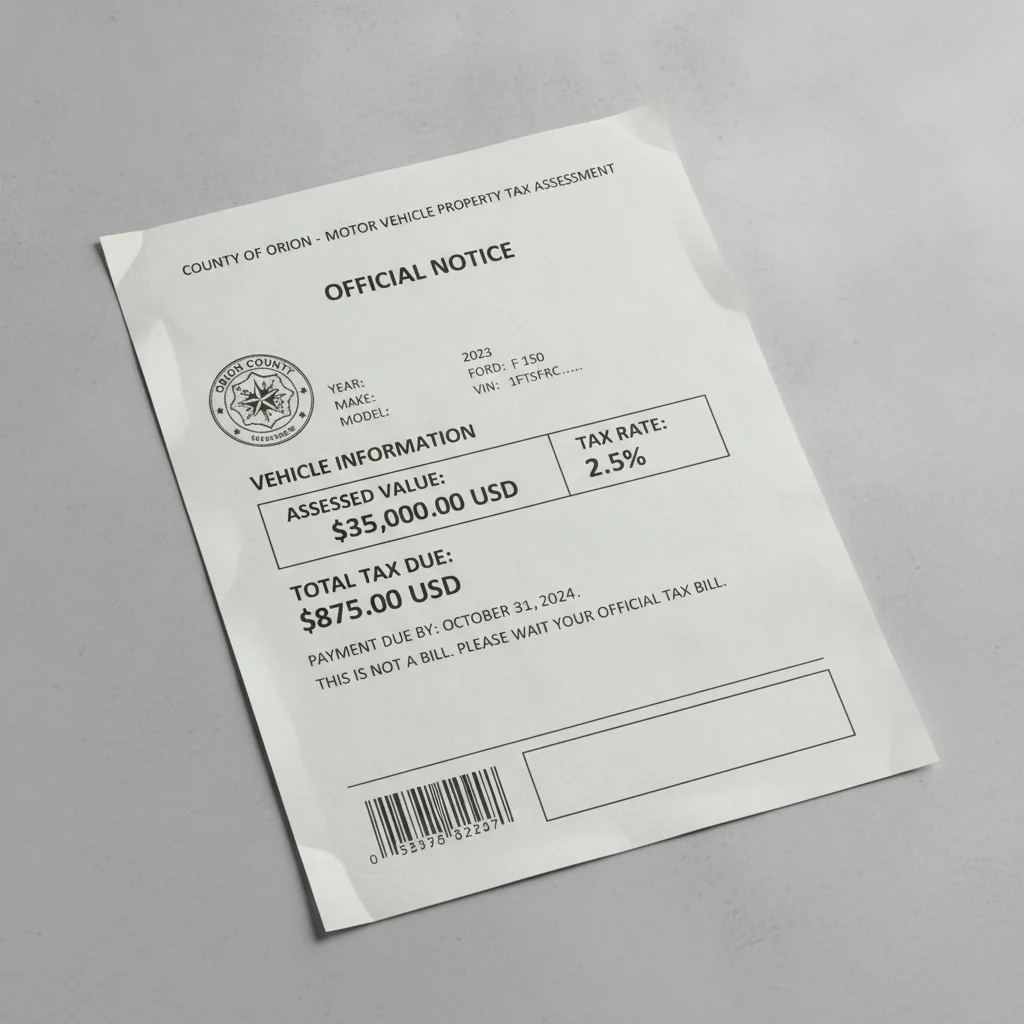
Tax Owed = Assessed Value × Tax Rate
The challenge is that both variables — assessed value and tax rate — are set independently by your state or county, and they can differ substantially from one place to the next.
Assessed Value: How Your Car Gets Priced for Tax Purposes
Most states start with one of three anchors for assessed value:
- Original MSRP: Some states peg the taxable value to the manufacturer's suggested retail price when the vehicle was new, then apply a depreciation schedule to reduce that value over time.
- Purchase price: A smaller number of states use the actual price you paid, which can be advantageous if you bought used at a discount.
- Fair market value via third-party guides: States like Virginia use NADA clean trade-in values to approximate what the car is actually worth on the open market each year.
Whichever starting point is used, states apply a depreciation multiplier that shrinks the assessed value annually. A car assessed at $35,000 in year one might drop to $28,000 in year two and $22,000 in year three, following the state's published schedule. This is good news for owners of older vehicles — the tax bill naturally fades over time.
~27
U.S. states with annual vehicle property tax
Estimates vary slightly by how excise taxes are classified, but roughly half of states levy some form of annual value-based vehicle tax.
$1,500+
Annual vehicle property tax, high-rate Virginia county
A newer vehicle valued at $35,000+ in certain Virginia counties can generate property tax bills exceeding $1,500 in the first year of ownership.
$4.57
Per $100 assessed value, highest Virginia county rates
Virginia county tax rates on personal property — including vehicles — vary widely, with some localities exceeding $4.50 per $100 of assessed value.
5–10 years
Typical lifespan of taxable vehicle value
Most state depreciation schedules reduce assessed vehicle value to near-zero or a nominal floor within 10 years, effectively eliminating the property tax burden on older cars.
$2,000+
5-year tax difference between high- and no-tax states
For a vehicle with a $35,000 starting assessed value, moving from a no-tax state to a moderate-rate state can generate over $2,000 in cumulative property taxes over five years.
Tax Rate: Where the Wide Variation Lives
Once assessed value is established, it gets multiplied by the applicable millage rate (often expressed as dollars per $100 or $1,000 of value). A rate of $4.57 per $100 of assessed value — which is typical in parts of Virginia — applied to a $30,000 assessed value yields a $1,371 annual tax bill. The same car in a county with a $1.50 rate would generate a $450 bill.
In many states, the rate is set at the county or municipal level, so two neighbors living just across a county line can owe meaningfully different amounts. Some states cap their rates statewide; others leave it entirely to local governments.
Assessed Value ≠ What You Paid
Your vehicle's assessed taxable value is not necessarily what you paid for the car or what it would sell for today. States use standardized schedules or reference guides to set assessed value, which may be higher or lower than the actual market price. If you bought a used car below market value, your assessed value could actually exceed what you paid — making an appeal worth exploring.
Military Members Get Special Treatment
The Servicemembers Civil Relief Act (SCRA) protects active-duty military personnel from vehicle property taxes in states other than their legal domicile state. If you're stationed in Virginia but your legal home state is Texas, you generally owe no Virginia vehicle property tax. Keep documentation of your military status and domicile handy when registering a vehicle in a new duty station state.
Which States Charge Vehicle Property Tax — and Which Don't
The United States has no federal vehicle property tax. This is purely a state and local matter, which is why the landscape is so fragmented.
States that levy some form of annual vehicle property tax include — but are not limited to — Virginia, North Carolina, South Carolina, Connecticut, Missouri, Kansas, Mississippi, Rhode Island, and Montana. Each has its own rules for rates, assessed value methodology, and collection process.
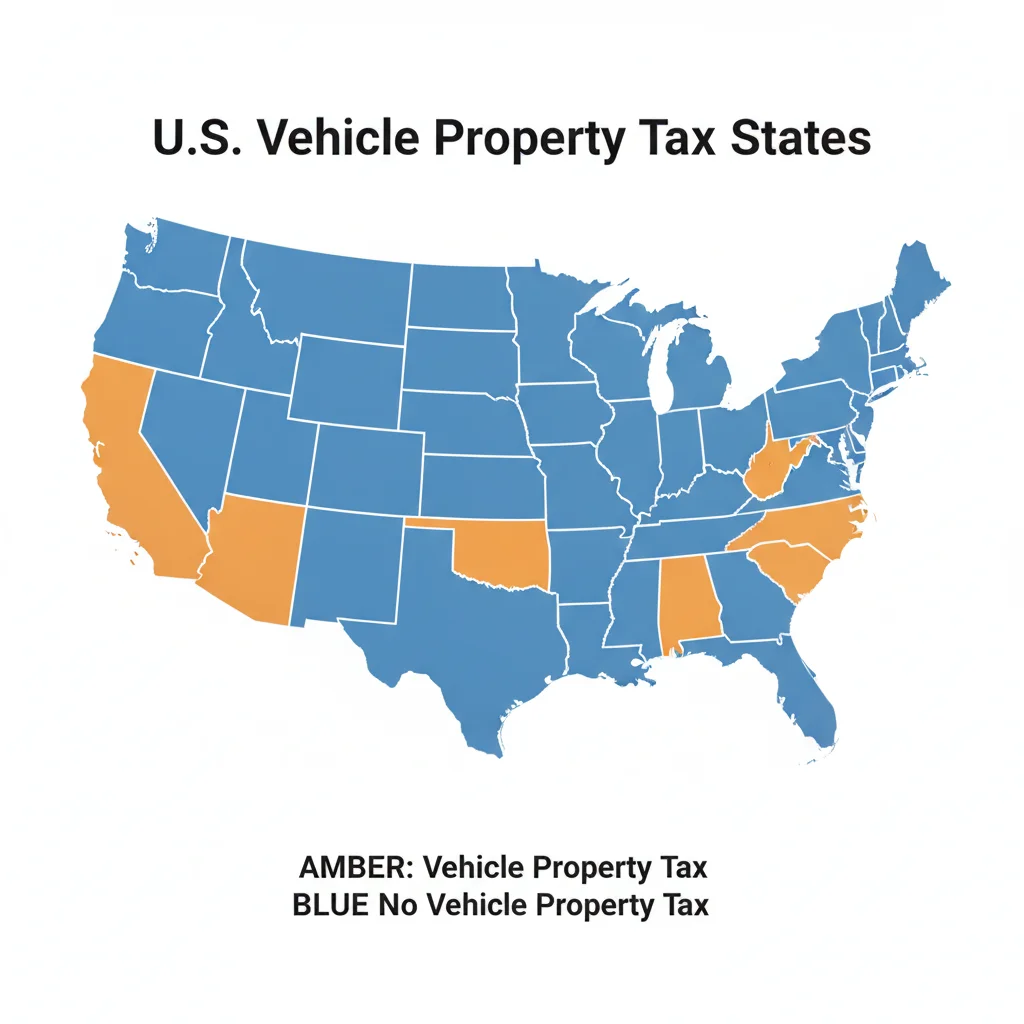
On the other end of the spectrum, states like California, Florida, Texas, and New York do not charge an annual vehicle property tax at the state level, though local jurisdictions in some of these states may assess personal property taxes that incidentally cover vehicles.
The distinction matters enormously when you're relocating or shopping across state lines. A buyer who moves from Florida to Virginia with a $45,000 SUV may be genuinely shocked to receive a $1,500+ property tax bill they had no idea was coming. For a full state-by-state breakdown, see our car ownership taxes and fees reference guide.
How the Tax Gets Collected
Collection methods vary almost as much as the rates themselves:
- Folded into registration renewal: In some states, the property tax assessment is bundled with your annual registration renewal, and you pay both at the DMV or online at the same time.
- Billed separately by the county: In Virginia and several other states, your county treasurer sends a personal property tax bill independent of your DMV renewal, often due in the fall.
- Blocked renewal until cleared: In states that link the two processes, an unpaid property tax will prevent you from renewing your tags — a powerful enforcement mechanism.
Check Both State and County Rates
Never rely on the statewide average rate when estimating your vehicle property tax. County and municipal rates can vary by a factor of two or more within the same state. Before you finalize a car purchase or accept a relocation package, look up the specific rate for your county or township — most county treasurer websites publish their current millage rates online.
Build the Tax into Your Monthly Budget
Rather than absorbing a large annual or semi-annual bill as a surprise expense, divide your expected vehicle property tax by 12 and set that amount aside each month in a dedicated savings buffer. For a $900 annual bill, that's just $75 a month — a much easier number to manage than a one-time hit to your checking account.
Real-World Examples of Vehicle Property Tax in Action
Abstract formulas become meaningful when you attach real numbers to them. Here's what the tax looks like across a few states with different approaches:
The variation is striking. A driver in Connecticut owning a three-year-old sedan might pay $400–$700 annually depending on their municipality's mill rate, while that same driver in a no-tax state pays nothing beyond registration fees. Over five years, the cumulative difference can easily exceed $2,000 — enough to cover a major mechanical repair or a year of car insurance premiums.
When you're comparing what registration fees cover versus what property taxes cover, remember they serve different government functions: registration fees fund DMV operations and road programs, while property taxes flow into local government general funds, including schools and public safety.
Exemptions, Deductions, and Ways to Reduce Your Bill
Vehicle property taxes aren't entirely inescapable. A range of exemptions and adjustments can meaningfully reduce what you owe.
Common Exemptions
- Veterans and disabled individuals: Many states offer full or partial exemptions for qualifying veterans, active-duty military personnel, or drivers with documented disabilities.
- Low-income households: Some localities cap the tax or offer relief programs for owners below an income threshold.
- Age-based relief: Certain states provide elderly residents with reduced assessments or payment deferral options.
- Electric and alternative-fuel vehicles: A growing number of jurisdictions offer lower assessed values or rate reductions for EVs and hybrids as an ownership incentive — though you should stack these against broader EV tax credits to understand the full picture.
Federal Tax Deductibility
Here's one advantage that often goes unclaimed: if your state's vehicle property tax is genuinely ad valorem (based on value), the portion tied to value assessment is generally deductible as a personal property tax on your federal Schedule A — assuming you itemize deductions. Flat fees or charges based on weight, age, or other non-value criteria do not qualify.
The IRS is specific about this: only the ad valorem portion counts. If your state assessment blends a value-based fee with a flat administrative charge, you can only deduct the value-based component. Keep your tax notices and check with a CPA before claiming the deduction.
“The ad valorem deduction is one of the most commonly missed deductions on tax returns for car owners in property-tax states. If your state charges based on value, that portion almost certainly qualifies — but you have to itemize to claim it, and you have to know it exists.”
— Barbara Weltman, Tax attorney and author of J.K. Lasser's Small Business Taxes
Appealing Your Assessment
If you believe your vehicle has been over-assessed, most jurisdictions offer a formal appeal process. This is most relevant for vehicles with unusual damage, high mileage, or limited-production models that don't fit standard depreciation tables well. You'll typically need documentation of the vehicle's actual market value — tools like KBB and NADA (see our guide to valuation tools) can provide supporting evidence for your appeal.
Vehicle Property Tax vs. Other Car Taxes: How They Fit Together
Car ownership comes with a layered tax structure that catches many buyers off guard. Understanding how vehicle property tax relates to — and differs from — other charges helps you see the full picture.
| Tax Type | When Charged | Based On | Recurs? |
|---|---|---|---|
| Sales / Use Tax | At purchase | Sale price | No |
| Vehicle Property Tax | Annually | Assessed value | Yes |
| Registration Fee | Annually | Vehicle type / weight / age | Yes |
| Excise Tax (some states) | Annually | Vehicle value or weight | Yes |
Some states that don't call their charge a "property tax" effectively achieve the same outcome through an excise tax or a value-based registration surcharge. Massachusetts, for example, uses an excise tax calculated from the manufacturer's list price, applied at a fixed rate per $1,000 of value. The label differs; the mechanism is nearly identical.
Understanding which taxes apply in your state — and when — is foundational to building an accurate total cost of ownership. If you're considering a cross-state purchase or relocation, our article on sales tax vs. use tax explains how those purchase-time taxes also shift depending on where the transaction occurs.
What to Do Before You Buy in a High-Tax State
If you're shopping for a car in — or considering relocating to — a state with meaningful vehicle property taxes, a few steps can save you from sticker shock later.
1. Research the Rate for Your County
State-level rates are a starting point, but local mill rates can push your bill significantly higher or lower than the state average. Look up your specific county or municipality's current rate before you finalize any purchase.
2. Model the Multi-Year Cost
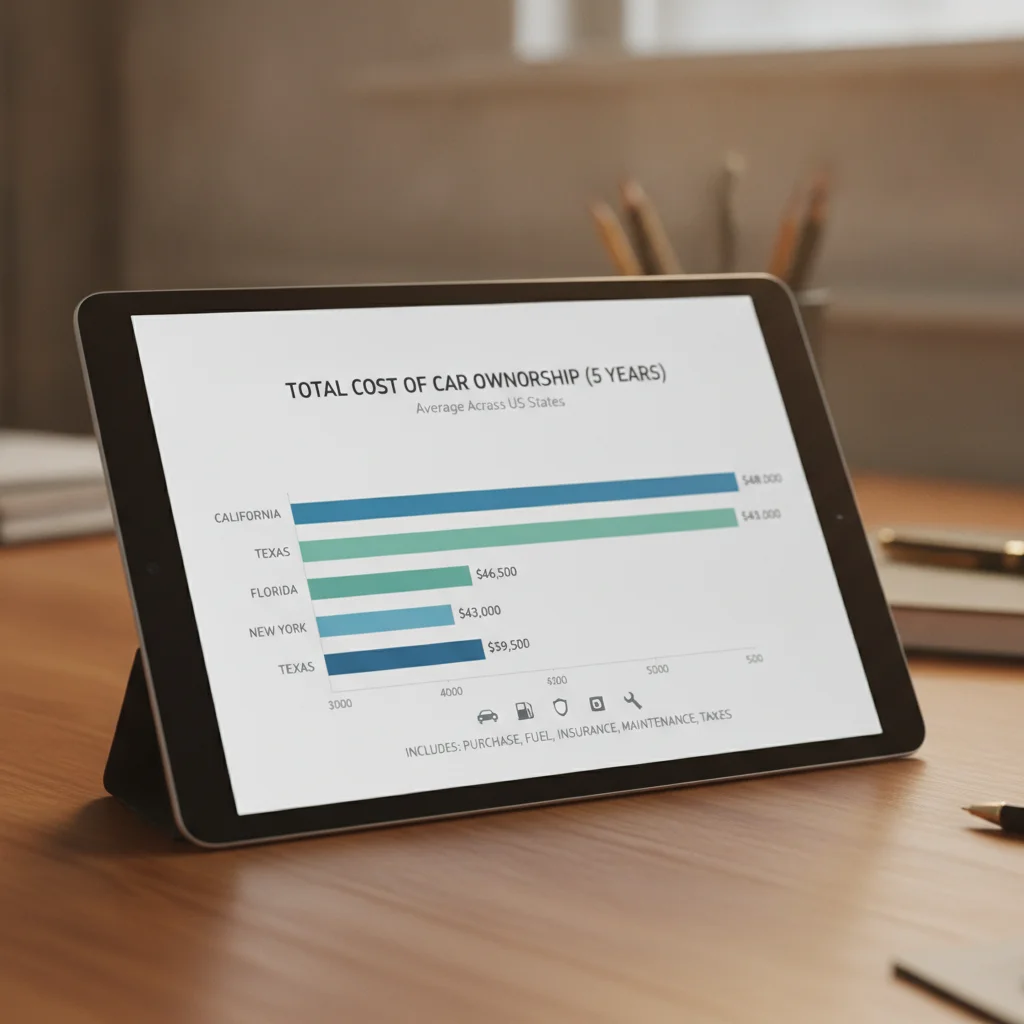
Run the depreciation math over a five-year ownership window. A $50,000 truck bought in a state with a 2% effective tax rate will generate roughly $3,500–$4,500 in cumulative property taxes over that period, even after annual depreciation. That number belongs in your total cost of ownership budget.
3. Factor In When the First Bill Arrives
Many buyers are caught off guard because the first vehicle property tax bill doesn't arrive at purchase — it arrives months later, or at the next annual assessment cycle. Budget for it proactively rather than treating it as an unexpected expense.
4. Compare Models Based on Taxable Value
Because assessed value often starts from MSRP, trimming to a lower equipment package or choosing a slightly less expensive model can generate compounding savings on annual property taxes over the full ownership period. A $5,000 difference in MSRP might translate to $400–$600 in cumulative property tax savings over five years in a high-rate state.
Check Both State and County Rates
Never rely on the statewide average rate when estimating your vehicle property tax. County and municipal rates can vary by a factor of two or more within the same state. Before you finalize a car purchase or accept a relocation package, look up the specific rate for your county or township — most county treasurer websites publish their current millage rates online.
Build the Tax into Your Monthly Budget
Rather than absorbing a large annual or semi-annual bill as a surprise expense, divide your expected vehicle property tax by 12 and set that amount aside each month in a dedicated savings buffer. For a $900 annual bill, that's just $75 a month — a much easier number to manage than a one-time hit to your checking account.
Vehicle property tax is one of the clearest examples of how government fees shape total ownership cost in ways that vary dramatically by geography. The more precisely you understand these recurring charges before you buy, the better positioned you'll be to make a decision that fits your actual budget — not just the sticker price.

All claims are backed by peer-reviewed research. Sources on request.