Key Takeaways
Option A
Sales Tax on a Car Purchase
The point-of-sale tax collected by dealers at the time of transaction.
Best for: In-state dealership purchases where the seller is registered to collect and remit state tax directly.
Option B
Use Tax on a Car Purchase
The self-reported tax owed when sales tax was never collected at purchase.
Best for: Out-of-state or private-party purchases where sales tax was not collected at the time of the transaction.
If you're buying from a franchised or independent dealership in your home state
Sales Tax on a Car Purchase
Your dealer is required by law to collect and remit state sales tax on your behalf. You pay at closing and the obligation is fully satisfied — no additional filing required.
If you're buying a car from a private seller or through an online platform that ships from another state
Use Tax on a Car Purchase
No dealer means no automatic tax collection. You'll owe use tax to your home state when you go to title and register the vehicle — budget for it in advance.
If you're purchasing from an out-of-state dealer and driving the car home
Use Tax on a Car Purchase
The selling state may collect its own sales tax, but your home state will likely apply use tax at registration. Understanding the credit system prevents double-payment errors.
If you're trading in a vehicle while purchasing from a dealer
Sales Tax on a Car Purchase
Most states allow the trade-in value to offset the taxable purchase price. The dealer handles the math and collects only on the reduced amount, shrinking your tax bill.
If you bought a car in a state with no sales tax and then moved or registered elsewhere
Use Tax on a Car Purchase
Oregon, Montana, New Hampshire, Delaware, and Alaska have no sales tax, but your new home state will almost certainly demand use tax when you register. Plan accordingly.
The Core Difference: Collection vs. Self-Reporting
Most car buyers focus on the sticker price, the interest rate, and the monthly payment. Taxes feel like a formality — a line item the dealer fills in. That's exactly true when you buy from an in-state dealership. But step outside that scenario and the rules shift dramatically, and most buyers don't realize it until they're standing at the DMV window.
Think of sales tax as a tax that someone else collects for the government on your behalf. When you purchase from a dealer registered in your state, they act as a tax agent — they calculate the owed amount, add it to your contract, and send it directly to the state revenue authority. You never have to think about it again.
Use tax is the mirror image of that. It exists specifically to capture tax revenue that would otherwise evade collection — situations where no registered dealer was present to collect sales tax. The obligation shifts entirely onto you, the buyer. You calculate it, you report it, and you pay it, usually at the time of vehicle registration.
The IRS and every state taxing authority are clear on one point: you owe one or the other, not necessarily both, but never neither. These two taxes are designed to be complementary — together they aim to ensure that every vehicle purchase generates the appropriate tax revenue for the state where the car will ultimately be registered and used.
Sales Tax Is Not Always Itemized Clearly
Some dealers roll sales tax into a broader 'taxes and fees' line on the purchase order rather than breaking it out separately. Always ask for the tax amount to be itemized before signing. Knowing the exact figure lets you verify that the correct rate was applied and gives you documentation if your home state's DMV later asks for proof of tax paid.
Online Marketplaces and Tax Responsibility Vary Widely
Some online car-buying platforms now collect and remit use tax on behalf of buyers, similar to how e-commerce marketplaces handle sales tax for physical goods. Others explicitly disclaim that responsibility and place it on the buyer. Read the platform's tax policy section carefully — it's usually buried in the purchase terms. When uncertain, contact your state's department of revenue directly to confirm your obligation before the vehicle arrives.
Penalties for Unpaid Use Tax Can Accumulate Fast
Most states charge interest on unpaid use tax from the date the vehicle should have been registered, plus potential penalty fees for late filing. If you've been driving an unregistered or recently purchased vehicle without paying use tax, the clock is already running. Voluntarily disclosing and paying promptly almost always results in lower penalties than being caught during an audit or title transfer review.
See our guide to car purchase paperwork to understand all the documents involved in a typical dealership transaction, including how tax amounts are documented on your sales contract.
What Triggers Sales Tax on a Vehicle Purchase
Sales tax is triggered by a single condition: a taxable sale of a vehicle by a dealer registered to collect tax in the state where the sale takes place. Every element of that sentence matters.
The Seller Must Be a Registered Dealer
Private sellers are not tax agents. When your neighbor sells you their used pickup, they have no legal obligation to collect sales tax, and most states don't expect them to. That responsibility falls to you as the buyer in the form of use tax (covered in the next section). Franchised new-car dealerships and most licensed used-car dealers are registered and required to collect.
The Sale Must Occur in the State
A California dealer sells a car to a California buyer — sales tax applies. But if that same California dealer sells to a buyer from Nevada who takes delivery at the California lot, the rules get complicated fast. Many states only require dealers to collect sales tax for buyers who are residents of their state or who take delivery within their borders. Some dealers collect anyway; others issue a tax exemption and let the buyer's home state handle it via use tax.
The Purchase Price Is the Tax Base
Sales tax is calculated on the negotiated purchase price after allowable deductions. In most states, this means the price after a trade-in credit is applied. This is one of the most underappreciated tax benefits in a car deal. The trade-in tax advantage can reduce your taxable amount by thousands of dollars, depending on your vehicle's value and your state's rules.

Sales tax rates vary enormously by state — and in many states, by county and city as well. A dealer in Los Angeles collects a different combined rate than one in rural Nebraska. Your contract should itemize the exact rate applied and the dollar amount collected. If it doesn't, ask before you sign.
45
States that levy both sales and use tax on vehicles
Only five states (Oregon, Montana, New Hampshire, Delaware, Alaska) have no statewide sales tax, per the Tax Foundation's 2024 state tax landscape data.
Up to 10.25%
Highest combined state and local vehicle sales tax rate
California's combined state and local sales tax can reach 10.25% in some jurisdictions, making it one of the costliest states for vehicle tax at purchase.
$1,500+
Typical use tax bill on a $25,000 vehicle in a 6% state
At a 6% rate — near the national average — use tax on a mid-range used vehicle purchase can easily exceed $1,500, a figure many private-sale buyers fail to budget for.
~30%
Of used vehicle sales that occur between private parties
According to industry estimates, roughly 30% of used-vehicle transactions are private-party sales, meaning use tax — not sales tax — is the applicable obligation for a significant share of buyers.
What Triggers Use Tax — and When You Owe It
Use tax exists because lawmakers recognized that consumers would exploit gaps in sales tax collection — buying across state lines, buying from private parties, or purchasing from out-of-state retailers — to avoid paying any tax at all. Use tax closes that loophole.
Out-of-State Purchases
This is the most common use-tax scenario for vehicle buyers. You find a great deal on a certified pre-owned SUV at a dealership two states away. You fly out, inspect it, sign the papers, and drive it home. The selling state may or may not have collected their sales tax. Either way, your home state expects you to pay use tax when you show up to register the vehicle.
Here's where most buyers breathe a sigh of relief: credit for taxes paid. Almost every state that levies both sales and use tax will credit you for any sales tax you already paid in another state. If your home state charges 6% and the selling state charged 5%, you typically owe the 1% difference as use tax — not 6% on top of the 5% already paid. Double taxation is rare when states have reciprocity agreements, but it's not impossible. Out-of-state purchase tax traps are real, and researching your specific state combination in advance is essential.
Private-Party Purchases
When you buy from a private seller — on Craigslist, Facebook Marketplace, or through a family transaction — no sales tax is collected. The moment you walk into the DMV to title and register that vehicle, the clerk will ask for the purchase price and calculate the applicable use tax on the spot. In some states, they'll look up the car's fair market value and tax you on whichever is higher. Common misconceptions about private-party car taxes catch many buyers off guard — assuming a handshake deal is tax-free is one of the most expensive assumptions in car buying.
Online Purchases Shipped from Another State
As online car retail grows, so does use-tax complexity. Platforms that facilitate vehicle delivery from out-of-state sellers vary widely in whether they collect and remit tax for you. State-specific online car purchase rules determine what each platform is legally required to do. When in doubt, assume use tax will be your responsibility and set aside the funds before the car arrives in your driveway.
Sales Tax Is Not Always Itemized Clearly
Some dealers roll sales tax into a broader 'taxes and fees' line on the purchase order rather than breaking it out separately. Always ask for the tax amount to be itemized before signing. Knowing the exact figure lets you verify that the correct rate was applied and gives you documentation if your home state's DMV later asks for proof of tax paid.
Online Marketplaces and Tax Responsibility Vary Widely
Some online car-buying platforms now collect and remit use tax on behalf of buyers, similar to how e-commerce marketplaces handle sales tax for physical goods. Others explicitly disclaim that responsibility and place it on the buyer. Read the platform's tax policy section carefully — it's usually buried in the purchase terms. When uncertain, contact your state's department of revenue directly to confirm your obligation before the vehicle arrives.
Penalties for Unpaid Use Tax Can Accumulate Fast
Most states charge interest on unpaid use tax from the date the vehicle should have been registered, plus potential penalty fees for late filing. If you've been driving an unregistered or recently purchased vehicle without paying use tax, the clock is already running. Voluntarily disclosing and paying promptly almost always results in lower penalties than being caught during an audit or title transfer review.
Side-by-Side: Sales Tax vs. Use Tax at a Glance
The mechanical difference between these two taxes is straightforward once you understand the collection mechanism. The table below captures the key distinctions that affect real car buyers in real purchase scenarios.
| Criterion | Sales Tax | Use Tax |
|---|---|---|
| Who collects it | The dealer, at point of sale | The buyer self-reports and pays |
| When it's triggered | At purchase from a registered dealer in-state | When taxable sale occurred without collection |
| Typical payment moment | At signing, included in deal paperwork | At DMV during title/registration |
| Applies to private-party sales | No — private sellers don't collect | Yes — buyer owes use tax instead |
| Applies to out-of-state purchases | May be collected by selling-state dealer | Home state levies on registration |
| Tax rate | State (+ local) sales tax rate | Identical to home state sales tax rate |
| Credit for tax already paid | N/A — collected once at sale | Credit given for prior sales tax paid |
| Trade-in deduction | Reduces taxable base in most states | Not typically applicable |
| Risk of non-compliance | Low — dealer handles it automatically | High — buyer must know and act |
One important nuance not captured in any table: both taxes are calculated on the same base — the vehicle's purchase price (or fair market value, whichever the state requires). The rate is identical for sales and use tax in any given state. The only difference is who collects it and how it's remitted. States designed it this way deliberately so neither tax creates a competitive advantage over the other.
For a comprehensive look at how these obligations vary by geography, the car ownership taxes and fees state-by-state reference is an excellent starting point before you negotiate any deal across state lines.
Special Scenarios That Blur the Line
Real-world car deals don't always fit neatly into textbook examples. Here are the situations where buyers most often get confused — or inadvertently underpay.
No-Sales-Tax States
Five states — Oregon, Montana, New Hampshire, Delaware, and Alaska — have no statewide sales tax. Buying a car in any of these states means zero sales tax collected at the point of sale. For residents of those states, that's the end of the story. But for buyers who live elsewhere and cross a border to take advantage of no-tax pricing, beware: your home state will almost certainly assess use tax when you go to register. The savings evaporate quickly.
Fleet and Business Purchases
Businesses purchasing vehicles for commercial use sometimes qualify for sales tax exemptions or deferrals, depending on state law. These exemptions don't eliminate the tax obligation — they often convert it to a use tax that accrues based on actual business use versus personal use. If your business buys vehicles, your accountant should be tracking this carefully.
Gift Transfers
Receiving a car as a gift sounds tax-free, but most states disagree. Gift transfers between non-family members are typically treated as a taxable sale at fair market value, triggering use tax at registration. Even family gift transfers have rules — some states exempt immediate family; others tax at a nominal value. Check your state's DMV guidelines before assuming a gifted vehicle is free of tax.
Leased Vehicles
Leasing doesn't fully escape either tax. Most states apply sales tax to each monthly lease payment rather than the full vehicle value. When you purchase a leased vehicle at the end of the term, the residual purchase may trigger additional sales or use tax depending on whether the lessor is registered in your state.
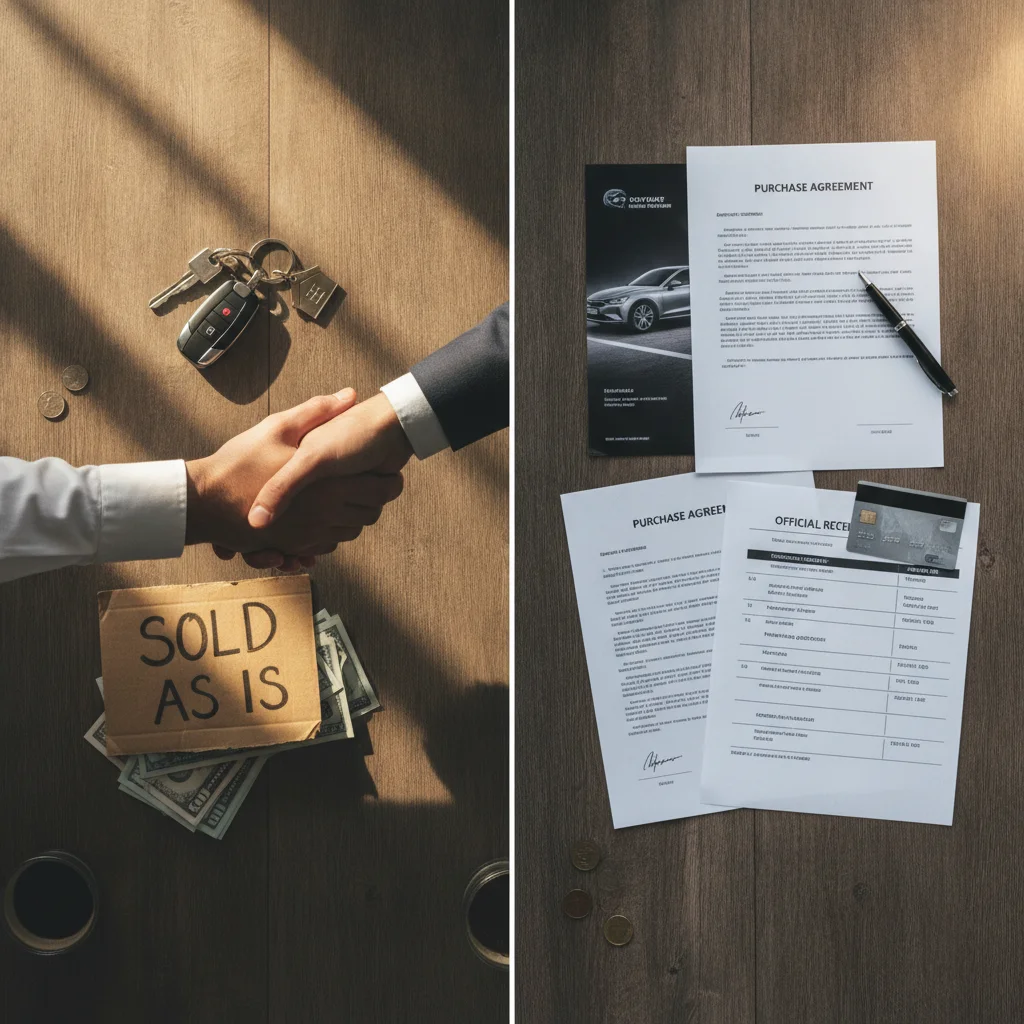
Understanding vehicle property taxes adds another layer — some states layer an annual ad valorem property tax on top of the one-time sales or use tax at purchase. These are entirely separate obligations with different payment schedules and calculations.
How to Calculate and Pay Use Tax Correctly
Since use tax is self-reported, errors — both underpayment and overpayment — are common. Here's how to get it right.
Step 1: Determine Your Home State's Rate
Your use tax rate equals your state's sales tax rate, including any applicable county or local additions. This is the same rate you'd pay at a dealer. Look it up on your state's department of revenue website — not on the bill of sale from the selling state.
Step 2: Establish the Correct Tax Base
Most states tax the greater of (a) the actual purchase price or (b) the vehicle's fair market value as determined by a reference guide like Kelley Blue Book or the National Automobile Dealers Association (NADA). This prevents buyers from artificially lowering the stated sale price on a private deal to reduce their tax bill. If you paid $18,000 for a vehicle with a KBB value of $22,000, your state may tax the $22,000 figure.
Step 3: Apply Any Credits
If you paid sales tax in another state, gather proof — your out-of-state dealer's purchase agreement clearly showing the tax amount collected. Present this to the DMV when registering. The clerk will apply the credit and collect only the difference, if any.
Step 4: Pay at Registration
In most states, use tax is collected by the DMV or title agency at the time of initial registration. You don't file a separate tax return unless your state specifically requires it (some states integrate vehicle use tax into the annual income tax return). Budget this amount before you complete the purchase — it can run from a few hundred dollars to well over a thousand on high-value vehicles.
Sales Tax Is Not Always Itemized Clearly
Some dealers roll sales tax into a broader 'taxes and fees' line on the purchase order rather than breaking it out separately. Always ask for the tax amount to be itemized before signing. Knowing the exact figure lets you verify that the correct rate was applied and gives you documentation if your home state's DMV later asks for proof of tax paid.
Online Marketplaces and Tax Responsibility Vary Widely
Some online car-buying platforms now collect and remit use tax on behalf of buyers, similar to how e-commerce marketplaces handle sales tax for physical goods. Others explicitly disclaim that responsibility and place it on the buyer. Read the platform's tax policy section carefully — it's usually buried in the purchase terms. When uncertain, contact your state's department of revenue directly to confirm your obligation before the vehicle arrives.
Penalties for Unpaid Use Tax Can Accumulate Fast
Most states charge interest on unpaid use tax from the date the vehicle should have been registered, plus potential penalty fees for late filing. If you've been driving an unregistered or recently purchased vehicle without paying use tax, the clock is already running. Voluntarily disclosing and paying promptly almost always results in lower penalties than being caught during an audit or title transfer review.
Staying on top of all the fees that accumulate across a vehicle's lifetime matters well beyond the purchase transaction. The paperwork and contracts hub covers everything from purchase agreements to title transfers — the documents where these tax obligations formally appear.

All claims are backed by peer-reviewed research. Sources on request.