Key Takeaways
Why Inherited and Gifted Vehicles Are Treated Differently
When you buy a car, the process is relatively linear: you pay, the seller signs the title, and you go to the DMV to register it in your name. When a vehicle comes to you through inheritance or as a gift, the path diverges — sometimes dramatically. There is no sale price to report, which affects how taxes are calculated. There may be no living person who can physically sign the title over to you. And depending on the estate's size, a court may need to get involved before any transfer can legally happen.
Think of vehicle ownership like a chain of custody. Every link in that chain needs to be documented and legally sound. A gap anywhere — an unsigned title, a missing death certificate, a lien nobody knew about — can halt your registration until it's resolved. The DMV isn't being difficult; it's protecting everyone in the chain from future fraud or ownership disputes.
Understanding these distinctions upfront will save you multiple trips to the DMV and potentially hundreds of dollars in avoidable fees. It also helps to know how this process compares to a standard purchase — see our guide on registering a newly purchased car for that baseline walkthrough.
The two scenarios — inheritance and gift — share many of the same steps but diverge on a few key documents. We'll address each in turn within the steps below, but here's the short version: inherited vehicles require proof that you have legal authority to act on behalf of the estate; gifted vehicles require proof that no money changed hands, which is what triggers a potential tax exemption.
What You'll Need Before You Start
Gathering documents before your DMV visit is the single most effective way to avoid wasted trips. Most DMVs will turn you away — without exception — if a required document is missing, and appointments in busy offices can be weeks out. Treat this checklist like a pre-flight check.
What you will need
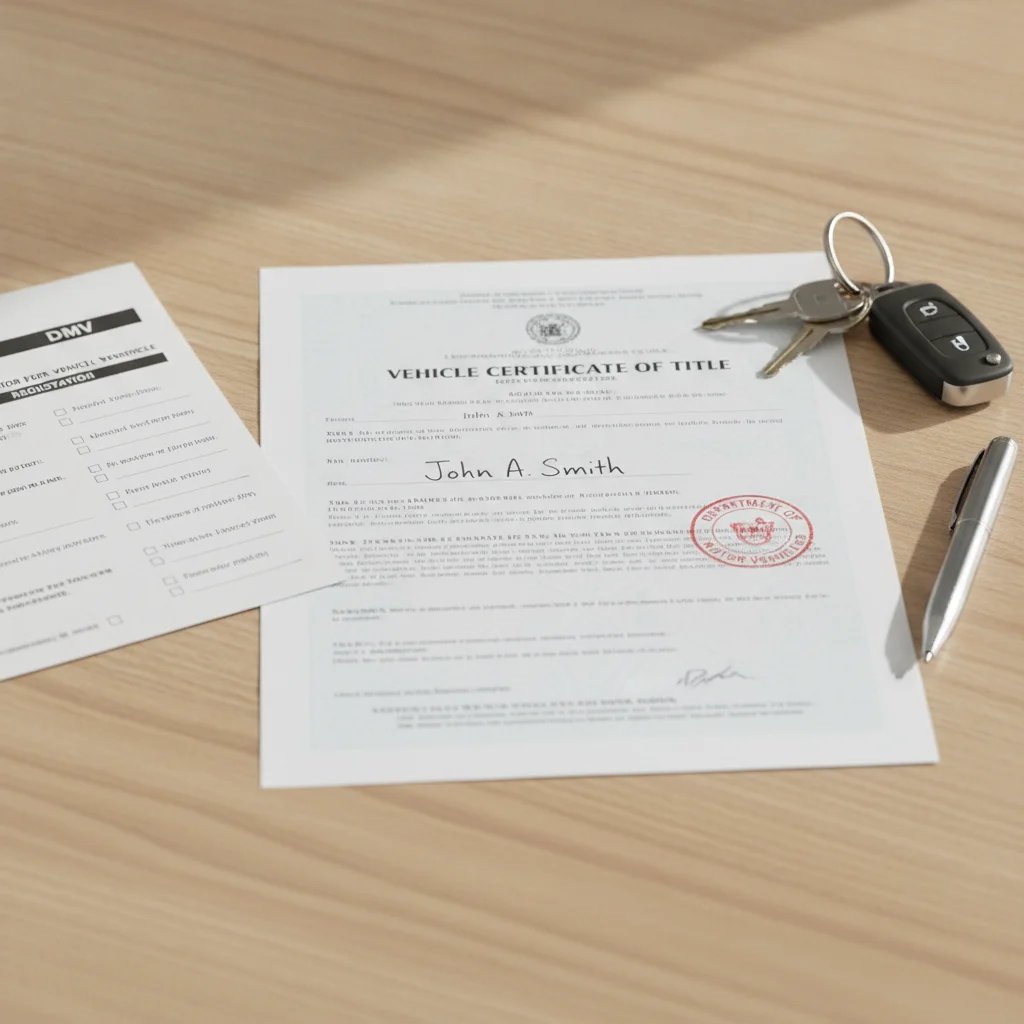
Vehicle Certificate of Title
The legal document that names the owner of the vehicle — must be signed over to you before registration can proceed.
Death Certificate (for inherited vehicles)
Official government document proving the previous owner's death, required by the DMV to process an estate title transfer.
Small-Estate Affidavit or Letters Testamentary
Court-issued document giving you legal authority to transfer estate property, including vehicles, when probate is involved.
Gift Affidavit or Certification of Gift
A signed statement from the donor confirming the vehicle was transferred without payment, used to claim a sales tax exemption.
Odometer Disclosure Statement
Documents the vehicle's mileage at the time of transfer, as required by federal law for vehicles under 10 years old.
Proof of Auto Insurance
Evidence of minimum state-required liability coverage in your name, needed to obtain new license plates or transfer existing ones.
Vehicle Identification Number (VIN) Inspection Form
Required in some states when the title is from another state or the vehicle has been off the road for an extended period.
A note on insurance: many people assume they can wait until after they have the title to purchase insurance. In practice, most DMVs require proof of insurance in your name before they will issue new plates or transfer existing ones. Contact your insurer before your DMV appointment and ask them to add the vehicle to your policy effective immediately. They can typically email you a temporary insurance card within minutes.
If the vehicle is coming from another state, review the state-specific title transfer requirements for your state before you assemble your documents — additional steps like VIN inspections or emissions tests may apply.
Understanding the Fees and Taxes Involved
One of the most common surprises people encounter is discovering that receiving a vehicle for free doesn't mean registering it is free. You will still owe some combination of the following:
- Title transfer fee: Charged by the state to legally change the name on the title. Typically ranges from $10 to $100 depending on the state.
- Registration fee: Based on the vehicle's age, weight, or value. Can be as low as $30 in some states or several hundred dollars in others.
- Use tax or gift tax: Some states charge a flat use tax on gifted vehicles (Texas charges $10 for qualifying family gifts, for example). Others waive it entirely for immediate family. A small number of states assess tax based on fair market value even for gifts — check your state's exact rules.
- Late transfer penalty: If you exceed the state's deadline for transferring a title (commonly 10–30 days), expect fees of $10–$25 per month or more.
- Emissions or safety inspection fees: Required in many states before a vehicle can be registered, regardless of how it was acquired.
For inherited vehicles, some states also charge a small estate processing fee or require a notarized affidavit at additional cost. See the registration and tax timeline for a broader breakdown of when these fees hit and how they stack up over a vehicle's life.
If the vehicle is an antique or classic car — generally 25 or more years old — different registration categories may apply with lower fees and different usage rules. Our article on classic and antique car registration covers those specifics in detail.
Probate Can Freeze a Title Transfer
If the previous owner died without a will (intestate) or with an estate large enough to require full probate, the DMV will not accept a simple title signing. You will need court-issued Letters Testamentary or Letters of Administration before any title transfer can happen. Attempting to skip this step is considered fraud in most states. Contact a probate attorney or your county courthouse early to understand the timeline — probate can take months.
Missing the Transfer Deadline Costs Real Money
Most states require you to transfer a vehicle title within 10 to 30 days of taking possession. After that window closes, late fees begin accruing — often $10 to $25 per month — and in some states you may be required to pay back-registration fees for the entire period the car was untransferred. If the vehicle is also uninsured during this gap, you face additional legal exposure. Start the process as soon as the vehicle is in your possession.
Never Backdate a Title or Gift Affidavit
It may be tempting to fill in an earlier date to avoid late fees, but signing a government document with a false date is fraud — a criminal offense in every state. DMV clerks are trained to flag discrepancies between document dates, insurance effective dates, and death certificates. If inconsistencies surface, your registration can be denied and you may face legal consequences.
Out-of-State Titles Add Complexity
If the vehicle was titled in a different state than where you live, you will need to satisfy both states' requirements. Some states require a physical VIN inspection before they will issue a new in-state title. Budget extra time and check your state DMV's specific out-of-state title transfer rules before your appointment.
Step-by-Step: Completing the Registration
Follow these steps in order. The sequence matters because some documents depend on others being in place first — for instance, you cannot get insurance in your name without knowing the VIN, and you cannot get plates without insurance. Work through each step systematically rather than trying to complete multiple steps simultaneously.
Confirm Your Legal Authority to Transfer the Vehicle
Before anything else, establish that you have the legal right to take ownership. The answer depends on how the vehicle came to you:
- Gifted vehicle: The current owner (the donor) is alive and willing to sign the title over to you directly. This is the simplest scenario.
- Inherited with a will: If the estate was small enough to avoid full probate (most states set a threshold between $10,000 and $75,000 in total estate value), you may be able to use a small-estate affidavit to transfer the vehicle without court involvement. Check your state's threshold.
- Inherited through full probate: A probate court has appointed an executor or administrator. That person holds Letters Testamentary or Letters of Administration, which grant them authority to transfer estate assets including vehicles.
- Inherited without a will (intestate): The court appoints an administrator. The process is similar to probate with a will, but may take longer to resolve.
If you're unsure which category applies, call your county courthouse's probate division — they can tell you whether the estate value requires full probate in your state.
Obtain and Inspect the Vehicle Title
Locate the original certificate of title. Examine it carefully before proceeding:
- Confirm the VIN on the title matches the VIN on the vehicle's dashboard and door jamb stickers.
- Check for any lienholders listed. If a bank or lender appears on the title, you must obtain a lien release letter from that institution before the DMV can transfer the title to you.
- Look for alterations, corrections, or white-out anywhere on the document. Most DMVs will reject a title that appears to have been altered, even innocently.
- For gifted vehicles: the donor must sign the title in the seller's signature field in ink — no digital signatures, no pencil.
- For inherited vehicles: do not have anyone sign the title until you have confirmed the correct signatory (executor, administrator, or affidavit holder) with your DMV.
If the title is lost or was never found in the estate, you will need to apply for a duplicate title — either in the deceased owner's name (so it can then be transferred) or directly to you in some states. This adds one to four weeks depending on the state.
Gather Supporting Documentation
In addition to the title, you will need supporting documents specific to your situation. Organize these into a folder before your DMV visit:
- For gifted vehicles:
- A completed gift affidavit or gift certification form (available on your state DMV's website). Both parties typically must sign. Some states require notarization.
- For inherited vehicles (small estate affidavit path):
- A completed small-estate affidavit, signed and notarized. Attach a certified copy of the death certificate. Some states also require a copy of the will if one exists.
- For inherited vehicles (full probate path):
- Certified Letters Testamentary or Letters of Administration from the probate court. A certified copy of the death certificate. Copies of the will if applicable.
For all scenarios, also bring a completed odometer disclosure statement (federal law requires this for vehicles under 10 years old), your driver's license, and proof of current auto insurance in your name covering this specific vehicle.
Purchase Auto Insurance in Your Name
Contact your insurance provider and add the inherited or gifted vehicle to your policy before your DMV visit. Give them the VIN, year, make, model, and — if you know it — the vehicle's current market value. They will need to confirm the vehicle is insured in your name specifically, not the previous owner's.
If the vehicle has been sitting unused for an extended period (common with inherited cars), an insurer may want a current inspection or photos before binding coverage. Plan for this step to take a day or two. Most insurers can email you a temporary insurance card immediately upon binding coverage.
You cannot legally drive the vehicle to the DMV without insurance in your name. If the vehicle is not drivable, most states allow you to transport it on a trailer under a separate transport permit, or you can complete the title transfer by mail or appointment in advance.
Complete Required Inspections
Many states require one or more inspections before a vehicle can be registered, regardless of how it was acquired:
- Emissions inspection: Required in most metro areas and states with air quality programs. Usually takes 15–30 minutes at a certified station and costs $10–$40.
- Safety inspection: Checks brakes, lights, tires, and other mechanical components. Required in roughly half of U.S. states.
- VIN verification: Some states require a physical VIN check by a law enforcement officer or DMV inspector when a vehicle is being titled for the first time in that state or after a long gap in registration. This is common for out-of-state titles.
Check your state's DMV website for current inspection requirements. If the vehicle hasn't been driven in years — which happens with inherited vehicles — address any obvious mechanical issues before taking it in for a safety or emissions check. A failed inspection means another appointment and another fee.
Visit the DMV or County Tax Office
With all documents in hand, visit your local DMV, county tax assessor's office, or motor vehicle office — whichever agency handles registration in your state. Bring everything in your document folder plus your payment method.
At the counter, you will:
- Submit the signed title (or have the executor sign it in the clerk's presence, depending on state rules).
- Submit your supporting documentation (death certificate, gift affidavit, probate documents, etc.).
- Complete any DMV-specific forms the clerk provides (application for title, registration application).
- Pay all applicable fees — title transfer fee, registration fee, use tax or gift tax if applicable.
- Receive temporary registration, license plates (or a plate transfer sticker), and a receipt.
Ask the clerk for an estimated processing time for your permanent title and plates. Some states mail them within a week; others take up to six weeks. Record your transaction confirmation number.
Receive and Verify Your New Title and Registration
When your permanent title and registration documents arrive by mail, verify the following before filing them away:
- Your name is spelled correctly and your address is current.
- The VIN on the title matches the VIN on the vehicle.
- No lienholder is listed (unless you have a loan on the vehicle).
- The title type shows as "clean" — not salvage, rebuilt, or flood.
If any information is incorrect, contact the DMV immediately. Correcting a title error is far easier when it's caught early than years down the road when you try to sell the vehicle. Store the title in a secure location — a fireproof safe or a bank safety deposit box — not in the vehicle's glove compartment.
Update your insurance policy with your new plate number and any changes to the vehicle's registered address. And set a reminder for your annual registration renewal date, which will now be based on your transfer date in most states.
What Happens After You Submit the Paperwork
In many states, the DMV will issue temporary registration on the spot while the permanent title and plates are mailed to you. Processing times vary widely — from a few days to six weeks — depending on the state and whether the title needed to go through probate review. Keep your temporary registration and receipt of your DMV transaction in the vehicle at all times during this period.
If the vehicle had an existing license plate registered to the deceased or the gift-giver, that plate typically cannot be transferred to the new owner in most states — plates are tied to the individual, not the vehicle. You will receive new plates, and the old ones should be surrendered to the DMV or destroyed according to your state's rules.
Make Certified Copies Before You Submit Anything
Death certificates, wills, and probate documents submitted to the DMV are often not returned. Make certified copies from the issuing agency — county courthouse or vital records office — before you hand anything over. Certified copies typically cost $10 to $20 each and can save weeks of delay if originals are lost in processing.
Check Whether the Vehicle Has a Lien First
Run a title check through your state's DMV or a third-party vehicle history service before you proceed. If a lender is listed on the title, they have a legal interest in the vehicle and must release the lien in writing before the title can transfer. This is especially common with inherited vehicles where loans weren't fully paid off before the owner's death.
Gifted Vehicle Between Family? Get the Affidavit Right
Most family gift exemptions apply only to immediate relatives — spouse, parent, child, or sibling, depending on the state. The gift affidavit must clearly state the relationship and confirm zero monetary exchange. If the recipient paid anything — even a symbolic dollar — some states will treat it as a sale and assess full sales tax on fair market value.
One situation worth planning for: if you inherited the vehicle and decide you'd rather sell it than keep it, you'll need to complete the title transfer into your name first before you can legally sell it to someone else. Attempting to sell directly from the estate — what some people call a "title jump" or "skip transfer" — is illegal in most states and makes it difficult for the buyer to register the car. For more on that scenario, see our guide on selling a car you inherited.
For reference on what a clean, properly transferred title looks like — and what red flags to watch for — the article on title and registration documents is a useful companion read. And if you want a broader overview of all the paperwork categories involved in vehicle ownership changes, the Paperwork & Contracts hub and the Paperwork & Title hub both organize the key topics by scenario.

All claims are backed by peer-reviewed research. Sources on request.