
Key Takeaways
DUI as a Long-Term Insurance Risk
When an insurer learns of a DUI conviction, it doesn't treat the offense as a single, isolated event. Instead, it recategorizes the driver as a persistently elevated risk — one whose behavior suggests a pattern that may repeat. This reclassification drives higher premiums for years, not months, and can trigger policy cancellation or force drivers into the high-risk insurance market.
Insurers assess DUIs using a "look-back period" — typically three to seven years for rating purposes, though some states allow up to ten. The conviction remains on a motor vehicle record (MVR) longer than it affects insurance pricing, and the two timelines are often confused.
How Insurers Price Risk — and Where a DUI Fits
Auto insurance pricing is fundamentally an actuarial exercise. Underwriters assign each driver a risk score based on variables that statistically predict future claims: age, vehicle type, credit history in most states, years licensed, and — most heavily weighted — driving record. A clean driving history earns discounts. A record with violations earns surcharges. A DUI earns something closer to a reclassification.
The distinction matters. A single speeding ticket is a data point. A DUI is, in actuarial terms, a behavioral signal — evidence that the driver made a decision that dramatically elevated the probability of a serious crash. Industry loss data consistently shows that drivers convicted of a DUI have materially higher subsequent claim rates than drivers with similar profiles but clean records. That's the core reason insurers treat the offense differently from minor violations. For a broader look at how violations are priced, see how traffic violations affect your car insurance rates.
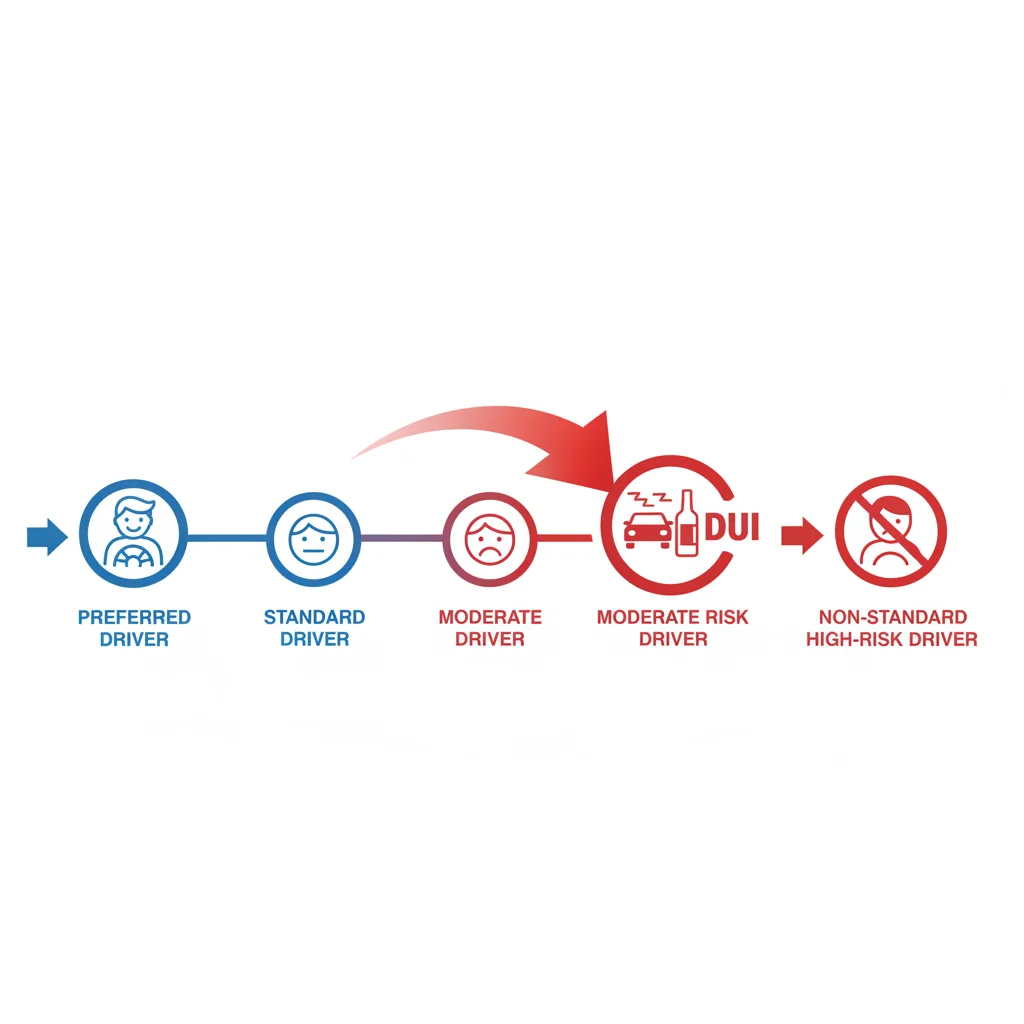
Most carriers segment their book of business into preferred, standard, and non-standard tiers. A DUI almost always moves a driver out of the preferred or standard tier entirely. In some cases it moves them off the carrier's book altogether, forcing them to find coverage through surplus lines insurers or state-assigned risk pools — both of which carry significantly higher premiums by design.
MVR Record vs. Insurance Look-Back: Two Different Timelines
Your motor vehicle record (MVR) and your insurance look-back period operate on different clocks. A DUI may remain on your state driving record for seven years, ten years, or permanently — depending on your state. But your insurer's look-back for pricing purposes may be shorter. Always check both timelines, as they affect different aspects of your legal and financial life.
Arrest vs. Conviction: Timing Affects Your Rate Clock
Insurers price based on the conviction date recorded on your MVR, not the date of the arrest. If months pass between arrest and conviction, the look-back clock hasn't started yet from the insurer's perspective. Conversely, if charges are later expunged in states where expungement affects the MVR, insurers may no longer be able to price the conviction — though this varies significantly by state law.
The Look-Back Window: What It Is and Why It Varies
Every insurer applies what the industry calls a look-back period — the span of time they examine on your motor vehicle record (MVR) when quoting or renewing a policy. For most standard carriers, that window is three to five years. For a DUI specifically, many carriers extend their look-back to seven years, and some states permit ten.
This is where confusion often arises. Your state's DMV may retain a DUI on your driving record for a longer period than your insurer's look-back window — sometimes permanently. But what appears on your permanent record and what insurers are permitted or choose to price are two different things. The legal record is a document of history. The insurance look-back is a pricing mechanism calibrated to recent predictive value.
~$1,500
Average annual premium increase after a DUI
Based on industry analyses from Bankrate and Insurance.com (2023–2024), the average U.S. driver pays roughly $1,500 more per year after a DUI conviction compared to a clean-record baseline.
3–7 years
Typical insurer look-back period for DUI
Most standard-market carriers apply a three-to-seven-year look-back period when rating a DUI, though some states permit up to ten years by regulation.
Up to 200%
Maximum premium surcharge in some states
Rate filings in certain high-penalty states and carriers show DUI surcharges that can reach or exceed 200% above the driver's pre-conviction premium.
2–3 years
Typical SR-22 filing requirement duration
Most states require convicted DUI drivers to maintain an SR-22 certificate for two to three years; some require it for five years for repeat offenses.
45%
Share of drunk-driving deaths among all traffic fatalities
According to the NHTSA, alcohol-impaired driving accounts for approximately 37–38 deaths per day in the U.S., representing roughly 30–32% of all traffic fatalities annually — the actuarial basis for DUI surcharge severity.
It's also worth noting that the look-back window resets based on conviction date, not arrest date. If you were arrested in January but convicted in October, the clock starts in October. Drivers who plead charges down to lesser offenses — or who successfully challenge a conviction — may see their insurance outcomes improve substantially, which is part of why legal defense strategies have real financial implications well beyond the courtroom. For a detailed breakdown of how DUI and DWI designations differ by state, see DUI vs. DWI: What the difference means legally.
Year-by-Year: How the Premium Impact Evolves
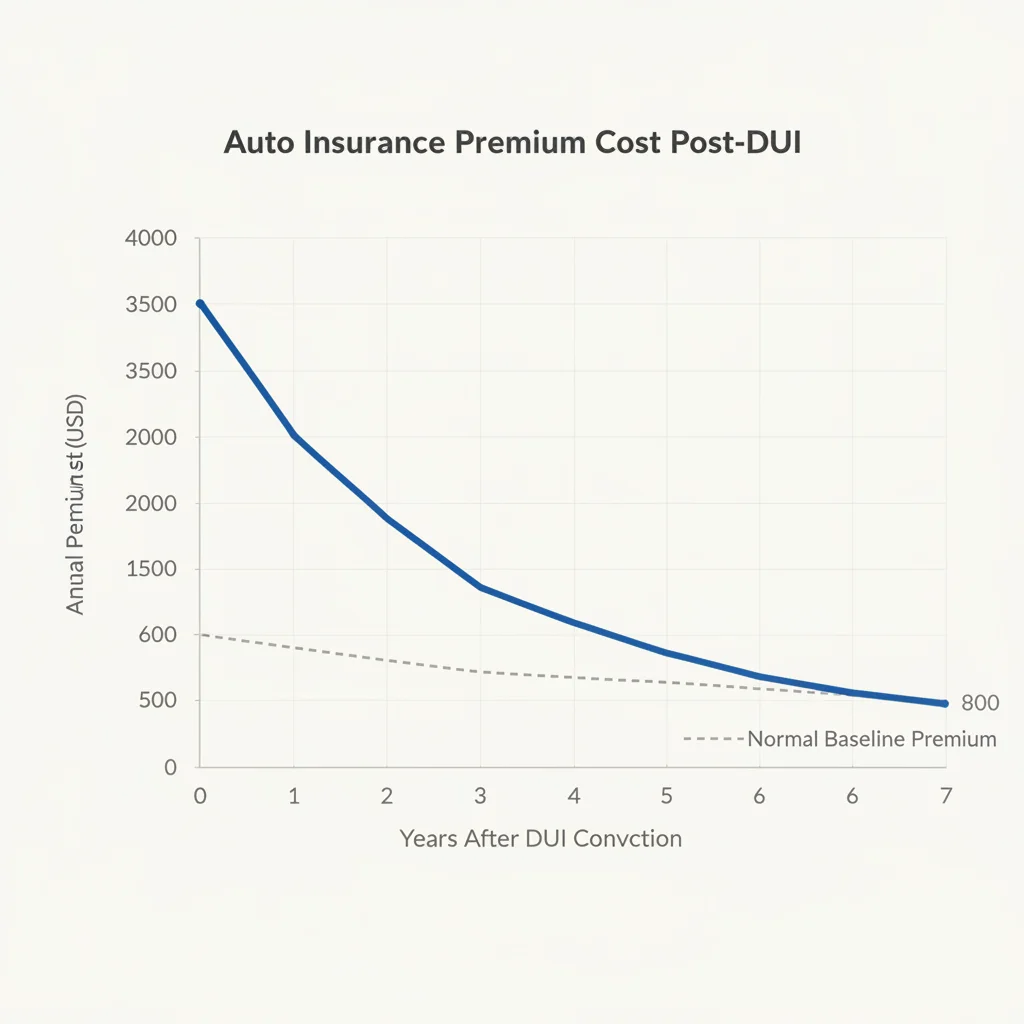
The financial damage from a DUI isn't static. It peaks in the first year after conviction and typically declines in stages as the incident ages. Understanding the trajectory helps drivers plan and make smarter coverage decisions over time.
Year 1: The Immediate Surcharge
In the first policy term after a DUI is discovered — usually at renewal when the insurer pulls an updated MVR — expect the steepest increase. National averages from multiple industry surveys place the first-year premium hike somewhere between 70% and 200%, depending on state regulations, prior record, and carrier. Some carriers cancel rather than reprice, forcing drivers to start over in the non-standard market.
Years 2–3: SR-22 Obligation and Sustained High Rates
Most states require a DUI-convicted driver to carry an SR-22 certificate of financial responsibility for two to three years. The SR-22 itself doesn't cost much — typically $15–$25 to file — but it signals high-risk status to any insurer who sees it, limiting your ability to shop competitively. Rates generally remain near their peak during this window, though some carriers apply a modest annual reduction if no additional violations occur.
Years 3–5: Gradual Normalization
Once the SR-22 requirement ends, a driver's ability to shop carriers expands meaningfully. Some standard-market insurers will quote a driver with a DUI that is three or more years old, especially if the rest of the record is clean. Rate reductions become more substantial annually as the offense ages within the look-back window.
Years 5–7 (and Beyond): Approaching the Edge of the Window
As the DUI approaches the far edge of the look-back period, its weight in the pricing model diminishes further. By year six or seven, some carriers treat a single, aged DUI similarly to a serious speeding conviction — still a surcharge, but no longer grounds for non-standard placement. When the conviction finally exits the look-back window, the pricing impact disappears almost entirely, though state MVR records may retain it longer. For comparison, how long a traffic violation stays on your record provides a useful reference for how different offense types age off your record.
“A DUI is not just a legal event — it's a data point that actuaries have spent decades studying. The recidivism rate and the claim correlation are both high enough that insurers are acting rationally when they treat it as a multi-year signal rather than a one-time lapse in judgment.”
— James Lynch, Chief Actuary, Insurance Information Institute (III)
SR-22: The Compliance Layer Insurers Must Navigate
The SR-22 is one of the most misunderstood elements of post-DUI insurance. It's not a type of insurance — it's a form, filed by your insurer with your state's department of motor vehicles, certifying that you carry at least the state-mandated minimum liability coverage. Think of it as a monitoring mechanism: the state wants proof, on an ongoing basis, that a high-risk driver isn't operating a vehicle uninsured.
The filing requirement is triggered by the court or the DMV, not by the insurer. Once required, you must maintain it for the duration specified — typically two to three years — without any lapse. If your policy cancels during that period for any reason, your insurer is required to notify the state, which can result in license suspension. This is why maintaining continuous auto insurance coverage becomes even more critical after a DUI: a lapse doesn't just raise your rates — it can restart your SR-22 clock or cost you your license.
Never Let Coverage Lapse During SR-22 Period
If your policy cancels while an SR-22 requirement is active, your insurer must notify the state — which can trigger an automatic license suspension. Set up automatic payments during your SR-22 period and flag your renewal dates well in advance. The cost of a lapse during this window goes far beyond a higher premium.
Ask About Telematics Before Dismissing High Quotes
Before rejecting a high quote from an otherwise competitive carrier, ask whether they offer a telematics or usage-based program. Some carriers allow DUI-convicted drivers to enroll, and a strong telematics score over six to twelve months can partially offset the surcharge — producing a lower effective rate than a carrier with a nominally lower base surcharge but no telematics option.
Not all insurers are willing to file SR-22s. If your current carrier cancels your policy after a DUI and you need SR-22 coverage, you'll need to find a carrier that specifically handles non-standard or high-risk policies. These carriers typically include names like The General, Dairyland, or Bristol West, as well as state-specific high-risk pools.
The Variables That Determine Your Specific Rate Increase
No two drivers face identical outcomes after a DUI. The magnitude of your rate increase depends on a combination of factors that underwriters assess simultaneously.
State Regulations
States set the rules for how long insurers can use a DUI in pricing, what surcharges are permissible, and whether carriers can cancel or non-renew based on a single conviction. California, for example, has strict regulations on cancellation but permits look-backs of up to ten years. Other states cap look-backs at three years for rating purposes, creating meaningfully different outcomes for drivers in different jurisdictions.
Prior Driving Record
A DUI on an otherwise spotless ten-year record is treated differently than a DUI that follows prior violations. Carriers view the latter as a pattern rather than an anomaly, and the surcharge reflects it. A second DUI conviction is categorically worse — many standard-market carriers will not write coverage for a driver with multiple DUIs within their look-back window under any terms.
Carrier Underwriting Philosophy
Each insurer sets its own underwriting guidelines and rate filings within state-permitted parameters. One carrier might apply a 90% surcharge for a DUI; another might apply 160% — for the same driver with the same record. This variation is the primary reason shopping the market aggressively after a DUI is worth the effort. Even comparing three or four quotes can surface rate differences of hundreds of dollars annually.
Coverage Level and Vehicle
Because surcharges are typically percentage-based, drivers with comprehensive coverage on expensive vehicles will see larger absolute dollar increases. A driver paying $800 per year faces a smaller absolute hit than one paying $2,000 per year, even at the same surcharge rate.
What Drivers Can Do to Limit Long-Term Damage
A DUI conviction doesn't give drivers many leverage points, but some strategies can meaningfully reduce the financial impact over time.
Shop Carriers Immediately — and Annually
Don't accept your current carrier's post-DUI renewal price as the market price. Get quotes from at least three to five carriers, including non-standard specialists. Repeat this process at every renewal, especially as the conviction ages and your options expand. See how a coverage gap can compound the problem in how a lapse in coverage signals risk to your next insurer — the last thing you want is to add a lapse record on top of a DUI.
Maintain a Flawless Record Going Forward
Actuarially, the single most powerful thing a driver can do after a DUI is avoid any additional violations or at-fault claims. A clean record following a DUI allows insurers to treat it as an isolated incident rather than a behavioral pattern, which improves both pricing and carrier availability over time.
Consider Usage-Based Insurance Programs
Some carriers offer telematics or usage-based insurance (UBI) programs that track driving behavior — braking, acceleration, speed, time of day — and price policies partly on observed behavior rather than solely on historical record. For a DUI-convicted driver who has since become a genuinely safer driver, these programs can provide a path to lower rates that a purely record-based approach wouldn't allow.
Never Let Coverage Lapse During SR-22 Period
If your policy cancels while an SR-22 requirement is active, your insurer must notify the state — which can trigger an automatic license suspension. Set up automatic payments during your SR-22 period and flag your renewal dates well in advance. The cost of a lapse during this window goes far beyond a higher premium.
Ask About Telematics Before Dismissing High Quotes
Before rejecting a high quote from an otherwise competitive carrier, ask whether they offer a telematics or usage-based program. Some carriers allow DUI-convicted drivers to enroll, and a strong telematics score over six to twelve months can partially offset the surcharge — producing a lower effective rate than a carrier with a nominally lower base surcharge but no telematics option.
Complete Any Available Rehabilitation Programs
Many states allow — and some require — insurers to consider completion of a DUI education or treatment program when setting rates. Even where it isn't required, proactively completing a state-approved program and providing proof to your carrier or prospective carriers demonstrates good-faith remediation and may reduce the surcharge margin.


All claims are backed by peer-reviewed research. Sources on request.