
Key Takeaways
Accident Forgiveness
Accident forgiveness is an optional auto insurance feature that prevents your premium from increasing after your first at-fault accident. Instead of triggering a rate hike — which typically runs 20% to 45% — the insurer agrees to treat that single incident as if it never happened for rating purposes. You still file the claim normally and the insurer pays out, but your clean-driver pricing is preserved going forward.
Accident forgiveness is applied at the policy level, not the claims level. It does not remove the accident from your driving record or CLUE report — it only instructs the insurer's rating engine to exclude that surcharge when calculating your next renewal premium.
Why 'Forgiveness' Is a Protection, Not a Discount
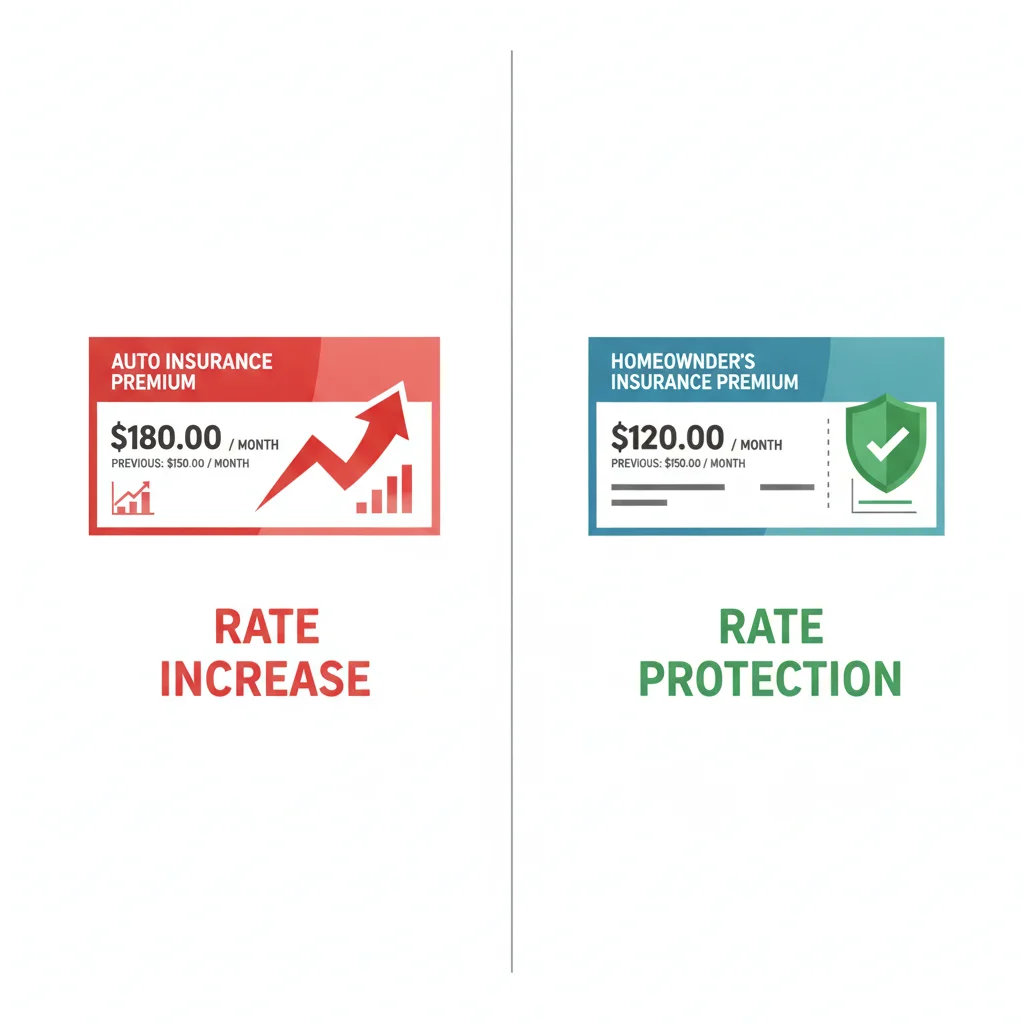
The name does some heavy lifting here. When insurers advertise accident forgiveness, it sounds generous — like they're cutting you a break. But the more accurate framing is that you're buying insurance against a rate increase, not receiving a reduction in what you currently pay.
Here's the distinction that matters: a discount lowers your premium right now. Accident forgiveness does nothing to your current rate. Its value only materializes in one specific scenario — after you cause an at-fault accident and your insurer would otherwise reprice your policy upward. If that never happens, the feature sits dormant and you've paid for something you never used.
That's not necessarily a bad outcome. You pay for collision coverage hoping you never need it too. The real question is whether the cost of the feature is proportionate to the risk it covers and the savings it protects. To answer that, you need to understand exactly what happens to your rate when you cause an accident — and how forgiveness short-circuits that process.
It's also worth noting that accident forgiveness sits in the same category as other optional policy features. For a broader view of which add-ons deliver real value versus which mostly benefit the insurer, see which add-ons routinely pay off.
What Happens to Your Rate After an At-Fault Accident
When you cause an accident and file a claim, your insurer flags the incident in its rating system. At renewal — typically six or twelve months later — your policy is repriced using an updated risk profile that now includes an at-fault accident. The surcharge isn't applied immediately; it hits when your current term expires.
~35%
Average premium increase after first at-fault accident
Based on national rate data compiled by Insurify and ValuePenguin; actual surcharges vary by state and insurer.
3–5 years
Typical surcharge period for at-fault accidents
Most U.S. insurers apply a surcharge for three to five years following an at-fault claim, depending on state regulations.
$50–$150
Annual cost of purchased accident forgiveness
Price range reflects major carriers' add-on pricing nationally; earned versions are available at no charge to qualifying long-tenured policyholders.
6%
Annual at-fault accident rate per driver
Based on NHTSA and Insurance Research Council estimates of reported at-fault collisions across U.S. licensed drivers.
~$1,500+
Typical surcharge cost over a 3-year window
Calculated from a $1,400 base premium with a 35% surcharge applied annually over a standard three-year surcharge period.
The surcharge period typically lasts three to five years depending on the state and insurer. During that window, you pay elevated premiums at each renewal until the incident ages off your rating record. Some states cap how long insurers can surcharge for a single incident; others give insurers more latitude.
The mechanics differ from your motor vehicle record. Insurers primarily use your CLUE report (Comprehensive Loss Underwriting Exchange) — a claims history database — and your driving record to set rates. An accident on your CLUE report can affect pricing even if the corresponding incident doesn't appear prominently on your DMV record.
Your CLUE Report vs. Your Driving Record
These are two separate databases. Your driving record is maintained by your state DMV and tracks violations and license actions. Your CLUE report (Comprehensive Loss Underwriting Exchange) tracks insurance claims — including at-fault accidents — and is maintained by LexisNexis. Insurers typically check both when pricing a policy. Accident forgiveness only affects how your current insurer processes the CLUE data; it doesn't modify either record.
What to Do Immediately After an Accident
Accident forgiveness is a financial protection, not a substitute for handling the incident correctly. You still need to document the scene, exchange information, and file a claim appropriately. For a step-by-step guide on what to do right after a collision, visit the <a href="/maintenance-and-ownership/safety-legal/accident-procedures">accident procedures resource hub</a>.
Accident forgiveness intercepts this process at the rating stage. Your insurer still processes and pays the claim normally. The accident still appears on your record. The only thing forgiveness does is instruct the rating engine: do not apply the surcharge code to this policy at renewal. That one instruction is what you're paying for.
Earned vs. Purchased: Two Very Different Paths
Not all accident forgiveness works the same way, and conflating the two versions leads to a lot of consumer confusion. There are two distinct paths to getting this feature on your policy.
Earned Accident Forgiveness
Several major insurers — including Geico, Progressive, and Allstate — offer accident forgiveness at no additional charge to policyholders who have maintained a clean driving record for a set period, typically three to five years. In Geico's case, the threshold is five years accident-free. Progressive's Name Your Price tool factors it into eligibility automatically for qualifying drivers.
This version costs nothing extra. It's a loyalty reward and a risk-management tool: insurers know that long-tenured clean-record drivers are unlikely to suddenly become high-risk, so forgiving one incident is a reasonable bet to retain a profitable customer.
Purchased Accident Forgiveness
The paid version is explicitly offered as an add-on endorsement, often ranging from $50 to $150 per year depending on insurer, state, and your existing premium. Allstate's version can be added by any eligible driver regardless of tenure. Liberty Mutual and Nationwide also offer purchasable versions.
The catch: eligibility requirements still apply. Most insurers won't sell you the feature if you already have a recent at-fault accident on record. You typically need to be claim-free for at least one year, and some carriers require a clean record going back three years before you can purchase it.
Ask Your Insurer If You've Already Earned It
Before purchasing accident forgiveness as a paid add-on, call your insurer and ask whether you already qualify for the earned version. Many policyholders with three to five years of clean driving have it automatically without realizing it. A five-minute phone call can prevent you from paying for something you already have.
Lock It In Before You Need It
Accident forgiveness must be in place before the at-fault accident occurs — there is no retroactive option. If you're currently eligible to purchase it and you're unsure whether to add it, consider that your eligibility window closes the moment an incident happens. Once you've had an at-fault accident, you typically can't purchase the feature until you've maintained another clean period.
For drivers who want to understand all legitimate savings mechanisms available to them, accident forgiveness is just one piece of the puzzle. See every auto insurance discount worth knowing about for a complete picture of what you may qualify for.
The Math: When Does It Actually Pay Off?
The financial case for accident forgiveness is straightforward to model. The key variable is the size of the surcharge it would protect against, measured over the full surcharge period.
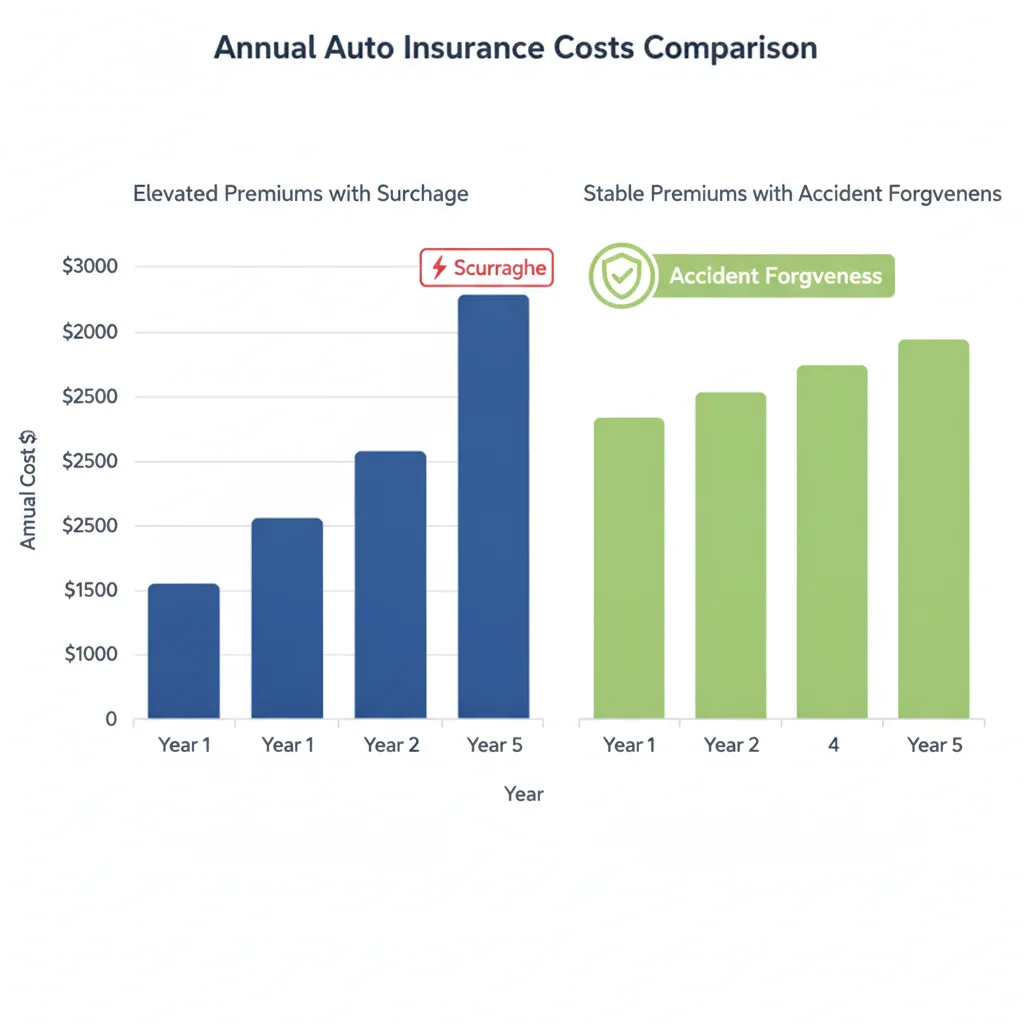
Consider a driver paying $1,400 per year for full coverage. An at-fault accident triggers a 35% surcharge — not unusual for a moderate collision claim. That's an additional $490 per year. If the surcharge lasts three years, the total extra cost is $1,470. If the surcharge lasts five years, the cost rises to $2,450.
Now compare that to the cost of accident forgiveness at, say, $100 per year. Over five years of paying for the feature, you've spent $500. If you use it once and avoid a $1,470 minimum surcharge, you've netted at least $970 in savings. Even factoring in the probability that many drivers won't have an at-fault accident in any given five-year window — roughly a 6% annual at-fault accident rate across the U.S. population — the expected value often favors the feature for drivers who drive frequently in congested areas.
“Accident forgiveness is essentially a financial hedge. You're betting a small annual amount against the possibility of a much larger multi-year cost. For drivers with significant exposure, the actuarial math tends to favor the hedge.”
— J. Robert Hunter, Former Director of Insurance, Consumer Federation of America
The math tilts against accident forgiveness in two scenarios: when you drive very few miles annually (lower exposure = lower probability of needing it) and when your base premium is already low (a 35% surcharge on a $600 policy is only $210/year, narrowing the savings window considerably).
It's also worth contrasting accident forgiveness with good driver discounts — a distinct concept. Where accident forgiveness protects against a rate increase after an incident, good driver discounts reward an ongoing clean record with a proactive reduction. You can — and ideally should — have both. Learn exactly how good driver discounts work and what disqualifies you.
The Fine Print That Changes the Calculus
Accident forgiveness policies are not uniform across insurers, and the details matter enormously. Before adding this feature — or assuming you already have it — work through this checklist.
One-Time Use vs. Recurring
Most accident forgiveness programs cover a single at-fault accident. Once used, the benefit may reset after another clean-driving period (typically three to five years), or it may be exhausted entirely depending on the policy. A second at-fault accident will almost always trigger a standard surcharge.
Per-Policy vs. Per-Driver
Some policies apply forgiveness to the named insured only. Others extend it to all rated drivers on the policy. If your teenager is on your policy and causes an accident, check whether your forgiveness applies to their incident or only to accidents caused by you.
Portability: The Biggest Trap
Accident forgiveness does not travel with you when you switch insurers. If you use accident forgiveness with Carrier A and then shop for a new policy, Carrier B will see the at-fault accident on your CLUE report and rate you accordingly. The forgiveness only affects your pricing at the insurer who granted it.
This creates a lock-in effect that's worth recognizing. Drivers with a recent forgiven accident may find their current insurer suddenly more competitive than they'd otherwise be — because shopping away means losing the protection retroactively in all future pricing.
Ask Your Insurer If You've Already Earned It
Before purchasing accident forgiveness as a paid add-on, call your insurer and ask whether you already qualify for the earned version. Many policyholders with three to five years of clean driving have it automatically without realizing it. A five-minute phone call can prevent you from paying for something you already have.
Lock It In Before You Need It
Accident forgiveness must be in place before the at-fault accident occurs — there is no retroactive option. If you're currently eligible to purchase it and you're unsure whether to add it, consider that your eligibility window closes the moment an incident happens. Once you've had an at-fault accident, you typically can't purchase the feature until you've maintained another clean period.
State Availability
Accident forgiveness is not available in all states. California, for example, restricts insurers from offering it in ways that could create discriminatory rating effects. Always confirm availability in your state before factoring it into your coverage decision.
Who Should Buy It and Who Should Skip It
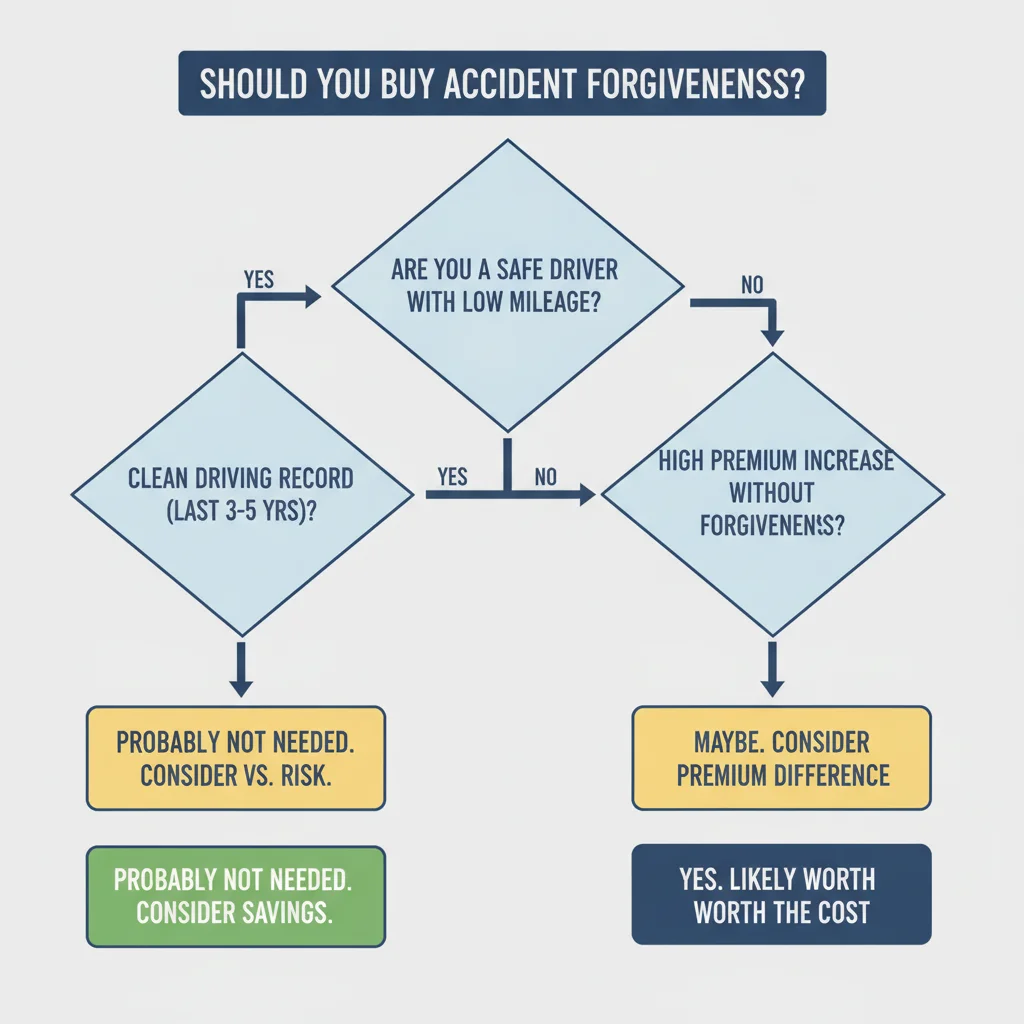
After breaking down how it works, the decision tree is actually fairly clean.
Strong Candidates for Purchasing Accident Forgiveness
- High-mileage commuters who log 15,000+ miles annually in traffic-heavy environments — more exposure means higher accident probability.
- Drivers with clean records of 3+ years who may not yet qualify for the earned version but can purchase it — locking it in before the next incident is the only option.
- Households with teen or young adult drivers on the policy — statistically the highest-risk demographic, where a single incident could trigger large surcharges.
- Drivers paying substantial premiums already — the larger the base premium, the larger the dollar value of any percentage surcharge protection.
Who Can Probably Skip It
- Drivers who already qualify for earned forgiveness through long-tenured clean records — no point paying for what you get free.
- Low-mileage drivers (under 7,500 miles per year) with limited accident exposure.
- Drivers on tight budgets who prioritize core coverage — every dollar spent on accident forgiveness is a dollar not available for higher liability limits, which protect against far more catastrophic financial risk.
Also worth checking: if you're buying a new vehicle and getting pitched on dealer add-ons simultaneously, keep your insurance decisions separate. The upsell dynamics in an F&I office are designed to blur spending categories. See dealer add-ons that quietly inflate your final bill for a similar breakdown of what's worth paying for at the dealership.
Finally, if you're not sure which optional coverages are on your current policy or what they do, the optional add-ons coverage hub is a good place to audit your existing coverage set.

All claims are backed by peer-reviewed research. Sources on request.