Key Takeaways
Why Defensive Driving Discounts Are Worth Pursuing
Car insurance premiums have climbed steadily in recent years, and most drivers feel the pinch at renewal time. While you can't always control your zip code, credit tier, or the age of your vehicle, you can control whether you've taken a qualifying defensive driving course — and that single action can shave a meaningful percentage off your annual premium.
The math is straightforward. If your annual premium is $1,800 and your insurer offers a 10% defensive driving discount, that's $180 back in your pocket every year. A typical online course costs $25–$50 and takes four to six hours. The payback period is measured in weeks, not years.
Beyond the discount, there's a practical safety angle too. Research from the NSC and the AAA Foundation for Traffic Safety consistently shows that drivers who complete structured safety training make fewer at-fault mistakes. Fewer mistakes mean fewer claims, which is ultimately what keeps your rate from spiking. For a deeper look at how evidence-based defensive techniques work on real roads, see what defensive driving actually means on American roads.

This guide walks you through every step: confirming your eligibility, choosing a qualifying course, completing it, and actually getting the discount applied to your policy. Each step matters — insurers don't hand this discount out automatically, and picking the wrong course means you've spent time and money for nothing.
What Makes a Course 'Qualifying' — and What Doesn't
This is where most drivers trip up. Not every course marketed as a "defensive driving" or "safe driver" program will earn you an insurance discount. Insurers and state DMV offices use specific approval criteria, and a course that satisfies one may not satisfy the other.
State Approval vs. Insurer Approval
There are two separate approval channels that matter:
- State-approved courses — authorized by your state's DMV or motor vehicle authority, typically for the purpose of point reduction or ticket dismissal.
- Insurer-approved courses — accepted by your specific insurance company for premium discount purposes.
A course can be state-approved without being on your insurer's accepted list, and vice versa. For the insurance discount, your insurer's list is the one that controls. Always verify with your carrier before enrolling.
Common Approved Providers
Several national organizations run programs that most major insurers accept across the country:
- National Safety Council (NSC) — Defensive Driving Course (DDC): Available online and in-person; widely recognized by state DMVs and major carriers.
- AARP Smart Driver: Specifically designed for drivers 50 and older; accepted by most insurers for the senior discount.
- AAA Road Wise Driver: Available in many states; targets mature drivers.
- Improv Traffic School / IDriveSafely / DriversEd.com: Online-only providers with broad state approval; acceptance varies by insurer, so confirm before signing up.
It's also worth noting that defensive driving courses are a separate benefit from good driver discounts. You may qualify for both simultaneously — they are not mutually exclusive.
Course Content Requirements
Qualifying courses generally must cover a defined minimum curriculum, which typically includes:
- Hazard perception and space management
- Distracted and impaired driving awareness
- Right-of-way rules and intersection safety
- Emergency maneuver techniques
- Effects of age and fatigue on reaction time
Courses that only cover traffic law refreshers without hands-on or scenario-based learning often won't qualify. When in doubt, ask the provider directly whether their certificate is accepted for insurance discounts in your state.
Don't Enroll Before Verifying Insurer Acceptance
Completing a defensive driving course that your insurer doesn't recognize will not earn you a discount — and most insurers will not make exceptions, even if the course is state-approved. The only safe sequence is: verify first, enroll second. This check takes less than 10 minutes and prevents wasted time and money.
Watch Out for Unaccredited Online Course Mills
Some websites sell "defensive driving certificates" with little or no actual coursework required. These are not accepted by legitimate insurers and may violate state laws if used for point reduction purposes. Stick to providers listed directly on your insurer's or state DMV's approved list.
Step-by-Step: From Research to Discount
Follow these steps in order. Skipping ahead — especially completing a course before confirming it qualifies — is the most common and most costly mistake drivers make.
What you will need
Call or log in to confirm your insurer's approved course list
Before spending a dollar or an hour on any course, contact your insurance company directly — by phone, online chat, or your insurer's mobile app — and ask two specific questions:
- Do you offer a defensive driving discount in my state?
- Which specific courses or providers do you accept?
Get the answer in writing, either via email confirmation or a screenshot of the approved provider list from their website. Insurer websites sometimes list approved providers in their discount FAQs, but lists can be outdated — a direct confirmation protects you.
Check your state's DMV for additional approval requirements
Even if your insurer approves a course, your state may have its own approval list for point-reduction and ticket-dismissal purposes. Visit your state DMV website and search for "approved defensive driving courses" or "traffic safety courses." Cross-reference the insurer's approved list with the state's list to find courses that satisfy both criteria simultaneously — this is particularly valuable if you have a recent moving violation.
Choose a qualifying course format and enroll
You'll typically have two format options:
- Online courses — Self-paced, typically 4–6 hours, completed over one or multiple sessions. Cost: $15–$50. Widely accepted and convenient.
- In-person classroom courses — Instructor-led sessions, usually 6–8 hours. Sometimes required for senior-specific discounts. Cost: $20–$75.
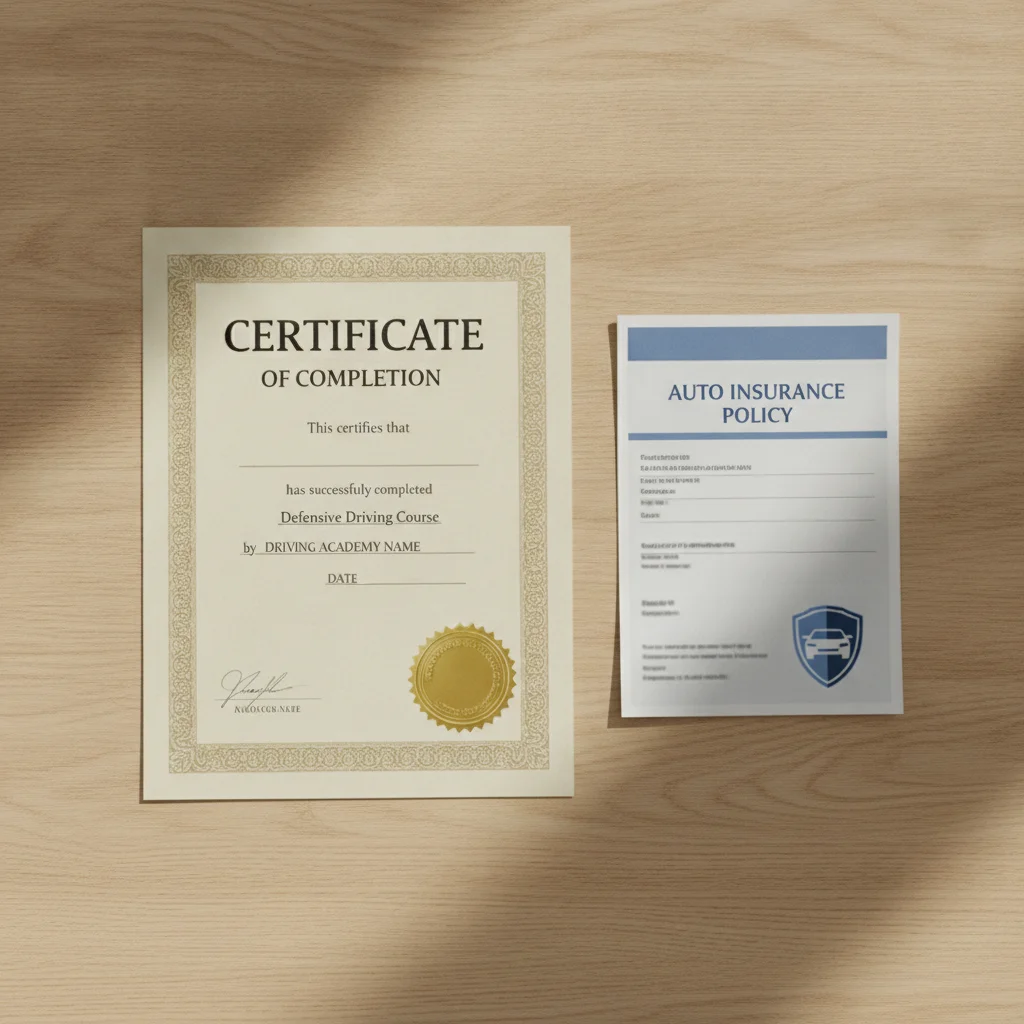
For most working adults, the online format is the practical choice. Confirm that the provider you select will issue a certificate that meets your insurer's documentation requirements (usually a numbered certificate with your name, completion date, and course name clearly printed).
Complete the course and save your certificate
Work through the course in full. Most online platforms track your progress and require you to pass a final quiz — typically scoring 70–80% or higher — before issuing a certificate. Once you pass:
- Download the certificate as a PDF immediately.
- Print a physical copy as a backup.
- Note the certificate number, issue date, and expiration date.
Store the PDF in a dedicated folder on your computer and/or cloud storage. You may need to reference it again when your discount comes up for renewal in 3 years.
Submit proof of completion to your insurer
Contact your insurer — again, directly, not through a third-party aggregator — and inform them you've completed a qualifying defensive driving course. Most carriers will ask you to:
- Upload the certificate through their online portal or app, or
- Email it to their policy services team, or
- Fax or mail a copy (rare but still required by some regional carriers)
Request a written confirmation — email or letter — stating that the discount has been applied and the effective date. If you're mid-policy, ask whether the discount is applied immediately or at your next renewal.
Verify the discount appears on your updated declarations page
After submitting your certificate, request an updated declarations page — the summary document that lists all active discounts and your coverage amounts. Confirm the defensive driving discount line item appears with the correct percentage. If it's missing, follow up immediately rather than waiting for renewal; errors caught early are far easier to correct.
Compare your new premium to the previous declaration to validate that the dollar amount of the discount matches what was communicated. Discrepancies should be escalated to a supervisor in the policy services department.
Once the discount is confirmed on your policy, set a calendar reminder for 30 months out. Most defensive driving discounts are valid for 3 years, so renewing your course before expiration keeps the savings uninterrupted.
Stack Multiple Discounts for Maximum Savings
The defensive driving discount is not an either/or proposition — it can be combined with good driver, multi-policy, low-mileage, and telematics discounts at most carriers. Review your declarations page annually and ask your insurer directly which discounts you're currently receiving and which you might still qualify for. Many drivers leave legitimate savings on the table simply by not asking.
Seniors: Ask About the Larger Discount
Drivers aged 55 and older often qualify for an enhanced defensive driving discount — sometimes 10–15% versus the standard 5–10% — when they complete a senior-specific program like AARP Smart Driver or AAA Road Wise Driver. Ask your insurer specifically about the senior course discount, not just the general defensive driving discount.
Set a Renewal Reminder Before You Forget
Most defensive driving discounts expire after 3 years and must be renewed by retaking an approved course. Set a calendar reminder for 33 months after your course completion date — giving yourself 3 months to find a course and complete it before the current discount lapses.
How Much Can You Actually Save?
Discount amounts vary by insurer, state, and your existing premium level. Here's a realistic breakdown of what major carriers typically advertise:
| Insurer | Typical Discount Range | Who Qualifies |
|---|---|---|
| GEICO | Up to 10% | Drivers who complete an approved course; higher in some states |
| State Farm | Varies by state (typically 5–15%) | Drivers completing a recognized defensive driving program |
| Allstate | Up to 10% | Drivers 55+ in many states for senior-specific courses |
| Progressive | Varies; often bundled into Snapshot telematics | Course completion plus safe driving behavior |
| Farmers | Up to 10% | State-approved course completers; age 55+ in some states |
These figures are representative — your actual discount depends on your state's regulations, your policy type, and how your insurer applies the credit. Liability-only policies may see a different percentage than full-coverage policies.
For young drivers especially, stacking a defensive driving discount on top of other available credits can make a material difference. See which discounts actually move the needle for young drivers to understand the full picture. Similarly, good grades can also lower your car insurance bill for students who are simultaneously enrolled in school.
Discounts Are Never Applied Automatically
Completing a course earns you the right to a discount — it does not trigger one automatically. You must proactively submit your certificate and request the discount be applied. Insurers are not required to retroactively apply savings you didn't claim. Make document submission the very next step after passing your course, not an afterthought.
One more consideration: if you've had a ticket or minor at-fault incident, a defensive driving course may also help reduce license points in many states — a secondary benefit that can further protect your rate from surcharging. The limits and rules around this are worth understanding separately; see what defensive driving courses can and cannot erase from your record.
Troubleshooting Common Problems
Even when you do everything right, snags happen. Here are the most common issues and how to resolve them:
"My insurer says my course doesn't qualify."
First, confirm you're speaking with someone in the policy discounts department, not a general service rep. Ask them for the specific list of approved providers and course IDs in writing. If your course provider is not on the list, you may need to retake the course with a listed provider — unfortunately there's no workaround here.
"My certificate was rejected because it's expired."
Certificates are time-sensitive. Most insurers require the course to have been completed within the last 3 years. Check the issue date on your certificate and the insurer's cutoff window. If expired, you'll need to retake the course.
"The discount wasn't applied at renewal."
Don't assume your insurer tracks this automatically. Contact your agent or insurer directly, reference the date you submitted documentation, and request a written confirmation of the discount being applied. If it should have been applied retroactively, ask whether a premium credit is owed.
"I completed the course but my state doesn't recognize it."
For the insurance discount, state recognition matters less than insurer recognition. However, if you were also hoping for a point reduction, a course not recognized by your state's DMV won't achieve that. Make sure you're choosing a course that meets both objectives if both matter to you.

"I'm not sure my policy type qualifies."
Some insurers apply the defensive driving discount only to specific coverage types — most commonly to liability, collision, and comprehensive components of a standard personal auto policy. Commercial vehicle policies and rideshare endorsements may be treated differently. Confirm with your insurer which coverages the discount applies to before enrolling.

All claims are backed by peer-reviewed research. Sources on request.