Key Takeaways
What Collision and Comprehensive Actually Cover
Before you can decide whether to keep, adjust, or drop physical damage coverage, you need a clear picture of what each type actually does — and doesn't — protect against. These two coverages are frequently bundled together under the informal label "full coverage," but they address entirely different risks.
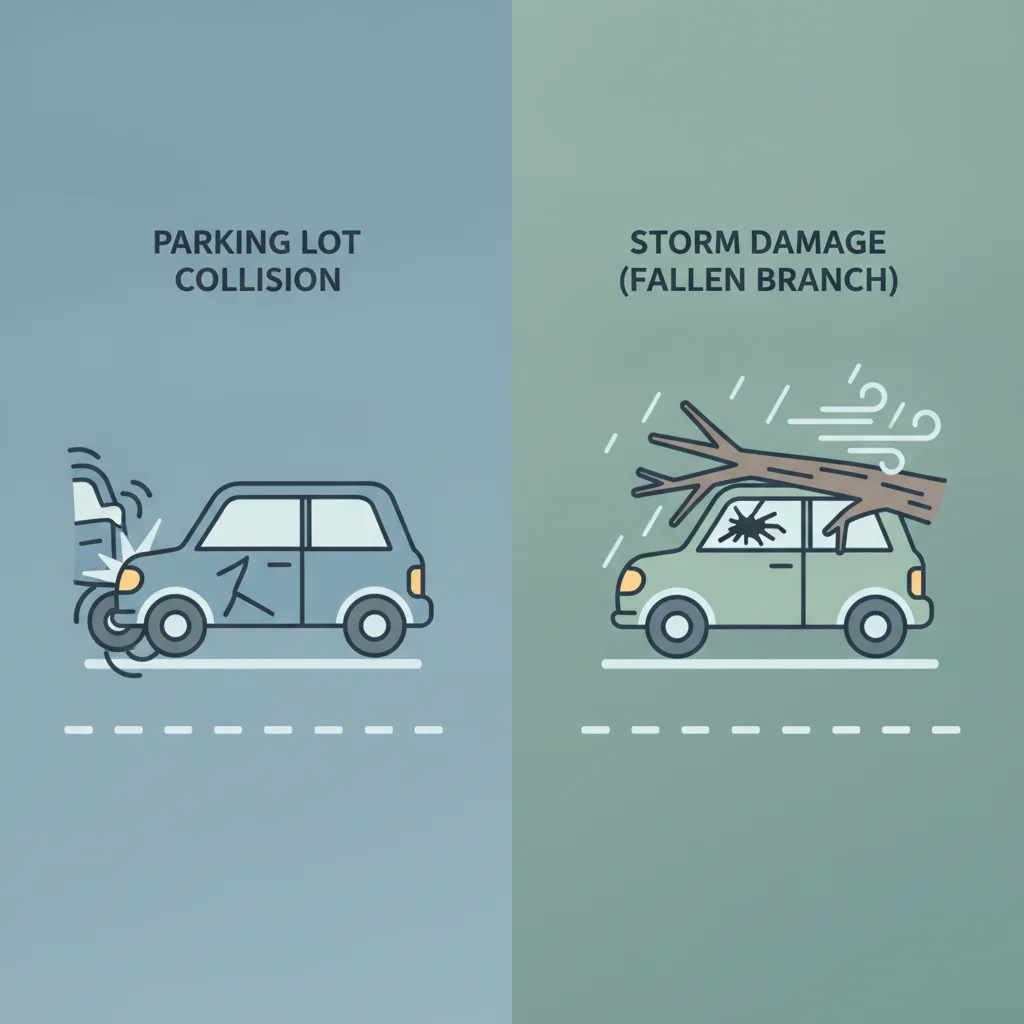
Collision coverage pays for damage to your own vehicle when it collides with another car, a guardrail, a tree, or any other object — regardless of fault. If you run a red light and hit another vehicle, or if someone backs into you in a parking lot and their insurer disputes liability, collision is what repairs your car.
Comprehensive coverage handles the rest: theft, vandalism, fire, hail, flood, falling objects, and animal strikes. It's sometimes called "other than collision" coverage, which is technically accurate but undersells the scope. A branch through your windshield in a storm? Comprehensive. Your catalytic converter stolen overnight? Comprehensive.
Neither coverage is required by law in any U.S. state — but both are typically required by a lender or lessor if you're financing or leasing the vehicle. Once you own the car outright, keeping or dropping either coverage becomes a purely financial calculation, and renewal is the right moment to run it.
Why Renewal Is the Critical Review Point
Most drivers treat auto policy renewal as a formality — glance at the new premium, grumble if it went up, click "continue." That passive approach costs money, and sometimes significant money, when the coverage no longer reflects reality.
Several things may have changed since you last actively reviewed your policy:
- Your car has depreciated, sometimes by thousands of dollars in a single model year.
- Your financial cushion has grown, meaning you could absorb a higher deductible or a total-loss event without the same hardship.
- You've paid off your auto loan, removing the lender's coverage mandate.
- Local theft or weather risk has shifted — catalytic converter theft, for example, surged dramatically in many metro areas between 2020 and 2023.
- Your driving patterns changed — remote work can sharply reduce collision exposure.
The renewal notice you receive 30–45 days before expiration is essentially an invitation to renegotiate. Treat it as one. See the full auto insurance renewal checklist for a broader look at everything worth reviewing before your policy rolls over.
Best Practices for Evaluating Your Physical Damage Coverage
The following practices are grounded in how insurance underwriters actually price physical damage coverage and how experienced policyholders consistently reduce waste without increasing their financial exposure. Work through each one before you respond to your next renewal notice.
Look up your car's actual cash value before reviewing your policy, every renewal period.
Insurers pay actual cash value — not replacement cost or what you paid — in a total-loss claim. If your car has depreciated significantly since you last checked, you may be paying premiums that exceed any realistic claim payout. Knowing the current number is the foundation of every other coverage decision.
Calculate your annual physical damage premium as a percentage of your vehicle's market value.
The 10% benchmark — dropping coverage when annual premium exceeds 10% of vehicle value — gives you a concrete threshold rather than a gut feeling. It accounts for both the cost of coverage and the realistic maximum recovery from a claim. Without this calculation, most drivers are guessing.
Raise your deductible to the highest amount you could pay without financial hardship.
Premium savings from a higher deductible compound over time and often exceed what you'd recover from claims over a five- to seven-year ownership period. Drivers who self-insure for smaller losses by accepting higher deductibles typically pay less in total costs over the life of vehicle ownership.
Evaluate collision and comprehensive separately rather than treating them as a single package.
The risks they cover are different in frequency and severity, and so is the case for keeping each one. A driver in a low-crime, mild-weather suburb has less reason to maintain comprehensive than a driver in a hail corridor or a high-theft urban area — even if their collision risk is similar.
Check whether you have loan or lease obligations before making any coverage changes.
Lenders and lessors contractually require both collision and comprehensive coverage and typically specify maximum allowable deductibles. Dropping either coverage on a financed vehicle violates your loan agreement and can trigger force-placed insurance — which is both more expensive and less protective than a standard policy.
Update your annual mileage estimate with your insurer at every renewal.
Miles driven is a primary pricing variable in auto insurance. Drivers who substantially reduced their commute — due to remote work, retirement, or a lifestyle change — frequently continue to be rated at outdated mileage figures. Correcting this can lower premiums across all coverages, not just physical damage.
The Deductible Decision: Getting the Math Right
Your deductible — the amount you pay out of pocket before insurance kicks in — is one of the most powerful levers available to you at renewal. Raising it lowers your premium; lowering it raises it. But the optimal setting isn't obvious without doing the math.
$3,105
Average collision claim payout in the U.S.
According to the Insurance Information Institute, the average collision claim in a recent year settled around $3,105 — a figure worth comparing against your premium and deductible combination.
~6 years
Average time between collision claims for U.S. drivers
Industry loss data consistently shows most drivers file a collision claim roughly once every five to six years, which is essential context when modeling whether a lower deductible justifies the higher premium.
15–30%
Typical premium reduction from raising deductible $500 to $1,000
The Insurance Information Institute estimates drivers can save 15–30% on collision and comprehensive premiums by doubling their deductible, with exact savings varying by insurer, state, and driver profile.
A common rule of thumb: choose the highest deductible you could pay comfortably from savings without hardship. If you have a $1,500 emergency fund, a $2,000 deductible creates real exposure. If you have $10,000 in accessible savings, a $1,000 deductible is probably leaving premium savings on the table.
It's also worth factoring in how often you'd realistically file a claim. Many experienced drivers go five or more years without a collision claim. If you raise your deductible from $500 to $1,000 and save $200 per year in premium, you break even after 2.5 claim-free years. After five years of no claims, you're $1,000 ahead — even if you do eventually need to pay the higher deductible.
Gap Insurance and Physical Damage Coverage
If you financed a vehicle and still owe more than it's currently worth — a common situation in the first two to three years of ownership — gap insurance (or loan/lease payoff coverage) covers the difference between your car's ACV and your remaining loan balance after a total loss. This is a separate product from collision and comprehensive, not a substitute. If you're in a negative equity position, dropping physical damage coverage before the gap closes is a particularly risky decision.
One nuance: collision and comprehensive deductibles can be set independently. Some drivers carry a higher collision deductible (reflecting the risk they can partially control through their driving behavior) and a lower comprehensive deductible (reflecting risks like theft or hail that are entirely outside their control). Ask your insurer whether split deductibles are available on your policy.
When the Numbers Say to Drop One or Both Coverages
There's a threshold at which continuing to pay for physical damage coverage becomes mathematically questionable. The most cited benchmark: if your annual premium for collision and comprehensive combined exceeds 10% of your vehicle's current market value, the coverage may not be worth keeping.
Here's a simplified example: If your car is worth $6,000 and you're paying $900 per year for physical damage coverage with a $500 deductible, a total-loss payout would net you only $5,500 — and you'd pay that $500 deductible first. You're spending $900 annually for a maximum recovery of $5,500. After seven years of no claims, you've spent more in premiums than the car is worth.
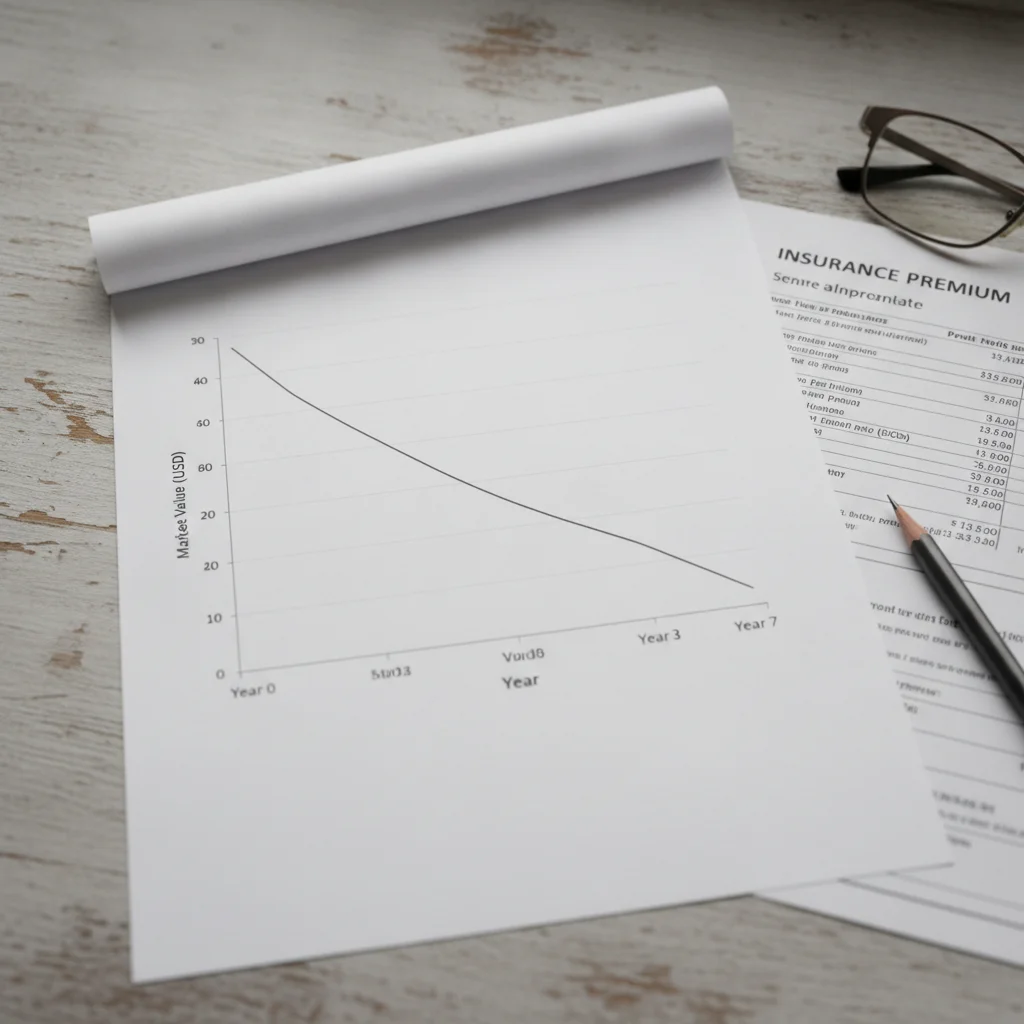
The calculation shifts based on your personal risk tolerance, local theft rates, and whether your vehicle is especially vulnerable to weather events. Someone parking in a hail-prone region of the Midwest may rationally keep comprehensive longer than someone in a mild-weather city.
For a structured approach to making this call, see the decision framework for older cars and physical damage coverage. And if you're close to the threshold, this breakdown of what triggers the decision to drop coverage can help you identify which coverage to cut first.
Drop Comprehensive Before Collision If You Must Choose
If your budget requires cutting one coverage first, most insurance professionals recommend dropping comprehensive before collision on older vehicles. Collision claims tend to be more frequent and more expensive than comprehensive claims for most drivers in most markets. The exception is if you live in a high-theft area or a region with significant hail or flood risk — in those cases, reconsider before cutting comprehensive.
Shop Competing Quotes at Every Renewal
Loyalty doesn't always pay in auto insurance. Insurers often reserve their best rates for new customers, a practice sometimes called "price optimization." Getting at least one competing quote at renewal — even if you don't switch — gives you pricing leverage and ensures you know what the market actually offers for your profile.
Adjusting Coverage as Your Car Ages
Coverage decisions aren't one-time events. A policy that was perfectly calibrated three years ago may be significantly misaligned today, purely because of depreciation. New cars lose value fastest in their first five years — and that depreciation curve has direct implications for what your insurer will pay in a total-loss scenario.
“Actual cash value is not what you paid for the car, not what you owe on it, and not what you think it's worth. It's what the market says your car is worth the moment before the loss — and insurers use data, not sentiment, to calculate it.”
— J. Robert Hunter, Former Director of Insurance at the Consumer Federation of America
The practical implication: check your vehicle's current market value at every renewal using Kelley Blue Book, Edmunds, or NADA Guides. Your insurer uses similar data to determine actual cash value (ACV) in a claim. If you haven't looked up your car's worth in two or three years, you may be shocked by how far it's fallen — and by how much you've been paying to insure a value that no longer exists.
The right way to adjust coverage as your car ages walks through how to build a year-over-year reassessment cadence into your ownership routine. Making this an annual habit — aligned with renewal — keeps your coverage and your costs synchronized with reality.

Making the Most of the Renewal Conversation
Renewal isn't just a review moment — it's a negotiation opportunity. Insurers price coverage based on their models, but those models respond to the inputs you provide. Updating your annual mileage, adding safety features you've installed, or simply asking about available discounts can move the needle on your premium without reducing meaningful protection.
Before you call or go online to renew, gather the following:
- Your vehicle's current market value (from at least two independent sources).
- Your current deductibles for both collision and comprehensive.
- Your annual and monthly premium for each coverage, isolated if possible.
- Your driving record since the last renewal — any claims or violations matter.
- Any changes to how or how much you drive.
Then run the 10% test on your physical damage coverage and compare your deductibles against your current savings cushion. If either number is out of alignment, come to the conversation prepared to ask for a specific change — not just a general discount.
For a structured approach to the discount conversation itself, this guide on what to ask before renewing can help you make sure you're not leaving premium reductions on the table. And if you're managing a broader set of policy decisions, the policy management hub covers the full landscape of updating, renewing, or canceling your coverage.
Physical damage coverage is ultimately a hedge against financial loss. At renewal, the question isn't whether to have insurance — it's whether the specific coverage you're carrying still matches the asset you're protecting and the risk you can absorb. That's a question worth answering deliberately, every single year.

All claims are backed by peer-reviewed research. Sources on request.