| Average Collision Deductible | $500 (Insurance Information Institute, 2023) |
| Average Comprehensive Deductible | $250–$500 (Insurance Information Institute, 2023) |
| Typical Total-Loss Threshold | 75–80% of ACV (Varies by state; national average range) |
| Coverage Type | Optional (unless lender requires it) (No state mandates collision or comprehensive) |
| Payout Basis | Actual Cash Value (ACV) in most policies (Replacement cost policies exist but are less common) |
| Gap Insurance Average Cost | $20–$40/year added to policy (Bankrate, 2024) |
Why the Vocabulary of Physical Damage Coverage Matters
When you file a claim after a hailstorm dents your hood or another driver runs a red light into your front quarter panel, the amount you actually receive from your insurer is shaped by terms you may have skimmed past when you bought the policy. Actual cash value. Deductible. Total-loss threshold. These aren't bureaucratic fine print — they're the formulas that determine how much money ends up in your pocket.
Collision and comprehensive are the two coverages under the physical damage umbrella. They are often sold together, commonly misunderstood as interchangeable, and frequently underestimated in how their specific language affects claim outcomes. For a fuller explanation of how these two coverages differ in practice, see what collision and comprehensive actually protect.
This reference is organized to give you quick, clear definitions of the most consequential terms — whether you're shopping for a new policy, reviewing your declarations page, or trying to make sense of a claims conversation with your adjuster.
| Average Collision Deductible | $500 (Insurance Information Institute, 2023) |
| Average Comprehensive Deductible | $250–$500 (Insurance Information Institute, 2023) |
| Typical Total-Loss Threshold | 75–80% of ACV (Varies by state; national average range) |
| Coverage Type | Optional (unless lender requires it) (No state mandates collision or comprehensive) |
| Payout Basis | Actual Cash Value (ACV) in most policies (Replacement cost policies exist but are less common) |
| Gap Insurance Average Cost | $20–$40/year added to policy (Bankrate, 2024) |
Collision vs. Comprehensive: The Core Distinction
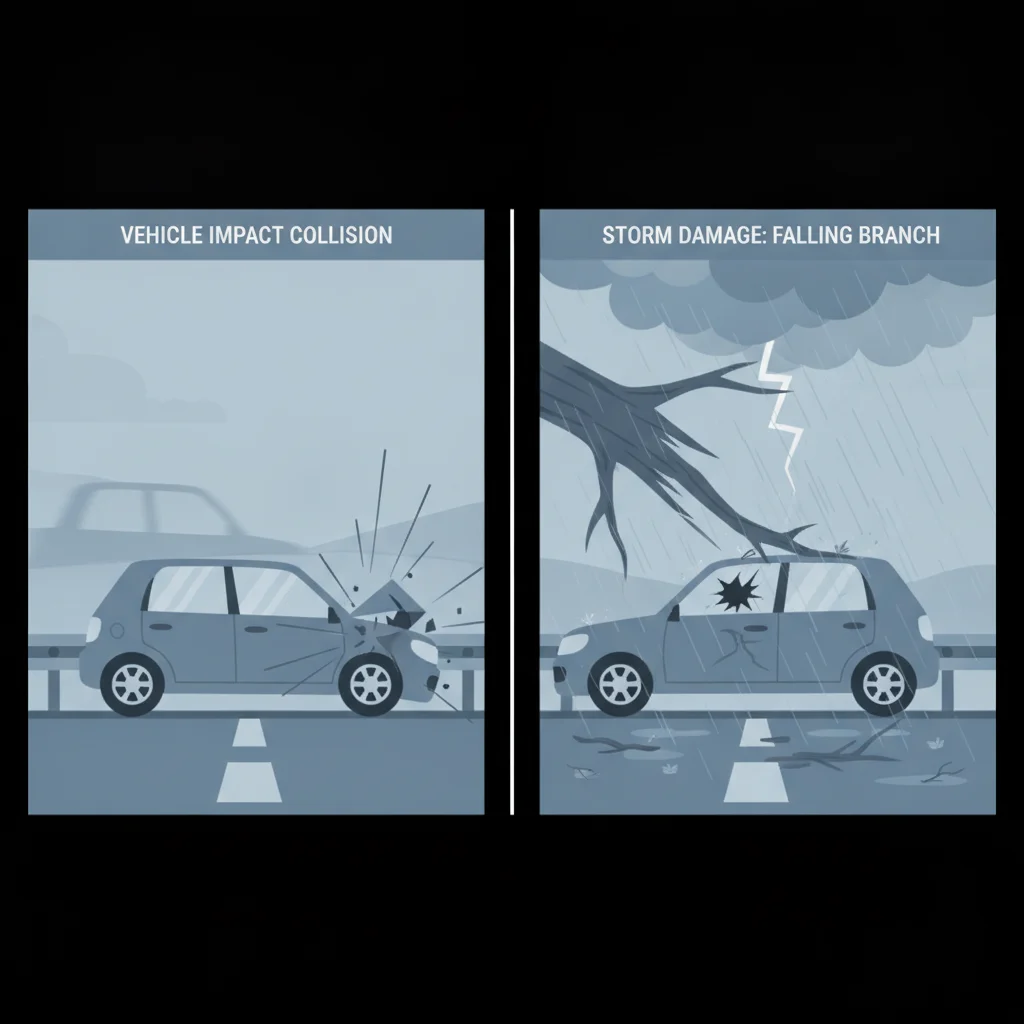
Before diving into the vocabulary that governs both coverages, it helps to anchor the fundamental distinction. Collision coverage responds when your vehicle makes contact with something — another car, a guardrail, a telephone pole, or the ground during a rollover. Comprehensive coverage responds to virtually everything else that can damage or destroy your vehicle that isn't a collision: theft, vandalism, fire, floods, hail, falling objects, and animal strikes.
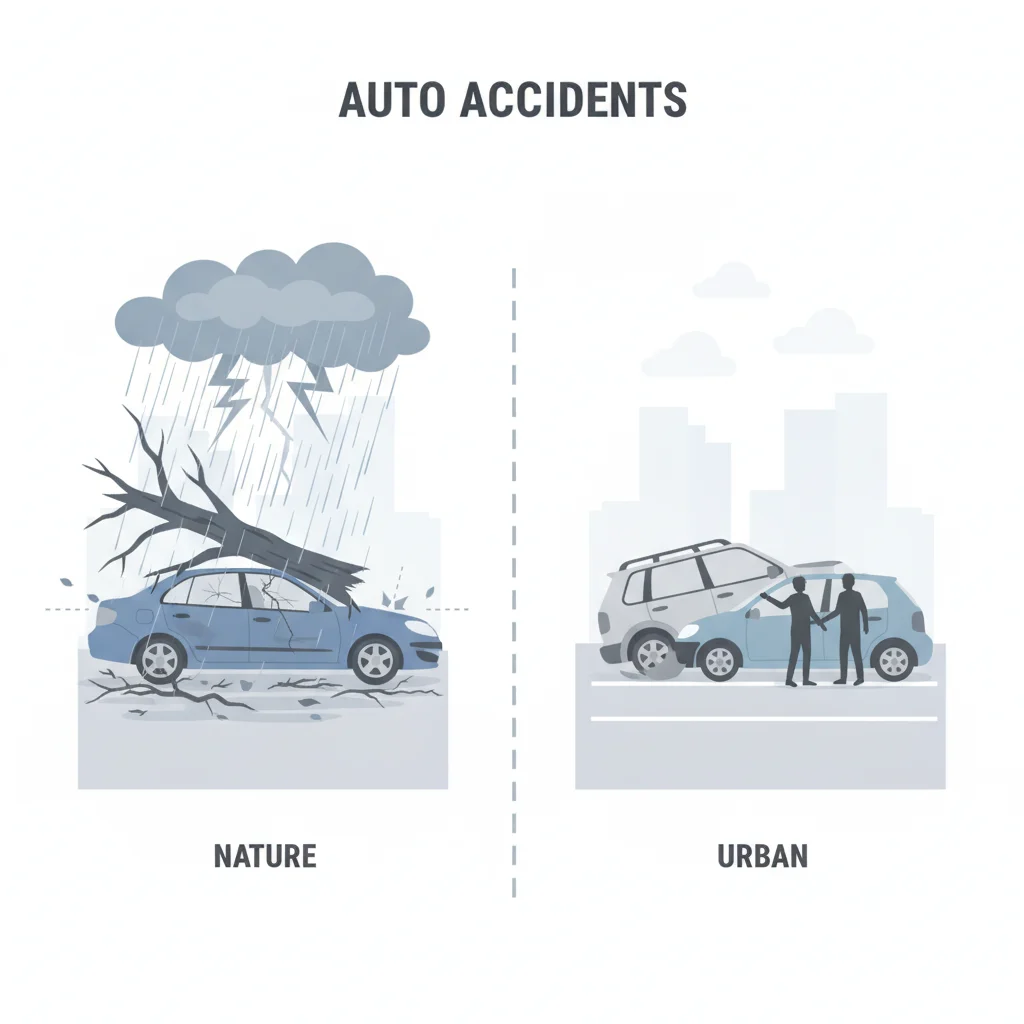
The practical significance: if a deer runs into your parked car, that's a comprehensive claim. If you swerve to avoid the deer and hit a tree, that's a collision claim. The triggering event — not the resulting damage — determines which coverage applies. Neither coverage is legally required in any U.S. state, though lenders and lessors almost always mandate both for financed or leased vehicles.
For drivers new to auto insurance, this beginner's guide to collision and comprehensive explains the basics from the ground up before you tackle the finer-grain terminology below.
80%
Drivers Who Carry Comprehensive Coverage
According to the Insurance Information Institute, roughly 80% of insured drivers carry comprehensive coverage — compared to about 76% who carry collision.
$3,750
Average Collision Claim Payout
The Insurance Research Council estimated the average collision claim payment at approximately $3,750 in recent reporting years, net of deductible.
1 in 4
Cars Totaled After a Crash
Industry data suggests roughly one in four vehicles involved in a significant collision is declared a total loss rather than repaired.
18.8%
Portion of Claims Involving Comprehensive Coverage
Comprehensive perils — theft, weather, animals — account for nearly one in five physical damage claims annually, per National Association of Insurance Commissioners data.
The Full Glossary: Physical Damage Coverage Terms
The terms below cover the complete lifecycle of a physical damage policy — from how your payout is calculated to what happens after your car is declared a total loss. Bookmark this page as a reference any time a claims document, adjuster call, or policy renewal surfaces unfamiliar language.
Actual Cash Value (ACV)
The market value of your vehicle at the time of a loss, accounting for depreciation. If your car is totaled, your insurer pays ACV minus your deductible — not the original purchase price or what it would cost to replace with a new model.
Deductible
The fixed dollar amount you agree to pay out of pocket before your insurer covers the rest of a claim. Higher deductibles lower your premium but increase your financial exposure when a loss occurs.
Total Loss
A determination made by the insurer when repair costs meet or exceed a state-defined percentage of the vehicle's ACV — commonly 75–80%. At that point, the insurer pays ACV rather than funding repairs.
Physical Damage Coverage
The umbrella term that includes both collision and comprehensive coverage. It pays for damage to your own vehicle rather than damage or injuries you cause to others, which is handled by liability coverage.
Coverage Limit
For physical damage coverages, the limit is effectively the ACV of the vehicle — not a set dollar cap chosen by the policyholder, unlike liability or medical payments coverage.
Salvage Value
What remains of a vehicle's value after it has been declared a total loss. The insurer typically takes ownership of the wreck and sells it to a salvage yard; this amount may factor into total-loss settlements.
Gap Insurance
An optional add-on that pays the difference between your vehicle's ACV and the outstanding balance on your auto loan or lease if the car is totaled. Without it, you could owe money on a car you no longer have.
Declared Value
An alternative to ACV used primarily for classic or collector vehicles, where the owner and insurer agree in advance on a specific payout amount, regardless of depreciation at the time of loss.
Comprehensive Coverage
Pays for vehicle damage caused by events other than collisions — including theft, vandalism, fire, hail, flooding, and animal strikes. Comprehensive and collision are typically purchased together but trigger under different circumstances.
Collision Coverage
Pays for damage to your vehicle resulting from a collision with another vehicle or object, or from a rollover. It applies regardless of fault, though your insurer may pursue the at-fault party through subrogation.
Subrogation
The legal process by which your insurer, after paying your claim, seeks reimbursement from the at-fault party's insurer. If subrogation succeeds, you may recover all or part of your deductible.
Diminished Value
The reduction in a vehicle's resale market value after it has been in an accident, even after full repair. Some states allow policyholders to claim diminished value from the at-fault party's insurer, but first-party claims under your own policy are rare.
For definitions specific to the claims filing process — including terms like subrogation, proof of loss, and adjuster — the complete auto insurance claims glossary is a companion reference worth keeping alongside this one.
How ACV, Deductibles, and Total-Loss Thresholds Interact
These three terms don't just sit in isolation — they work together to determine your net recovery after a significant loss. Understanding their interaction is one of the most practically useful things you can do before a claim happens.
The ACV Calculation
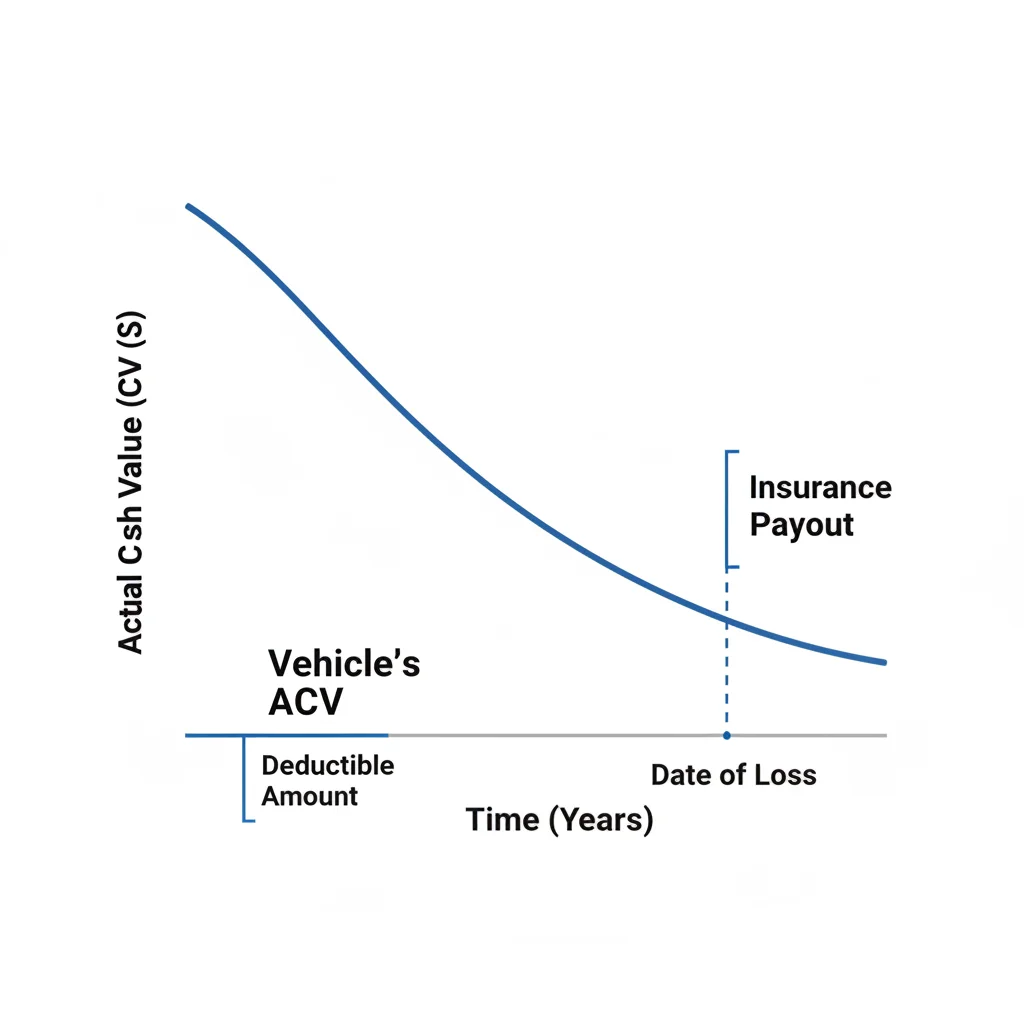
When your insurer values your vehicle, it draws on market databases, comparable sales in your region, and your vehicle's condition, mileage, and options. The resulting figure — your actual cash value — is almost always lower than what you paid, because depreciation begins the moment you drive off the lot. A three-year-old vehicle may be worth 40–50% less than its original MSRP depending on make, model, and market conditions.
Where the Deductible Comes In
Your deductible is subtracted from the ACV (or repair estimate) before you receive a payment. If your car sustains $4,000 in collision damage and you carry a $1,000 deductible, your insurer pays $3,000. Choosing a higher deductible when you buy the policy reduces your annual premium — but it increases your out-of-pocket exposure every time you file. Drivers who rarely make claims and have emergency savings often find higher deductibles worth the trade-off; drivers with tighter finances may prefer the predictability of a lower deductible.
The Total-Loss Tipping Point
If repair costs approach or exceed your state's total-loss threshold as a percentage of ACV, the insurer will declare the vehicle a total loss rather than authorize repairs. At that point, you receive the ACV minus your deductible — and the insurer takes the salvage. This is why gap insurance matters: if you owe $18,000 on a car with a $14,000 ACV, a total-loss settlement leaves you $4,000 short on your loan balance.
Lender Requirements Can Override Your Preferences
If you're financing or leasing a vehicle, the lender almost always requires both collision and comprehensive coverage for the duration of the loan or lease. Dropping either coverage to save on premiums while you still owe money could trigger a force-placed insurance policy — one chosen by the lender, usually at a higher cost and with fewer protections for you.
State Laws Vary on Total-Loss Thresholds
Each state sets its own total-loss threshold — the percentage of ACV at which an insurer must declare a vehicle totaled rather than repaired. Thresholds range from roughly 60% to 100% depending on the state. A car that gets repaired in one state might be declared a total loss for the same repair cost in another.
Comprehensive Claims and Rate Increases
Many drivers assume that filing a comprehensive claim — for hail damage or a stolen catalytic converter, for example — won't affect their rates since the event wasn't their fault. In practice, insurers in most states are permitted to factor comprehensive claims into renewal pricing, though the impact is generally smaller than at-fault collision claims.
Optional add-ons like gap insurance are specifically designed to close this kind of financial gap — and are worth examining if you financed your vehicle with a small down payment or a long loan term.
Coverage Limits for Physical Damage: What the Term Actually Means
Auto insurance shoppers accustomed to selecting liability limits — say, $100,000 per person and $300,000 per accident — are sometimes confused when they realize collision and comprehensive don't work the same way. There is no coverage limit you select for physical damage. Instead, the effective limit is your vehicle's actual cash value at the time of loss.
This has a few practical consequences worth understanding:
- You can't over-insure a vehicle. Even if you choose to pay for physical damage coverage on a 15-year-old sedan, your maximum recovery is what that vehicle is worth on the open market — not what you paid for it or what a new equivalent costs.
- Coverage naturally shrinks as the car ages. Because ACV declines with depreciation, the effective "limit" of your physical damage coverage decreases every year. At some point — usually when annual premiums approach 10% or more of the vehicle's ACV — many financial advisors suggest dropping collision and/or comprehensive.
- Classic and collector vehicles are exceptions. Agreed-value or stated-value policies for collector cars use a pre-negotiated amount rather than ACV, protecting owners from depreciation-based underpayment. These are specialty products, not standard personal auto policies.
For a deeper look at how collision and comprehensive fit within the broader structure of a personal auto policy, physical damage coverage explained walks through how these two parts work together as a system.
Quick-Reference: When Each Term Appears in the Claims Process
Knowing a term's definition is one thing. Knowing when to expect it — and why it matters in that moment — is more useful. Here's a stage-by-stage map of where each key term typically surfaces.
| Claims Stage | Terms to Watch | What to Know |
|---|---|---|
| Filing the Claim | Collision vs. Comprehensive | Which coverage applies determines your deductible and whether the event is fault-based. Misidentifying can delay processing. |
| Vehicle Inspection | ACV, Salvage Value | The adjuster assesses ACV using market comparables. Ask for the valuation report if you believe the number is too low. |
| Repair Authorization | Total-Loss Threshold, Deductible | If repair costs approach the threshold, the insurer may switch from repair to total-loss processing. Your deductible applies either way. |
| Settlement Offer | ACV, Diminished Value, Gap Insurance | Your settlement is ACV minus deductible. If you owe more than ACV, gap insurance pays the difference. Diminished value claims are separate. |
| Post-Settlement | Subrogation | If another driver was at fault, your insurer may recover its payout — and potentially your deductible — through subrogation. |
If any of these steps surfaces jargon not covered here, the auto insurance claims glossary is the most comprehensive reference for claims-specific terminology. And if you're comparing liability coverage — the coverage that pays for damage you cause to others — liability coverage explains what it does and doesn't include.
For a comprehensive end-to-end guide to everything physical damage coverage entails, from shopping to claims resolution, see everything you need to know about collision and comprehensive insurance.
Collision vs. Comprehensive: What Each One Actually Protects
A detailed breakdown of when each coverage type kicks in, including real-world scenarios that clarify which policy applies to which event.
The Complete Auto Insurance Claims Glossary
Definitions for every term you'll encounter during the claims process — from subrogation and salvage value to adjuster and proof of loss.
Optional Add-Ons Hub
Covers extras like gap insurance, roadside assistance, and rental reimbursement — all of which interact with your physical damage coverage.
Everything You Need to Know About Collision and Comprehensive Insurance
An end-to-end guide covering how claims work, when each coverage applies, and how to decide whether physical damage coverage makes financial sense for your vehicle.

All claims are backed by peer-reviewed research. Sources on request.