
Key Takeaways
Named Insured
The named insured is the person (or people) specifically listed by name on the declarations page of an auto insurance policy. This is the individual who owns the policy, has the authority to make changes to it, and bears the primary rights and responsibilities it creates. Most policies list at least one named insured; spouses or domestic partners are often listed as a second named insured.
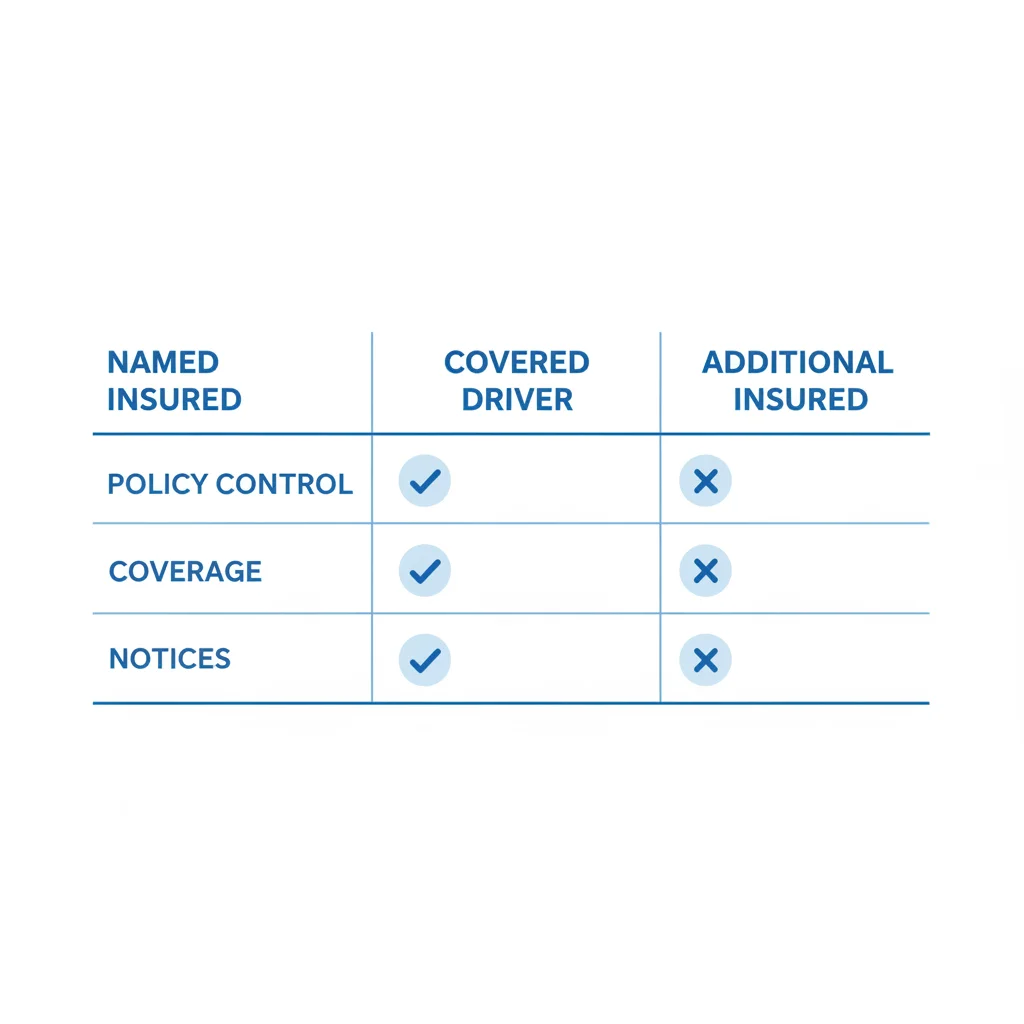
Insurers distinguish between a 'named insured,' an 'additional insured,' and a 'covered driver' — each category carries different rights, liabilities, and claim-handling protections under the policy contract.
Why This One Term Can Shape Your Entire Coverage Experience
If you've ever opened an auto insurance policy and skimmed past the declarations page, you may have glossed over a term that actually determines a lot: named insured. It's not just a label. It's a legal designation that defines who controls the policy, who gets the important mail, and who can make decisions that affect everyone else on the coverage.
Most drivers assume that if they're listed on a policy — as a spouse, a young adult on a parent's plan, or a domestic partner — they have the same standing as the person who bought it. They don't. The named insured sits at the top of the policy's authority structure, and understanding that hierarchy is important any time you need to file a claim, make a coverage change, or navigate a life transition like a divorce or a move.
This article breaks down exactly what the named insured designation means, how it differs from being a covered driver or additional insured, and what situations can go sideways if you haven't thought carefully about who's listed in that role.
Spouses and Domestic Partners: A Special Case
Many standard auto policies automatically extend named insured status to a resident spouse, even if they're not explicitly listed. However, this varies by insurer and state. Don't assume — verify by reviewing your declarations page. If your partner isn't listed and you want them to have full policy authority, ask your insurer to add them as a second named insured through a formal endorsement.
Insurable Interest: The Legal Underpinning
Courts and regulators have long held that an insurance policy is only valid when the named insured has an actual financial stake in what's being insured. For auto policies, that typically means owning or being financially responsible for the vehicle. Arrangements that separate the named insured from the car's ownership can invite scrutiny — particularly after a large claim.
The Declarations Page: Where 'Named Insured' Actually Appears
The declarations page — often called the 'dec page' — is the summary sheet at the front of your auto policy. It lists the policy period, the vehicles covered, the coverage types and limits, and the named insured. If you haven't looked at yours recently, that's the place to start.
The named insured field will show a name, or two names if a spouse or co-owner is included. Below that, you might see additional drivers listed — these are people the insurer knows will be operating the vehicle, but their designation is different. They're covered for liability purposes while driving, but they don't share the named insured's administrative authority over the policy.

The dec page also typically identifies any additional interests — most commonly a bank or credit union if the vehicle is financed, or a leasing company if the car is leased. Those entities are not named insureds either. They're listed so that the insurer knows to notify them if the policy is cancelled or lapses, which protects their financial interest in the collateral. For a deeper look at the terms you'll find alongside this designation, see auto insurance policy terms drivers reference most often.
~60%
Drivers who misunderstand policyholder vs. driver status
An Insurance Research Council survey found that a significant portion of policyholders conflate being 'on' a policy with controlling it.
1 in 8
U.S. drivers currently uninsured or improperly covered
According to the Insurance Information Institute, roughly 12.6% of U.S. drivers are uninsured — many gaps stem from coverage arrangements that weren't correctly established.
45 states
States requiring proof of insurance tied to registered owner
Most states require that the vehicle's registered owner have an active policy in their name, reinforcing why named insured and title holder alignment matters legally.
What the Named Insured Can Do — That Others Can't
The named insured holds a set of rights and carries a set of responsibilities that no other party on the policy shares. Here's a practical breakdown:
- Make coverage changes. Only the named insured (or their authorized representative) can increase or decrease coverage limits, add or remove endorsements, change deductibles, or switch the policy to a different vehicle.
- Add or remove drivers. Want to add a teenager or remove an ex-spouse from the policy? That's the named insured's call. A covered driver cannot make these changes unilaterally.
- Cancel the policy. If the named insured decides to switch insurers or cancel coverage, they can do so. Other drivers on the policy cannot initiate cancellation.
- Receive official notices. Renewal offers, rate change notifications, non-renewal warnings, and cancellation notices all go to the named insured. If someone else is handling the day-to-day of that policy, those critical documents may not reach the right person in time.
- File and manage claims. While covered drivers can report accidents, the named insured has the authority to manage the overall claim — accept or dispute settlements, authorize repairs, and interact directly with adjusters.
This is why the role of managing your auto policy falls squarely on the named insured's shoulders. It's not a passive designation.
Make Sure the Right Person Gets Policy Notices
If you're the named insured but your spouse or partner handles the day-to-day finances, make sure renewal and cancellation notices reach both of you. Set up email alerts through your insurer's portal, or ask your agent to send notices to a secondary email address. A missed non-renewal notice can result in an unintended lapse in coverage.
Review Your Dec Page After Every Major Life Change
Pull up your declarations page any time you experience a significant life event — marriage, divorce, new vehicle, home move, or a driver leaving or joining your household. It takes two minutes and can prevent a coverage gap that might take years to fix. Your insurer's app makes this easier than ever.
Named Insured vs. Covered Driver vs. Additional Insured
These three categories are often confused, and mixing them up can have real consequences. Here's how they differ:
| Designation | Coverage Rights | Policy Control | Receives Notices |
|---|---|---|---|
| Named Insured | Full coverage as defined by policy | Yes — can make changes, cancel, renew | Yes |
| Covered Driver | Covered while operating listed vehicles | No | No |
| Additional Insured | Limited, specific to their interest | No | Sometimes (if policy cancels) |
A covered driver — your college-age child, a parent, or a roommate you've added — gets accident coverage but has no say over the policy itself. An additional insured (think: a lienholder or a business that owns the vehicle) is typically protected from liability claims but again cannot direct the policy.
The distinction matters most when something goes wrong. If a covered driver gets into an accident and wants to negotiate directly with the insurer about the settlement, they may find their authority limited. The named insured is the primary counterparty to the insurance contract.
“The named insured is the insurer's primary counterparty — the person who accepted the policy terms, paid the premium, and has the authority to change or terminate the contract. Everyone else on the policy operates within the framework that person established.”
— J. Robert Hunter, Former Federal Insurance Administrator and Director of Insurance at the Consumer Federation of America
Life Changes That Require Revisiting the Named Insured
The named insured designation isn't something you set and forget. Several common life events should prompt a review of who is listed — and in what capacity — on your policy.
Marriage
When you get married, most couples combine their auto policies or add each other as a second named insured. Doing so typically qualifies you for a multi-car discount and simplifies claims. If you simply add a spouse as a 'driver' rather than a named insured, they may lack the authority to manage the policy if you're unavailable.
Divorce
Divorce is where the named insured distinction gets complicated fast. If your ex-spouse is the primary named insured on a shared policy, you may have limited ability to remove yourself, adjust coverage, or ensure that vehicles you now own separately are covered correctly. Courts sometimes address insurance policy management in divorce proceedings, but the insurer will follow the policy contract — not the divorce decree — unless formally notified and updated. This is one of the more consequential coverage gaps drivers encounter.
Moving Out of a Shared Household
Auto insurance is priced based on where the vehicle is garaged and who lives in the household. If the named insured moves out but the policy stays intact, the insurer may have grounds to question coverage if a claim arises — because the risk profile they underwrote has changed materially.
Adding a Young Driver
When a teenager or young adult starts driving, they should be added as a covered driver. If they eventually buy their own vehicle, they'll need their own policy with themselves as named insured — piggybacking on a parent's policy is not always appropriate or even permissible, depending on the insurer's rules and the state.
Maintaining continuous coverage through these transitions is critical. Gaps — even brief ones — can raise your rates and complicate future applications.
When the Named Insured and the Vehicle Owner Don't Match
Here's a scenario that creates more problems than most drivers expect: you insure a car in your name, but the title is in someone else's name — or vice versa. This is sometimes called a non-owner policy mismatch, and insurers take it seriously.
Many insurers operate under the principle of insurable interest — the named insured should have a financial stake in the vehicle. If the car is titled to your parent but insured in your name, an insurer could argue you lack sufficient insurable interest, and use that as a basis to limit or deny a claim.
This comes up most often with family members trying to help each other get better rates. A parent might insure an adult child's car to leverage their own lower-risk profile. While some insurers permit this in specific family situations, it's worth checking the policy language explicitly. When in doubt, the safest setup is: the person who owns and primarily drives the vehicle is the named insured.
Spouses and Domestic Partners: A Special Case
Many standard auto policies automatically extend named insured status to a resident spouse, even if they're not explicitly listed. However, this varies by insurer and state. Don't assume — verify by reviewing your declarations page. If your partner isn't listed and you want them to have full policy authority, ask your insurer to add them as a second named insured through a formal endorsement.
Insurable Interest: The Legal Underpinning
Courts and regulators have long held that an insurance policy is only valid when the named insured has an actual financial stake in what's being insured. For auto policies, that typically means owning or being financially responsible for the vehicle. Arrangements that separate the named insured from the car's ownership can invite scrutiny — particularly after a large claim.
For a full picture of how auto insurance policy management works across a vehicle's lifetime — from purchase through sale — it's worth reading through how each policy element connects to the others.
How to Verify and Update Your Named Insured Status
Checking your named insured status takes about 60 seconds. Pull up your declarations page — either in your insurer's app, via the online portal, or on the physical document you received when you bound the policy. The named insured will appear prominently at the top, usually labeled 'Named Insured' or 'Policyholder.'
If something needs to change — a name update after marriage, adding a second named insured, or removing someone after a life change — contact your insurer directly. Most changes require a signed endorsement or a formal policy amendment. Some insurers allow this through their app; others require a phone call or written request.
Key scenarios that warrant an immediate review:
- You've recently married or divorced
- You've moved to a new address
- You've bought or sold a vehicle
- A household member has moved out or moved in
- You've paid off a car loan and need to remove the lienholder
Make Sure the Right Person Gets Policy Notices
If you're the named insured but your spouse or partner handles the day-to-day finances, make sure renewal and cancellation notices reach both of you. Set up email alerts through your insurer's portal, or ask your agent to send notices to a secondary email address. A missed non-renewal notice can result in an unintended lapse in coverage.
Review Your Dec Page After Every Major Life Change
Pull up your declarations page any time you experience a significant life event — marriage, divorce, new vehicle, home move, or a driver leaving or joining your household. It takes two minutes and can prevent a coverage gap that might take years to fix. Your insurer's app makes this easier than ever.
Understanding the full vocabulary of your policy — including where the named insured fits relative to other terms — is part of being an informed policyholder. The auto insurance terms you need to know are a solid reference when you're comparing or reviewing coverage.
The named insured designation might seem like administrative fine print, but it defines who's actually in charge of your coverage. In a claim situation, during a life change, or when a renewal comes up with a significant rate increase, that authority matters. Make sure the right person holds it — and that they're paying attention to the policy on behalf of everyone it protects.

All claims are backed by peer-reviewed research. Sources on request.