Key Takeaways
Trim Level
A trim level is a pre-packaged version of a vehicle model that comes with a specific set of features, equipment, and a fixed price. Manufacturers offer multiple trims of the same model — from a stripped-down base version to a fully loaded top tier — so buyers can choose how much content they want without custom-ordering. Each trim has a distinct name (like LX, EX, Limited, or Platinum) and builds on the one below it.
Trim levels are factory-defined configurations registered with the MSRP; they are separate from dealer-added packages or accessories, which are installed after the vehicle leaves the factory.
What Trim Levels Actually Are — And Why They Exist
When a manufacturer builds a car, they don't sell one version of it. They sell four or five. Each version is called a trim level, and each one is essentially a pre-made shopping decision: here's what you get, here's what it costs, take it or leave it.
The reason manufacturers do this is straightforward — it's profitable and efficient. Building every car custom would be a logistics nightmare. Instead, they group popular feature combinations into named tiers and produce them at scale. A Honda CR-V comes in LX, EX, EX-L, and Sport Touring. A Toyota Camry comes in LE, SE, XSE, XLE, and TRD. A Ford F-150 starts at Regular Cab XL and climbs through XLT, Lariat, King Ranch, Platinum, and Limited — a spread that can exceed $40,000 from bottom to top.
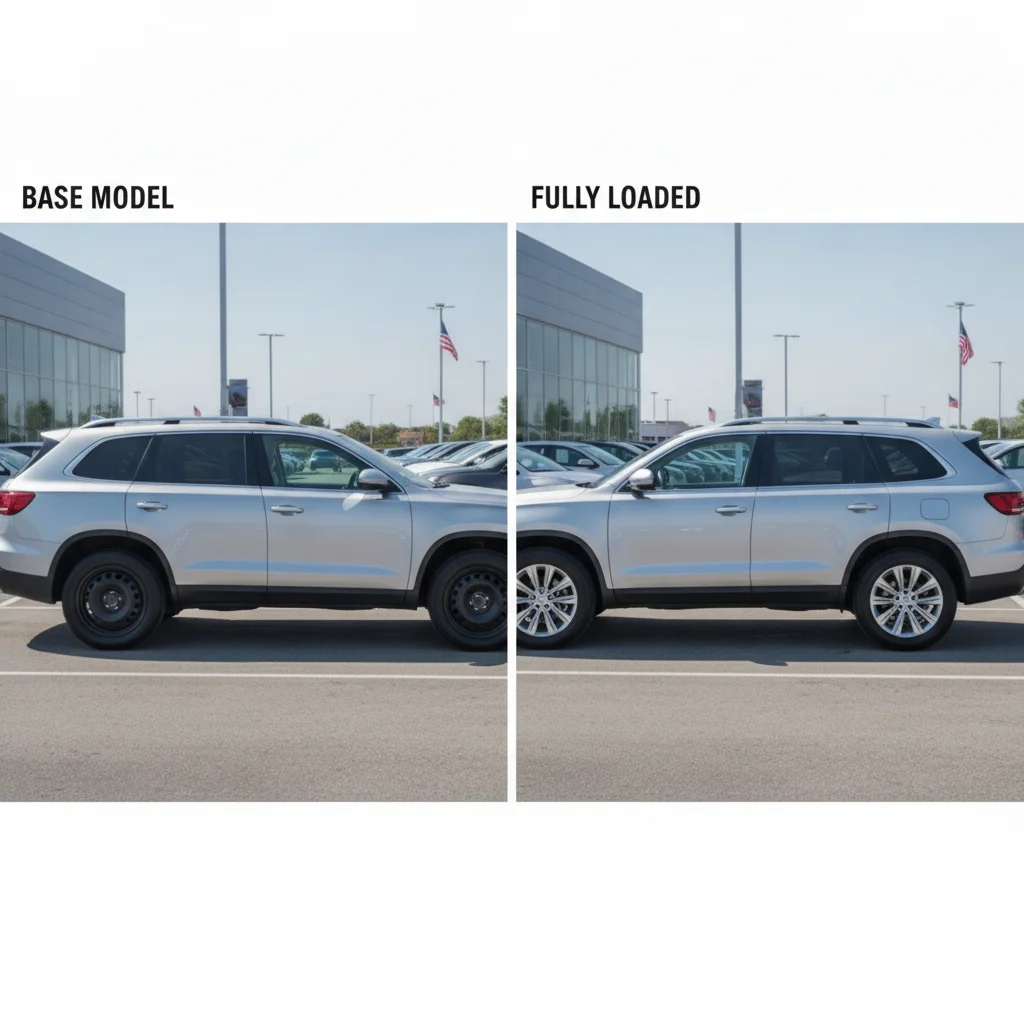
Each tier builds on the one below it. The base model (often called LX, LE, XL, or just "Base") is the manufacturer's minimum viable product for that model. The top trim is the everything-on version. Everything in between is calibrated to capture buyers at different willingness-to-pay thresholds.
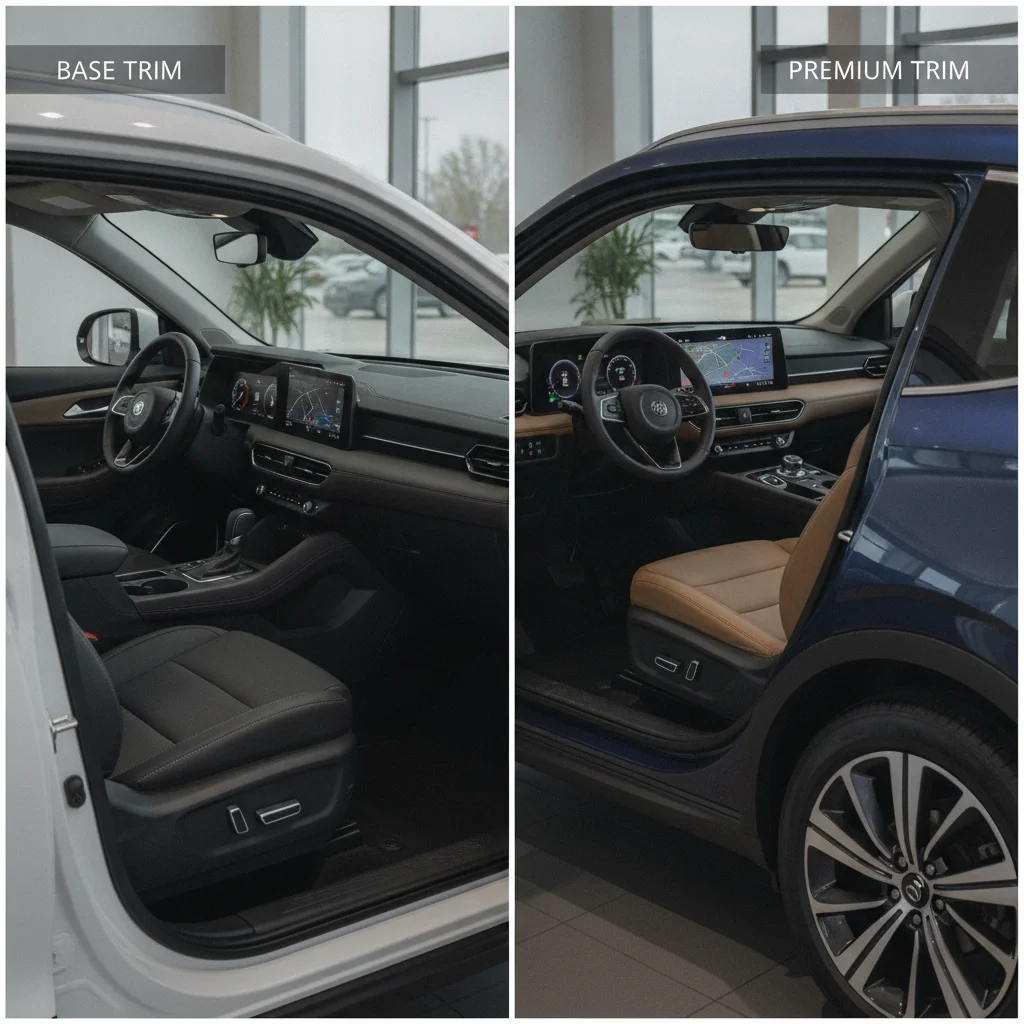
Here's what this means for you practically: two buyers can drive off the same lot in the same make and model, one paying $28,000 and the other paying $38,000. They're driving the same engine. The nameplate on the back says the same thing. But one has blind-spot monitoring, heated seats, a 12-speaker audio system, and real leather. The other has cloth seats and a six-speaker radio. Same car. Very different purchase.
How Manufacturers Name and Structure Trims
Every manufacturer uses its own naming convention, which creates real confusion for buyers who shop across brands. Here's a quick decoder for the most common systems:
| Brand | Entry | Mid | Upper-Mid | Top |
|---|---|---|---|---|
| Honda | LX | EX | EX-L | Touring |
| Toyota | LE | XLE | Limited | Platinum |
| Ford | XL | XLT | Lariat | Platinum/Limited |
| Chevrolet | LS | LT | LTZ | Premier/High Country |
| Nissan | S | SV | SL | Platinum |
Notice that "Platinum" and "Limited" appear at multiple brands — but they mean very different things in terms of absolute feature content and price. Never assume a name signals a consistent feature level across manufacturers.
Manufacturers also sometimes create performance-oriented trims (like Toyota's TRD or Honda's Sport) that sit outside the linear value ladder. These swap or modify equipment rather than strictly adding it — you might get better wheels and suspension tuning but lose a power moonroof that appears on the EX-L above it. That's intentional, and it catches buyers off guard.
Trim Names Don't Transfer Between Brands
"Platinum" at Ford and "Platinum" at Toyota signal very different things in terms of feature content and price position. Always evaluate a trim by its actual equipment list, not its name. The same logic applies when comparing trims across model years of the same brand — manufacturers sometimes rename or restructure tiers between generations.
Dealer-Added Options Are Not Trim Features
You'll often see dealer-installed packages — paint protection film, all-weather mats, cargo nets, remote start systems — listed on the window sticker alongside factory content. These are added by the dealer after the vehicle arrives and are negotiable in a way factory trim content is not. Don't confuse them with trim-defined features, and never pay MSRP for them.
Certified Pre-Owned Programs Are Trim-Sensitive
Most manufacturer CPO programs apply across trim levels, but some premium brands restrict CPO certification to higher trims only. If you're considering a CPO purchase as a cost-effective alternative to a new higher trim, verify that the specific trim you're looking at qualifies for the program and what the warranty coverage actually includes.
One more structure to know: some manufacturers use trim names inconsistently across bodystyles within the same model. A CR-V Sport Touring may have different standard content than a Pilot Sport Touring, even though they share a name. Always verify against the window sticker for the specific bodystyle you're buying.
The Features That Actually Separate Trims
Not all features are created equal — and not all trim differences matter to every buyer. Here are the categories where trim jumps are most consequential:
Safety Technology
This is the most important category to audit. Automatic emergency braking, lane-keeping assist, adaptive cruise control, and rear cross-traffic alert are now federally mandated on many vehicles — but how robust they are and whether they operate at all speeds often varies by trim. On some models, the base trim includes basic AEB but not full-speed range adaptive cruise. On others, the entire driver assistance suite is locked to the top two tiers.
Run the safety feature comparison specifically. Don't assume the base car has everything federally required — mandate coverage is narrower than most people realize.
$10,000+
Typical base-to-top trim price spread
On most mainstream SUVs and trucks, the gap between the entry trim and the fully loaded top trim exceeds $10,000 — and on popular trucks like the Ford F-150, can exceed $40,000.
62%
New car buyers who choose a mid or upper-mid trim
According to automotive market data from Edmunds, the majority of new vehicle buyers gravitate toward mid-level trims rather than the base or the top tier.
$59/mo
Monthly payment impact of a $3,000 trim upgrade
At 7% APR over 60 months, every $3,000 in additional financed amount adds approximately $59 to the monthly payment — a figure salespeople often downplay.
30–50%
Typical retained value of premium tech features
Features like built-in navigation and panoramic sunroofs often retain only 30–50% of their original price contribution in used-car valuations after three years, per analysis of major valuation platforms.
Top 2
Trims where full ADAS suites are typically available
On many mainstream models, the complete advanced driver assistance package — including adaptive cruise and lane centering — is only available on the top two trim levels.
Powertrain Options
Some models offer their most efficient or most powerful engine only in higher trims. The base model may come with a 2.5-liter four-cylinder while the mid trim adds a hybrid powertrain. Hybrid variants frequently command a $2,000–$4,000 premium but can pay that back in fuel costs over three to five years depending on how you drive. If fuel economy matters to you, check which trims offer the powertrain you want — it might not be in the base.
Interior Materials
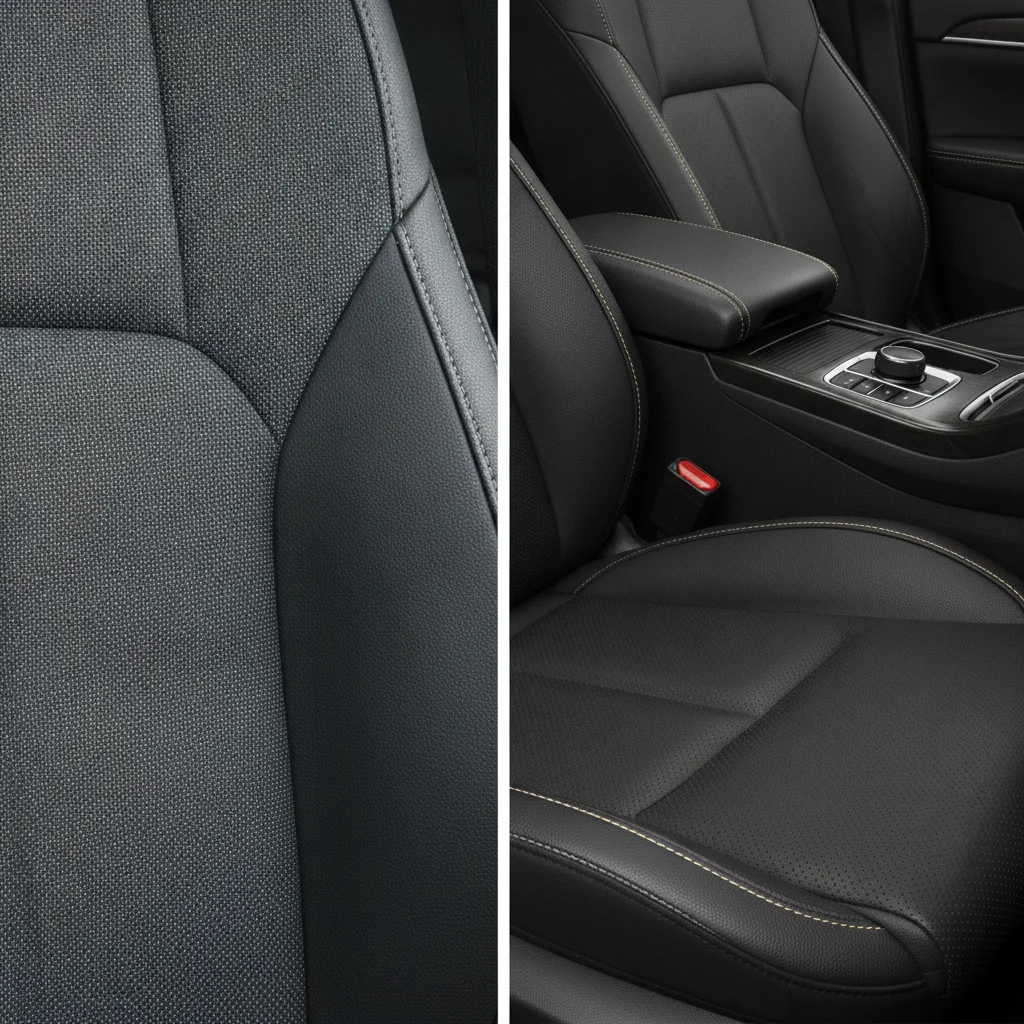
Cloth versus leatherette versus genuine leather is the most visible trim differentiator. The jump from cloth to synthetic leather is usually one tier. Genuine leather often appears only at the top one or two trims. Leatherette (also called SofTex, NuLuxe, or V-Tex depending on brand) is durable and easier to clean than fabric — and for many buyers, it's the sweet spot between cost and practicality.
Technology and Infotainment
Screen size, wireless Apple CarPlay and Android Auto versus wired-only, built-in navigation, premium audio brands (Bose, Harman Kardon, Bang & Olufsen), and number of USB ports all vary by trim. Built-in navigation has become less critical now that most buyers use phone-based mapping, but audio system quality is a legitimate differentiator if you care about sound.
Comfort Features
Heated front seats, heated rear seats, ventilated seats, heated steering wheel, and power-adjustable seats all tier up through the trim ladder. In cold-weather climates, heated seats and a heated steering wheel are practical, not luxury. In warm climates, ventilated seats serve the same role and typically appear only at upper trims.
Wheels and Exterior
Alloy wheel size and design, chrome or dark trim accents, LED headlights, and automatic high beams often differentiate trims visually. LED headlights are a meaningful upgrade — they genuinely improve nighttime visibility and burn out far less frequently than halogen. Some base trims still ship with halogen; check this specifically.
Always Compare Trims Side by Side Online First
Every major manufacturer's website has a trim comparison tool. Use it before you step foot in a showroom. Screenshot the comparison so you have a reference point if the salesperson's description of what's included doesn't match what you researched. Discrepancies are common, especially with recently updated model years.
Ask for the Window Sticker, Not a Sales Sheet
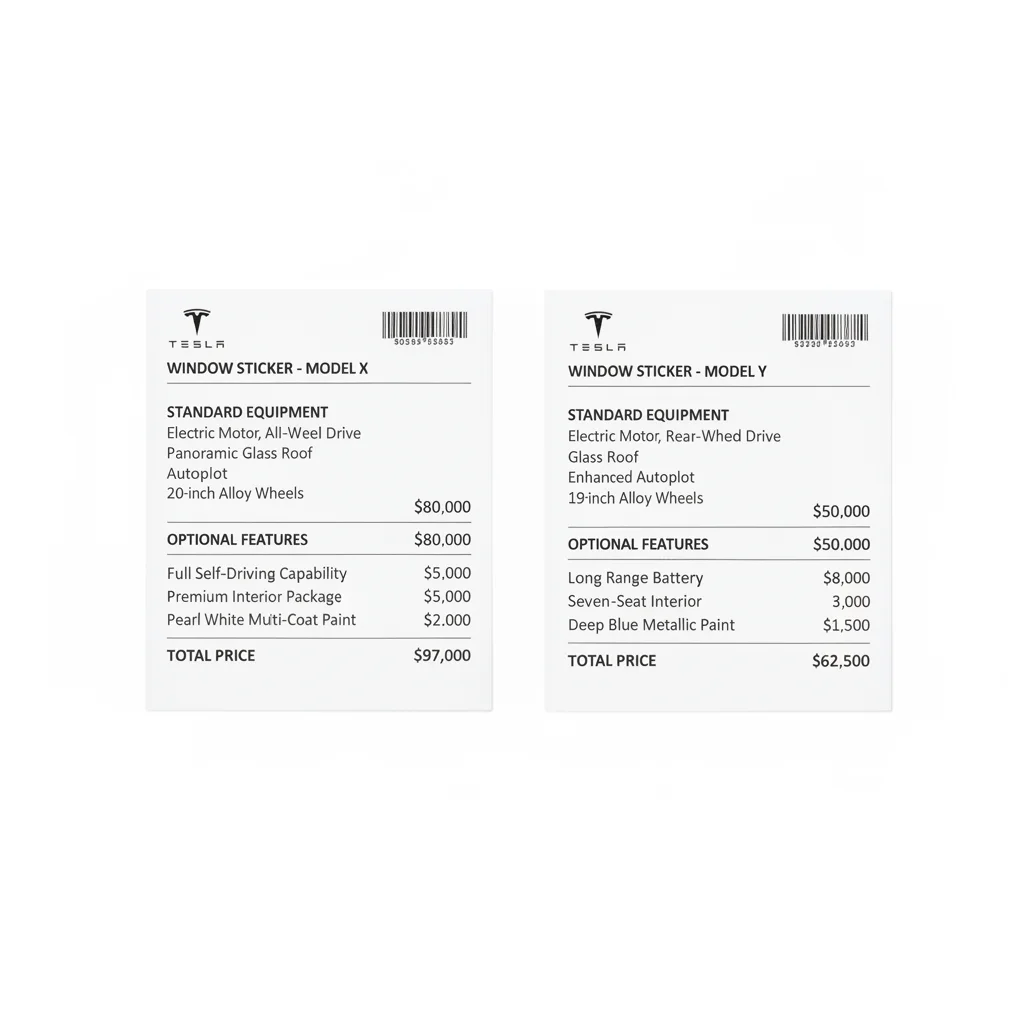
Window stickers (Monroney labels) are legal documents that itemize every factory-installed feature and its MSRP contribution. Sales sheets and brochures are marketing materials that can omit or obscure details. Request the window sticker for any specific vehicle you're seriously considering — dealers are required to have one for every new car on the lot.
Lock In Your Trim Decision Before Financing Talks
Once you sit down in the finance office, the trim is already decided — and that's intentional. Decide which trim you want before you discuss monthly payments. Salespeople are trained to blur the line between trim upgrades and financing terms, making it easy to accidentally agree to a more expensive vehicle because the payment seemed manageable.
How to Calculate Whether the Upgrade Is Worth It
The right framework for evaluating a trim upgrade isn't "does the top trim look nicer?" It's: what specific features does the upgrade add, and what do those features cost me monthly?
Here's the math. Say you're financing a car for 60 months at 7% APR. A $3,000 trim upgrade adds roughly $59/month to your payment. A $6,000 upgrade adds about $118/month. That's the real cost of moving up — not a lump sum, but a monthly commitment for five years.
Now list what you get for that monthly delta. If the $3,000 upgrade adds wireless CarPlay, heated seats, a blind-spot monitor, and upgraded wheels, that's probably worth $59/month to most buyers. If it adds a panoramic sunroof, larger wheels, and a brand badge on the dash, you need to decide if those matter to you.
“The monthly payment is the most powerful tool a dealership has for obscuring the true cost of a vehicle. When buyers focus on the payment instead of the price, they consistently end up in higher trims and longer loan terms than they originally intended.”
— Ivan Drury, Director of Insights, Edmunds
There's also a loan size consideration. Understanding how loan terms affect your total cost is essential here — a larger financed amount at a longer loan term means you'll pay significantly more in interest over time. A $4,000 trim upgrade financed at 7% over 72 months doesn't cost you $4,000. It costs you closer to $4,900 in total payments.
Run those numbers before you commit to the higher trim at the dealer. Salespeople are trained to present the monthly payment difference, not the total cost difference. "It's only $60 more a month" sounds manageable. "It's $4,320 more over the loan" lands differently.
Also factor in insurance. Higher trims with more expensive features cost more to repair and therefore more to insure. The premium audio system and panoramic sunroof add to your comprehensive coverage cost. It's rarely dramatic, but it's real.
Trim Level and Resale Value: The Part Most Buyers Miss
The trim you buy today determines the category your car falls into when you sell or trade it in three, five, or seven years from now. This is significant, and most first-time buyers don't think about it at purchase time.
Higher trims generally hold a higher nominal dollar value in the used market — but they don't always recover the original premium you paid. Higher trims don't always depreciate slower — in fact, some premium features depreciate faster than the base mechanical components underneath them.
For example, a panoramic sunroof that cost $1,800 new might add $400–$600 to a used-car appraisal three years later. A leather interior upgrade that cost $1,200 new might recover $700–$900. The retained value percentage varies dramatically by feature type.
What tends to hold value well:
- Powertrain upgrades (hybrid systems, larger engines)
- All-wheel drive versus front-wheel drive
- Safety technology packages
- Leather interiors
What tends to depreciate faster relative to cost:
- Built-in navigation (phone-based navigation has eroded the value of factory nav)
- Panoramic sunroofs in high-failure-rate vehicles
- Manufacturer-specific tech features with poor software longevity
- Premium audio system branding
If you're going to sell or trade in within five years, your trim level will directly influence your trade-in valuation. Choose trim features that the used-car market actually prices in, not just what looks good in the showroom.
The Mid-Level Trim: Why It's Usually the Smart Buy
If you want a rule of thumb backed by real market behavior: the second or third trim from the bottom is usually the best value in any model lineup. Here's why.
The base trim is priced to generate foot traffic and low payment advertisements. It's often intentionally stripped to make the advertised price look attractive. Critically, it frequently omits features that most buyers consider non-negotiable — like Apple CarPlay, a backup camera beyond minimum compliance specs, or blind-spot monitoring.
The top trim is priced to capture buyers who want the absolute best and won't shop it. It loads on features many buyers won't use regularly — massaging seats, 14-speaker audio, 360-degree camera systems, head-up displays — and charges a significant premium for them.
The mid-level trim hits the practical sweet spot. It typically includes:
- The full driver assistance suite
- Apple CarPlay and Android Auto (usually wireless)
- A decently sized touchscreen
- Synthetic leather or upgraded cloth seating
- Heated front seats
- Alloy wheels
And it does so without the premium you'd pay to add the features you'll rarely use. Dealers also stock mid-level trims in greater volume, which means more color and configuration choices — and more negotiating leverage for you, since inventory is higher.

That said, "mid-level is best" isn't an absolute rule. If you live in Minnesota and the heated steering wheel only appears on the top trim, that's worth pricing. If you haul cargo regularly and only the top trim offers a properly rated towing package, the upgrade may pay for itself in utility. Let your actual use case override the general rule.
How to Research Trims Before You Step Into a Dealership
Walking into a dealership without having researched trims is one of the most expensive mistakes a car buyer can make. Here's the research process that protects you:
Step 1: Build the car on the manufacturer's website
Every major manufacturer has a build-and-price tool. Use it to see every trim, every option, and every price. Compare trims side by side using the manufacturer's own comparison table. Screenshot the results — prices on the web can differ from what dealers quote.
Step 2: Pull the window sticker (Monroney label) data
For vehicles already on a lot, the window sticker lists every installed feature and its individual price contribution. For vehicles you're considering ordering, the manufacturer's website will show the equivalent. The sticker is your source of truth — not the salesperson's description.
Step 3: Check the safety ratings and feature list against NHTSA and IIHS
The NHTSA and Insurance Institute for Highway Safety (IIHS) test specific trim configurations. Sometimes a model earns a Top Safety Pick+ rating only on trims that include a specific headlight or safety package. Know which trim earns the rating before assuming the base model qualifies.
Step 4: Price the used market for context
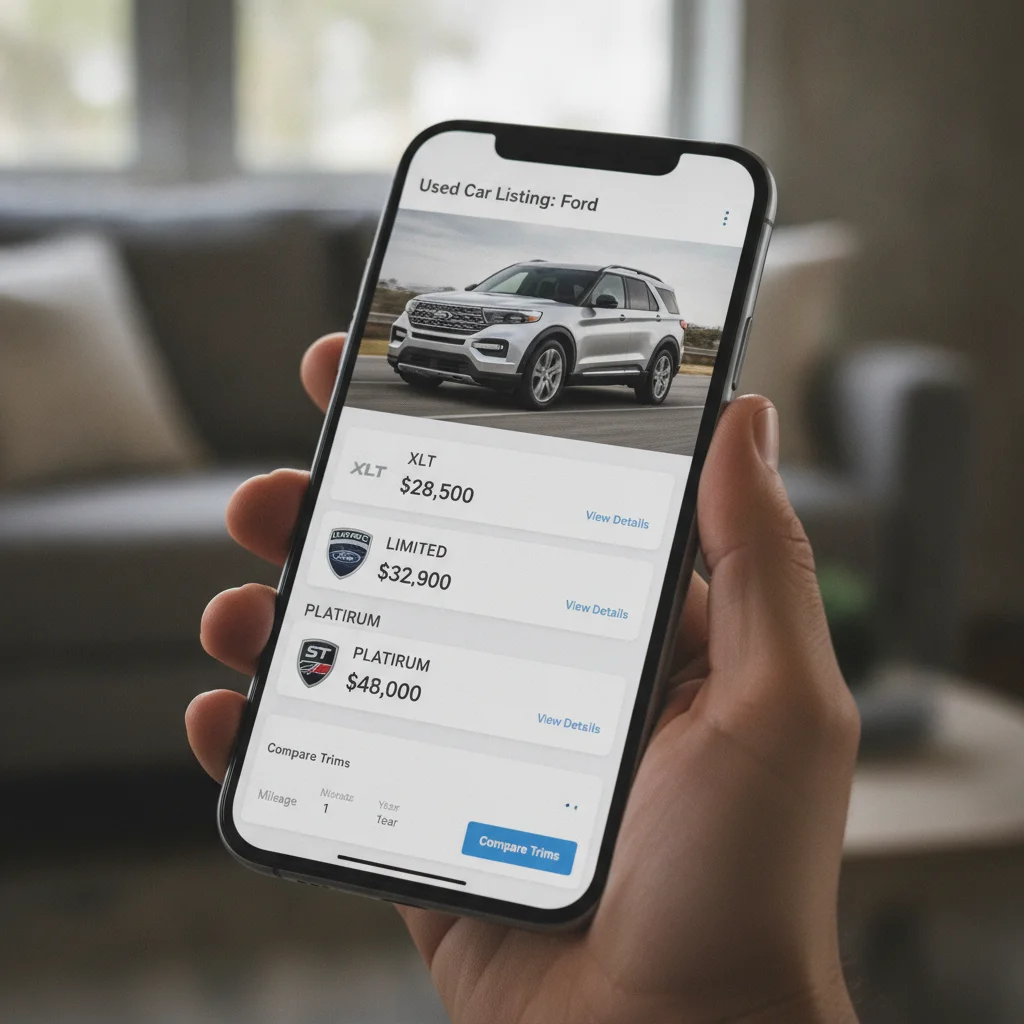
Look up one- and two-year-old examples of the trim you're considering on used-car marketplaces. This tells you what the car will likely be worth when you sell, and gives you a real sense of how the market values different trims. Understanding how valuation tools price used cars helps you decode what you're seeing in those listings.
Step 5: Compare total cost of ownership, not just sticker price
A higher trim may have a higher sticker but also come with longer warranty coverage on certain components, or qualify for better financing rates through the manufacturer's captive finance arm. State registration fees are often based on vehicle value, meaning a higher-trim car may cost more to register annually in states that use MSRP as the tax base.
Always Compare Trims Side by Side Online First
Every major manufacturer's website has a trim comparison tool. Use it before you step foot in a showroom. Screenshot the comparison so you have a reference point if the salesperson's description of what's included doesn't match what you researched. Discrepancies are common, especially with recently updated model years.
Ask for the Window Sticker, Not a Sales Sheet
Window stickers (Monroney labels) are legal documents that itemize every factory-installed feature and its MSRP contribution. Sales sheets and brochures are marketing materials that can omit or obscure details. Request the window sticker for any specific vehicle you're seriously considering — dealers are required to have one for every new car on the lot.
Lock In Your Trim Decision Before Financing Talks
Once you sit down in the finance office, the trim is already decided — and that's intentional. Decide which trim you want before you discuss monthly payments. Salespeople are trained to blur the line between trim upgrades and financing terms, making it easy to accidentally agree to a more expensive vehicle because the payment seemed manageable.
All claims are backed by peer-reviewed research. Sources on request.