

Key Takeaways
F&I Office (Finance & Insurance)
The Finance and Insurance office is the room at a car dealership where you finalize your loan, sign the purchase contract, and are offered a menu of add-on products — from extended warranties to paint protection. It's staffed by an F&I manager, a trained salesperson whose primary job is to maximize the dealership's profit after you've already agreed to buy. Every product, every number, and every conversation in that room is structured to increase revenue.
F&I managers earn most of their income from back-end gross profit: reserve income from finance contracts (the spread between the buy rate and the rate you're quoted), and commissions on ancillary product sales. Regulatory oversight of F&I practices falls under the FTC, CFPB, and state dealer licensing boards.
What the F&I Room Is Actually Designed to Do
By the time you reach the finance office, you've already made the big decision. You've picked the car, agreed on a price, and mentally moved on to imagining the drive home. That's not an accident. The F&I room is designed to catch you at maximum emotional commitment and minimum financial guard.
F&I managers are not loan processors. They are trained salespeople with a specific revenue target — typically $1,200 to $2,000 or more in back-end profit per vehicle. They achieve this through two channels: the interest rate markup on your loan, and commissions on ancillary products. Everything in that room, from the way the desk is arranged to the sequence of offers, is structured to maximize both.
Understanding this doesn't mean you need to be adversarial. It means you walk in with your eyes open. See our complete dealership negotiation walkthrough for the full arc of the deal — the F&I room is just the final chapter.

One of the most effective tools the F&I manager has is time pressure. You've been at the dealership for hours. The salesperson may hint that another buyer is interested. The F&I manager speaks quickly, presents many documents at once, and often buries the most expensive items in the middle of a long product menu. Slowing down costs them momentum and costs you nothing.
The Financing Play: How Your Interest Rate Gets Marked Up
When you finance through a dealership, the dealer submits your credit application to multiple lenders, who respond with their best rates — called buy rates. The lender gives the dealer permission to mark that rate up, typically by 1 to 3 percentage points, and keep the difference as income over the life of your loan. This is called dealer reserve.
$1,700+
Average F&I back-end profit per vehicle
NADA (National Automobile Dealers Association) data consistently shows per-vehicle F&I income in the $1,500–$2,000+ range at franchised dealerships.
1–3%
Typical dealer markup on your loan rate
The CFPB has documented that dealer rate markups commonly range from 1 to 3 percentage points above the lender's buy rate, costing buyers hundreds to thousands over the loan term.
73%
New car buyers who finance through the dealership
Experian's State of the Automotive Finance Market reports show the majority of new-car transactions are financed through dealer-arranged lending, giving dealers broad opportunity to earn reserve income.
2–3x
Dealership GAP price vs. insurer price
Consumer advocates and independent analyses regularly find dealer-sold GAP insurance priced at two to three times the cost of equivalent coverage purchased directly from an auto insurer.
$3,000+
Median VSC (extended warranty) price at dealerships
Based on aggregated buyer reports and dealer cost disclosures, dealer-sold Vehicle Service Contracts on new vehicles commonly list between $2,500 and $4,500, with significant negotiating room from list price.
Here's the math in plain terms. Suppose a lender approves you at 6.5% on a $35,000, 60-month loan. Your monthly payment at 6.5% would be about $684. If the dealer quotes you 8.5%, your payment rises to roughly $716. That $32/month difference sounds small, but over 60 months it adds up to nearly $1,920 in extra interest — most of which goes to the dealership, not the lender.
The most effective counter is arriving with a real competing offer. Get pre-approved at your bank or credit union before setting foot in the dealership. Then, if the dealer wants to finance the deal, they have to beat your existing rate — not an imaginary starting point they control. Learn more about when dealer financing can legitimately win that competition in our article when dealer financing beats your bank.
Get Pre-Approved Before You Visit
Contact your bank or credit union and get a written pre-approval letter before you visit any dealership. Include the maximum loan amount, the interest rate, and the term. Show it to the F&I manager at the start of the financing conversation — not as a threat, but as a real competing offer they need to beat. This single step prevents the majority of rate markup scenarios.
Negotiate Products Separately From Your Loan
Never let the F&I manager blend product prices into a combined payment quote. Ask for each product's standalone price in total dollars, then evaluate it independently. If you want the extended warranty, negotiate its price on its own merits — just like you negotiated the vehicle price. Bundling obscures what you're paying for each item.
One tactic to watch for: the F&I manager may offer a lower rate in exchange for purchasing a product bundle, like a warranty package. Do the math on the total cost of that bundle before agreeing — frequently the interest savings are outweighed by the product cost.
The Product Menu: What They're Selling and What It's Worth
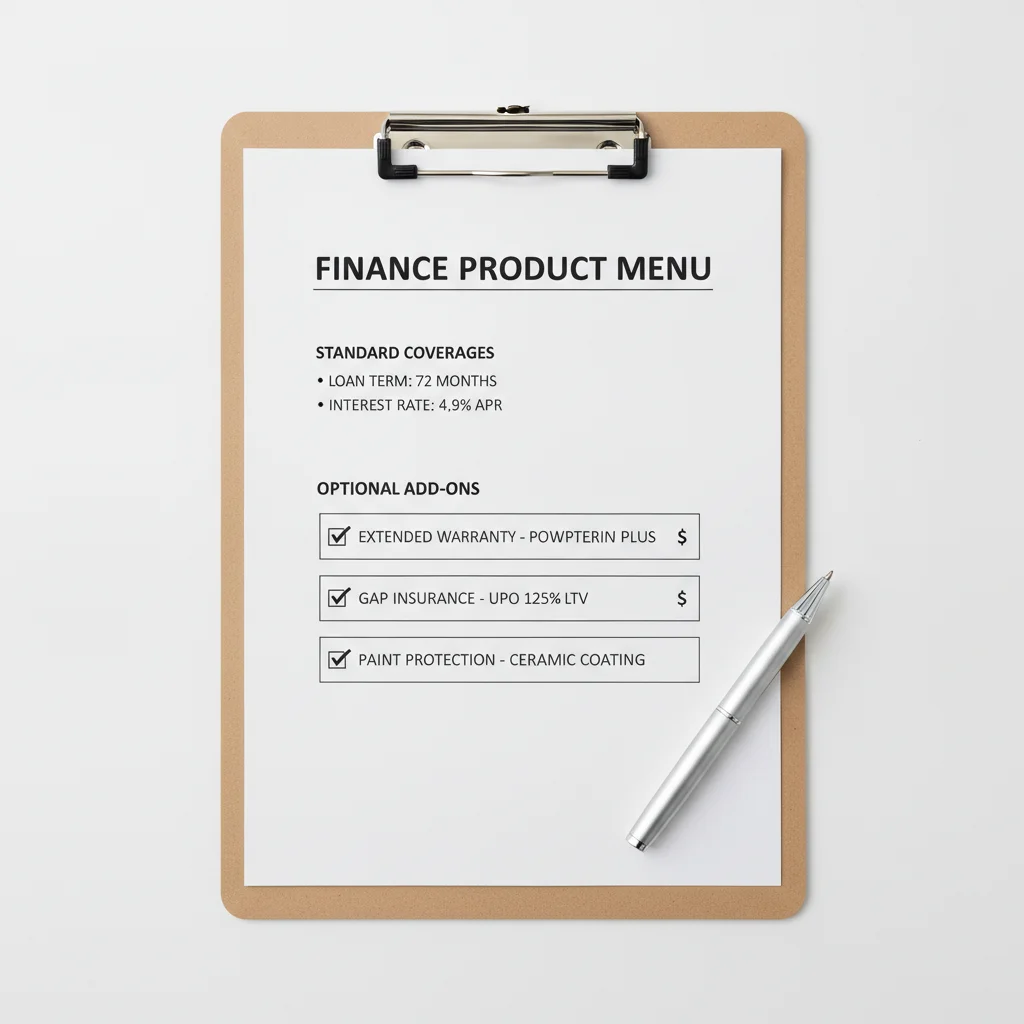
After the rate conversation, the F&I manager typically presents a product menu — a list of optional add-ons displayed on a screen or printed sheet. These products are real and some have legitimate value. But the price shown is never the floor, and the manager's job is to get as many as possible onto your contract.
Extended Warranties (Vehicle Service Contracts)
A Vehicle Service Contract (VSC) extends coverage beyond your factory warranty. On a new car still under the manufacturer warranty, a VSC rarely makes sense — you're paying for redundant coverage. On a used car outside warranty, especially a complex or European model, it can be worth having. The listed price, however, is almost always negotiable. Dealers often mark VSCs up by 50–100% over cost. If the price shown is $3,200, offer $1,500 and negotiate from there. Verify the VSC is underwritten by a rated third-party administrator, not the dealer directly, in case the dealership closes.
GAP Insurance
GAP (Guaranteed Asset Protection) covers the difference between your loan payoff and the car's actual cash value if it's totaled. It is a legitimate product for buyers who financed 90% or more of the vehicle's value. The problem is the price: dealers charge $400 to $900 for GAP coverage your own auto insurer often sells for $20 to $40 per year as a policy add-on. Always call your insurer and compare before agreeing to dealer GAP.
Credit Life and Disability Insurance
This coverage pays off your loan if you die or become disabled. It sounds reassuring but it's extremely poor value — the coverage is tied to the declining loan balance, so it gets cheaper to provide over time while your premium stays flat. A standard term life insurance policy provides far better coverage at a fraction of the cost.
Paint Protection, Fabric Guard, and Window Tint
These surface-protection products are often already applied to vehicles on the lot before you ever arrive — meaning you're being asked to pay for something that was done without your consent. A dealership ceramic coating sold for $995 in the F&I room can be purchased from an independent detailer for $200 to $400. Decline or negotiate hard. If the product is listed as installed and non-removable, at minimum insist the price be reduced to match outside market rates.
Tire and Wheel Protection
These plans cover damage from potholes and road hazards. They can have value in areas with rough roads if you're buying a vehicle with expensive low-profile tires. Read the exclusions carefully — many plans exclude damage from misalignment, wear, or manufacturer defects. Pricing is almost always negotiable.
You Can Buy Some Products Later
Vehicle Service Contracts and GAP insurance do not have to be purchased in the F&I room on the day of sale. Many reputable third-party providers sell equivalent VSCs at significantly lower prices, and your auto insurer can often add GAP coverage at any time. The F&I manager may imply that now is your only opportunity — that is not accurate for most products.
Dealer Financing Is Not Always the Worst Option
Manufacturers sometimes offer subsidized financing rates (0%, 1.9%, or 2.9% APR promotional offers) through their captive finance arms that are genuinely below market. These deals are real and worth taking if you qualify. The key distinction is that these are manufacturer-funded incentives, not dealer-marked-up bank rates. Always confirm whether a promotional rate is manufacturer-backed before comparing it to your pre-approval.
The Monthly Payment Trap
The single most effective tool in the F&I manager's kit is the monthly payment conversation. Once you're thinking in terms of "just $47 more per month," you've lost the ability to evaluate actual cost. Every product gets reframed as a small monthly increment, and the cumulative effect is invisible until you see the total contract value.
“The monthly payment is the great equalizer for dealers. Once buyers start thinking in payments, they stop thinking in total cost — and that's exactly where the F&I office wants them.”
— Marv Eleazer, F&I Director and long-time contributor to industry publication F&I and Showroom
Here's how to counter it: price every product in total dollars, then decide independently whether that product is worth that dollar amount to you. If the F&I manager quotes you a warranty for $58/month over 60 months, that's $3,480 total. Is a warranty worth $3,480 to you? That's the actual question. When framed that way, most buyers answer differently than they would to "just $58 a month."
Similarly, watch for the loan term extension play. The F&I manager may offer to drop your monthly payment by extending your loan from 48 months to 72 months. This makes products feel affordable but costs you significantly more in interest over the life of the loan and leaves you underwater on the vehicle for longer. Resist the temptation to judge a deal by its monthly payment alone.
How to Navigate the F&I Room Without Getting Rattled
Walking into the F&I room prepared is not about being difficult — it's about being deliberate. Here's a practical sequence that works:
- Bring your pre-approval in writing. Have the rate, term, and lender name on paper. Hand it to the F&I manager at the start of the conversation. This immediately resets the negotiating dynamic.
- Ask for the out-the-door price in writing before entering the F&I room. Compare it line-by-line to the finance contract. Any new charges need an explanation and your explicit approval.
- Say "I'd like to see the itemized total, not the monthly payment" for every product. This isn't rude — it's a reasonable request. Any F&I manager worth dealing with will comply.
- Decline products you haven't researched. It's entirely acceptable to say, "I want to compare that price before I decide." You can often purchase VSCs and GAP through third-party providers after the sale.
- Take your time reading every document. The F&I manager may express mild impatience. Ignore it. You are signing legal obligations that will affect your finances for years. See our breakdown of F&I office documents to know what each form means before you face it.
For a broader look at what's happening across the entire dealership visit, understand what dealership staff are trained to observe so you control what signals you send from the moment you walk in.
Get Pre-Approved Before You Visit
Contact your bank or credit union and get a written pre-approval letter before you visit any dealership. Include the maximum loan amount, the interest rate, and the term. Show it to the F&I manager at the start of the financing conversation — not as a threat, but as a real competing offer they need to beat. This single step prevents the majority of rate markup scenarios.
Negotiate Products Separately From Your Loan
Never let the F&I manager blend product prices into a combined payment quote. Ask for each product's standalone price in total dollars, then evaluate it independently. If you want the extended warranty, negotiate its price on its own merits — just like you negotiated the vehicle price. Bundling obscures what you're paying for each item.
After the sale, review your financing paperwork and contracts carefully. Errors and unauthorized additions are more common than buyers realize, and catching them early matters.
What the F&I Office Reveals About the Deal You Already Made
Here's something most buyers don't consider: the F&I office can tell you a great deal about how the front-end deal went. If the F&I manager seems unusually eager to keep you happy, it often means the front-end gross was thin — they need the back-end products badly. If they're relaxed and move quickly, the dealership already made solid profit on the vehicle sale and they're just layering more on top.
You can also learn something from how they respond to your pre-approval. If they immediately try to beat your rate without a fight, your lender rate was competitive. If they get flustered or try to discredit your lender, you likely have a strong offer and they're losing a revenue stream. Either outcome works in your favor.
For a deeper look at how dealerships structure profit across the entire F&I process, see how F&I offices make money after the sale. Understanding the revenue model demystifies why every interaction in that room is the way it is.

The F&I room doesn't have to be the most stressful part of buying a car. With the right preparation — a competing rate, a clear out-the-door number, and a willingness to slow the process down — it becomes a manageable final step rather than an ambush. The manager has a job to do. So do you.
All claims are backed by peer-reviewed research. Sources on request.