
Key Takeaways
Before entering the F&I office, write down the agreed selling price, your APR, your loan term, and your expected monthly payment on a notecard. Compare that notecard to the RISC before you sign a single line.
The few minutes between leaving the sales floor and entering the F&I office are enough time for numbers to shift. A written reference point removes any ambiguity about what you originally agreed to.
Ask the F&I manager to print the RISC before any add-on products are added, then review it clean. Once the service contract and GAP are bundled in, it becomes harder to isolate individual line items.
Reviewing the financing terms in isolation first ensures you're evaluating the loan on its own merits, not through the lens of a product presentation designed to reframe the monthly payment as affordable.
If you're offered an extended service contract, ask for the actual contract booklet — not the brochure — and spend 10 minutes reading the exclusions section before deciding.
Most service contract disputes arise from exclusions buyers didn't know existed. The exclusions list is the single most important section of the contract, yet it's the one F&I managers are least likely to highlight.
What Happens in the Finance and Insurance Office
Most buyers spend hours negotiating a price on the showroom floor, then walk into a small back office and sign a stack of paperwork in under thirty minutes. That office — called the Finance and Insurance (F&I) office — is where a deal becomes a legal contract. It's also where the dealership has its second best shot at increasing its profit.
The person you meet there carries the title of Finance Manager or F&I Manager. Their job is twofold: process the financing paperwork and present additional products and warranties. Understanding this dual role helps you stay focused on what matters most — accurately reading every document before it gets your signature.

The documents appear in a rough order. You'll typically see the purchase agreement first, then the financing contract, then federal and state disclosures, then add-on product agreements. This guide walks through each category in that sequence, explaining what each document is legally required to contain, what to check, and what to push back on. For a broader look at how you arrived at this desk, see our walkthrough of the full dealership negotiation process.
The RISC Is Your Most Binding Contract
Once you sign the Retail Installment Sales Contract, you are legally obligated to its terms. Unlike a verbal promise or even a handshake on the sales floor, the RISC supersedes everything else. If a salesperson told you the APR would be 6.9% and the RISC says 8.4%, the RISC is what governs your loan. Read it completely — every number, every term — before signing.
The Buyer's Order (Purchase Agreement)
The buyer's order — sometimes called the purchase agreement or the sales contract — is the first formal document you'll sign. Think of it as the deal memo: it captures the agreed price, the trade-in value (if any), dealer fees, taxes, and every line-item charge before financing enters the picture.
What It Must Include
- Vehicle identification: Year, make, model, trim, color, and 17-character VIN (Vehicle Identification Number).
- Agreed selling price: The out-the-door number you negotiated on the floor.
- Trade-in value: The dealer's appraisal credit and any payoff amount if you still owe on your trade.
- Dealer fees: Documentation fee (doc fee), dealer prep, and any advertised or state-mandated fees.
- Government fees: Sales tax, title fee, and registration fee calculated for your jurisdiction.
- Cash due at signing: Your down payment or cap cost reduction.
This document should reflect exactly what you agreed to verbally. If the selling price is $500 higher than what you shook hands on, stop right there. Do not move to the next document until the buyer's order matches your negotiated deal.
Photograph the Buyer's Order Before You Leave the Sales Floor
Before walking to the F&I office, ask the salesperson if you can take a photo of the buyer's order with your phone. This creates a timestamped record of the agreed price before any numbers enter a computer. If the RISC reflects a different amount, you have documentary evidence of the original deal.
Insist on Printed Copies Before You Leave
Never drive off without physical copies of every document you signed. Some dealerships store everything digitally and offer to email documents later — that's not sufficient for the RISC or the buyer's order. Insist on printed copies while you're still in the building, before you take possession of the vehicle.
If your deal includes a trade-in, pay close attention to the trade-in allowance line versus the trade-in payoff line. The allowance is the credit you're receiving; the payoff is the amount the dealer is paying off on your existing loan. If your payoff is higher than your allowance (negative equity), that difference typically rolls into your new loan — a detail that can dramatically change your monthly payment. Learn more about how trade-in values are calculated at our dealer trade-in hub.
$1,700+
Average F&I profit per vehicle sold
According to NADA's annual dealership financial profile, finance and insurance gross profit averages over $1,700 per new vehicle retailed.
72–84 mo
Most common new car loan terms in 2024
Experian's State of the Automotive Finance Market report shows that loans of 72 months or longer now represent more than a third of all new car financing.
0.5%–2.5%
Typical dealer reserve rate markup range
The CFPB has documented that dealers commonly mark up lender buy rates by 0.5 to 2.5 percentage points, with the dealer retaining the difference as profit.
$200–$900
Dealer markup on GAP insurance
Consumer advocates estimate dealers mark up GAP insurance by $200–$900 above cost, while the same coverage can be added to an auto policy for a fraction of the price.
The Retail Installment Sales Contract (RISC)
The Retail Installment Sales Contract — almost always abbreviated RISC — is the single most important piece of paper in the F&I office. This is the legally binding financing agreement between you, the dealership, and ultimately the lender to whom the dealer sells your loan. Every number that matters to your financial future lives on this page.
The Key Fields on a RISC
| Field | What It Means | What to Verify |
|---|---|---|
| Annual Percentage Rate (APR) | The true yearly cost of borrowing, including fees | Must match your approval letter or rate sheet exactly |
| Finance Charge | Total dollar cost of the loan over its full term | Calculate manually: (monthly payment × number of payments) − amount financed |
| Amount Financed | The principal loan amount after down payment and trade-in credits | Should match the buyer's order total minus your cash/trade |
| Total of Payments | Sum of all scheduled payments | Amount financed + finance charge |
| Loan Term | Number of months in the repayment schedule | Confirm you agreed to this term — longer terms lower payments but increase total cost |
| Payment Due Date | Day of month your first and subsequent payments are due | Note any grace period and late fee amount |
One of the most common errors buyers encounter is a rate on the RISC that is higher than the rate originally quoted. This can happen legitimately (if the lender bumped the rate after final approval) or as an intentional markup. Dealers are legally permitted in most states to add a markup — called a dealer reserve — on top of the lender's buy rate. That markup is profit to the dealership, and you won't see it labeled as such on the contract.
Before entering the F&I office, write down the agreed selling price, your APR, your loan term, and your expected monthly payment on a notecard. Compare that notecard to the RISC before you sign a single line.
The few minutes between leaving the sales floor and entering the F&I office are enough time for numbers to shift. A written reference point removes any ambiguity about what you originally agreed to.
Ask the F&I manager to print the RISC before any add-on products are added, then review it clean. Once the service contract and GAP are bundled in, it becomes harder to isolate individual line items.
Reviewing the financing terms in isolation first ensures you're evaluating the loan on its own merits, not through the lens of a product presentation designed to reframe the monthly payment as affordable.
If you're offered an extended service contract, ask for the actual contract booklet — not the brochure — and spend 10 minutes reading the exclusions section before deciding.
Most service contract disputes arise from exclusions buyers didn't know existed. The exclusions list is the single most important section of the contract, yet it's the one F&I managers are least likely to highlight.
If you arranged financing through your bank or credit union before visiting the dealership, compare the RISC terms against your pre-approval letter line by line. The dealership may offer to beat your rate — but always verify the final document, not just the verbal promise.
For a complete reference on all the paperwork categories you might encounter — not just the RISC — see our full guide to every document you'll sign at a dealership.

Federal and State Disclosure Forms
Several disclosures in the finance office are not optional — they're federally or state-mandated. The F&I manager may breeze past these quickly, treating them as formalities. They are not formalities. They are legal protections that exist specifically for you.
Federal Truth in Lending Act (TILA) Disclosure
Under the Truth in Lending Act (Regulation Z), any creditor extending consumer credit must disclose the APR, the finance charge, the amount financed, and the total of payments in a clear, standardized format. On an auto loan, these disclosures are typically embedded within the RISC itself in a prominent box — often called the Federal Box. Read it independently of the rest of the contract.
Odometer Disclosure Statement
Required by the federal Motor Vehicle Information and Cost Savings Act, this statement certifies the mileage on the vehicle at the time of sale. The seller (the dealer on a used car, or the previous owner on a private transfer) must certify that the odometer reading is accurate. You, the buyer, sign to acknowledge it. If the odometer has been altered or the reading is not actual mileage, this document is your legal record. Verify the number matches the odometer before you sign.
Arbitration Agreement
Many dealerships include a mandatory arbitration clause — either as a standalone document or embedded within the purchase agreement. By signing, you typically agree to resolve disputes through a private arbitration process rather than through the courts. This is not a federally required disclosure; it's a dealership-generated contract clause. You can attempt to cross it out and initial it, though the dealer may refuse to proceed. At minimum, know you're signing it and understand what you're giving up.
Arbitration Clauses Are Not Required by Law
Federal law does not require you to sign an arbitration agreement to purchase a vehicle. Many buyers sign them without realizing they're waiving their right to sue in court. If you have concerns, you can ask to cross out the arbitration clause, though the dealership is not obligated to accept the modification. Some states have specific rules limiting the enforceability of arbitration in consumer contracts.
Used Car Buyer's Guide Is Federally Mandated
The FTC's Used Car Rule requires dealers to post a Buyer's Guide on every used vehicle they sell. This guide discloses whether the car comes with any warranty or is sold 'as-is.' You're entitled to a copy of the Buyer's Guide as part of your paperwork. If a dealer sells you a used vehicle without providing one, that's a federal regulatory violation.
State-Specific Disclosures
Depending on your state, you may also sign a Lemon Law disclosure (your rights if the vehicle has a recurring defect), a Used Car Buyer's Guide (federally required by the FTC for used vehicle sales), a privacy notice from the lender, and in some states, an emissions or smog certification acknowledgment.
Never Sign a Blank or Incomplete Document
Some F&I managers may present a partially completed contract and ask you to sign with the promise that numbers will be filled in later. This is not acceptable under any circumstance. Every field on the RISC — especially APR, loan term, and amount financed — must be complete before you sign. Signing an incomplete contract surrenders your legal protections.
Watch for Products Added Without Your Approval
It's not uncommon for dealers to pre-load the amount-financed field with an extended service contract or appearance protection package, presenting it as part of the standard deal. Scan every line of the RISC's itemized charges before signing. Any charge you didn't explicitly agree to can and should be removed.
Title and Registration Documents
The title documents confirm legal ownership of the vehicle. These are arguably more important than any financing form because a problem here can leave you unable to legally drive or resell the car.
Certificate of Title (or Application for Title)
For new vehicles, you won't receive an existing title — the manufacturer's certificate of origin (MCO) travels with the car and the dealer files for the title on your behalf. For used vehicles, the dealer should have a clean title (or a title application if the title is still in transit from the previous lender). You'll sign as the new owner, and the dealer submits the paperwork to your state's DMV.
Check the following on any title document:
- Your name is spelled correctly and your address is accurate.
- The VIN on the title matches the VIN on the vehicle and on the RISC.
- Lien holder information is correct if you're financing (the lender's name and address must appear).
- If a trade-in is involved, the dealer is listed as the seller on your trade's title — confirm they've collected the correct title from you.
For a detailed breakdown of which documents transfer legal ownership and what each one does, visit our paperwork and title hub.
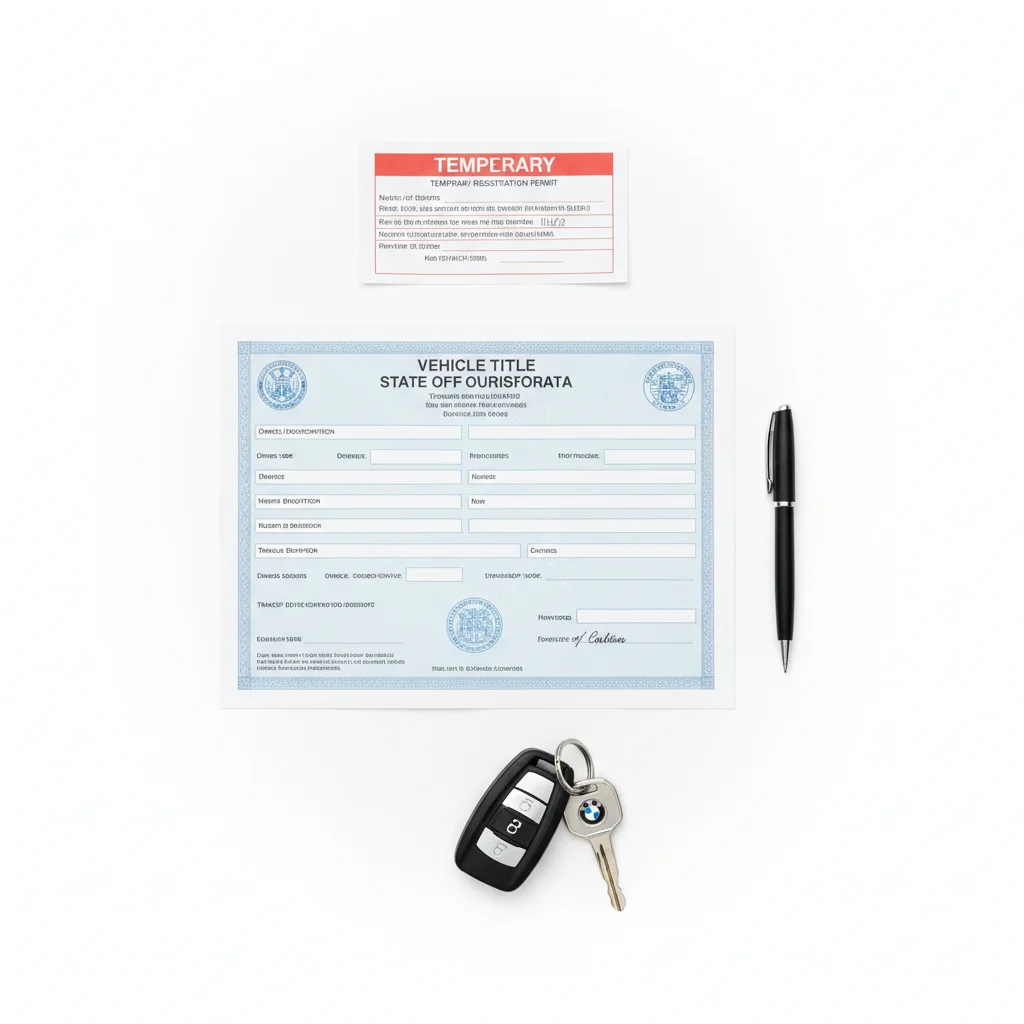
Registration and Temporary Permit
Most dealers handle the registration filing on your behalf and charge you the state registration fee as part of your out-the-door cost. You'll typically receive a temporary paper registration or license plate permit that is valid while your permanent plate or registration is processed. Confirm the expiration date on that temporary permit before you leave — some expire in 30 days, others in 90.
Add-On Product Agreements
After the required documents, the F&I manager typically presents a menu of optional products. These carry their highest profit margins of anything in the office. Each product has its own separate contract or addendum, which is why the paperwork stack grows so thick.
GAP Insurance (Guaranteed Asset Protection)
GAP insurance covers the difference between what you owe on your loan and what your vehicle is worth if it's totaled or stolen. It's genuinely useful if you're financing more than 80% of the vehicle's value, especially on long-term loans (72–84 months) where the loan balance depreciates slower than the car. However, dealers routinely charge $600–$900 for a product you can often buy through your auto insurer for $20–$40 per year added to your policy. If you want GAP coverage, comparison shop before signing.
Extended Service Contract (Aftermarket Warranty)
Often called a warranty, an extended service contract is actually a separate agreement from the manufacturer's warranty. It's sold by the dealer (and administered by a third-party company) and covers specified repairs after the factory warranty expires. These contracts typically have deductibles, exclusions, and claim processes that buyers don't discover until they need to use them. If you want one, read the coverage terms — specifically the exclusions list — before signing, not after.
Before entering the F&I office, write down the agreed selling price, your APR, your loan term, and your expected monthly payment on a notecard. Compare that notecard to the RISC before you sign a single line.
The few minutes between leaving the sales floor and entering the F&I office are enough time for numbers to shift. A written reference point removes any ambiguity about what you originally agreed to.
Ask the F&I manager to print the RISC before any add-on products are added, then review it clean. Once the service contract and GAP are bundled in, it becomes harder to isolate individual line items.
Reviewing the financing terms in isolation first ensures you're evaluating the loan on its own merits, not through the lens of a product presentation designed to reframe the monthly payment as affordable.
If you're offered an extended service contract, ask for the actual contract booklet — not the brochure — and spend 10 minutes reading the exclusions section before deciding.
Most service contract disputes arise from exclusions buyers didn't know existed. The exclusions list is the single most important section of the contract, yet it's the one F&I managers are least likely to highlight.
Credit Insurance Products
You may be offered credit life insurance (pays off your loan if you die), credit disability insurance (makes your payments if you become disabled), and involuntary unemployment insurance. These products are almost universally overpriced compared to standalone term life or disability policies. They also add to your financed amount, meaning you pay interest on the insurance premium for the life of the loan.
Paint, Fabric, and Appearance Protection
Dealers may present paint sealant, fabric protection, and windshield etching as packages already installed on the vehicle. The etching is typically performed before you arrive; the sealant is often a jar of wax applied by a lot attendant. These add-ons are rarely worth the $300–$800 price tag, and their presence on the buyer's order is negotiable even if a dealer implies otherwise.
To understand how the F&I office constructs its product revenue — and how to push back effectively — read our guide to how dealership finance offices make money.

What to Review Before You Sign Anything
The finance office is designed to be efficient. Efficiency benefits the dealer. Your job is to slow down just enough to be accurate. Here's a systematic review process to use on every document before your pen touches paper.
The Five-Point Check
- VIN match: The 17-character VIN should appear on the buyer's order, the RISC, and the title documents. All three must be identical. A transposed digit is a legal problem you'll inherit.
- Price match: The selling price on the RISC's amount-financed calculation must reconcile with the buyer's order. Add your down payment and trade-in credit back to the amount financed — the result should equal the agreed selling price plus taxes and fees.
- Rate match: If you have a pre-approval or were quoted a specific APR, the RISC APR must match. Even a 0.5% discrepancy costs real money over a 60-month term.
- Term match: The loan term in months must be what you agreed to. A 72-month term presented as 60 months changes your payment and your total cost significantly.
- Add-ons check: Scroll the itemized lines on the RISC's amount-financed section. Anything you didn't explicitly agree to — a service contract, GAP, appearance protection — should not be there. Remove it before signing, not after.
Before entering the F&I office, write down the agreed selling price, your APR, your loan term, and your expected monthly payment on a notecard. Compare that notecard to the RISC before you sign a single line.
The few minutes between leaving the sales floor and entering the F&I office are enough time for numbers to shift. A written reference point removes any ambiguity about what you originally agreed to.
Ask the F&I manager to print the RISC before any add-on products are added, then review it clean. Once the service contract and GAP are bundled in, it becomes harder to isolate individual line items.
Reviewing the financing terms in isolation first ensures you're evaluating the loan on its own merits, not through the lens of a product presentation designed to reframe the monthly payment as affordable.
If you're offered an extended service contract, ask for the actual contract booklet — not the brochure — and spend 10 minutes reading the exclusions section before deciding.
Most service contract disputes arise from exclusions buyers didn't know existed. The exclusions list is the single most important section of the contract, yet it's the one F&I managers are least likely to highlight.
Common paperwork errors are more frequent than most buyers expect. Transposed VINs, incorrect trade payoffs, and unsigned addenda can create serious problems down the line. Our guide to dealership paperwork errors buyers overlook covers the most common mistakes and how to catch them before you leave.
“The back office is where the dealership makes its real money. A buyer who walks in prepared — knowing their rate, their term, and what they agreed to pay — is a buyer who leaves without surprises on their statement.”
— Dara Flemming, Former consumer finance journalist and auto loan specialist
Never Sign a Blank or Incomplete Document
Some F&I managers may present a partially completed contract and ask you to sign with the promise that numbers will be filled in later. This is not acceptable under any circumstance. Every field on the RISC — especially APR, loan term, and amount financed — must be complete before you sign. Signing an incomplete contract surrenders your legal protections.
Watch for Products Added Without Your Approval
It's not uncommon for dealers to pre-load the amount-financed field with an extended service contract or appearance protection package, presenting it as part of the standard deal. Scan every line of the RISC's itemized charges before signing. Any charge you didn't explicitly agree to can and should be removed.
Documents You Should Take Home With You
Every document you sign in the F&I office should be in your hands before you drive off the lot. This is not optional, and it's not a favor the dealer grants — you have a legal right to copies of everything you sign.
Your Complete Document Checklist
- Buyer's Order / Purchase Agreement
- Your record of the agreed-upon price, fees, and trade-in terms.
- Retail Installment Sales Contract (RISC)
- The governing financing document. Keep this for the entire life of your loan.
- Federal Box / TILA Disclosure
- Your APR, finance charge, amount financed, and total of payments — legally required.
- Odometer Disclosure Statement
- The certified mileage record at time of purchase.
- Any Add-On Product Agreements
- Extended service contract, GAP agreement, or any other product you purchased.
- Temporary Registration / Permit
- Your legal authorization to operate the vehicle until permanent plates arrive. Note the expiration date.
- Manufacturer's Certificate of Origin (new vehicles) or Title (used vehicles)
- For used vehicles, ask about the timeline if the title is still being processed by the lender.
Photograph the Buyer's Order Before You Leave the Sales Floor
Before walking to the F&I office, ask the salesperson if you can take a photo of the buyer's order with your phone. This creates a timestamped record of the agreed price before any numbers enter a computer. If the RISC reflects a different amount, you have documentary evidence of the original deal.
Insist on Printed Copies Before You Leave
Never drive off without physical copies of every document you signed. Some dealerships store everything digitally and offer to email documents later — that's not sufficient for the RISC or the buyer's order. Insist on printed copies while you're still in the building, before you take possession of the vehicle.
If the F&I manager tells you copies will be mailed to you, that's not acceptable for the RISC or the buyer's order. Request printed copies on the spot. Most modern dealerships can print immediately. If they genuinely can't (say, due to a system issue), get a written promise with a specific delivery date and follow up within 24 hours.
Organizing your documents now also prepares you for any disputes. If a payment amount doesn't match what you signed, or if an add-on you declined shows up on your first statement, your signed RISC is the document that resolves the question.
CFPB Auto Loan Tool
The Consumer Financial Protection Bureau's auto loan tool lets you explore how loan terms and APR affect total cost, and explains your rights as a borrower before you enter the dealership.
FTC Used Car Buyer's Guide Explainer
The Federal Trade Commission's official guide to the Used Car Rule explains what dealers are required to disclose and what 'as-is' actually means for your legal protections.
Every Document You'll Sign at a Car Dealership, Explained
Our companion article breaks down the full universe of dealership paperwork — from the buyer's order to the odometer statement — with explanations written for buyers, not lawyers.
Dealership Paperwork Errors Buyers Commonly Overlook
A focused checklist of the most frequent F&I paperwork errors — transposed VINs, incorrect payoffs, hidden add-ons — and the exact steps to catch each one before you sign.
Auto Loan Amortization Calculator
Enter your loan amount, APR, and term to see your monthly payment and total interest paid — useful for verifying that the numbers on your RISC are mathematically accurate.

All claims are backed by peer-reviewed research. Sources on request.