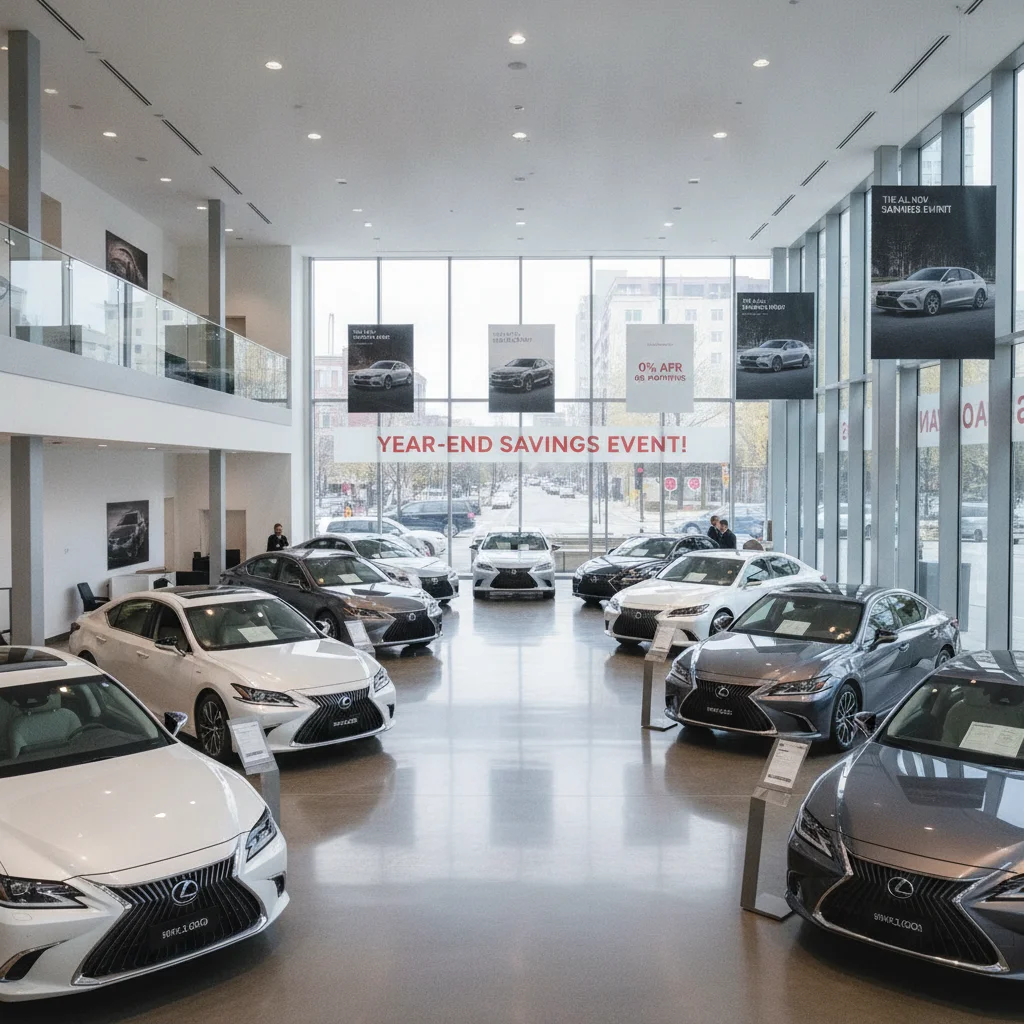

Key Takeaways
Dealer Incentives
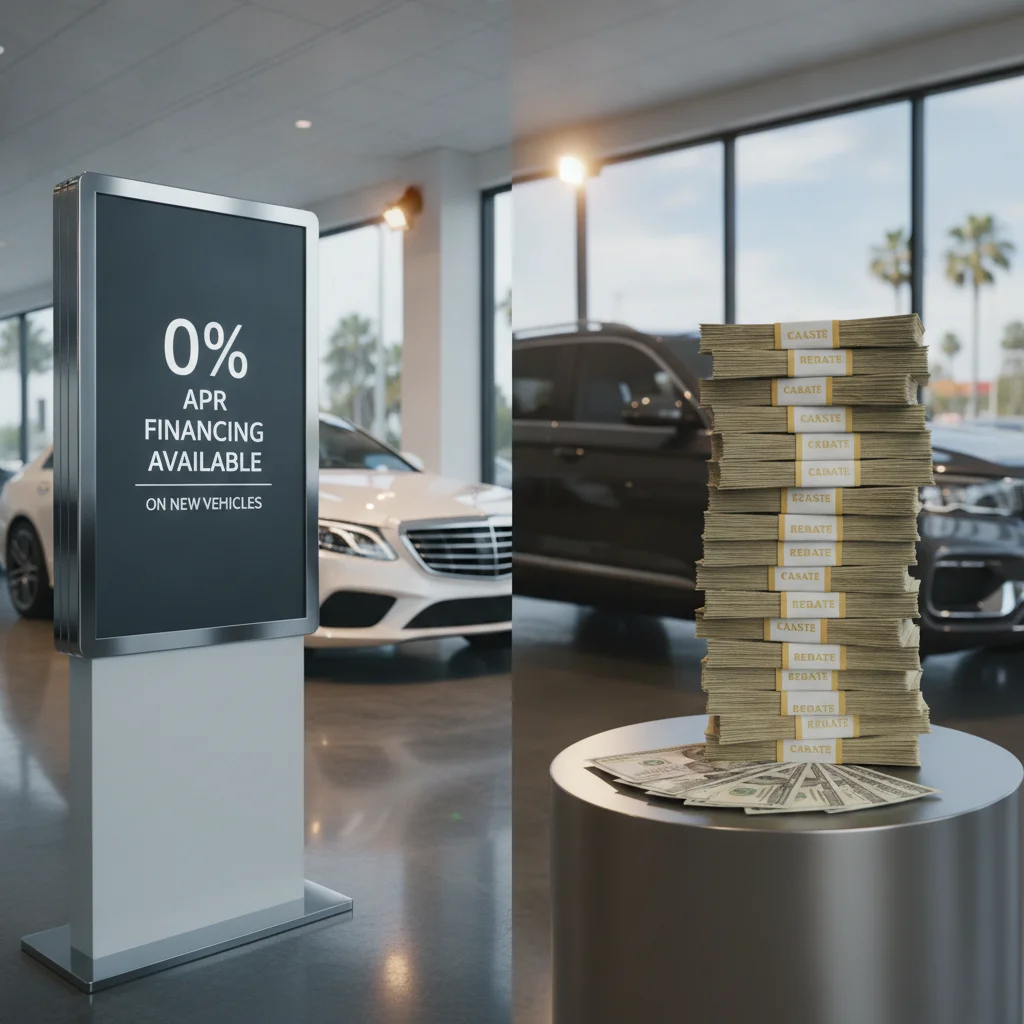
Dealer incentives are financial offers from automakers — not the dealership — designed to move specific vehicles. They come in three main forms: cash rebates paid directly to the buyer, low-APR financing deals subsidized by the manufacturer's captive lender, and dealer cash that flows to the dealership and is often invisible to the buyer. Understanding which type applies to the car you're shopping gives you real leverage at the negotiating table.
Manufacturer incentives are booked separately from the vehicle transaction price. Rebates reduce the purchase price (and thus your taxable amount in most states), while low-APR deals reduce your cost of financing — these are structurally different savings that cannot always be combined.
The Three Buckets of Manufacturer Incentives
Walk into most dealerships and the salesperson will mention something vague like 'there are some great deals right now.' That tells you nothing. Manufacturer incentives fall into three distinct categories, and each one works differently. Lumping them together is how deals that look great on the surface turn out to be worth less than you expected.
1. Consumer Cash Rebates
A cash rebate is a direct reduction in the vehicle's selling price, funded by the automaker. If a manufacturer is offering $3,500 cash back on a specific truck, that $3,500 comes off the price — it's not magic, it's a subsidy the manufacturer is eating to move units. In most states, the rebate reduces the taxable purchase price, meaning you also pay slightly less sales tax.
2. Special APR Financing
The manufacturer's captive finance arm — Ford Motor Credit, Toyota Financial Services, GM Financial, and so on — can offer below-market interest rates as an incentive. These are real rate subsidies: the automaker is making up the difference to its finance company. A 1.9% APR on a 60-month loan when market rates are 7%+ represents thousands of dollars in forgone interest income that the manufacturer is absorbing.
3. Dealer Cash (The Hidden One)
This is the one most buyers never hear about. Dealer cash is a manufacturer payment made directly to the dealership — not to the consumer. It serves as a soft incentive: instead of advertising a consumer rebate that trains buyers to expect discounts, the manufacturer quietly funds the dealer's ability to lower prices. The dealer can use it to close deals, pad their gross, or some combination of both.
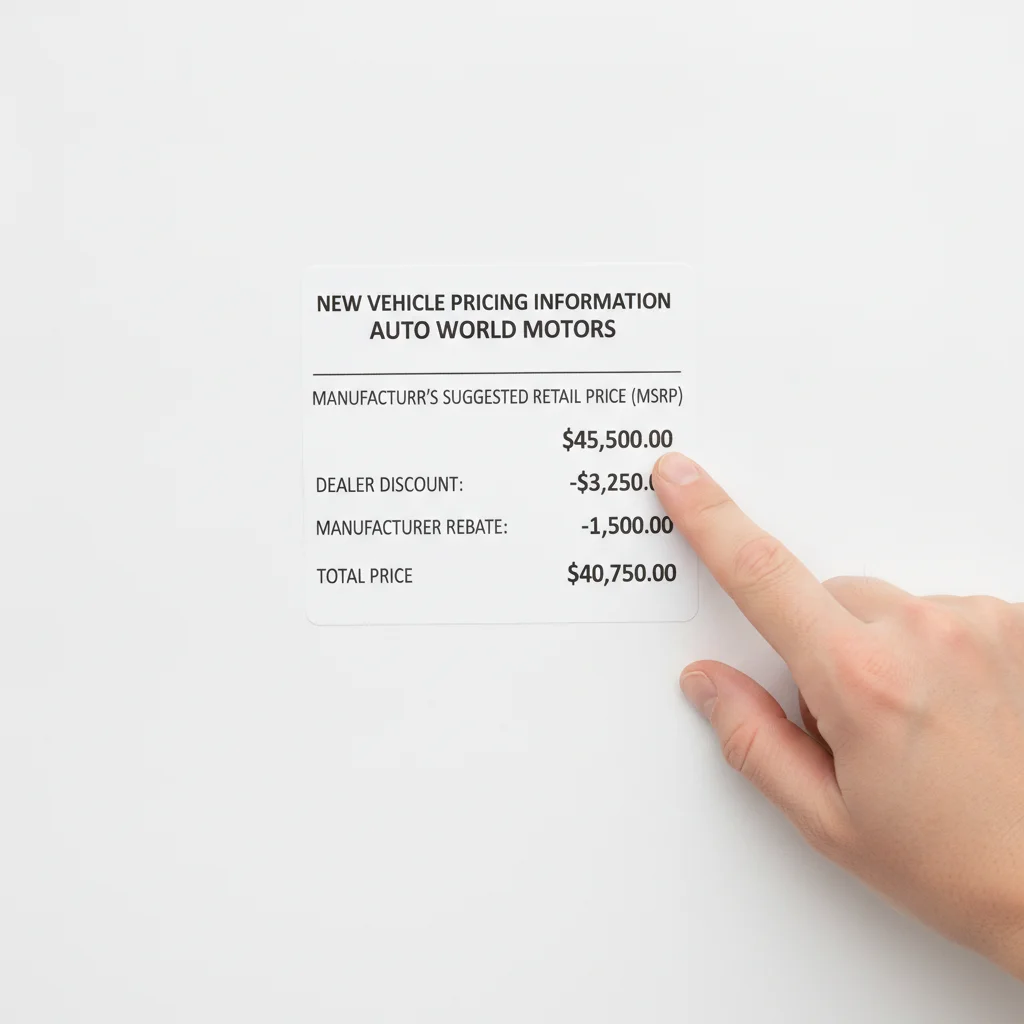
The critical point: dealer cash is not automatically passed on to you. But if you know it exists for a vehicle you're shopping, you have leverage. You can push for a below-invoice price knowing the dealer has a buffer they're not advertising. Sites like Edmunds publish dealer cash amounts when they can verify them — that's research worth doing before you set foot in a showroom. See our full breakdown of how manufacturer incentives are structured for more on each incentive type.
The Either/Or Problem: Rebate vs. Low APR
Here's where most buyers get tripped up. When a manufacturer offers both a cash rebate and a low-APR deal on the same vehicle, they almost always make you choose one. You cannot take $3,000 cash back AND get 1.9% financing on the same car. This is deliberate — both incentives cost the manufacturer money, and they're not going to give you both.
The decision between these two options is a math problem, not a gut-feel call. The variables that matter are:
- Loan amount — the larger the amount financed, the more valuable a rate reduction becomes
- Loan term — a rate discount saves more over 72 months than over 36 months
- Market rate — if you qualify for 6.5% on your own, the gap between that and 1.9% is meaningful; if you can get 4% elsewhere, the gap narrows
- Rebate size — a $4,500 rebate on a $28,000 car is a bigger percentage than $1,500 on a $50,000 truck
$3,200
Average consumer cash rebate on new vehicles
According to Edmunds Q1 2024 data, average cash rebates across all new vehicle segments reached approximately $3,200 per unit.
7.1%
Average new car loan APR in 2024
Experian's State of the Automotive Finance Market report for Q1 2024 showed an average new vehicle loan APR of 7.1% for all credit tiers.
$1,400+
Potential interest saved with 0% vs. market APR
On a $30,000 loan over 60 months, a 0% APR offer versus a 7% market rate saves approximately $5,600 in total interest — illustrating why the math matters.
62%
Buyers who don't know dealer cash exists
A Cox Automotive consumer survey found the majority of new car buyers are unaware that manufacturers provide separate incentive payments directly to dealerships.
As a rough benchmark: if the rebate amount is greater than the total interest you'd save by taking the special APR over your loan term, take the rebate. Calculate the total interest at both the special rate and your best available outside rate, find the difference, and compare it to the rebate. Our dedicated comparison article — 0% APR financing vs. cash rebate: which actually saves more? — walks through this math with real numbers.
Run the Math Before You Walk In
Use a simple loan calculator to compute total interest at both the special APR and your best available outside rate. Subtract to get your interest savings from the special rate, then compare that figure to the rebate amount. Whichever number is higher wins — and this calculation takes about five minutes. Doing it at home beats doing it under pressure across from a finance manager.
Print the Manufacturer's Offer Page
Before your dealership visit, print or screenshot the manufacturer's current offers page for your specific ZIP code and vehicle configuration. If a dealer claims an incentive you found doesn't apply, you have documentation. Manufacturers publish these offers publicly — dealers cannot legitimately deny a consumer incentive that's currently active on a qualifying vehicle.
Stacking Incentives: What Can Actually Be Combined
While the base incentive (rebate vs. low APR) is an either/or choice, manufacturers do allow certain targeted incentives to be layered on top of the base offer. These are designed for specific buyer segments and can add meaningful dollars to your total savings.
Common Stackable Incentives
- Loyalty Bonus
- Currently own or lease a vehicle from the same brand? Manufacturers often add $500–$1,500 on top of the base rebate to keep you in the family. You typically need to be the registered owner or lessee.
- Conquest Cash
- The opposite of loyalty — some manufacturers offer a bonus to buyers switching from a competing brand. This is common when a brand is trying to capture share from a specific competitor.
- Military Discount
- Active duty, veterans, and sometimes immediate family members qualify for an additional $500–$1,000 with most major manufacturers. Requires documentation, but it's worth claiming.
- Recent Graduate Offer
- Buyers who graduated within the last two years (with a job offer or existing employment) can often stack a $500–$1,000 bonus. Requirements vary by manufacturer.
- Affiliate / Partner Programs
- Costco Auto, credit union partner programs, and employer discount programs can unlock pricing tiers that stack with some manufacturer offers. Check these before you shop.
Incentive Eligibility Requires Documentation
Targeted incentives like military discounts, loyalty bonuses, and recent graduate offers all require proof at time of purchase. Military buyers typically need a military ID or DD-214. Loyalty programs require your current vehicle's registration. Recent graduate offers need a diploma or transcripts plus proof of employment. Gather these documents before your dealership visit — dealers cannot process the incentive retroactively after the deal is finalized.
Lease Incentives Work Differently
The incentive analysis in this article applies to purchased vehicles. Lease deals use different financial structures — residual value adjustments and money factor reductions — that can't be compared directly to purchase rebates or APR deals. If you're deciding between leasing and buying, evaluate the incentive package for each path separately using lease-specific tools.
The key discipline here is to ask the finance manager to print out every incentive being applied to your deal. Do not accept a verbal summary. A printout forces them to account for every line item, and you can cross-reference it against what you found on the manufacturer's website before you walked in.

How Dealers Manipulate Incentive Presentation
I spent years on the dealer side, and there are a handful of moves that get used consistently to make incentive deals look better than they are. Knowing them in advance costs you nothing.
Rolling the Rebate Into Their 'Discount'
A dealer might advertise a vehicle at $2,500 below MSRP. What they don't tell you is that $2,000 of that 'discount' is actually the manufacturer rebate — a discount that's available to every buyer regardless of negotiation. Their actual dealer discount is $500. Always separate the manufacturer incentive from the dealer discount in your mind.
The Monthly Payment Shuffle
Low-APR deals reduce your monthly payment — which makes them easy to blur with price discounts. 'We can get you into this car for $399 a month' tells you nothing about whether you're getting a good deal on the price, the rate, or both. Always work from the out-the-door price, then evaluate financing separately.
Steering You Away From Outside Financing
Dealers earn finance reserve — a markup on the interest rate — when they arrange your loan through their captive lender. If you bring your own pre-approval from a credit union or bank, they lose that income. When special APR financing is involved, they can't mark up the rate (the manufacturer sets it), so the incentive to steer you into dealer financing is lower — but watch for it on any vehicle without a special rate offer.
Hiding Dealer Cash
As noted earlier, dealer cash is not disclosed on the window sticker. Dealers prefer you don't know it exists. Research the vehicle on Edmunds before negotiating — they often publish both consumer incentives and dealer cash figures.
“The deal isn't just about the price on the sticker — it's about understanding every dollar flowing in and out of that transaction. Most buyers only see the tip of the iceberg.”
— Phil Reed, Senior consumer advice editor, Edmunds
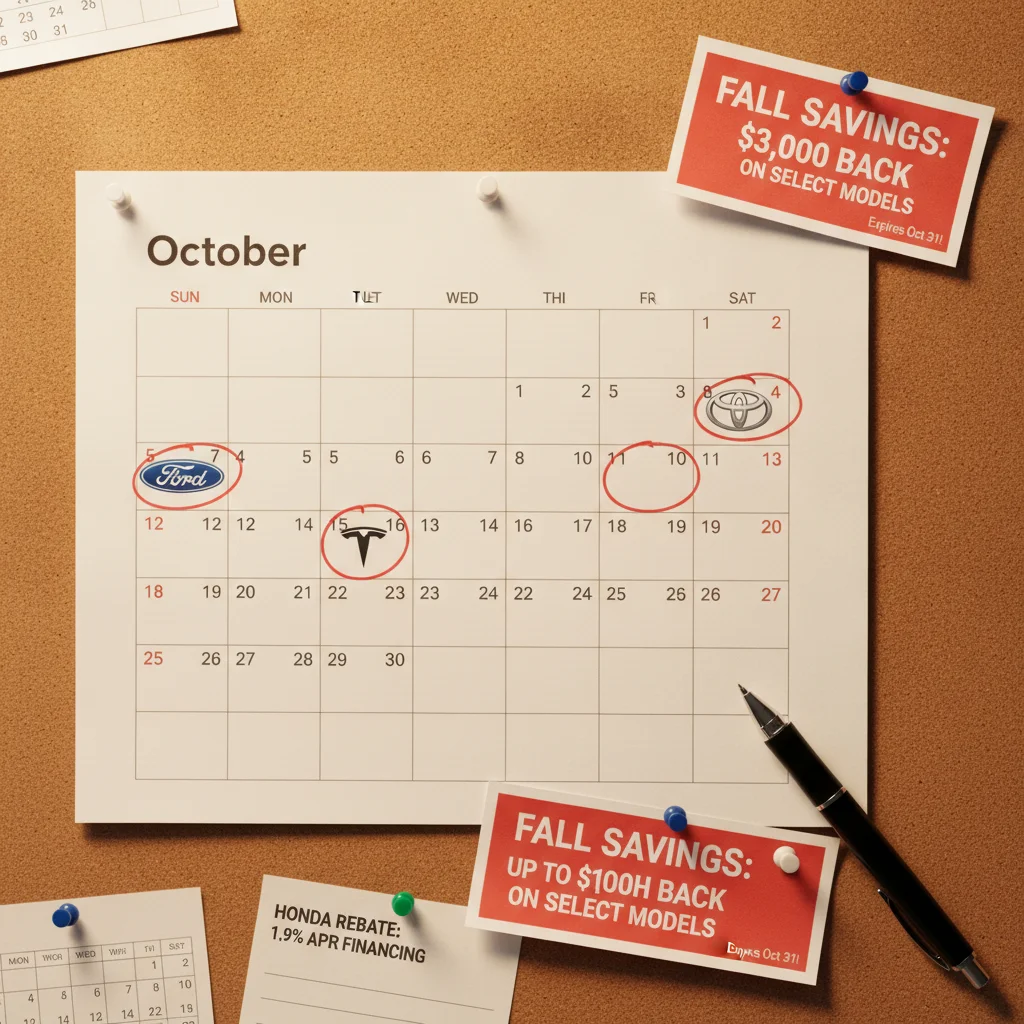
Timing also plays a significant role in how incentive programs are deployed. Manufacturers rotate programs on roughly monthly cycles tied to their sales objectives. A vehicle that has weak incentives in March may have a substantial rebate added in April to hit quarterly targets. See how to read manufacturer incentive cycles to understand how to anticipate these shifts before you shop.
Regional Variation and Eligibility Fine Print
One of the most common surprises buyers encounter is discovering that the incentive they saw advertised nationally doesn't apply in their region — or doesn't apply to the specific trim they want. Manufacturer incentives are structured by region, by trim level, and sometimes by specific VIN ranges.
Why Incentives Vary by Region
A manufacturer selling trucks well in the Midwest has less urgency to discount there. Meanwhile, the same truck might carry a $2,500 rebate in markets where it's struggling. Regional incentives are a sales-velocity tool, not a blanket consumer benefit. Always look up incentives using your actual ZIP code, not a national average.
Trim-Level Restrictions
Special APR deals almost always exclude the base trim (which already has thin margins) and sometimes the highest trim (which sells itself). Cash rebates may be restricted to specific model years — typically the outgoing model year as the new one arrives. Confirm that your exact configuration qualifies before you get emotionally attached to a deal.
Incentive Eligibility Requires Documentation
Targeted incentives like military discounts, loyalty bonuses, and recent graduate offers all require proof at time of purchase. Military buyers typically need a military ID or DD-214. Loyalty programs require your current vehicle's registration. Recent graduate offers need a diploma or transcripts plus proof of employment. Gather these documents before your dealership visit — dealers cannot process the incentive retroactively after the deal is finalized.
Lease Incentives Work Differently
The incentive analysis in this article applies to purchased vehicles. Lease deals use different financial structures — residual value adjustments and money factor reductions — that can't be compared directly to purchase rebates or APR deals. If you're deciding between leasing and buying, evaluate the incentive package for each path separately using lease-specific tools.
Lease incentives operate under an entirely different set of rules involving residual values and money factors — they're not addressed here but are equally susceptible to manipulation. If you're comparing lease vs. purchase, treat the incentive analysis separately for each path.
The broader picture of when to buy is worth understanding too. Incentive programs tend to stack highest at end of month, end of quarter, and at model-year changeover. Our car buyer's calendar breaks down how pricing and incentive availability shift month by month.
Building Your Incentive Checklist Before You Shop
The buyers who capture the most incentive value aren't the ones who negotiate hardest at the table — they're the ones who show up having already done the homework. Here's the pre-visit process that actually works.
- Identify the vehicle and trim — incentives are trim-specific. Lock in your configuration before researching.
- Visit the manufacturer's website — go to the 'Current Offers' section and enter your ZIP code. Note every consumer incentive listed for that exact model and trim.
- Check Edmunds and similar third-party sources — these often surface dealer cash figures the manufacturer site won't show consumers.
- List every targeted incentive you might qualify for — loyalty, military, recent grad, affiliate program. Gather the documentation you'll need before you go.
- Get pre-approved for financing before visiting — this gives you a real rate benchmark. When the dealer offers special APR financing, you can compare it to your pre-approval. If the special APR beats it, great. If not, you have a fallback.
- Calculate the rebate vs. APR decision in advance — use your expected loan amount and term to run the numbers before you're sitting across from a finance manager.
- Negotiate price first, incentives last — establish the lowest selling price before applying any rebate. Once the rebate is in the mix, some dealers use it to anchor and resist further price negotiation.
Run the Math Before You Walk In
Use a simple loan calculator to compute total interest at both the special APR and your best available outside rate. Subtract to get your interest savings from the special rate, then compare that figure to the rebate amount. Whichever number is higher wins — and this calculation takes about five minutes. Doing it at home beats doing it under pressure across from a finance manager.
Print the Manufacturer's Offer Page
Before your dealership visit, print or screenshot the manufacturer's current offers page for your specific ZIP code and vehicle configuration. If a dealer claims an incentive you found doesn't apply, you have documentation. Manufacturers publish these offers publicly — dealers cannot legitimately deny a consumer incentive that's currently active on a qualifying vehicle.
Trade-ins introduce another layer of complexity. Dealers sometimes inflate a trade-in offer while holding firm on vehicle price — or vice versa. Keeping these transactions separate protects your ability to evaluate each deal on its own merits. Our piece on the hidden math behind your trade-in offer explains exactly how dealers structure appraisals to their advantage.
For buyers who want to understand the full ecosystem of manufacturer incentives — including how automakers decide when to add or pull cash-back programs — see the timing your purchase hub for a comprehensive set of resources on maximizing your buying window.
All claims are backed by peer-reviewed research. Sources on request.