Key Takeaways
Why Manufacturer Incentive Cycles Exist
Automakers don't invent discount programs out of generosity. They use them as precision financial tools to accomplish three specific goals: move aging inventory before model-year changeover, prop up sales volume in slow months to hit Wall Street earnings targets, and defend market share when a competitor launches a rival model or cuts prices.
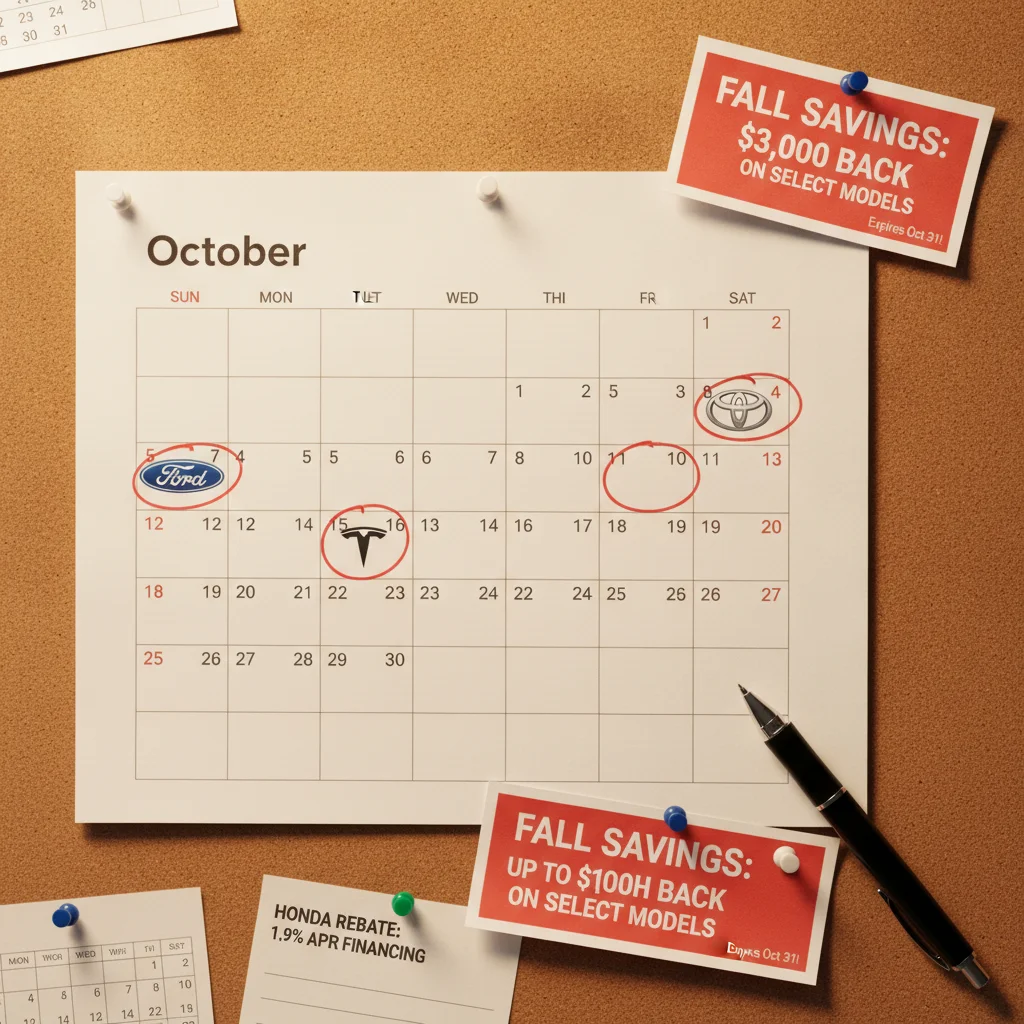
Because those pressures are structural and repeat every year, the incentive calendar is far more predictable than most buyers realize. Manufacturers typically run discrete incentive programs on 30-day periods that align with the calendar month. A program that launches September 1st will close hard on September 30th — and a fresh program, often with different terms, opens October 1st.
Layered on top of the monthly rhythm are four broader windows that almost always produce the deepest offers. Understanding where you are in that cycle is the foundation of reading incentives correctly. The Car Buyer's Calendar maps out precisely how rebate sizes and APR promotions shift month by month, which pairs directly with what you'll build here.
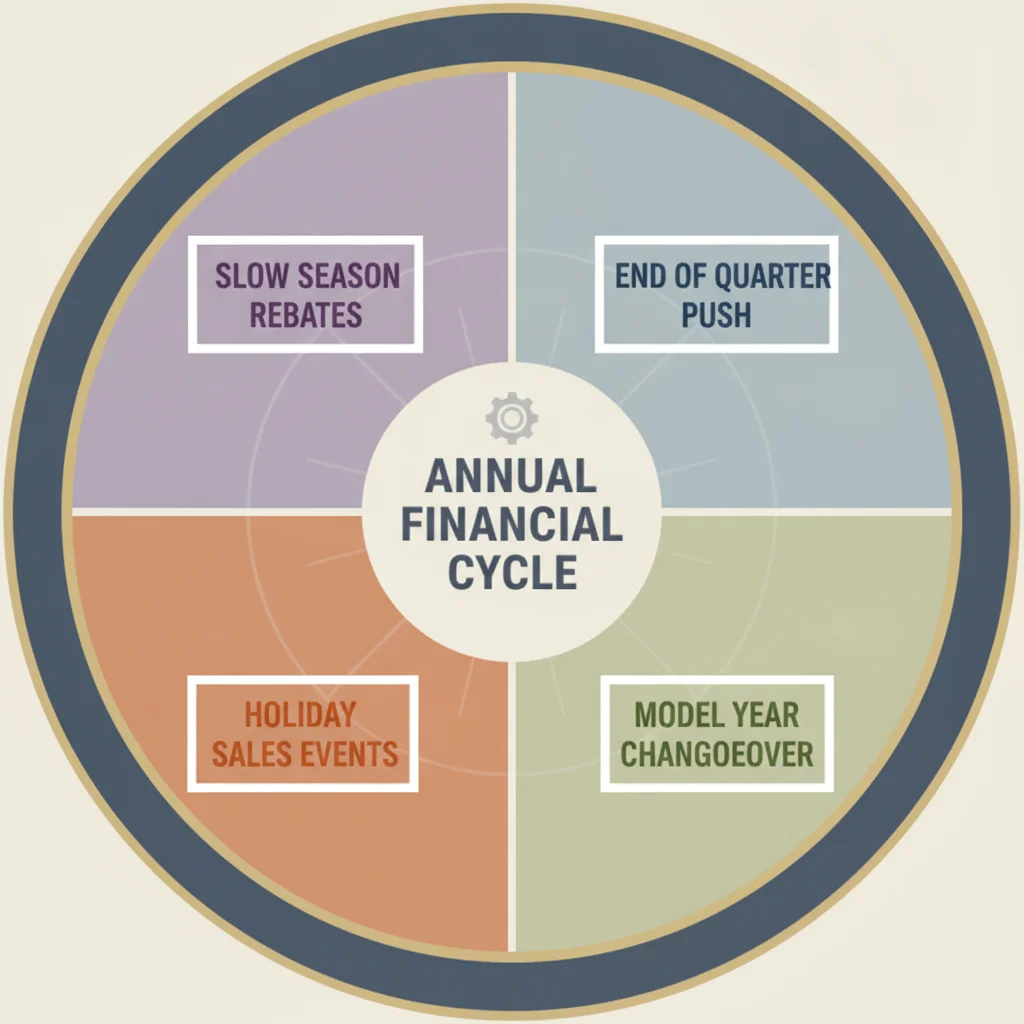
The four recurring windows are:
- End of Quarter (March, June, September, December): Sales divisions face quarterly volume targets. Incentives often spike in the final two weeks of March, June, September, and especially December as regional managers push dealers to close units.
- Model-Year Changeover (typically July–October): New model year vehicles begin arriving in late summer. Manufacturers and dealers are highly motivated to clear current-year stock and will deepen cash-back offers on outgoing models significantly.
- Holiday Sales Events (Memorial Day, Labor Day, Black Friday, year-end): Heavily advertised nationally. Often the most accessible incentive windows because the advertising is loud — but not always the deepest, since they're priced for mass participation.
- Slow Season Rebounds (January–February, mid-July): Traffic in showrooms craters in January and again in mid-summer. Manufacturers respond with elevated rebates or expanded low-APR eligibility to stimulate demand.
Knowing which window is approaching gives you the ability to time your visit rather than react to whatever a dealer tells you is a 'limited time deal.'
Tools and Resources You Will Need
Tracking incentive cycles doesn't require industry contacts or subscription services. The data is largely public — it just requires knowing where to look and how often to check.
Manufacturer Incentives Page (brand-specific)
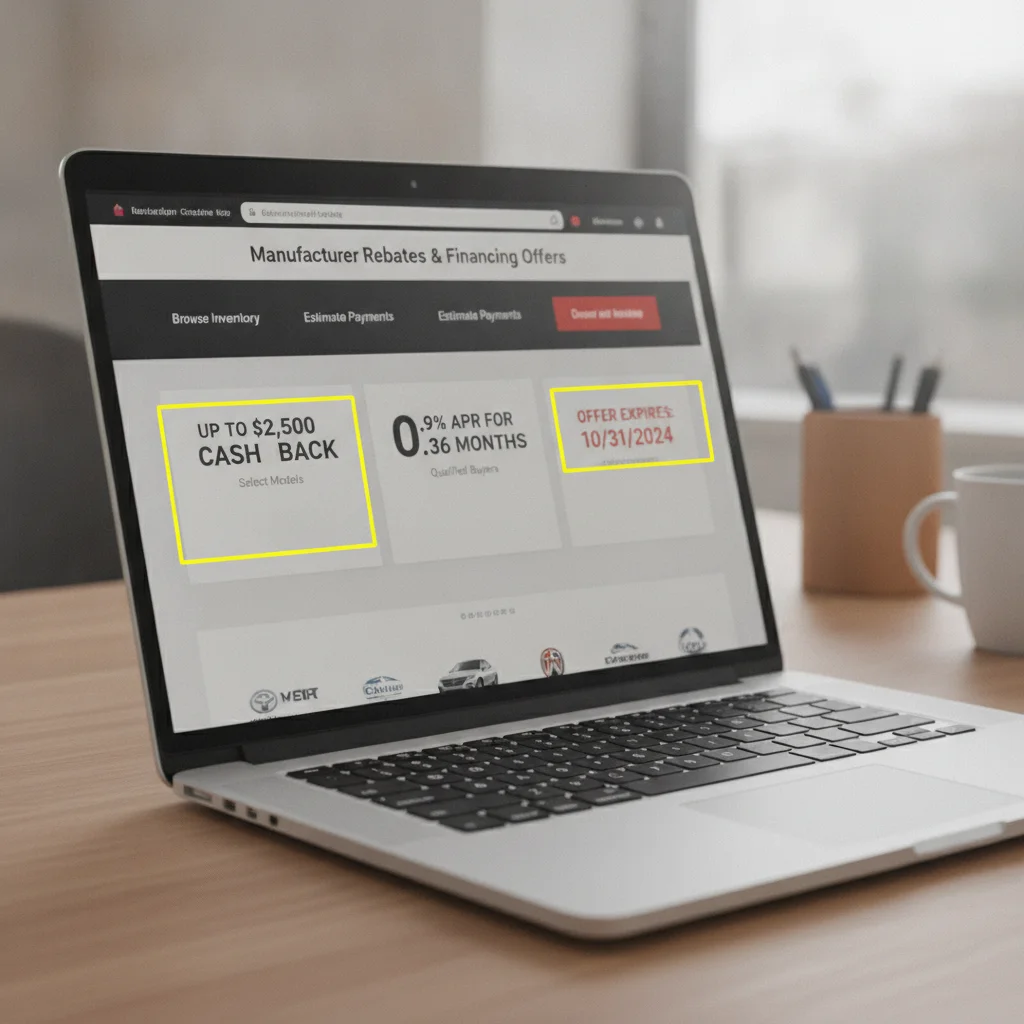
Primary source for current cash-back rebates, promotional APR offers, and program expiration dates updated at the start of each program month.
Edmunds Incentives & Rebates Tool
Aggregates manufacturer offers across brands and provides historical incentive data so you can assess whether the current offer is above or below average.
Bank or Credit Union Pre-Approval
Establishes your real-world borrowing rate, which you need to calculate whether a cash-back rebate or a promotional low-APR offer saves you more money.
Auto Loan Calculator
Computes total interest paid under different rate-and-term scenarios so you can compare the true cost of competing incentive structures.
Credit Report (from AnnualCreditReport.com)
Reveals your credit tier so you can confirm eligibility for the top-tier promotional APR before building your deal around it.
TrueCar or Cars.com Inventory Search
Tracks regional inventory levels on your target trim so you can monitor whether supply is tightening before a better incentive window arrives.
Spreadsheet or Notes App
Records your month-over-month incentive tracking data so you can identify trends and make a confident timing decision.
The manufacturer's own website is the most authoritative source for current incentive terms. Every major automaker — Ford, GM, Toyota, Honda, Stellantis, Hyundai, and others — maintains a dedicated offers or incentives page updated at the start of each program month. Navigate directly to the brand's website and look for tabs labeled 'Current Offers,' 'Deals,' or 'Incentives.' Filter by your ZIP code because offers vary regionally.
Third-party aggregators compile and archive these offers across brands, which makes comparison shopping dramatically faster. Sites like Edmunds, Cars.com, and TrueCar publish manufacturer offers alongside dealer-level data. Edmunds in particular tracks historical incentive data, which lets you see whether the current offer is larger or smaller than what ran in prior months — invaluable context.
For financing specifically, bookmark the manufacturer's captive finance arm: Ford Credit, Toyota Financial Services, GM Financial, Honda Financial Services, and so on. These lenders publish their own rate sheets, and their promotional APR programs — the 0%, 0.9%, or 1.9% offers — come directly from the automaker's marketing budget, not the dealer. The captive finance page will list exact credit tier requirements, which you'll need to cross-reference against your own credit profile.
What you will need
How to Read the Incentive Cycle Step by Step
The process below will take you from identifying the right window to calculating which offer structure actually saves you the most money on your specific deal. Follow each step before you set foot in a dealership.
Identify the Current Program Month and Its Expiration Date
Go directly to your target manufacturer's website and navigate to the current offers page. Locate the program expiration date — it is usually displayed in small print near the top or bottom of the offers listing, formatted as something like 'Offers valid through [Month] [Day], [Year].' Write that date down. This is your operating deadline.
Note how many days remain in the current program. If you have fewer than seven days, the next monthly program is about to launch and you should wait to see whether the incoming terms are stronger or weaker before committing.
Record Every Incentive Available on Your Target Model
On the same page, list every offer type available for your specific model and trim: cash-back rebate amounts, promotional APR tiers and loan terms, lease money factor and residual if applicable, and any affinity bonuses (loyalty, conquest, military, college graduate). Many manufacturers display a dropdown or filter that lets you switch between 'Finance Offers,' 'Lease Offers,' and 'Cash Offers' — check all three tabs.
Create a simple table with four columns: Offer Type, Amount or Rate, Term (months), and Credit Tier Required. You'll reference this table in the next step when you run the math.
Determine Where You Are in the Annual Incentive Cycle
Using your table from Step 2, look up the same model's incentive history on Edmunds or a comparable third-party site. Most will display a rolling 3–6 month history of offers. Compare the current cash-back amount to what ran in prior months. Ask three questions:
- Is the current rebate higher, lower, or equal to the trailing three-month average?
- Is an end-of-quarter or model-year changeover window approaching within the next 60 days?
- Has this model received a recent price increase or competitive model launch that might prompt the manufacturer to sweeten offers?
If the current incentive is below the trailing average and a stronger window (end of quarter, changeover season) is six to eight weeks away, a patient buyer can reasonably wait. If the current offer is at or above the historical peak, that is a signal to move.
Calculate the True Value of Each Offer Type
This step requires arithmetic, but it's straightforward. You need to compare the cash-back path against the low-APR path for the same vehicle at the same selling price.
Cash-Back Scenario: Take your expected loan amount (selling price minus down payment minus rebate), apply your actual market interest rate (get a pre-approval from your bank or credit union to find this), and calculate total interest paid over your chosen term using a basic loan calculator.
Low-APR Scenario: Take the same loan amount but without the rebate applied, and calculate total interest paid at the promotional rate over the same term.
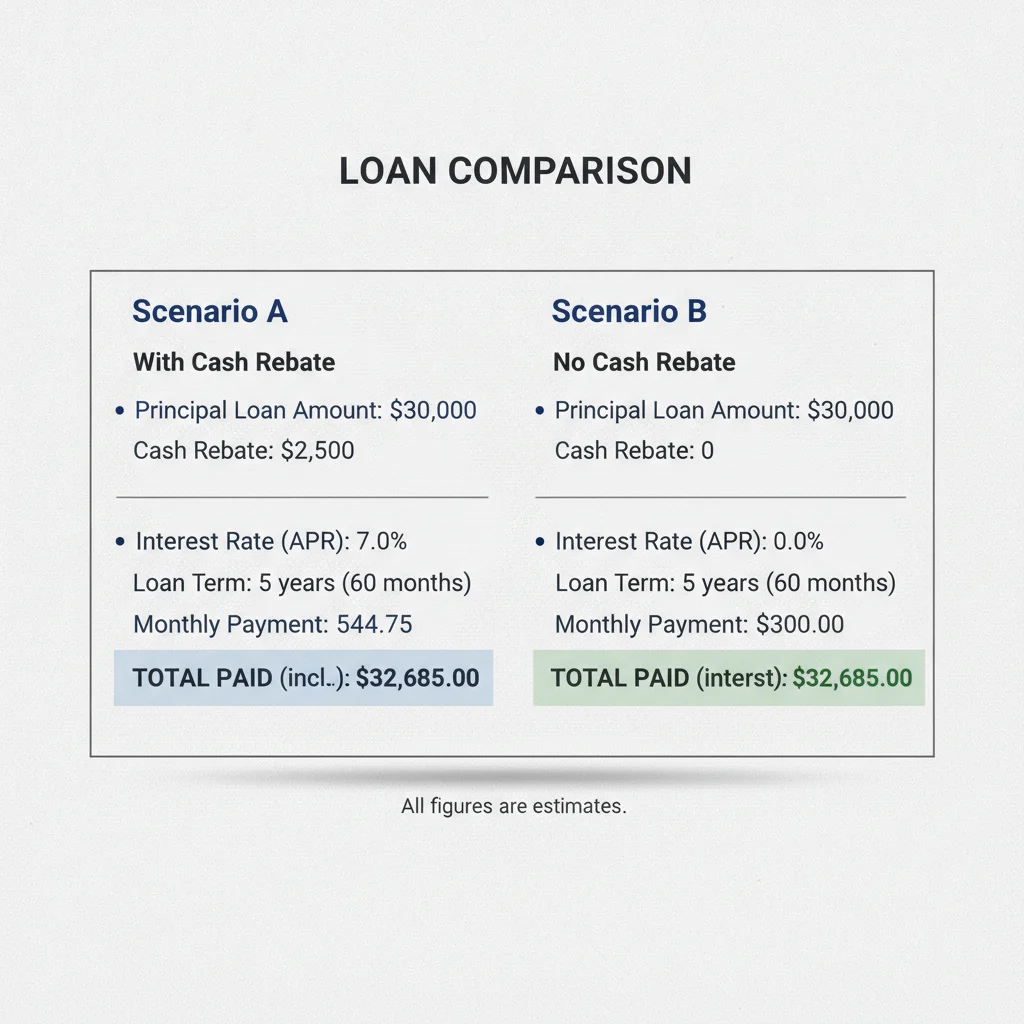
The difference in total interest paid between the two scenarios is the 'true value' of the low APR. If the total interest savings exceed the rebate amount, the low-APR deal wins. If not, take the cash. Here's a concrete example:
| Scenario | Loan Amount | Rate | Term | Total Interest |
|---|---|---|---|---|
| $2,500 Rebate + 7% APR | $27,500 | 7.0% | 60 mo | $5,348 |
| 0% APR, No Rebate | $30,000 | 0.0% | 60 mo | $0 |
In this example, the 0% APR saves $5,348 in interest versus only $2,500 from the rebate — the low-APR path wins by $2,848. But if your loan term were shorter or your market rate lower, the math shifts. Run it with your own numbers every time.
Set Your Purchase Date and Alert Triggers
Based on your analysis from Steps 3 and 4, make a concrete decision: buy now within this program month, or wait for a specific future window. Vague intentions to 'wait for a better deal' almost never produce results. Instead, set two specific triggers:
- Calendar alert: Set a reminder for the 15th of each month to re-check the manufacturer's offers page and update your comparison table. Monthly programs change on the 1st, so mid-month gives you two weeks of data to evaluate the new terms.
- Inventory alert: Use the dealer's website or a third-party tool to set a saved search for your target trim. When inventory on that specific configuration drops below three units regionally, the risk of waiting outweighs the benefit — a better incentive is worthless if the car you want isn't available.
If you've concluded the current incentive is the best likely offer for the next 60–90 days, commit to a target purchase week (ideally the third week of the month) and begin the final negotiation sequence.
Verify Incentive Eligibility on the Actual VIN at the Dealership
When you arrive at the dealership and identify the specific vehicle you want to purchase, ask the finance manager to print the manufacturer's current incentive disclosure for that VIN before any paperwork begins. This document, sometimes called the 'deal sheet' or 'factory invoice addendum,' will confirm which incentive programs apply to that specific vehicle, the exact rebate amount, and the promotional APR tiers available.
Compare this printout against your own research from Steps 1 and 2. Discrepancies are rare but do occur — particularly when a vehicle has been on the lot for an extended period and its model year or region code creates an eligibility boundary. If a program you expected to see is missing, ask the finance manager to call the manufacturer's dealer support line to verify before proceeding.
Once incentive eligibility is confirmed in writing, finalize your offer-type choice (cash back vs. low APR) using the math you already ran in Step 4, and proceed to negotiate the out-the-door price independently of the incentive amount.
Stacking Incentives and Spotting Hidden Opportunities
Manufacturer programs are the floor, not the ceiling. Dealers layer their own discounts on top, and a few combination strategies are worth knowing explicitly.
Dealer Cash vs. Consumer Cash
Manufacturers sometimes run two separate incentive tracks simultaneously on the same vehicle: dealer cash (paid directly to the dealer) and consumer cash (paid to the buyer as a rebate). Dealer cash isn't always disclosed proactively. Ask your salesperson directly: 'Is there any manufacturer-to-dealer cash on this vehicle right now?' If the answer is yes, you can negotiate for some or all of it to flow to you through a reduced selling price. Decoding Dealer Incentives goes deep on exactly how to identify and claim both consumer and dealer money in the same transaction.
Loyalty and Conquest Bonuses
Many manufacturers run loyalty bonuses (extra cash for current owners of the same brand) and conquest bonuses (extra cash for switchers from a competitor brand). These are typically stackable with the base consumer cash rebate and are worth $500–$1,500 on average. Check the manufacturer's fine print for both, since you can only qualify for one or the other on a given purchase, not both simultaneously.
Military, First Responder, and College Graduate Programs
These affinity programs run year-round on their own separate tracks and are almost always stackable with the monthly incentive program. If you or a household member qualifies, include these before doing your rebate-versus-APR calculation — they change the math.
Timing a Trade-In During an Incentive Cycle
If you're trading in a vehicle, be aware that strong manufacturer incentives can subtly shift negotiating leverage. When a dealer knows you're motivated by a limited-time rebate expiring at month-end, they may tighten the trade-in appraisal to recapture margin. Separate the two negotiations when possible: get an independent trade-in offer first, then negotiate the new car purchase price. Understanding Dealer Trade-Ins explains how appraisal pricing works and how to push back effectively.
Incentives Can Disappear Mid-Month
While monthly programs officially run from the 1st through the last day of the month, manufacturers can and occasionally do terminate or modify offers early — particularly if a program is oversubscribed or a corporate announcement changes direction. Never assume the incentive you researched last week is still available today without re-verifying on the manufacturer's website before you visit the dealership.
Don't Let Timing Override Fit
Chasing the optimal incentive window can tempt buyers into purchasing the wrong vehicle — wrong trim, wrong powertrain, or wrong color — simply because that configuration happened to be in stock during a favorable month. A 15% better incentive on a car that doesn't fit your needs will cost you more in dissatisfaction and eventual resale loss than waiting for the right vehicle at a slightly smaller discount.
Track Two or Three Consecutive Months First
If you have 60–90 days before you need to buy, spend the first month purely observing: record the current offer amounts, note the expiration dates, and do nothing else. The following month, compare the new program terms against your baseline. By the third month you'll have a clear picture of the trend direction — rising, falling, or flat — which dramatically reduces the guesswork in your timing decision.
Internet Sales Departments Move Faster
Most dealerships have a dedicated internet or fleet sales department that operates on compressed margins and lower pressure tactics than the showroom floor. Contact them by email with your target vehicle configuration, your research on current incentives, and your pre-approval rate. You'll often receive out-the-door pricing faster and with less friction, leaving more time to evaluate the deal carefully.
Model-Year Changeover Is the Single Best Window
If your schedule allows flexibility, the July-through-October changeover period — when new model year inventory begins arriving and outgoing models need to clear — consistently produces the largest absolute rebates of the year on most mainstream models. Cash-back offers on outgoing model-year vehicles during this window can run 20–40% higher than the same vehicle's average rebate from January through June.
Common Mistakes That Undermine Your Timing Strategy
Even buyers who do the research ahead of time make a handful of predictable errors that erode the savings they worked to find.
Waiting Too Long Within the Window
The last weekend of any incentive month is the busiest time at every dealership in the country. Salespeople are stretched thin, negotiating leverage tilts toward the house, and inventory on popular trims can evaporate. If you've confirmed that the current incentive is the one you want, aim to close in the third week of the month rather than the final days. You'll get more attention, more time to review documents, and you'll still capture the incentive.
Applying for Financing Without Knowing Your Tier
Promotional APR rates — especially 0% and 0.9% offers — are reserved for Tier 1 credit, which typically means a FICO score of 720 or above, sometimes 740 or higher depending on the lender. If your score falls below that threshold and you've budgeted around a 0% payment, your deal will reprice at signing. Pull your credit report before you shop so there are no surprises. Timing Your New Car Purchase covers how your financial readiness interacts with market timing to maximize your position.
Ignoring Regional Variation
Incentive offers are not uniform nationally. A manufacturer running a $3,000 cash-back offer in the Southeast may be running only $1,500 in the Pacific Northwest on the same model, because regional inventory levels and competitive pressure differ. Always pull the offer for your specific ZIP code, not the national headline number you saw in an advertisement.
Mistaking Advertised Payment for the Deal
Television and digital ads promote a monthly payment that assumes maximum rebate, maximum down payment, and Tier 1 credit simultaneously. That combination describes a minority of buyers. Reconstruct the deal from its components — out-the-door price, down payment, interest rate, and term — rather than working backward from the advertised payment.
The incentive cycle is a system, and systems reward people who understand their mechanics. Once you've tracked a specific model through two or three monthly cycles, you'll develop an intuitive sense for when that vehicle's offers are at a seasonal peak and when manufacturers are holding back. That pattern recognition is worth more than any single coupon or advertised weekend sale event.
For context on how lease returns influence used inventory pricing during some of the same windows, see Timing Your Car Purchase Around a Lease Return — particularly relevant if your budget spans both new and certified pre-owned options.
Low APR and Cash Back Rarely Coexist
Most manufacturers force you to choose between a subsidized interest rate and a cash rebate — you typically cannot claim both on the same vehicle. Before you walk into a dealership, run the numbers: multiply the rebate amount against your expected loan balance and compare the total interest saved at the promotional APR versus your standard rate. Choosing the wrong option can cost you hundreds or even thousands over the life of the loan.
Incentives Are VIN-Specific and Expire
Manufacturer offers are attached to specific model trims and vehicle identification numbers in the dealer's inventory management system. An incentive advertised on a manufacturer's website this week may not apply to every car on the lot — and it will hard-expire at the end of the program month, often at midnight on the last calendar day. Always verify eligibility on the specific vehicle before signing, and get the incentive dollar amount disclosed in writing on the purchase agreement.

All claims are backed by peer-reviewed research. Sources on request.