

Key Takeaways
Production Announcement Signal
A production announcement signal is any official statement from an automaker about changes to how many vehicles it plans to build, which models it will continue or discontinue, or how it will reallocate factory capacity. These announcements create predictable ripple effects on new and used car prices — often weeks or months before consumers notice a change at the dealership. Buyers who know how to interpret these signals can position themselves to pay less or sell for more.
In industry terms, these signals often appear in earnings calls, press releases, or SEC filings as 'production volume guidance' or 'capacity utilization adjustments.' Monitoring them alongside dealer inventory data gives the clearest picture of near-term pricing pressure.
Why Factory Decisions Are Pricing Decisions
Most car buyers think of pricing as something that happens at the dealership — a negotiation between a salesperson and a consumer. In reality, the most powerful pricing forces are set months earlier, inside corporate boardrooms and on factory floors.
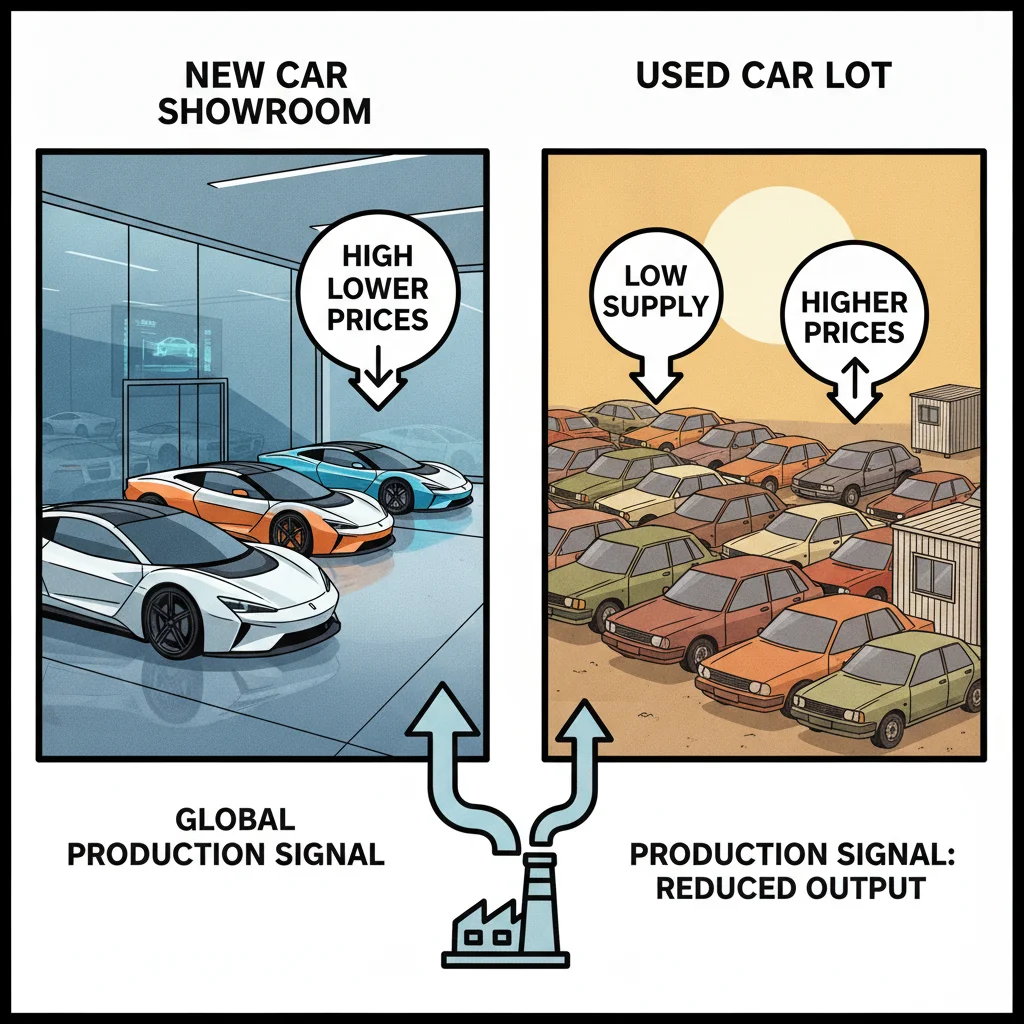
When an automaker adjusts production, it controls supply. And in any market, supply is half of the price equation. A manufacturer that cuts output by 15% isn't just making fewer cars — it's quietly tightening the inventory pipeline that feeds every dealer lot in the country. By the time you're standing on that lot, the outcome is already partially scripted.
The good news: automakers are publicly traded companies or operate in regulated industries that require transparency. Their production decisions leave a paper trail — earnings calls, plant shift announcements, supplier contracts, and regulatory filings. Learning to read that trail is one of the most underused advantages available to any car buyer.
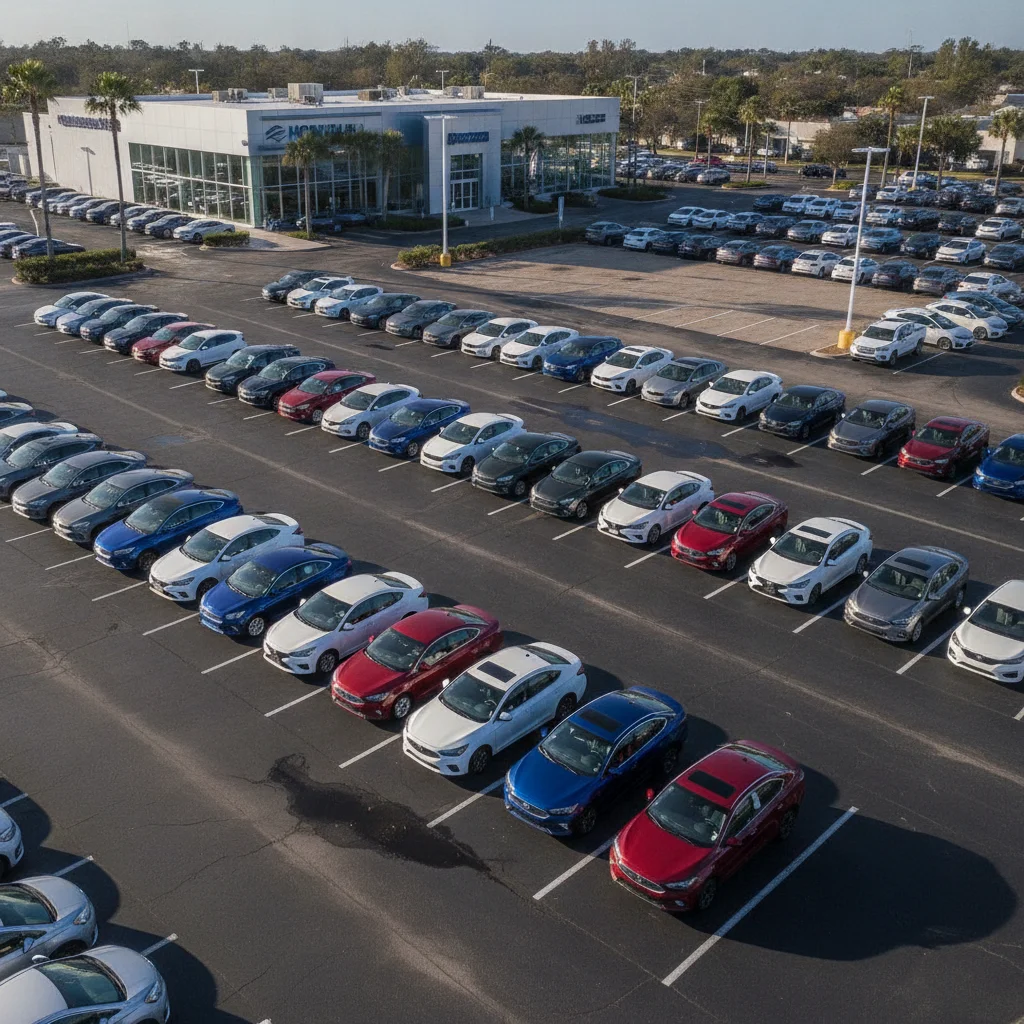
Think of it this way: a fishing fleet captain who knows a storm is coming can adjust plans before the weather hits. Production announcements are your weather forecast for car prices.
The Four Types of Production Signals — and What Each Means for Price
Not all production announcements are created equal. Each type sends a different pricing signal, and each affects new and used markets differently.
1. Output Cuts
When an automaker announces it's reducing how many units it will build — whether by running plants on one shift instead of two, idling a facility, or simply revising annual volume targets downward — the supply of new vehicles shrinks. Dealers can't discount aggressively on cars they don't have in surplus. Transaction prices typically rise above MSRP, or dealer incentives disappear entirely.
The 2021–2022 semiconductor shortage is the clearest modern example. When automakers couldn't source enough chips, new car production fell dramatically. Average transaction prices shot past MSRP on many models — some by $5,000 to $10,000 or more. Buyers who watched plant shutdown announcements in early 2021 had a few weeks to act before prices spiked.
30–40%
Used car price increase during 2021–2022 chip shortage
According to Manheim Used Vehicle Value Index data, average used vehicle prices surged 30–40% above pre-pandemic levels as new-car production cuts starved the used market of trade-in supply.
~90 days
Typical lag from production cut to dealership price impact
Industry analysts at Cox Automotive estimate it takes approximately 60–90 days for an announced production cut to reduce dealer lot counts meaningfully, with pricing effects lagging another 30–60 days.
8–15%
Typical MSRP discount on outgoing models after redesign announcement
Historical transaction data from Edmunds shows outgoing model year vehicles commonly sell 8–15% below MSRP in the months immediately following a confirmed next-generation announcement.
$10,000+
Dealer markup above MSRP on constrained models (2022 peak)
At the height of the 2021–2022 inventory shortage, popular models like the Toyota RAV4 Hybrid and Ford Bronco carried average dealer markups exceeding $10,000 above MSRP, per Edmunds transaction data.
3–6 months
Window between production ramp-up and buyer price relief
Analysis by WardsAuto of multiple production expansion cycles shows buyer-facing price improvements — wider incentives and lower transaction prices — typically materializing 3 to 6 months after a ramp-up goes live.
2. Production Ramp-Ups
The opposite signal. When a manufacturer announces it's adding a third shift, expanding a plant's capacity, or building a new facility to meet demand, more vehicles are coming. That increased supply eventually reaches dealers and creates competition — dealers have to discount to move units faster than their neighbors. This is when buyer-favorable conditions start forming.
3. Model Discontinuations
When a nameplate is killed — think Chevrolet SS, Ford Fusion, or Dodge Dart — two things happen almost simultaneously. New inventory of that model clears out at deep discounts (dealers don't want orphaned stock). Then the used market softens, because future buyers have no new-car benchmark price and no manufacturer support to anchor resale value.
If you own a car whose model has just been discontinued, this is a critical signal: sell or trade sooner rather than later. The depreciation curve steepens quickly once the announcement is confirmed. See how discontinuation accelerates depreciation for more detail on what to watch.
4. Platform or Generation Changes
When an automaker announces a full redesign or new-generation model, the outgoing version becomes a known quantity with an expiration date. Dealers holding current-generation inventory need to move it before the new model arrives. This creates a predictable discount window — often the best buying opportunity on a given model. Model year changeover timing is a closely related concept worth understanding.
Production Announcements vs. Sales Announcements
Don't confuse production announcements with monthly sales figures. Sales data tells you what already happened — how many vehicles dealers already sold last month. Production announcements tell you what's coming to dealer lots in the future. For pricing prediction purposes, production data is almost always more useful than sales data because it's forward-looking.
EV Incentive Cliffs Change the Math
Federal EV tax credits under the Inflation Reduction Act are subject to assembly-location rules, battery sourcing thresholds, and income caps that can change with little notice. An EV production ramp-up that would normally signal lower prices can be partially or fully offset by a simultaneous loss of tax credit eligibility. Always verify current incentive status at fueleconomy.gov alongside any production news you track.
How to Actually Find These Announcements
You don't need a Bloomberg terminal or an industry subscription to track production signals. Here's a practical, mostly free toolkit:
- Automaker investor relations pages: Every publicly traded automaker publishes quarterly earnings and sometimes monthly sales data. These documents often contain production guidance in plain language. Search for ' investor relations' and look for 'earnings transcript' or 'production guidance.'
- SEC filings (EDGAR): U.S.-listed automakers and their U.S. subsidiaries file production-related disclosures in 10-Q and 10-K reports. Search SEC.gov for the company name.
- Trade publications: Automotive News, WardsAuto, and Car and Driver's news section cover plant announcements in near-real time. Much of this is freely accessible.
- Union contract news: UAW negotiations and contract agreements often spell out production commitments — how many vehicles a plant will build and for how long. These are underappreciated pricing signals.
- Google Alerts: Set an alert for ' production' or ' plant' and new articles will land in your inbox automatically.

Once you've spotted a signal, cross-reference it with current dealer inventory data on sites like Cars.com or Edmunds. If you see a production cut announced alongside already-lean inventory, that's a strong sign prices will firm up quickly.
Set Up a Free Production Alert System
Go to Google Alerts and create alerts for '[Model name] production,' '[Brand] plant shutdown,' and '[Brand] production cut.' Set delivery to 'as it happens' rather than daily digest. This gives you the same early warning system that auto industry professionals use, at zero cost. Pair it with a monthly check of your target model's days-on-lot statistic via Edmunds or Cars.com to see when inventory is actually tightening.
Time Your Decision to the Announcement, Not the News Cycle
The moment a production cut reaches mainstream consumer media — mainstream car-buying articles, local news, or social media — prices at many dealers have already adjusted. Your advantage lives in the 60-to-90-day window between the trade-press announcement and the mainstream coverage. Build your car-buying timeline around production signals, not around when you happen to feel ready to shop.
The Timing Gap: From Announcement to Dealership Impact
Understanding the lag between a production announcement and its effect on your local dealership is what separates savvy buyers from the crowd. The general timeline works like this:
- Week 0–2: Announcement made via earnings call, press release, or union negotiation. Trade media covers it; mainstream consumer coverage is minimal.
- Week 4–8: Factory output begins adjusting. Vehicles already in the pipeline continue to flow to dealers, so inventory appears normal initially.
- Week 8–16: Dealer lot counts for the affected model begin declining. Days-on-lot metrics start dropping as unsold inventory clears without being replenished at the same rate.
- Week 12–20: Dealer discounting softens or disappears. Manufacturers may pull cash-back incentives. Transaction prices begin rising above what they were three months prior.
- Week 20+: Mainstream financial and consumer media publish articles about 'tight supply' and 'rising prices.' By now, the optimal buying window has closed.
This timing gap — roughly three to five months — is your window. If you're planning a purchase in the next six months and you see a production cut announced today, you need to decide quickly whether to buy before inventory tightens or wait and risk paying more.
“The car buyer who reads an earnings call transcript is, on average, three months ahead of the buyer who reads a newspaper headline. That gap is worth real money at the negotiating table.”
— Ivan Drury, Director of Insights, Edmunds
The inverse is also true for production ramp-ups. Acting on a capacity expansion announcement can mean waiting a few months for inventory to build, then arriving at the dealership with genuine leverage when competitors are running three-shift operations.
New Car vs. Used Car: Different Signals, Different Strategies
The same production announcement can be good news for one type of buyer and bad news for another. Understanding which camp you're in matters.
For New Car Buyers
A production cut is generally bad news — it removes your leverage. You should either buy before inventory tightens or pivot to a competing model that's in ample supply. A ramp-up is good news — patience will reward you with better deals in three to six months.
When a new generation is announced, the outgoing model often hits deep discounts. This is the sweet spot: previous-year model pricing can drop 8–15% below MSRP as dealers and manufacturers both push to clear inventory.
For Used Car Buyers
New car supply cuts paradoxically hurt used car buyers too. When fewer new cars are available, buyers who can't find new inventory flood the used market, pushing used prices up. This is exactly what happened in 2021–2022 when used car prices rose 30–40% on some models — a direct downstream effect of new-car production cuts.
A new-car production ramp-up, by contrast, is eventually good for used buyers. More new cars mean more trade-ins, more lease returns, and more used supply.
For Sellers and Traders
If you're planning to trade in or sell privately, a new-car production cut near your target sale date can actually boost your used car's value — less new supply means more buyers competing for your used vehicle. The market timing dynamics here are worth understanding before you list.
Track both valuation tools like KBB and Edmunds and production news simultaneously to find the optimal moment to list.
Electric Vehicles: A Noisier Signal
EV production announcements carry extra variables that make them harder to interpret than traditional vehicle signals — but they're not unreadable.
First, EV pricing is heavily influenced by federal tax credits, which are tied to assembly location, battery sourcing, and buyer income limits. An automaker may announce increased EV production while simultaneously triggering a credit phase-out, making the net consumer price higher despite more supply. Always check the incentive status alongside the production news.
Second, battery supply chains are separate bottlenecks. An automaker can announce ambitious EV production targets while a battery supplier is struggling with raw material shortages. In this case, the production announcement may be aspirational rather than operational — verify with plant-level news, not just corporate targets.
Third, EV technology evolves rapidly enough that a production cut may signal a strategic pause before a significant battery upgrade, not permanent capacity reduction. A brief supply dip followed by a significantly improved product can actually represent a buying opportunity for the new version — if you can wait.
The broader economic signals that move the used car market — including fuel prices and consumer confidence — layer on top of EV production signals in ways that make EVs a more complex but rewarding subject to track.
Production Announcements vs. Sales Announcements
Don't confuse production announcements with monthly sales figures. Sales data tells you what already happened — how many vehicles dealers already sold last month. Production announcements tell you what's coming to dealer lots in the future. For pricing prediction purposes, production data is almost always more useful than sales data because it's forward-looking.
EV Incentive Cliffs Change the Math
Federal EV tax credits under the Inflation Reduction Act are subject to assembly-location rules, battery sourcing thresholds, and income caps that can change with little notice. An EV production ramp-up that would normally signal lower prices can be partially or fully offset by a simultaneous loss of tax credit eligibility. Always verify current incentive status at fueleconomy.gov alongside any production news you track.
Putting It All Together: A Buyer's Action Framework
Reading signals is only useful if you translate them into decisions. Here's a simple framework:
- Signal: Production cut announced on a model you want
- Act within 60 days or prepare to pay full MSRP — or above. If you can't act quickly, pivot to a competing model in healthy supply.
- Signal: Production ramp-up announced on a model you want
- Wait 3–6 months. Inventory will build, dealers will discount, and manufacturer incentives may appear. Use the waiting period to track the observable cues that a price drop is coming.
- Signal: Model discontinuation announced
- If buying: look for end-of-life discounts, but research parts availability and resale carefully. If selling: list immediately — don't wait for the market to fully price in the news.
- Signal: New generation or redesign announced
- Buy the outgoing model at a discount or wait for the new version. The worst position is buying the current model at full price just before the new one launches.
Set Up a Free Production Alert System
Go to Google Alerts and create alerts for '[Model name] production,' '[Brand] plant shutdown,' and '[Brand] production cut.' Set delivery to 'as it happens' rather than daily digest. This gives you the same early warning system that auto industry professionals use, at zero cost. Pair it with a monthly check of your target model's days-on-lot statistic via Edmunds or Cars.com to see when inventory is actually tightening.
Time Your Decision to the Announcement, Not the News Cycle
The moment a production cut reaches mainstream consumer media — mainstream car-buying articles, local news, or social media — prices at many dealers have already adjusted. Your advantage lives in the 60-to-90-day window between the trade-press announcement and the mainstream coverage. Build your car-buying timeline around production signals, not around when you happen to feel ready to shop.
No single signal should drive a decision on its own. Cross-reference production news with current dealer inventory levels, transaction price data (available through Edmunds True Market Value or TrueCar), and your own purchase timeline. The buyer who combines multiple data sources consistently outperforms the one relying on a single headline.


All claims are backed by peer-reviewed research. Sources on request.