
Key Takeaways
Why Price Drops Are Predictable — If You Watch the Right Signals
Most car buyers treat the sticker price like a fixed fact of nature. It isn't. Dealer pricing is a living system shaped by inventory age, competitive pressure, manufacturer incentive cycles, and the quiet panic of a model that isn't moving. The good news: nearly all of those forces leave observable footprints before prices actually fall.
Think of it like reading weather patterns. A single cloud doesn't tell you much, but a combination of dropping pressure, rising humidity, and a shift in wind direction tells an experienced observer that rain is coming. Car pricing works the same way. Days on lot, trim-level announcements, factory production data, and seasonal sales calendars all interact — and when several of those signals line up, a discount is often just weeks away.
This guide walks through the most reliable signals, what each one means mechanically, and how to use them to time a purchase or negotiation in your favor. For the broader timing framework — end-of-month, end-of-year, model changeover windows — see our guide to timing your new car purchase.
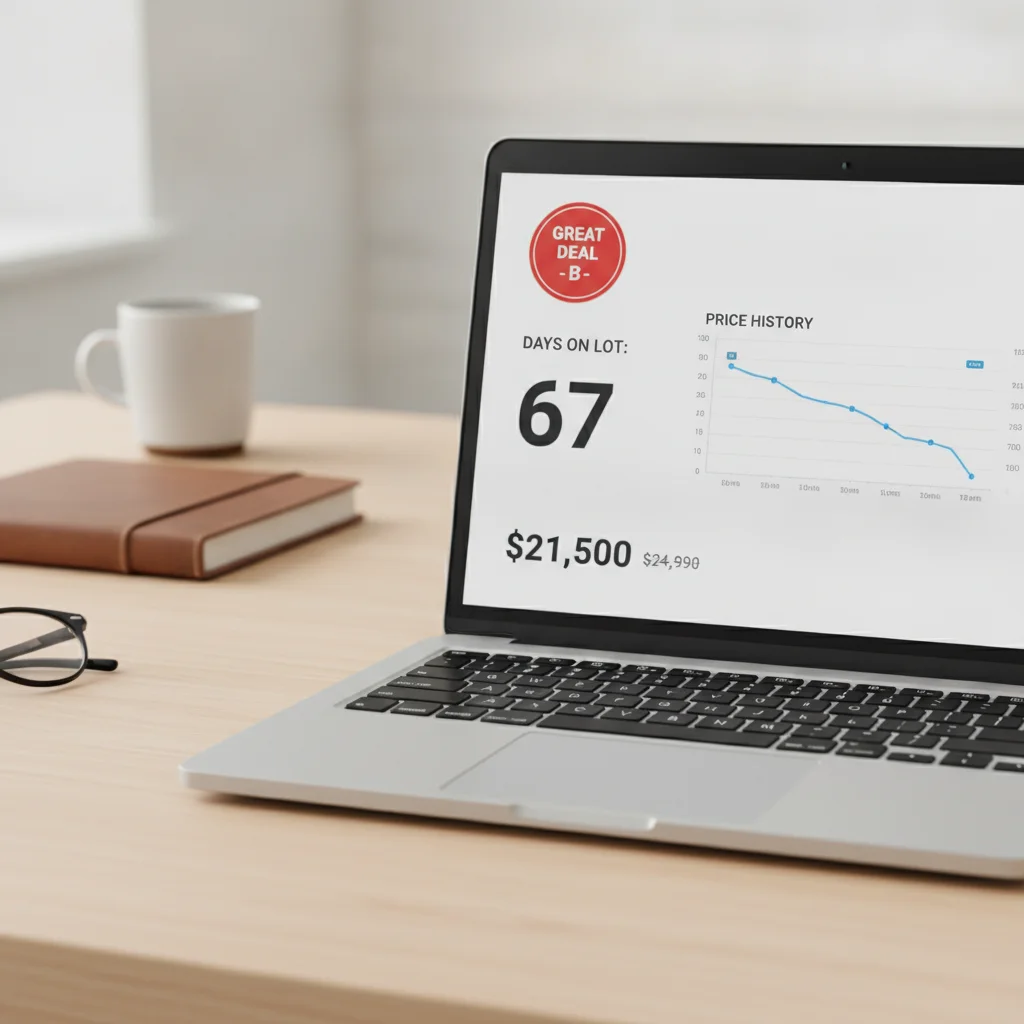
Below are the eight clearest signals that a vehicle's price is heading south — and what to do when you spot each one.
Days on Lot Crossing the 45-Day Threshold
Every vehicle that arrives at a dealership starts a clock. Dealers track this figure obsessively because inventory carrying costs — floor plan interest, insurance, lot space — compound daily. Industry benchmarks vary by segment, but for most mainstream vehicles, 45 days without a sale triggers internal pressure to discount. By 60–75 days, many dealers will have already applied a price reduction or flagged the unit for a factory-to-dealer incentive pull-forward.
You can find days-on-lot data yourself without ever calling a dealer. Sites like CarGurus, Cars.com, and Autotrader display a "days listed" figure on most vehicle pages. A car listed for 55 days on a lot that typically turns inventory in 30 days is a car that wants to be sold. Compare the days-on-lot figure against the make and model's average days-to-turn — CarGurus publishes this market context directly in its "Good Deal" rating algorithm.
What to do: Sort search results by days listed (longest first) for the model you're targeting. Any unit past 45 days deserves a lowball opening offer. Past 60 days, expect the dealer to be genuinely motivated — ask about any "aged inventory" programs they may be running.
A car sitting on the lot past 45 days is carrying costs that make the dealer eager to deal.
An Announced Model-Year Refresh or Full Redesign
Automakers typically announce upcoming redesigns six to eighteen months before the new model hits showrooms — and that announcement immediately devalues the current generation in buyers' minds. Dealers know this too. As soon as an official reveal date or production start is publicly confirmed, the outgoing model transitions from "current" to "soon-to-be-old," and discounting begins.
The pattern is consistent: a model in the final year before a full redesign often carries the largest incentives it will ever see in its lifecycle. Manufacturers and dealers both need to clear existing inventory before the new generation arrives. A $35,000 crossover in its last model year before a complete overhaul might carry $2,000–$4,000 in combined factory and dealer discounts that its successor won't see for years.
Track refresh cycles through manufacturer press rooms, automotive news outlets like MotorTrend and Car and Driver, and the spy-shot communities that often surface prototype sightings 12–18 months out. The guide to reading automaker production announcements explains exactly how to interpret those signals before prices shift.
[in_content_images:1]What to do: If a model you're considering is in the final year before a known redesign, that's a buyer's market. Push for invoice price or below, and stack any manufacturer rebate on top.
Outgoing models before a redesign often carry the largest incentives they'll ever see.
A Trim Level Being Discontinued
Manufacturers quietly prune trim lines every model year — adding one here, removing one there. When a specific trim is discontinued, dealers holding that configuration face a hard deadline: sell it before the next model year arrives or carry it as a prior-model-year unit, which almost always means a steeper discount later. Dealers generally prefer to take a modest hit now rather than a larger one in six months.
Discontinued trims also tend to be overlooked by buyers who are focused on the newest configuration. That oversight creates opportunity. A mid-tier trim with features equivalent to the new model's entry-level package, priced $1,500–$3,000 below comparably equipped current-year units, represents genuine value — particularly if the features you actually use haven't changed.
What to do: Check the manufacturer's build-and-price tool for the upcoming model year. Any trim that appeared last year but is absent this year is discontinued. Search dealer inventory for remaining examples of that trim, then negotiate from a position of knowing exactly why the dealer needs to move it.
Discontinued trims sit in a pricing dead-end — dealers must sell them now or discount deeper later.
Days Supply Climbing Above 60 in Your Region
"Days supply" is the industry's measure of how long it would take to sell every unit of a given model currently in dealer inventory, at the current sales pace. Sixty days is roughly equilibrium — below it, dealers hold price; above it, incentives appear. When days supply for a specific model in your region pushes past 75–90, you're looking at a buyer's market for that vehicle.
The regional dimension matters more than the national figure. A truck model might be selling fast in Texas while stacking up unsold in the Pacific Northwest. Local dealer incentives respond to local days supply — so a vehicle at 90 days supply in your metro area is under more pricing pressure than the national average suggests.
You can access regional days supply data through aggregator sites and through automotive market intelligence tools like Cox Automotive's Inventory Insights (available to consumers in summarized form through their Autotrader and Kelley Blue Book properties). When days supply is elevated, that data is your opening argument in any negotiation. See our hub on dealer negotiation strategies for how to present market data effectively at the table.
Regional days supply above 75 tells you that particular model is under real pricing pressure near you.
Manufacturer Incentive Windows Approaching Their End
Factory incentives — cash rebates, low-APR financing offers, lease subventions — run on calendar cycles, almost always tied to month-end and quarter-end sales targets. The last week of March, June, September, and December consistently produce the largest incentive stacks of each quarter because manufacturers and dealers are both chasing volume targets simultaneously.
The mechanism is straightforward: a manufacturer might offer a $1,500 factory rebate all month, then add a $500 "conquest bonus" for the final week to hit a quarterly unit target. A dealer facing a monthly bonus threshold (most large dealers have volume-based incentive tiers with their manufacturer) might add another $500 off the top in the final days. Neither discount advertises itself — both require you to show up at the right moment.
Track current incentive offers through Edmunds and TrueCar, which update their data weekly. The key pattern to watch is "stackable" offers — when a low-APR deal and a cash rebate are simultaneously available, it's often a signal that the manufacturer is in aggressive push mode. That rarely lasts more than a few weeks.
[note_callout]The last week of any calendar quarter is when factory and dealer incentives stack highest.
A Competing Model Launch in the Same Segment
When a direct competitor launches a redesigned or newly introduced model, it creates immediate pricing pressure on the existing vehicles in that segment. Shoppers who were considering a Honda CR-V, for example, will cross-shop any refreshed Toyota RAV4 or new Hyundai Tucson that enters the market. Dealers holding the "old" competitor are fully aware of this dynamic and will frequently discount preemptively to keep traffic coming through the door.
This signal is particularly powerful in high-volume segments — compact SUVs, midsize trucks, family sedans — where even a moderate competitive launch shifts enough shopping behavior to move days supply meaningfully within 30–60 days. The depreciation ripple from a competitor launch can also affect used car values for the same model, as hidden depreciation triggers explains in detail.
[in_content_images:2]What to do: Monitor automotive press releases for launch announcements in your target segment. A competitor going on sale in the next 60–90 days creates a negotiating window for the existing players before buyers have actually test-driven the new arrival.
A competitor's launch is one of the fastest ways to loosen pricing on an existing model in the same segment.
Seasonal Demand Dropping for the Body Style
Convertible demand craters in October. Four-wheel-drive truck demand softens in July. Fuel-economy-focused small cars face a brief uptick in spring when gas prices rise, then relax again by fall. These seasonal patterns are consistent enough to plan around, and they create predictable windows when body-style-specific demand dips — and prices follow.
The classic example is the convertible purchased in November: a dealer holding a sports car or drop-top in cold-weather season has limited buyers and every reason to deal. The same logic applies regionally to AWD crossovers in warm-climate markets (lower local demand = more pricing flexibility) or to full-size pickups in urban metros where utility is aspirational rather than practical.
Seasonal demand data is publicly visible through Google Trends (search volume for specific models), through CarGurus price trend charts, and through Kelley Blue Book's market analysis reports. A model showing declining search volume into its off-season, combined with rising days-on-lot, is a two-signal alignment pointing toward a discount.
What to do: Deliberately shop convertibles in fall and winter. Look for AWD vehicles in warm-climate markets. Time your truck purchase for midsummer if you're in a non-agricultural market. You're not creating the discount — you're showing up when the discount already exists.
Shopping a convertible in November or a pickup truck in midsummer puts seasonal pricing pressure in your favor.
The Sticker-to-Invoice Gap Widening
The dealer invoice price — what the dealer nominally paid the manufacturer for the vehicle — is publicly available through Edmunds, TrueCar, and Consumer Reports. MSRP minus invoice represents the visible markup. But the more useful number is the gap between current transaction prices (what buyers are actually paying, as reported by aggregator platforms) and invoice. When that gap starts widening — meaning actual transaction prices are falling toward or below invoice — the market is telling you inventory is exceeding demand.
Dealers can and do sell below invoice when manufacturer holdbacks, floor plan assistance, and volume bonuses cover the visible loss. A vehicle transacting at $500 below invoice isn't necessarily a money-loser for the dealer — the backend incentive structure often makes it profitable anyway. Understanding this dynamic means you can push toward invoice or below without feeling like you're being unreasonable.
Tracking this requires combining two data sources: the invoice price (static, from Edmunds or Consumer Reports) and the current average transaction price (dynamic, updated frequently on TrueCar and CarGurus). When the transaction price drops within $500 of invoice for a model you're targeting, that's a clear signal that the market has shifted in your favor. Layer this against the market timing factors driving the used car side and you'll have a complete picture of the pricing environment.
[in_content_images:3]When transaction prices fall within $500 of invoice, the market has already moved — use the data to close the deal.
Putting the Signals Together for Maximum Leverage
No single signal is a guarantee of a discount — but when two or three converge on the same vehicle, you're holding real negotiating power. A midsize SUV that has been on the lot for 60 days, carries a trim level the manufacturer just announced it's dropping, and sits in a region with above-average inventory surplus? That's a three-signal alignment. Dealers in that situation need to move metal, and they know it.
Stack Your Signals Before You Negotiate
Bring printed or screenshot evidence of days-on-lot, current days supply, and any competitive pricing data when you sit down with a dealer. Framing your offer around market data — rather than a gut feeling about what's 'fair' — keeps the conversation rational and makes it harder for the sales team to dismiss your position. Dealers respond to buyers who have done their homework.
Before you walk into any negotiation, assemble your evidence in writing: the days-on-lot figure from a listing aggregator, the current market days supply for that model, any public announcements about refreshes or trim changes, and the gap between the sticker and the dealer invoice price. Presenting that information calmly — not aggressively — shifts the conversation from haggling to problem-solving. You're helping the dealer move a stale unit; they're giving you a fair price.
The same logic applies to the broader market. Economic signals that move the used car market — fuel prices, unemployment, consumer sentiment — ripple into new car pricing too. A spike in gas prices that hammers large-SUV resale values will eventually pressure new large-SUV sticker prices as well. Staying aware of that macro backdrop adds another layer to your timing advantage.
Low APR and Cash Rebates Rarely Coexist Long
Manufacturers occasionally offer both a zero or low-APR financing deal and a cash rebate simultaneously — but these stacked incentive windows are usually short-lived, typically lasting two to four weeks. When you see them advertised together, treat it as a time-sensitive signal rather than a permanent offer. Confirm expiration dates directly with the dealer and get any incentive confirmed in writing before you finalize financing.
Invoice Price Is a Starting Point, Not a Floor
Many buyers assume invoice is the lowest a dealer will go, but that's not accurate. Manufacturer holdbacks (typically 1–3% of MSRP), floor plan assistance, and volume bonuses mean dealers can profitably sell below invoice. The actual floor depends on the model, the month, and the dealer's position against their volume bonus tier. Invoice is where negotiation becomes serious — not where it ends.
Finally, don't forget that a price drop on the vehicle you want today may create a financing decision for tomorrow. If rates are trending upward — something you can track through economic signals in the auto loan market — locking in at a lower rate sooner can offset waiting for a deeper discount. The best deal isn't always the lowest sticker price; it's the lowest total cost of ownership.

All claims are backed by peer-reviewed research. Sources on request.