

Key Takeaways
Why the Product Cycle Is the Most Underused Buyer Advantage
Most car buyers focus almost entirely on negotiating tactics: end-of-month visits, floor-manager escalations, competing dealer quotes. Those tactics matter. But one factor quietly dwarfs all of them in raw dollar impact — knowing where a specific model sits in its product cycle when you walk onto that lot.
Automakers typically redesign a model completely every five to seven years. Between full redesigns, they often issue a mid-cycle refresh (also called a facelift) around the three-year mark that updates styling, infotainment, and sometimes powertrains. Each of these transitions creates a pricing window that informed buyers can exploit — and uninformed buyers stumble into at exactly the wrong moment.
Think about it from the dealer's perspective. When a fully redesigned version of a popular SUV is three weeks from arriving on the lot, every outgoing-generation unit sitting in inventory is costing the dealer floor-plan interest every day. Demand for the current model drops the instant the new one is announced. That pressure transfers directly to you as a buyer — if you know how to use it.
Conversely, if you walk in on launch week of a hot redesign, dealers know demand exceeds supply. Markups above MSRP become standard. Waiting lists are real. The leverage has completely flipped.
This guide walks you through exactly how to identify where any model sits in its cycle, what that means for pricing and resale, and how to time your purchase to maximize your financial position. For broader context on how calendar timing layers on top of cycle timing, see our article on timing your new car purchase to get a better deal.

What You Need Before You Start
Before you can time anything intelligently, you need a few inputs in place. Gather these before moving on to the research steps below.
What you will need
Once you have a clear target vehicle and a realistic budget range, you're ready to map its product cycle. The research phase typically takes 30–60 minutes and is the highest-leverage time you'll spend in the entire car-buying process.
How to Time Your Purchase Around a New Model Release
Follow these steps in order. Each one builds on the previous. Skipping steps — particularly the research and resale-value analysis — leads to the most common and costly mistakes buyers make around model transitions.
Identify the model's current generation and launch year
Start at the manufacturer's press release archive or a site like Car and Driver's model history pages. Find the year the current generation of your target vehicle launched. This single data point tells you where you are in the cycle.
- Generation launched 0–2 years ago: You're early in the cycle. No significant redesign is imminent.
- Generation launched 3–4 years ago: You're in mid-cycle territory. A refresh may be coming; a full redesign is likely 2–3 years out.
- Generation launched 5+ years ago: You're late in the cycle. A redesign or significant refresh is plausible within the next 1–2 model years.
Write down the launch year and note any official mid-cycle refresh that's already occurred (usually identifiable by a model year where press coverage mentions updated styling or added features without calling it a full redesign).
Search for credible redesign rumors or official announcements
Once you know the generation age, spend 20 minutes searching automotive news outlets (Car and Driver, Motor Trend, Automotive News, The Car Connection) for your model name plus terms like "next generation," "redesign," "spy shots," or "2026 reveal."
Sort the results by publication date and focus on items from the past six months. Treat sources differently based on type:
- Official manufacturer announcement or reveal: Highly reliable. Note the stated on-sale date.
- Spy shots of a camouflaged prototype: Signals a redesign is 12–24 months away, depending on testing phase.
- Industry analyst or supplier leak: Moderately reliable. Cross-reference with at least two outlets.
- Forum speculation without sourcing: Low reliability. Useful for awareness, not for timing decisions.
Document what you find: the source, the estimated arrival date, and the confidence level you assign to it.
Check current inventory levels at regional dealers
Use manufacturer configurators or third-party inventory aggregators (Cars.com, AutoTrader, Dealer.com inventory search) to count how many units of your target model are available within 150 miles of your location. Filter to the trim you want.
Compare that number against what you'd normally expect. A model with 800 units nationally in the trim you want is very different from one with 80. Late-cycle outgoing models often show thinning inventory 3–5 months before the new model arrives — dealers stop ordering heavily once the redesign date is confirmed.
Note the days-on-lot figure if the aggregator shows it (Cars.com and similar platforms sometimes display this). Units sitting 60-plus days on a lot indicate dealer motivation to deal. Units moving in under 15 days suggest demand still outpaces supply in that trim.
Analyze resale value projections for the outgoing generation
Before committing to an outgoing model because of the purchase discount, verify that the discount won't be eaten alive by accelerated depreciation when you go to sell or trade.
Use Edmunds' "True Cost to Own" tool or iSeeCars' depreciation calculator to look at the current generation's resale projections. Then compare against the previous generation's actual resale data — what did a 3-year-old version of the last redesign actually sell for? That historical track record is your best proxy for what the current outgoing generation will do.
A rough rule of thumb: if your purchase discount (relative to MSRP) exceeds the incremental first-year depreciation premium you'd take on the outgoing model versus the redesigned version, the outgoing model wins financially. If the numbers are close, your ownership horizon becomes the tiebreaker — longer horizon favors the outgoing model's better depreciation curve in years two through five.
Identify the pricing window and set your negotiation target
With cycle position, redesign timing, inventory levels, and resale data in hand, you can now set a precise negotiation target rather than a vague hope for a discount.
Use Edmunds True Market Value (TMV) or the equivalent for the specific trim, color, and options package you want. TMV already reflects current transaction prices — not MSRP. Your target should be below TMV if:
- The redesign is confirmed and arriving within 90 days
- Inventory of your trim exceeds 45 days on lot at multiple dealers
- The quarter or calendar year is ending (dealer incentives stack)
In a strong outgoing-model window, targeting 3–5% below current TMV is realistic. In the final 60 days before a new generation arrives, some buyers have achieved 8–10% below TMV on slow-moving trims. Set your walk-away price before you negotiate — the energy of a dealership visit can erode discipline quickly.
For how calendar-year end-of-month timing stacks on top of this cycle timing, see how end-of-month and end-of-year timing amplifies your leverage.
Decide: buy the outgoing model, wait for the redesign, or pivot to certified pre-owned
Synthesize everything from the previous steps into a clear go/no-go decision using this framework:
- Buy the outgoing model now if: the redesign is confirmed within 12 months, inventory is available, your resale analysis shows the purchase discount offsets depreciation risk, and your ownership horizon is five-plus years.
- Wait for the redesign if: the new model introduces features or powertrains that are important to your use case, you have no urgent purchase timeline, and you've budgeted for the first-year premium and steeper initial depreciation.
- Buy certified pre-owned (CPO) outgoing generation if: the redesign has already launched, outgoing new inventory is gone, but your budget can't absorb the redesign premium. CPO examples from lease returns of the outgoing generation will hit the market 24–36 months after the redesign launches and often represent the best overall value in the segment.
Document your decision and the reasoning behind it. If you're financing the vehicle, revisit your loan terms with this decision in mind — outgoing models sometimes qualify for manufacturer-subsidized financing rates as an additional incentive to clear inventory, which can meaningfully lower your total cost of ownership compared to a redesign at market rates.
Once you've completed the steps above, you'll have a clear picture of whether you're buying into a discount window on an outgoing model or preparing to pay a premium for a fresh redesign. Neither outcome is automatically wrong — but you should be making that choice deliberately, with full knowledge of the financial tradeoffs.
Stack Cycle Timing With Calendar Timing
The most powerful buying moments occur when product-cycle timing and calendar timing overlap. An outgoing model in its final 60 days of production, purchased at the end of a calendar quarter or fiscal year, can generate discounts that neither timing strategy produces alone. Dealers facing both inventory carrying costs and quarterly sales targets have maximum motivation to deal.
Confirm Incentives on Outgoing Models
Automakers frequently offer manufacturer cash-back or subsidized APR financing specifically to move outgoing inventory before a redesign arrives. Check the manufacturer's current incentives page — these deals are published monthly and often aren't proactively mentioned by dealers. Stacking a manufacturer cash rebate on top of a negotiated price reduction can meaningfully lower your effective purchase price.
Set a Research Deadline
It's easy to spend weeks in analysis paralysis during the research phase. Set a hard deadline — typically five to seven days from the start of your research — and commit to a decision once you have all the data inputs from the steps above. Late-cycle inventory windows close faster than buyers expect.
For a side-by-side look at how mid-cycle updates (not just full redesigns) affect your calculus, see buying before vs. after a mid-cycle refresh. The dynamics are similar but the discount magnitudes and resale impacts are smaller and more nuanced.

The Depreciation Reality: Outgoing vs. Redesigned Models
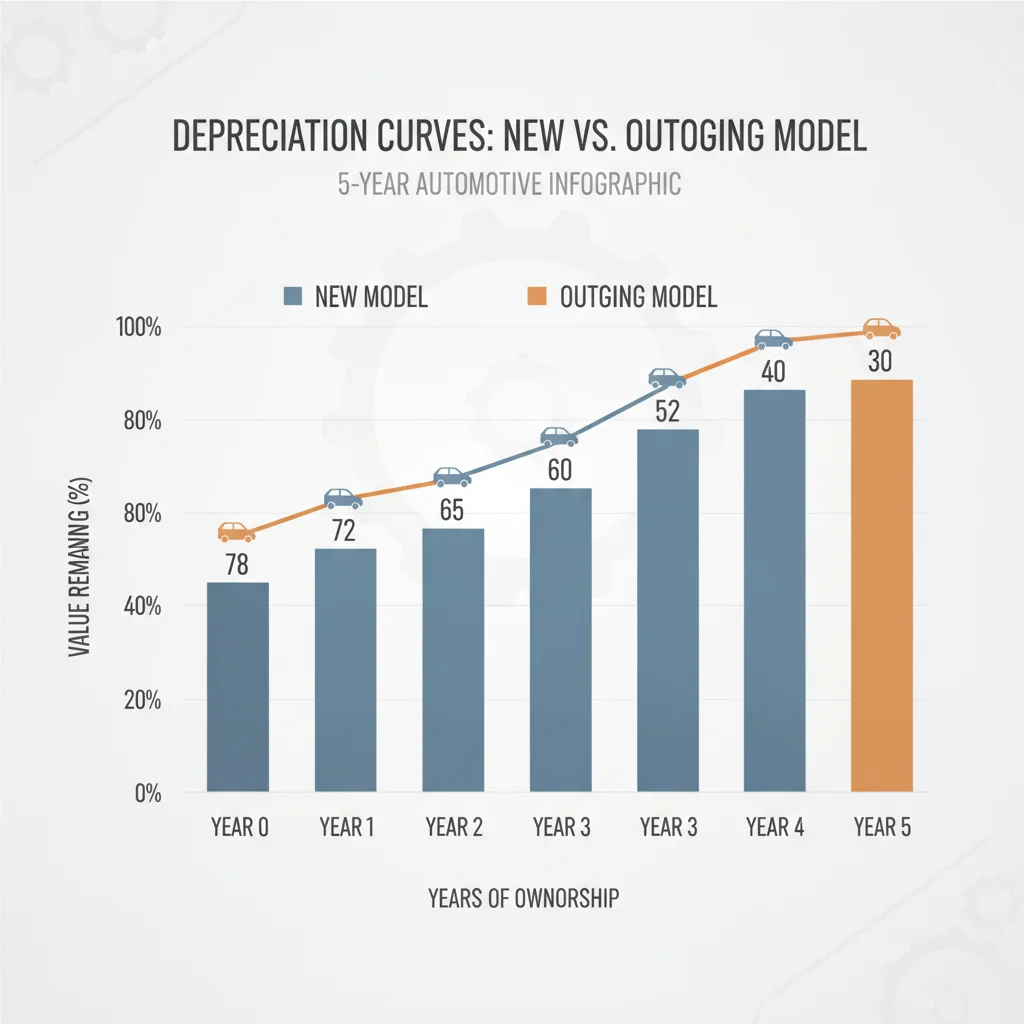
The financial case for buying an outgoing model isn't just about the purchase discount — it's also about the depreciation curve you're stepping onto.
A newly redesigned model typically drops 15–25% of its value in the first 12 months of ownership. Part of that is the standard new-car depreciation hit. But a redesigned model carries additional risk: if the new version proves popular, the previous generation loses value faster in the used market because buyers specifically want the newer look and features.
By contrast, an outgoing model that you've already bought at an 8–12% discount from a motivated dealer has already taken much of its design-age hit at the point of sale. Its depreciation curve over years two through four is often gentler than a brand-new redesign's first-year cliff.
| Scenario | Typical Purchase Discount | Year 1 Depreciation | 3-Year Resale Outlook |
|---|---|---|---|
| Last year of outgoing model | 8–15% off MSRP | 12–16% | Moderate — predictable |
| First year of redesigned model | 0–5% (often at or above MSRP) | 18–25% | Variable — depends on reception |
| Mid-cycle refresh year (outgoing) | 3–7% off MSRP | 14–18% | Moderate |
| Mid-cycle refresh year (refreshed) | 0–3% off MSRP | 15–20% | Slightly better than outgoing |
These are representative ranges, not guarantees. Trucks and certain SUVs depreciate more slowly than sedans. Luxury vehicles can depreciate far faster in a hot redesign's first year. Always check segment-specific resale data using tools like Edmunds True Market Value or iSeeCars depreciation reports before finalizing your decision.
Outgoing Inventory Disappears Faster Than You Think
Once a redesign is officially announced with an on-sale date, outgoing inventory can thin from plentiful to near-zero within six to eight weeks in popular segments. Buyers who plan to 'wait a little longer' often find the window has closed entirely. If your research confirms a favorable buying position, act within weeks — not months.
Manufacturer Incentives Can Vanish Overnight
Cash-back offers and subsidized financing rates on outgoing models are published monthly and can be pulled or reduced at any time. Never assume the incentives you saw last week are still active — confirm directly on the manufacturer's consumer website on the day you negotiate. An incentive expiry can shift your effective price by $1,500–$3,000 in a single day.
If you're considering a previous model year rather than the outgoing current-year model, the discounts can be even deeper — but inventory is extremely limited. Our current-year vs. previous-year model pricing reality check breaks down exactly what you gain and give up in that scenario.
Special Situations: Electrification, Auto Shows, and Lease Return Floods
Three market forces can dramatically complicate — or amplify — the standard redesign timing playbook.
When a Redesign Means Electrification
When an automaker announces that an upcoming redesign will be the model's first fully electric or hybrid version, the outgoing ICE (internal combustion engine) version can become extremely difficult to resell within three to five years. If you buy the last gas-powered version of a model knowing the next generation will be electric, factor in a faster value decline and potentially limited buyer pools when you eventually sell. On the other hand, if you have a long ownership horizon (seven-plus years) and specifically want a non-electric version, the outgoing discount may be exactly right for you.
Auto Show Announcements
Major auto shows — Detroit, LA, New York — are where automakers frequently reveal upcoming redesigns. A reveal at a January auto show often means the new model arrives in dealer lots by September of that same year. If you're tracking a model and a show announcement drops, your timeline for buying the outgoing version just compressed significantly. Dealers will be aware of this too, and their urgency to move current stock increases. See how auto show cycles affect luxury and enthusiast models specifically in our piece on timing a luxury car sale around auto show season.
Lease Return Inventory
When a popular model gets redesigned, a wave of three-year leases on the outgoing generation comes due simultaneously. This floods the used market with low-mileage certified pre-owned (CPO) examples right around the time the new model is launching — often creating a second, used-market discount window that mirrors the new-car clearance window. If budget is flexible, this CPO flood can be an excellent alternative to buying outgoing new inventory. Learn how to position yourself for that wave in our guide on timing your car purchase around a lease return.
Full Redesigns Create Resale Risk You Must Model
Buying an outgoing model with a known redesign imminent is a sound financial strategy only if your resale or trade-in timeline accounts for faster value erosion. If you plan to sell within two to three years, run the resale math explicitly — not just intuitively. A purchase discount of 10% can be entirely eliminated by a 12–15% first-year resale hit if you're selling at an unfortunate moment in the depreciation curve.

Understanding the full picture of what model year changeover actually means for your wallet will help you layer these factors together into a single, coherent decision. And if you're on the selling side — trying to unload your current vehicle before the new model hits — our article on listing before a new model year drop walks through how to time your private listing ahead of the depreciation wave.
Putting It All Together: A Decision Framework
After working through the research, resale analysis, and market context, most buyers land in one of four situations. Here's how to think about each:
- Situation 1: The outgoing model is in its final 6 months, inventory is still available.
- This is typically the best buying moment of an entire product cycle. Negotiate hard — dealers are motivated. Verify resale prospects for the outgoing generation are acceptable for your ownership horizon. Act within weeks, not months.
- Situation 2: The redesigned model just launched and is in high demand.
- Unless the new features or powertrain are essential to you, waiting 12–18 months will likely save you 8–12% off what early buyers paid, as dealer markups fade and incentives begin. Consider whether the outgoing model (now a previous-generation used car) meets your needs at a fraction of the cost.
- Situation 3: The model is 2–3 years into its current generation.
- This is the cycle's neutral zone. Modest discounts are available but not dramatic. Resale curves are predictable. Focus your energy on standard negotiation tactics rather than cycle timing. A mid-cycle refresh may be approaching — check industry sources for hints before buying.
- Situation 4: A mid-cycle refresh just launched or is imminent.
- The dynamics mirror a full redesign but are smaller in magnitude. Pre-refresh outgoing models carry 3–7% discounts. Post-refresh models command modest premiums initially. For a full breakdown of this specific window, see buying before vs. after a mid-cycle refresh.
The underlying principle across all four situations is the same: information about cycle position is leverage. Dealers have it by default. Most buyers don't. Spending 45 minutes on the research steps in this guide transfers a meaningful amount of that leverage to your side of the negotiating table.
For additional strategies on when calendar timing intersects with product cycle timing, see the buying new cars hub for a full library of purchase decision guides.

All claims are backed by peer-reviewed research. Sources on request.