| Average documentation fee (no-cap states) | $300–$900 (Consumer Reports, 2023) |
| Typical destination charge range (new vehicles) | $900–$1,800 (Manufacturer Monroney stickers, 2023–2024 models) |
| Dealer holdback (percentage of MSRP) | 1%–3% (Edmunds Dealer Insights, 2023) |
| Average F&I add-on markup over dealer cost | $500–$1,500 per product (NADA, 2022) |
| States with no documentation fee cap | Approximately 30 states (Automotive News, 2023) |
| VIN etching — retail price vs. DIY cost | $200–$400 vs. under $20 (Insurance Institute for Highway Safety) |
| Typical acquisition fee on a lease | $500–$1,000 (LeaseHackr community data, 2023) |
| Average market adjustment markup (high-demand vehicles) | $2,000–$10,000+ (iSeeCars market analysis, 2022–2023) |
Why the Back Half of a Car Contract Is Where the Money Disappears
Most buyers negotiate hard on one number: the vehicle price. They spend 45 minutes arguing over $500 on the sticker and then sign a contract loaded with $1,800 in fees they never questioned. That's not an accident. It's by design.
The fees section of a buyer's order — the itemized list below the agreed vehicle price — is where dealerships recover margin lost during negotiation. Some of those charges are completely legitimate. Others are manufactured profit dressed up with official-sounding names. A few are outright duplications of charges you've already paid.
The only defense is knowing what every line means before you're in the chair. This glossary covers every common fee you'll encounter, what it actually pays for, whether it's mandated or invented, and how hard you can push back on it.
For a broader look at the documents you'll encounter throughout the process, see what every document you'll sign at a dealership actually means. If you want a deeper dive specifically into which charges are challengeable, this breakdown of legitimate versus negotiable dealer fees covers the legal landscape by state.
| Average documentation fee (no-cap states) | $300–$900 (Consumer Reports, 2023) |
| Typical destination charge range (new vehicles) | $900–$1,800 (Manufacturer Monroney stickers, 2023–2024 models) |
| Dealer holdback (percentage of MSRP) | 1%–3% (Edmunds Dealer Insights, 2023) |
| Average F&I add-on markup over dealer cost | $500–$1,500 per product (NADA, 2022) |
| States with no documentation fee cap | Approximately 30 states (Automotive News, 2023) |
| VIN etching — retail price vs. DIY cost | $200–$400 vs. under $20 (Insurance Institute for Highway Safety) |
| Typical acquisition fee on a lease | $500–$1,000 (LeaseHackr community data, 2023) |
| Average market adjustment markup (high-demand vehicles) | $2,000–$10,000+ (iSeeCars market analysis, 2022–2023) |
The Fees That Are Real (and Non-Negotiable)
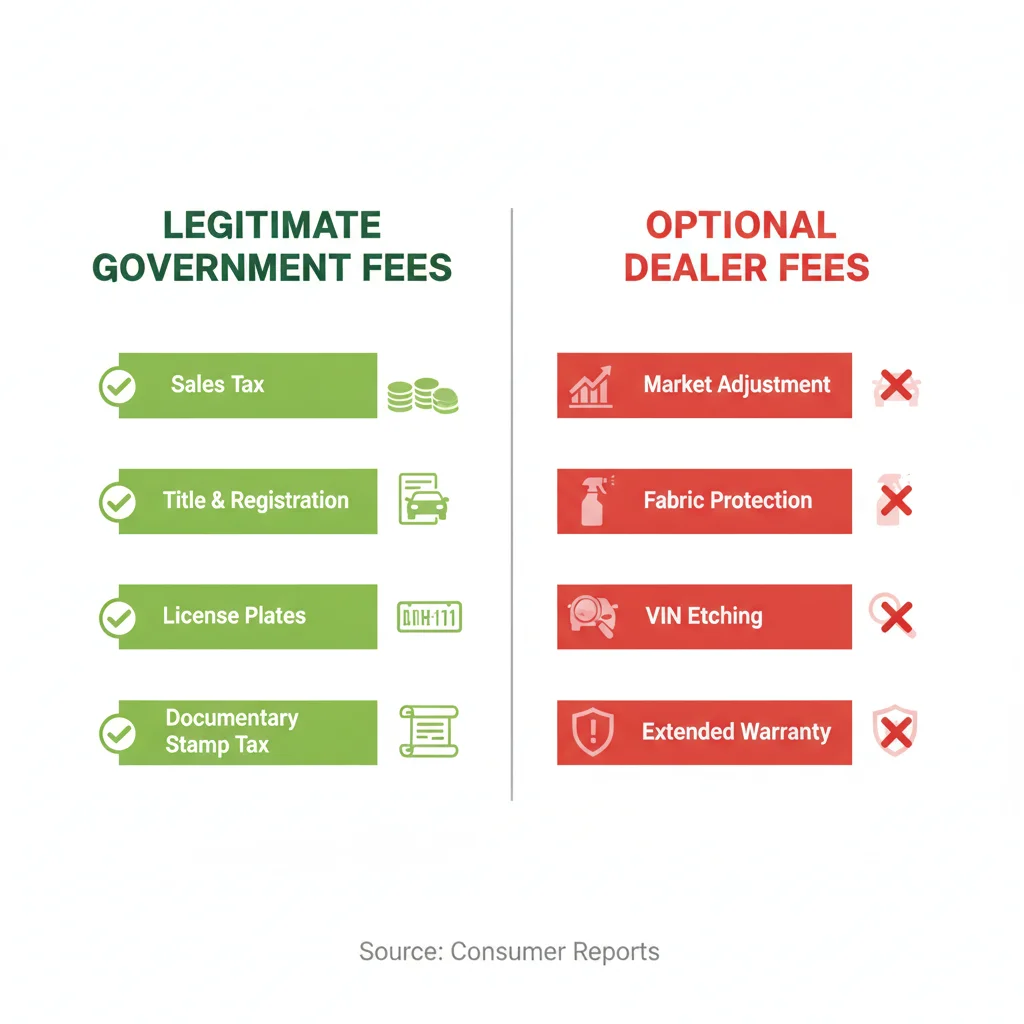
Not every line item on a contract is a shakedown. Some charges are fixed by the manufacturer or mandated by government — you cannot negotiate them away, and a dealer who offers to do so is playing games with the math elsewhere in the deal.
Destination Charge
This fee — also called freight — covers shipping the vehicle from the factory to the dealership. It is set by the manufacturer, printed on the Monroney sticker, and is identical for every buyer of that model nationwide. A dealer cannot legally waive it, and any dealer who claims to is almost certainly burying it in the vehicle price instead.
Current destination charges run from roughly $900 on small economy cars to over $1,800 on full-size trucks and SUVs. Verify the exact amount on the manufacturer's website before you set foot in the showroom.
Doc Fee Caps Vary Significantly by State
States like California cap the documentation fee at $85. Texas allows fees up to $150. Florida has no cap, so fees routinely hit $700–$1,000. Before you negotiate, look up your state's specific rules — it tells you immediately how much room you have to push back. The National Automobile Dealers Association (NADA) publishes state-by-state fee summaries annually.
Manufacturer Fees vs. Dealer Fees Are Not the Same
The destination charge printed on the Monroney sticker is set by the manufacturer and is identical for every dealer selling that model. A dealer who presents it as a negotiable concession is not actually giving anything up. Conversely, dealer-added fees below the sticker price are invented by the store and have no manufacturer backing whatsoever.
F&I Products Are Almost Always Overpriced at the Dealership
Finance and Insurance (F&I) products — extended warranties, GAP insurance, tire-and-wheel protection — are the highest-margin items a dealership sells. The dealer markup on a GAP policy alone can be $500–$900 above cost. In most states you can purchase these products from third-party providers or your own insurance company for significantly less. Never commit to F&I add-ons on the same day you negotiate the vehicle price.
Government Taxes and Registration Fees
Sales tax, title fees, and registration costs are set by your state and county — full stop. A dealer has zero control over these and cannot negotiate them on your behalf. What dealers can do is present these accurately or inflate them. Always verify the tax rate using your state DMV website and confirm that the registration fee matches published schedules.
The line between real government fees and dealer-manufactured fees is one of the most important distinctions a buyer can make. Understanding which fees are dealer-created and which are government-mandated can save you real money at signing.
Acquisition Fee (Leases Only)
If you're leasing, the leasing company — not the dealer — charges an acquisition fee to set up the lease. It typically runs $500–$1,000 depending on the brand. This fee is largely fixed, though some brands allow dealers to roll it into the capitalized cost rather than requiring it upfront. It is worth asking whether it can be included in the cap cost if you're cash-strapped at signing.
$894
Average doc fee in Florida (no cap)
According to a 2023 Consumer Reports analysis of dealer contracts across ten major metro areas.
42%
of buyers unaware fees were negotiable
A 2022 Cox Automotive buyer survey found fewer than half of car buyers knew they could challenge dealer-added fees.
$1,500+
Average F&I profit per vehicle sold
NADA data for 2022 shows F&I income represents one of the highest-margin revenue streams per vehicle transaction.
30+
States with no doc fee cap
Most U.S. states impose no statutory limit on documentation fees, leaving buyers entirely dependent on negotiation.
$3,800
Average above-MSRP markup paid in 2022
iSeeCars reported that in the peak inventory shortage period, buyers paid an average of $3,800 over sticker on new vehicles.
The Fees That Are Dealer-Invented (and Negotiable)
This is the category that matters most. These charges did not exist before a dealer typed them into their contracting software. They have no manufacturer backing, no government mandate, and in most states, no legal floor or ceiling.
Documentation Fee (Doc Fee)
Every dealer charges this. It supposedly covers processing the purchase paperwork — title work, registration filing, loan documents. In practice, it is a profit line. The actual labor cost to process these documents is nowhere near what dealers charge in states without caps.
In cap states like California ($85 max) and New York ($75 max), this is a minor annoyance. In no-cap states like Florida and Georgia, doc fees routinely hit $800–$1,000 on a single transaction. You cannot eliminate the doc fee in most cases, but you can counter by demanding that the vehicle price be reduced by an equivalent amount — effectively making the fee a wash.
Dealer Prep Fee
This charge is listed as covering the work to prepare the vehicle for delivery: removing factory plastic wrap, washing it, checking fluid levels, performing a pre-delivery inspection. The problem is that manufacturers already reimburse dealers for this work through a pre-delivery inspection (PDI) allowance built into the dealer holdback. You are being charged twice for the same service.
Push back on this fee directly. Ask the finance manager to show you the manufacturer's PDI allowance documentation. Most will drop it or credit it against the purchase price rather than have that conversation.
Market Adjustment / Dealer Markup
During inventory crunches — like the 2021–2023 shortage — market adjustments became a fixture on new vehicle contracts. This is pure above-MSRP markup, sometimes labeled as "market adjustment," "limited availability surcharge," or "in-demand vehicle addendum." It is 100% profit and 100% negotiable.
Your best tool against a market adjustment is competition. Get quotes from multiple dealers on the same vehicle. If one dealer is adding $5,000 in market adjustment and another isn't, you have your answer. Walk — and tell them why.
Advertising Fee
Some dealers pass along regional advertising costs as a line-item fee, arguing it's a legitimate cost of doing business. It isn't your cost of doing business. This fee is routinely negotiated away or rolled into the vehicle price offset. If a dealer insists it's mandatory, treat it as part of the vehicle price and negotiate accordingly.
VIN Etching Fee
The vehicle's VIN is etched onto window glass, supposedly as a theft deterrent. Dealers charge $200–$400 for this. The actual cost of a VIN etching kit is under $20, and the process takes ten minutes. Worse, many manufacturers now do this at the factory. Ask to see the window before accepting this charge, and decline it outright if it's already been done.
Documentation Fee (Doc Fee)
A dealer charge for processing paperwork related to the sale, including title, registration, and loan documents. It is set by the dealer — not by the government — and is capped by law in some states.
Destination Charge
The manufacturer's fee to ship a vehicle from the factory to the dealership. It is fixed for every buyer of that model regardless of where the dealer is located, and it is non-negotiable.
Dealer Prep Fee
A charge for preparing the vehicle for delivery — washing, removing protective wrapping, and doing a pre-delivery inspection. This work is often already covered by the manufacturer's dealer holdback, making it a duplicate charge.
Market Adjustment
An above-MSRP markup added at the dealer's discretion, typically on high-demand or low-inventory vehicles. It is entirely negotiable and should be the first line item challenged.
Dealer Holdback
A percentage of the vehicle's MSRP (typically 1–3%) that the manufacturer reimburses to the dealer after the sale. It represents hidden dealer profit built into every transaction.
GAP Insurance
Guaranteed Asset Protection insurance covers the difference between what you owe on an auto loan and what your car is worth if it's totaled or stolen. Dealers markup this product significantly; it is almost always cheaper through your own insurer.
VIN Etching Fee
A charge for engraving the vehicle identification number onto windows as a theft deterrent. This is often already done at the factory or can be done independently for under $20.
Acquisition Fee
A fee charged by a leasing company (not the dealer) to set up a lease agreement, typically ranging from $500 to $1,000. It is sometimes negotiable as a credit rather than a waiver.
Reconditioning Fee
A used-car specific charge for work done to make the vehicle retail-ready — detailing, minor repairs, fluid changes. Legitimate in concept but frequently inflated well beyond actual cost.
Freight / Handling Fee
Sometimes listed separately from the destination charge, this covers transport logistics within the distribution network. In many cases it is the same as the destination charge presented twice under different names.
F&I Products: The Most Profitable Upsell in the Building
The finance and insurance (F&I) office is where the real money is made. After you've agreed on a price, the finance manager presents a menu of add-on products — each one optional, each one enormously profitable for the dealer. Knowing what each product actually is, what it costs to provide, and what it's worth to you is the only way to navigate this room without getting burned.
Extended Warranty / Vehicle Service Contract (VSC)
Extended warranties are the top-selling F&I product. A dealer-sold VSC on a $35,000 vehicle might be priced at $2,800. The dealer's cost for that same contract from the warranty administrator might be $900. That's $1,900 in gross profit on a single upsell.
Extended warranties have legitimate value for buyers keeping a vehicle past 100,000 miles or buying a used car with a spotty reliability record. The key is that you don't have to buy it from the dealer. Third-party providers — some backed by the same administrators — sell comparable coverage for significantly less. Never commit to a VSC on the day you buy the car. You typically have 30 days to add one, and some manufacturers allow enrollment up to the original warranty expiration date.
GAP Insurance
GAP insurance covers the difference between your loan balance and the vehicle's actual cash value if it's totaled or stolen. It's a legitimate product for buyers making a small down payment on a depreciating asset. The problem is the dealer markup.
A dealer might charge $700–$900 for a GAP policy that costs them $150–$200 wholesale. Your own auto insurance company typically offers GAP coverage for $20–$40 per year added to your premium. Buy it from your insurer — not the F&I office.
Tire-and-Wheel Protection
Covers repair or replacement of tires and wheels damaged by road hazards. Sounds useful. In practice, the coverage exclusions are extensive and the dealer margin is high. If you drive on well-maintained roads and aren't buying run-flat tires on a performance vehicle, this is almost never worth the cost. Decline it.
Paint and Fabric Protection
Often presented as a package — paint sealant plus interior fabric treatment — for $300–$800. The products themselves are consumer-grade sealants and fabric sprays that cost under $50 at any auto parts store. This is one of the easiest F&I charges to decline. Just say no.
For used car buyers specifically, these F&I add-ons become even more critical to scrutinize. The hidden costs in used car dealer paperwork walks through how documentation fees, dealer add-ons, and optional warranties inflate used car deals in ways new car buyers don't always encounter.
How to Read a Buyer's Order Before You Sign
The buyer's order is the master document that captures every element of the deal — vehicle price, trade-in credit, fees, taxes, and financed amount. It's the document that matters most, and it's the one buyers spend the least time reviewing. Understanding the full scope of car purchase paperwork is essential before you get to the signing table.
The Column-by-Column Review
Every buyer's order has a few consistent sections:
- Vehicle Price: Should match the price you negotiated. Check it first.
- Trade-in Allowance: The credit applied for your trade. Confirm it matches the written appraisal offer — not a verbal number.
- Fees Section: This is where you apply everything in this glossary. Go line by line. Ask what each fee is for. Ask whether it's mandatory by law or set by the dealer.
- Taxes: Verify the tax rate against your state's published rate. Dealers do occasionally key in incorrect rates — sometimes deliberately.
- Total Amount Financed: This is the number your monthly payment is built from. Make sure it reflects every negotiated concession, not just the vehicle price.
The Two Questions That Cut Through Everything
For every fee you don't recognize, ask: "Is this required by law, or is this set by the dealership?" And then: "If I don't want it, can it be removed?"
Legally mandated fees cannot be removed. Dealer-invented fees can be negotiated or removed — the F&I manager knows this better than anyone in the room. Silence and hesitation are your enemies here. Ask clearly, wait for an answer, and don't let vague responses like "it's standard" pass without follow-up. "Standard" is not the same as "required."
Also pay close attention to how taxes are handled across dealer-added fees. Dealer-itemized taxes buried in fine print explains how some fees are presented as tax-adjacent when they're anything but — a tactic designed to make them feel less negotiable.
Get the Out-the-Door Price in Writing First
Before you ever sit in the F&I office, ask for the out-the-door (OTD) price in writing — a single number that includes the vehicle, all dealer fees, and estimated taxes. Use that number to verify that the buyer's order adds up correctly. If the OTD price you were quoted and the total on the buyer's order don't match, stop and ask why before signing anything.
Dealers who refuse to provide an OTD price before you get to the F&I office are almost always hiding fee inflation they plan to insert once you're committed to the transaction. That's your cue to slow down or walk.
Quick Reference: Negotiability at a Glance
Use this table as your reference when you're reviewing a contract. Each fee is categorized by type and flagged for negotiability.
| Fee Name | Who Sets It | Typical Range | Negotiable? |
|---|---|---|---|
| Destination / Freight | Manufacturer | $900–$1,800 | No |
| Documentation Fee | Dealer (capped in some states) | $75–$999 | Partially — offset via price |
| Sales Tax | State / County | Varies by location | No |
| Title & Registration | State DMV | $50–$300 | No |
| Dealer Prep Fee | Dealer | $200–$600 | Yes — often removable |
| Market Adjustment | Dealer | $500–$10,000+ | Yes — fully negotiable |
| Advertising Fee | Dealer | $200–$500 | Yes |
| VIN Etching | Dealer | $200–$400 | Yes — decline outright |
| Paint / Fabric Protection | Dealer (F&I) | $300–$800 | Yes — decline outright |
| Extended Warranty (VSC) | Dealer (F&I) | $1,200–$3,500 | Yes — buy third-party |
| GAP Insurance | Dealer (F&I) | $500–$900 | Yes — buy from insurer |
| Tire & Wheel Protection | Dealer (F&I) | $400–$900 | Yes — evaluate carefully |
| Acquisition Fee (Lease) | Leasing Company | $500–$1,000 | Partially — can cap-cost it |
| Reconditioning Fee (Used) | Dealer | $300–$900 | Yes — negotiate against price |
Print this table or screenshot it. The F&I office moves fast and depends on buyers not having a framework. Walking in with one changes the dynamic entirely.
If you're heading into a trade-in alongside this purchase, keep in mind that trade-in values are another arena where dealers recoup margin. Understanding how dealer trade-in appraisals work gives you the tools to make sure your trade isn't quietly subsidizing fees you thought you'd negotiated away.
All claims are backed by peer-reviewed research. Sources on request.