Key Takeaways
Early Loan Payoff & Credit Score Impact
When you pay off a car loan before its scheduled end date, your credit score can shift — sometimes up, sometimes down, and occasionally both in sequence. Closing an installment account removes it from your active credit mix, reduces your total open account history, and can temporarily lower your score even though you did something financially responsible. The effect varies based on your overall credit profile, how old the loan is, and what other accounts you carry.
Credit scoring models like FICO and VantageScore evaluate installment loans separately from revolving credit. Closing an installment account affects your credit mix ratio and can alter the average age of your accounts, both of which are weighted factors in score calculations.
Why Paying Off Debt Doesn't Always Boost Your Score Immediately
Most people assume that eliminating a debt is automatically good for their credit. It's a logical assumption — you owe less, so you should look better to lenders. But credit scoring models don't simply reward debt elimination. They evaluate the type of accounts you hold, how long you've held them, and how actively you're demonstrating responsible credit behavior right now.
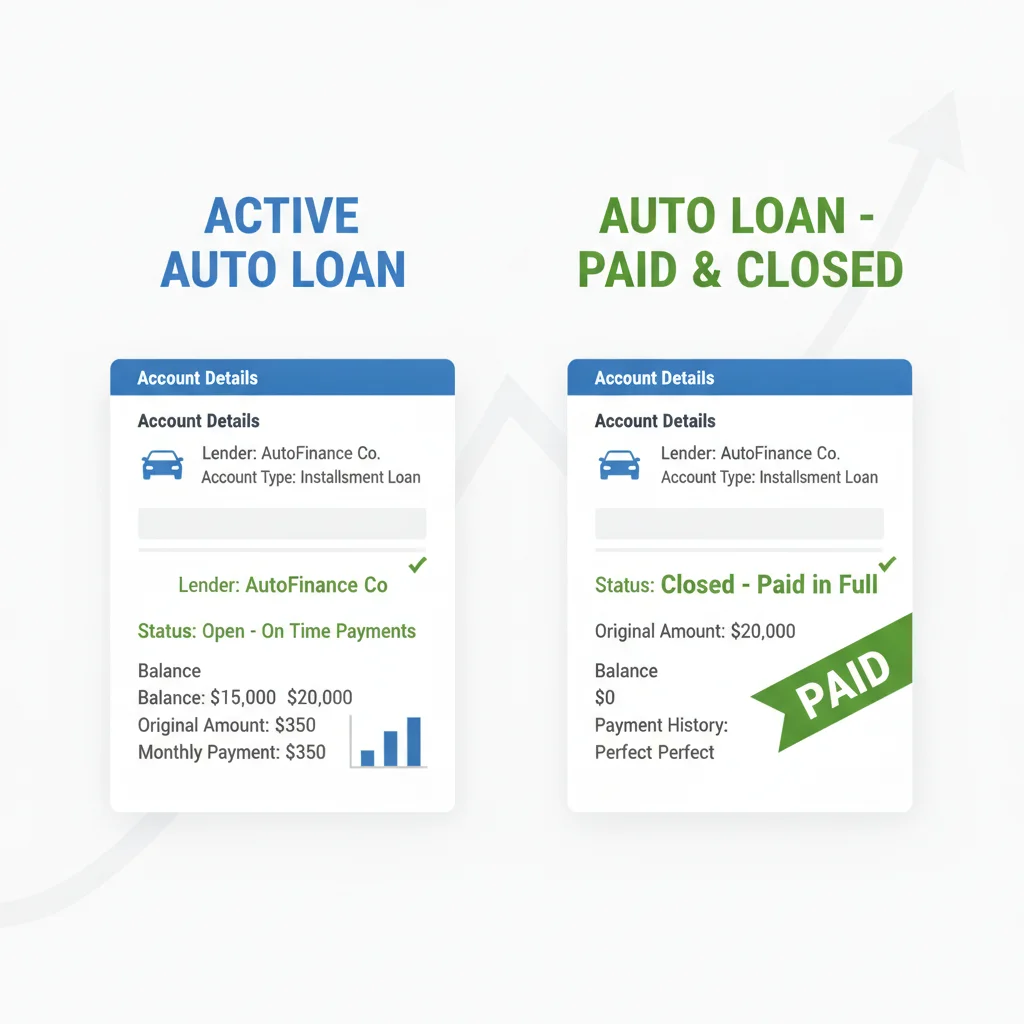
When you pay off a car loan early, you're closing an installment account — a loan with a fixed payment schedule and a defined end date. That closure has ripple effects across several scoring factors simultaneously. Understanding each one helps you anticipate what's coming and avoid making decisions based on a misread of your credit report.
To get a full picture of how lenders structure payoff terms and what "paying off early" officially means on a contract, see what early payoff actually means on an auto loan.
The Four Credit Factors Affected by Closing an Auto Loan
FICO scoring — used by the majority of auto lenders — weights five categories. Closing a car loan directly touches four of them. Here's what changes and by how much each factor is weighted:
| Credit Factor | FICO Weight | How Early Payoff Affects It |
|---|---|---|
| Payment History | 35% | Positive record stays on report for up to 10 years — no negative impact |
| Amounts Owed | 30% | Installment loan balance drops to zero; can improve utilization picture |
| Length of Credit History | 15% | Average account age may decrease if this was one of your older accounts |
| Credit Mix | 10% | Losing an installment account reduces diversity if no other installment loan remains |
| New Credit | 10% | Not directly affected unless you open new accounts simultaneously |
The net effect depends on which of these shifts dominates in your specific credit profile. For a borrower with a long credit history and several active accounts, the impact is typically negligible. For someone with a shorter history or few open accounts, the effect can be more pronounced — but still temporary.
35%
Payment history's share of your FICO score
According to FICO's publicly documented scoring model — the factor most protected by a strong on-time payment record on a paid-off loan.
10 years
How long a closed positive account stays on your report
Per Experian and TransUnion reporting guidelines — closed accounts in good standing continue influencing your score for up to a decade.
10%
Credit mix's share of FICO score
FICO's scoring breakdown — the factor most directly affected by closing your only installment loan account.
1–3 months
Typical score recovery timeline after loan closure
Based on general credit modeling behavior reported by major credit bureaus when no other negative changes occur simultaneously.
15%
Length of credit history's FICO weight
Includes average age of all accounts — the factor most affected when a long-standing auto loan is closed ahead of schedule.
Credit Mix: The Factor Most Borrowers Overlook
Credit mix is worth dwelling on because it surprises the most people. Scoring models prefer to see that you can responsibly manage different types of credit — both revolving accounts like credit cards and installment accounts like auto loans, mortgages, or personal loans.
When your car loan closes and you have no other active installment accounts, you lose that diversification. If your credit card is your only remaining open account, you're now showing lenders a one-dimensional credit profile. That drop in credit mix can shave points off your score even though your overall financial position is objectively stronger.
Credit Mix vs. Credit Score: Keep Perspective
Credit mix is one of the smaller scoring factors, accounting for about 10% of your FICO score. A reduction in mix alone is unlikely to cause a dramatic point drop. The factor becomes more significant only when it compounds with other changes — such as a simultaneous drop in average account age or a new hard inquiry from a recent loan application. Evaluate the full picture, not just one factor in isolation.
The good news is that credit mix carries relatively modest weight — about 10% of your FICO score. A reduction in this factor alone is unlikely to cause a dramatic score drop. The real concern arises when credit mix loss compounds with a reduction in account age at the same time.
For a broader look at how your credit profile influences the loan rates you'll qualify for, the Credit Score Impact hub covers lender thresholds and rate tiers in detail.
Account Age: Why an Old Loan Closing Hurts More Than a New One
The length of your credit history contributes 15% to your FICO score. This factor considers both the age of your oldest account and the average age of all your accounts combined. When you close a car loan, that account eventually stops aging — and if it was one of your older accounts, its removal drags down your average account age.
Here's a concrete illustration: Suppose you opened a car loan five years ago and your only other account is a credit card you opened two years ago. Your average account age is currently 3.5 years. Once the car loan closes and eventually drops from your active calculations, your average age shifts toward your credit card's age — dropping meaningfully. That reduction signals to scoring models that you have less demonstrated credit experience.
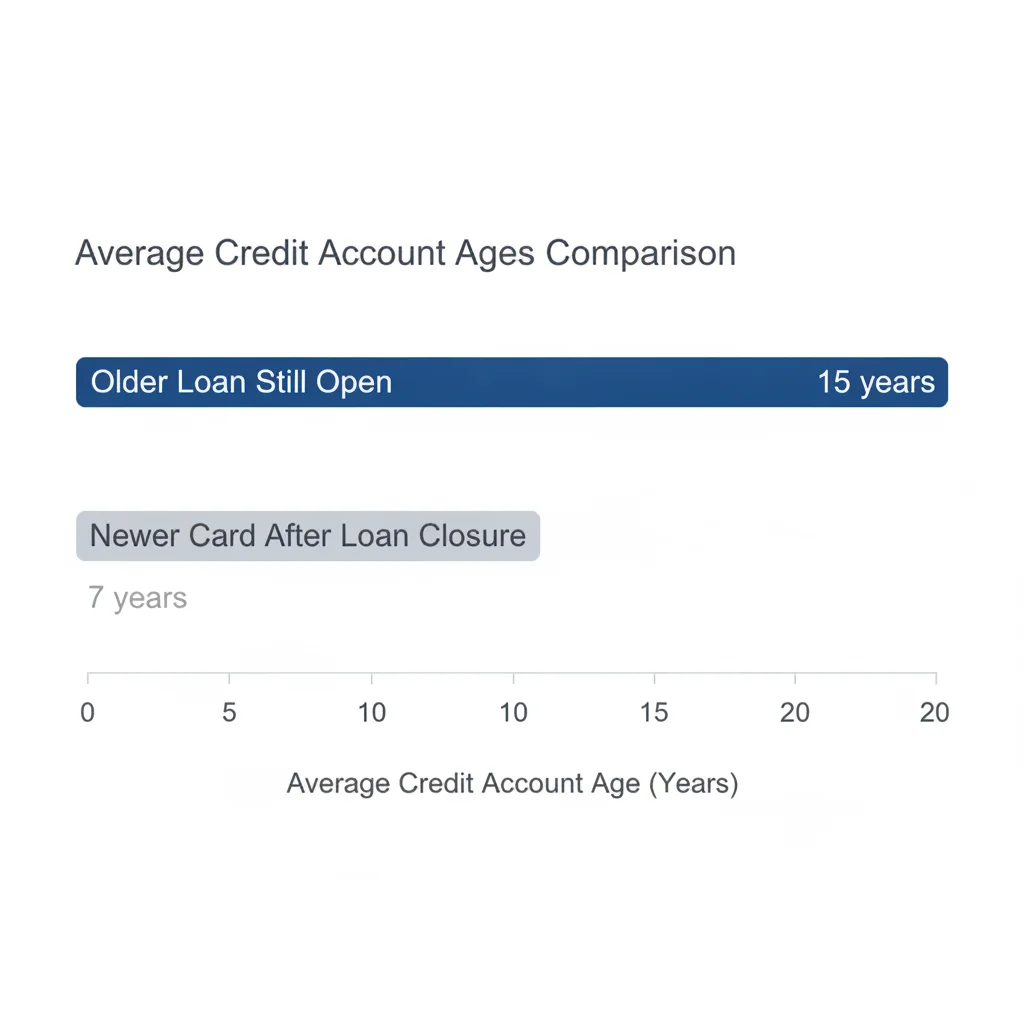
If, on the other hand, your car loan is relatively new — say, 18 months old — and you have a 10-year-old credit card still open, closing the loan has a much smaller effect on your average account age. The older, established account anchors your history.
Keep Your Credit Card Active After Payoff
Once your auto loan closes, your credit card may become your only remaining active account. Make sure it stays active and in good standing — a small recurring charge paid in full each month keeps the account generating positive payment data. This is especially important for thin-file borrowers who have fewer accounts cushioning any structural change to their credit profile.
Timing Payoff Around Major Loan Applications
If you're planning to apply for a mortgage or another large loan within 60 to 90 days, consider completing that application before making your final auto loan payoff. Even a small, temporary score dip could affect your rate tier on a high-value loan. Your lender can advise on the optimal sequence based on your specific credit file.
Keep in mind: closed accounts in good standing remain on your credit report for up to 10 years. During that time, they continue to count toward your account age calculations. The reduction in average age typically becomes most noticeable after the account finally ages off your report, not immediately after closure.
What Actually Improves: The Positive Side of Early Payoff
While credit mix and account age can take a minor hit, other aspects of your credit profile improve — or at minimum, don't worsen.
Your Payment History Remains Intact
Every on-time payment you made on the car loan is recorded and stays visible on your credit report for a decade. Payment history is the single largest scoring factor at 35%. A strong payment record on a closed account continues to support your score long after the loan is gone.
Your Installment Loan Utilization Drops to Zero
While most borrowers associate utilization with credit cards (revolving credit), FICO also evaluates how much of your original installment loan balance you've paid down. Paying off the balance completely means your installment utilization is at its best possible position: zero. For borrowers who were still in early repayment and carrying a high remaining balance relative to the original loan amount, this can be a meaningful positive.
Debt-to-Income Ratio Improves (for Future Applications)
Credit scores don't directly measure your income, but lenders evaluate your debt-to-income (DTI) ratio when you apply for new credit. Eliminating a monthly car payment reduces your recurring obligations, which strengthens your application profile for future loans — including mortgages or a new auto loan down the road.
If you're also thinking about what changes on the insurance side once your lender is removed from your policy, see lowering your coverage after paying off a car loan for what to reconsider.
How Long Does the Score Dip Last — and What Speeds Recovery?
For most borrowers, any score decrease from paying off a car loan early is both small and short-lived. Credit scores are recalculated each time a lender requests your report or each time data updates are submitted by creditors — typically monthly. Here's the general timeline:
- Month 1–2: The loan shows as "paid" or "closed" on your report. The scoring model registers the account closure and recalculates. You may see a small dip during this window.
- Month 2–3: Your other active accounts continue generating positive payment data. If your credit card balances are low and you're not applying for new credit, your score typically stabilizes.
- Month 3–6: Most borrowers see their score recover to close to — or slightly above — where it was before the payoff, assuming no other negative changes.
“A credit score is a snapshot in time, not a permanent verdict. Closing a loan responsibly is a positive financial act — the score catches up to that reality within a few months, as long as you don't disrupt everything else at the same time.”
— Rod Griffin, Senior Director of Consumer Education and Advocacy at Experian
The factors that speed recovery are entirely within your control: keep your credit card balances below 30% of their limits (ideally below 10%), make all other payments on time, and avoid applying for new credit in the months immediately after closing the loan. Each of those behaviors generates fresh positive data that offsets the one-time structural change from closing the installment account.
For a complete walkthrough of the payoff process itself — from the first extra payment to the final confirmation call — see the complete early payoff roadmap.
When the Credit Impact Matters More — and When It Doesn't
Context determines whether the temporary score dip from early payoff actually matters for your financial life. Here are two scenarios that shape the calculus:
When the Impact Matters More
If you're planning to apply for a mortgage, refinance another loan, or take out a new auto loan within the next 60 to 90 days, the timing of your payoff deserves thought. Even a modest score drop of 10 to 15 points could push you from one rate tier to a less favorable one on a large loan. In this scenario, it may be worth waiting until after your new application is approved before closing the auto loan.
Similarly, if you have a thin credit file — fewer than five total accounts, a short credit history, or no revolving credit — the loss of an installment account has proportionally larger consequences. The Loan Preapproval hub explains how lenders evaluate borrowers with limited credit depth and what you can do to strengthen your application regardless.
When the Impact Doesn't Matter Much
If you have an established credit history, multiple active accounts, and no major loan applications on the horizon, paying off your car loan early is almost certainly the right financial move. The interest savings are real and immediate. The credit score impact is modest and temporary. Keeping a loan open purely to protect a credit score that you don't need for any near-term purpose rarely makes financial sense.
Before making your final payoff, it's also worth reviewing whether your loan terms make early payoff genuinely worthwhile — some loan structures reduce or eliminate the benefit. See signs your auto loan terms make early payoff less worthwhile to check your contract first.
Keep Your Credit Card Active After Payoff
Once your auto loan closes, your credit card may become your only remaining active account. Make sure it stays active and in good standing — a small recurring charge paid in full each month keeps the account generating positive payment data. This is especially important for thin-file borrowers who have fewer accounts cushioning any structural change to their credit profile.
Timing Payoff Around Major Loan Applications
If you're planning to apply for a mortgage or another large loan within 60 to 90 days, consider completing that application before making your final auto loan payoff. Even a small, temporary score dip could affect your rate tier on a high-value loan. Your lender can advise on the optimal sequence based on your specific credit file.
Once you've made your final payment, don't assume the loan is automatically closed in the eyes of your lender and credit bureaus. Verify the process by reviewing how to confirm your auto loan is fully paid off to make sure your lien is released and your title is updated correctly.
And if you want to understand exactly how early payoff reduces your total interest cost, what happens to your interest when you pay off a car loan early walks through the math in plain terms.

All claims are backed by peer-reviewed research. Sources on request.