Key Takeaways
Why a Payoff Quote Is Not the Same as Your Remaining Balance
Many borrowers assume that the balance shown on their monthly statement — or in their lender's online portal — is the amount they need to send to close the loan. That assumption can leave you short by hundreds of dollars, or even trigger a collections notice on a loan you thought was gone.
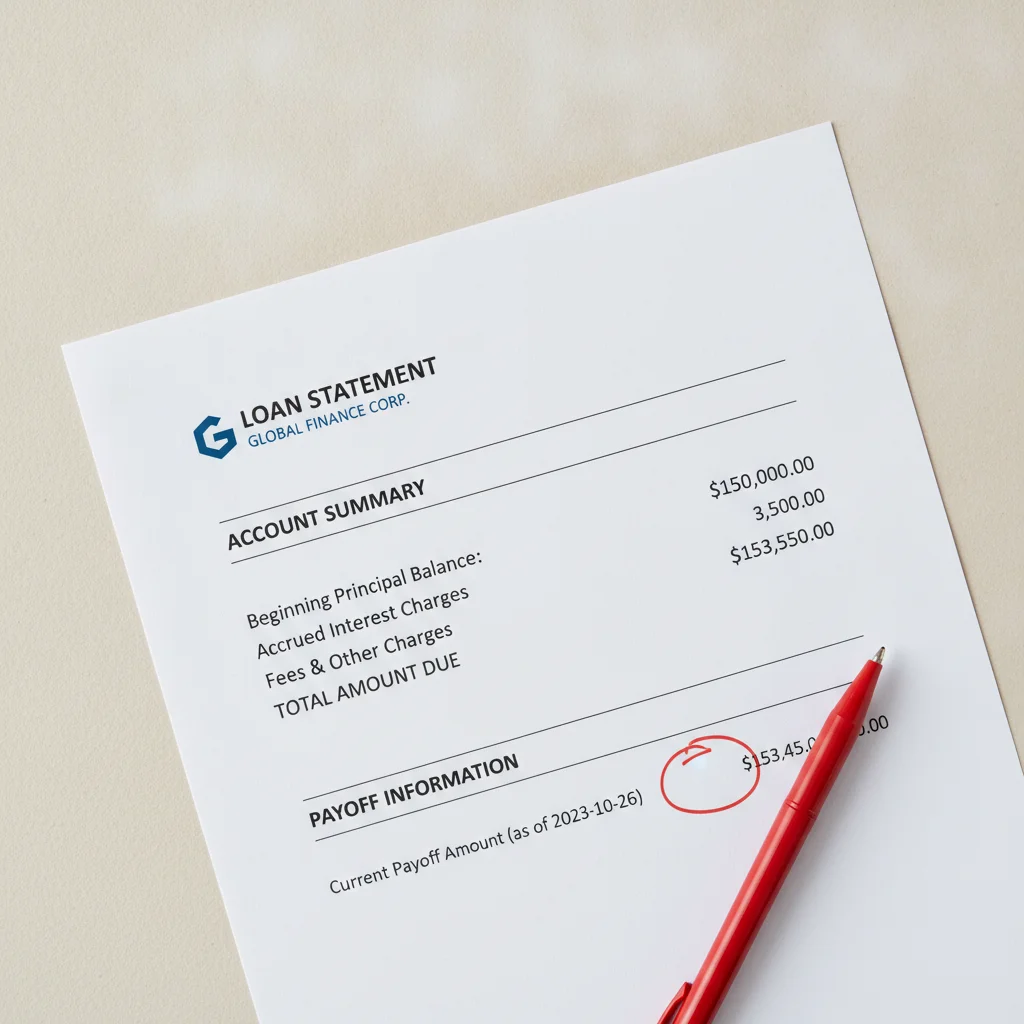
Your remaining balance is a snapshot of how much principal you still owe as of your last statement date. Your payoff quote, by contrast, is the precise total required to satisfy the loan in full on a specific future date. It includes:
- Outstanding principal — the core loan amount still owed
- Accrued interest — interest that has built up since your last payment
- Per diem interest — daily interest that will continue to accumulate until the lender receives your payment
- Any applicable fees — such as a prepayment penalty, if your contract includes one
Because auto loans use simple interest that accrues daily, the payoff amount is technically a moving target. Every day you wait costs a small but real amount of additional interest. That is why lenders issue payoff quotes with a fixed good-through date — typically 10 to 30 days from the request — and calculate the figure assuming you will pay by that date.
Understanding this distinction is foundational before you make any early payoff move. The glossary of early payoff terms covers amortization, per diem interest, and other vocabulary you will encounter throughout this process.
What You Need Before Requesting Your Payoff Quote
Before you contact your lender, gather the following information. Having it ready will make the process faster and reduce the chance of receiving a quote that contains errors.
What you will need
One item deserves special attention: your account number. Lenders use it to pull the exact loan record. If you call with only your name and Social Security number, there is a higher chance of a data-entry error — particularly if you have multiple accounts with the same lender. Always confirm the account number from your statement or welcome letter before you call.
Also check whether your loan contract includes a prepayment penalty. This is a fee some lenders charge when you pay off a loan early because they are losing interest income. Not all loans carry this clause, but you need to know before you commit to paying off early. See what early payoff actually means for a deeper look at how lenders define early payoff and when penalties apply.
Loan account statement (most recent)
Provides your account number, current balance, and lender contact information needed to initiate the quote request.
Original loan contract
Lets you verify whether a prepayment penalty applies and confirm the interest rate used to calculate per diem charges.
Lender's online portal login
Enables instant payoff quote access and allows you to download a PDF quote without waiting on hold.
Cashier's check or wire transfer access
Many lenders require certified funds — not personal checks — for payoff amounts above a certain threshold.
Secure file storage (digital or physical)
Stores the payoff quote, proof of payment, and lien release documents for future reference if a dispute arises.
Step-by-Step: How to Request Your Auto Loan Payoff Quote
There are three main channels for requesting a payoff quote: your lender's online portal, a phone call to customer service, or a written request by mail or secure message. Each method has trade-offs in speed, documentation, and convenience.
Choose your request method
Decide how you will contact your lender:
- Online portal — Fastest option if your lender supports it. Log in, navigate to your loan account, and look for a "Payoff Quote" or "Payoff Amount" link. You will usually receive the quote immediately as a downloadable PDF.
- Phone — Best when you want to ask questions in real time. Call the customer service number on the back of your payment coupon or your lender's website. Ask specifically for the payoff department — not general customer service — to reduce transfer delays.
- Written request (mail or secure message) — Slowest but creates a paper trail. Useful if your lender requires a written request by policy, or if you want documentation of exactly what you asked for.
Specify your intended payoff date
When you request the quote, tell the lender the specific date by which you plan to send payment. This is critical. The lender uses that date to calculate how much per diem interest will accrue between now and then, giving you a number that is accurate as of that deadline.
If you are unsure of the exact date, choose a date that is 7–10 business days out from when you plan to send the payment. This buffer accounts for mail delivery time if you are sending a check, or processing time for an ACH bank transfer.
Do not pick a date that is too far in the future — the more days you add, the more accrued interest gets built into the quote, meaning you will have overpaid if you end up sending the payment earlier.
Request the quote in writing, even after a phone call
If you call the lender, ask the representative to send the payoff quote to you in writing — either by mail, secure email, or through your online account portal. A verbal figure is not sufficient documentation if a dispute arises later.
When you receive the written quote, verify that the following information is present:
- Your name and account number
- The loan balance breakdown (principal, accrued interest, fees)
- The per diem interest rate
- The good-through date
- Payment instructions (where and how to send the funds)
Verify the payment instructions on the quote
A payoff payment often needs to go to a different address or account than your regular monthly payments. The lender may route payoffs to a separate processing center or require a specific payment method (such as a cashier's check or wire transfer for large amounts).
Read the payment instructions on the quote carefully and follow them exactly. Common mistakes include:
- Sending a personal check when a certified check is required
- Including your regular loan account number on a check instead of the payoff reference number provided
- Mailing to the regular payment processing center instead of the payoff department address
These errors can delay posting, cause the payment to miss the good-through date, and require you to request a new quote.
Send payment and keep proof
Submit your payoff payment using the method specified in the quote. Immediately save your proof of payment:
- Wire or ACH — Screenshot or print the bank confirmation showing the transaction reference number, date, and amount
- Cashier's check — Keep a copy of the check and the certified mail receipt if you mailed it
- Online payment through the lender's portal — Screenshot the confirmation page and note the confirmation number
Do not discard this documentation until you have received written payoff confirmation from the lender and a lien release document. These records protect you if the lender claims a balance remains.
Once you have the quote in hand, review every line item. Confirm the good-through date, verify the per diem interest rate used to calculate the daily accrual, and check that any fees listed match what your loan contract says. If anything looks wrong, call back and ask a supervisor to walk through the calculation with you.
Good-Through Dates Are Non-Negotiable
If your payment arrives after the good-through date on the payoff quote, the lender is not required to accept that amount as full satisfaction of the loan. Even a one-day delay can mean you owe additional per diem interest and must either send a supplemental payment or request a new quote entirely. Plan your payment well before the deadline.
How to Read Your Payoff Quote Document
A payoff quote is usually a one- or two-page document. Here is what each section means:
| Line Item | What It Means |
|---|---|
| Principal balance | The remaining loan amount as of the quote date, excluding interest |
| Accrued interest | Interest that has built up since your last payment posted |
| Per diem rate | The daily interest charge (principal × annual rate ÷ 365) |
| Good-through date | The deadline by which you must pay to satisfy the quote amount |
| Payoff total | The exact amount needed to close the loan by the good-through date |
| Prepayment fee | Any early termination fee stated in your contract (often $0) |
A quick way to sanity-check the math: multiply the per diem rate by the number of days between your last payment and the good-through date, then add that to the principal balance. The result should closely match the payoff total shown. If it is off by more than a few dollars, ask the lender to explain the discrepancy.
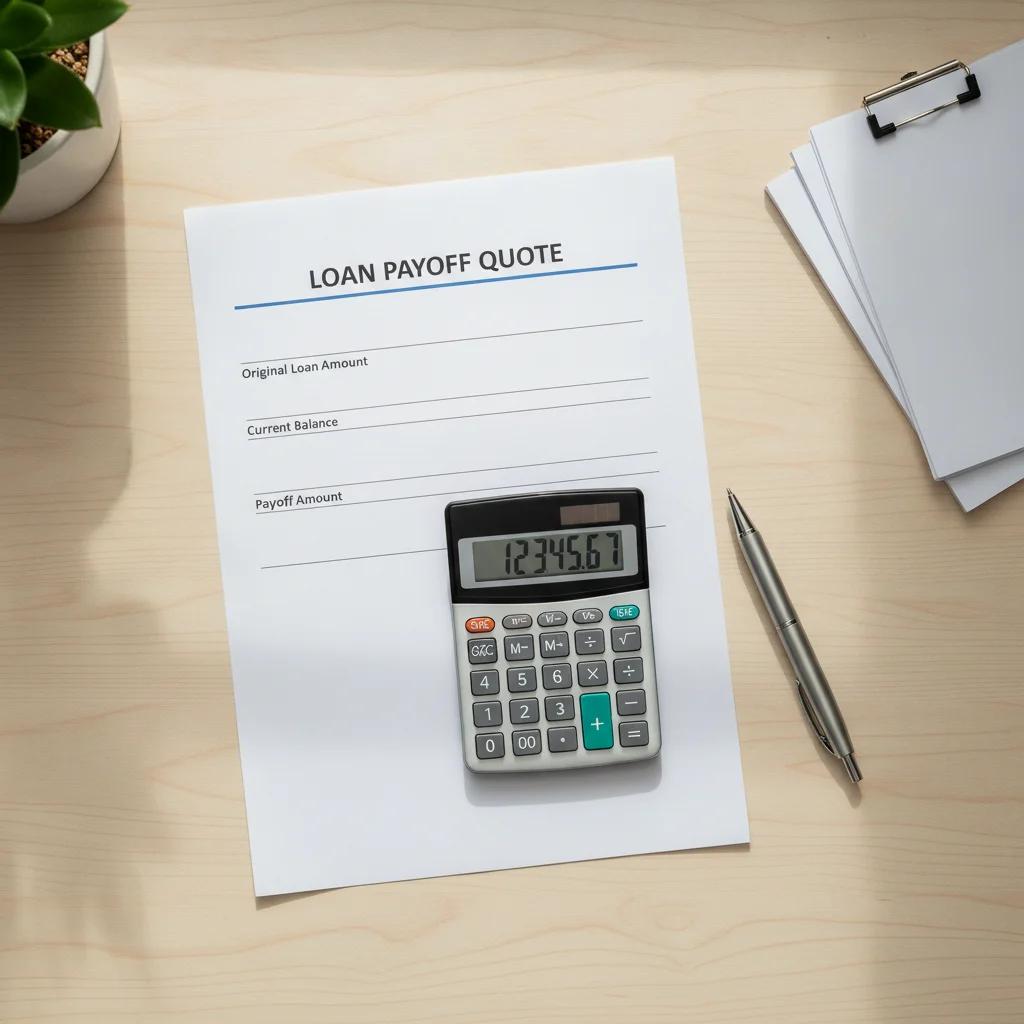
Keep the payoff quote document even after you pay. It is proof of the amount you were instructed to pay, which matters if the lender later claims a balance remains. File it alongside your loan contract and payment confirmation.
Request Payoff Quotes Mid-Month for Lower Accruals
Because interest accrues daily, requesting your payoff quote shortly after a monthly payment posts — rather than near the end of the billing cycle — often results in a lower accrued interest figure. The principal balance is at its freshest lowest point right after a payment is applied, so the per diem calculation starts from a smaller base.
Save Every Document Until the Title Is In Your Hands
Do not discard your payoff quote, payment confirmation, or lender correspondence until you have physically received — or electronically confirmed — a clean title in your name. Title processing can take weeks, and having a complete paper trail protects you at every step of that process.
For context on how some widely held beliefs about payoff amounts can mislead borrowers, see common auto loan payoff myths — particularly the myth that your statement balance is always sufficient to close the account.
After You Pay: Confirming the Loan Is Closed
Sending the payoff amount is not the finish line. You need confirmation that the lender has received the funds, applied them correctly, and released the lien on your vehicle. Without a lien release, the lender technically still has a legal claim on the car — even if your balance reads zero.
Here is what to expect and request after your payment clears:
- Written payoff confirmation — Ask for a letter or secure message confirming the loan is paid in full. Most lenders send this automatically within 7–14 business days.
- Lien release document — This is the legal paperwork that removes the lender's name from your vehicle title. In some states it is a separate form; in others it is handled electronically between the lender and your state's DMV.
- Updated title — Once the lien is released, your state will issue a clean title in your name alone. In electronic title states, this may update automatically. In paper title states, you may need to apply at the DMV.
If you do not receive payoff confirmation within 30 days of payment, contact your lender in writing and request status on both the account closure and the lien release. The full post-payoff checklist walks through each of these steps in detail, including what to do if the lender is slow to release the lien.
A Zero Balance Does Not Cancel the Lien
Your lender holds a lien on your vehicle until they formally release it — regardless of what your account balance shows. A lien that is not released means the lender still appears as a lienholder on your title. If you try to sell or refinance the vehicle before the lien is cleared, the transaction will hit a wall. Always request the lien release document explicitly and follow up if you do not receive it within 30 days of payoff.
This article is one part of a broader roadmap. If you are planning to pay off your loan ahead of schedule, the complete early payoff roadmap covers everything from making your first extra payment to handling the final title transfer.

All claims are backed by peer-reviewed research. Sources on request.