
Key Takeaways
Option A
Conditional Preapproval
The provisional offer that still has hoops to clear.
Best for: Buyers who want to start shopping early but understand the final terms may shift based on vehicle details, income verification, or credit review.
Option B
Firm Preapproval
The locked-in offer that gives you real negotiating power.
Best for: Buyers who want maximum dealership leverage and need certainty that the rate and amount quoted will hold when they sign.
If you want maximum negotiating leverage the moment you walk onto a lot
Firm Preapproval
A firm offer is a binding commitment from the lender — the dealer's finance office cannot undercut it with a 'better' deal that's actually worse.
If you're still early in the shopping process and don't know the exact vehicle yet
Conditional Preapproval
It gives you a realistic rate range and budget ceiling while you narrow down your vehicle choice, without requiring you to commit to a specific car upfront.
If you're buying from a private seller or out-of-state dealer
Firm Preapproval
Private transactions and remote purchases leave no room for last-minute financing surprises — a firm offer ensures your funding is guaranteed before you transfer ownership.
If your income or employment situation is non-traditional (freelance, commission, recent job change)
Conditional Preapproval
Start here to understand what the lender requires, then work to satisfy those conditions before treating the offer as final funding.
If the vehicle you want is older or has high mileage
Firm Preapproval
Conditional offers often exclude vehicles beyond certain age or mileage thresholds — a firm offer secured for that specific car eliminates the risk of last-minute approval failure.
Why the Distinction Matters Before You Step on the Lot
Most buyers treat any preapproval letter like a golden ticket — proof that a lender is on their side and ready to fund. That assumption is exactly what gets people into trouble at the dealership. There are two meaningfully different things a lender might hand you, and mistaking one for the other can cost you hundreds of dollars in interest or blow up a deal entirely.
Before diving into the specifics, it helps to understand what preapproval actually is. As covered in what auto loan preapproval actually means, a preapproval is a lender's assessment of your creditworthiness before you've selected a vehicle — but the depth of that commitment varies enormously depending on whether the offer is conditional or firm.
Here's the core issue: a conditional preapproval tells you what you might qualify for. A firm preapproval tells you what the lender will fund. Dealers know this distinction better than almost any buyer does. If you walk in with a conditional offer, a savvy finance manager can exploit any unresolved conditions to steer you toward their in-house financing. Walk in with a firm offer, and that leverage disappears.
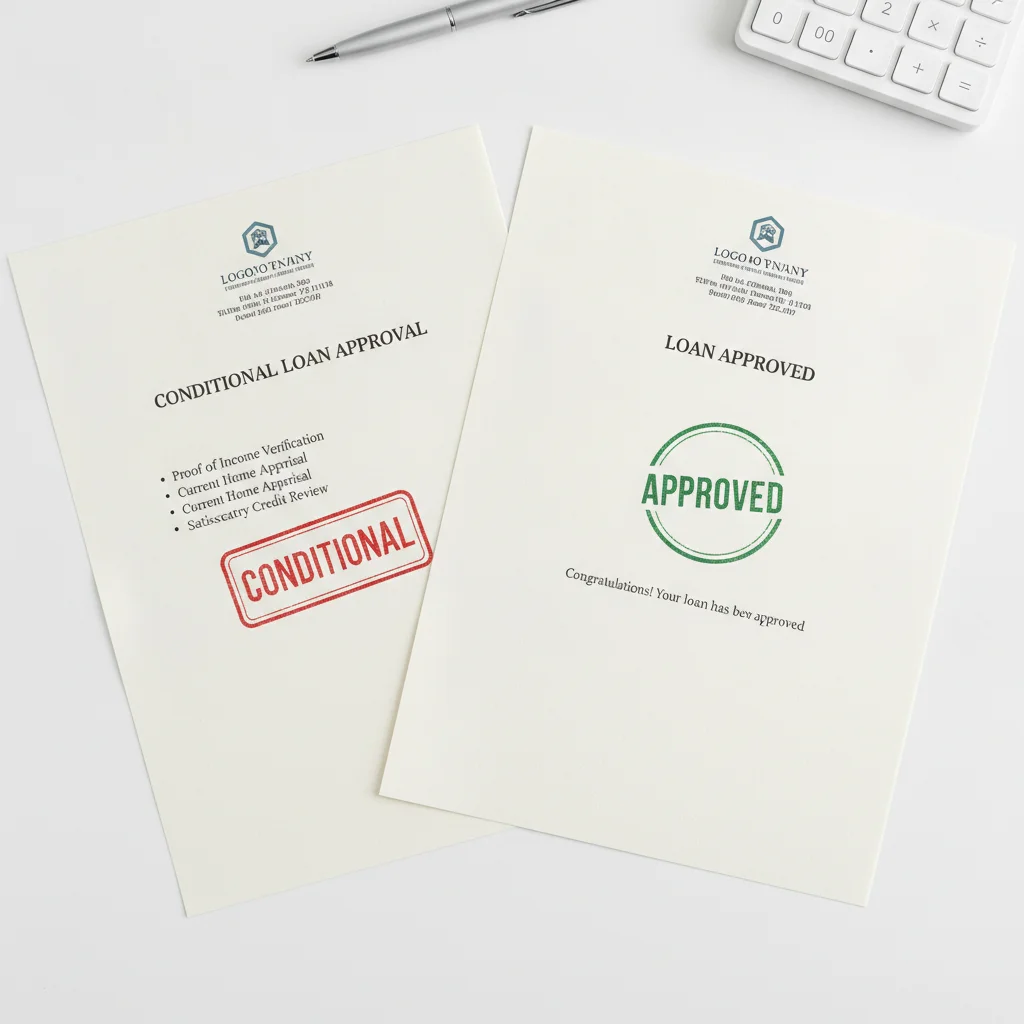
The practical difference also shows up in your ability to negotiate the vehicle price separately from financing. Pre-approved financing changes the entire dealership conversation — but only when the approval is actually solid enough to back up that confidence.
Conditional Preapproval: What It Is and What Can Change
A conditional preapproval is an offer extended by a lender based on an initial review of your credit profile, but it carries stipulations that must be satisfied before funding is confirmed. Think of it as a term sheet, not a contract. The lender has run your credit and decided you're likely creditworthy, but they've reserved the right to adjust — or withdraw — the terms based on information they haven't fully verified yet.
Common Conditions You'll See
- Income verification: The lender quoted you based on what you reported. If your pay stubs, tax returns, or bank statements don't match, expect a rate adjustment or a reduced loan amount.
- Vehicle restrictions: Many conditional approvals exclude vehicles older than a certain model year (often 8–10 years) or above a mileage ceiling (typically 100,000–150,000 miles). Buy outside those parameters and the offer evaporates.
- Loan-to-value limits: If the car you select is priced significantly above its book value, the lender may cap funding at their assessed value — leaving a gap you have to cover in cash.
- Employment confirmation: Some lenders require a call to your employer or a recent pay stub. Recent job changes, gaps in employment, or self-employment can trigger additional scrutiny.
- Final credit review: A hard inquiry at the time of final application may reveal new delinquencies, a recent inquiry spike, or a score drop that disqualifies you from the quoted rate.
| Criterion | Conditional Preapproval | Firm Preapproval |
|---|---|---|
| Lender commitment level | Provisional — subject to conditions | Binding — terms are locked |
| Underwriting status | Partial — not fully verified | Complete — documentation reviewed |
| Rate reliability | May increase based on conditions | Locked at quoted rate |
| Loan amount certainty | Estimate — can be reduced | Confirmed ceiling amount |
| Dealership negotiating power | Limited — gaps can be exploited | Strong — finance office has no leverage |
| Income verification | Often still pending | Completed before offer issued |
| Vehicle restrictions | Specified but untested | Confirmed for eligible vehicle types |
| Risk of last-minute denial | Moderate to high | Low (barring major life changes) |
| Best used when | Still choosing a vehicle | Ready to buy a specific car |
| Typical source | Online lenders, banks (initial review) | Credit unions, banks (full underwriting) |
None of this means a conditional preapproval is worthless — it gives you a realistic ceiling and a starting rate estimate. But treat it as homework, not a finished product. Before you visit a dealer, satisfy every outstanding condition you can. Call the lender and ask directly: "What would make this offer unconditional?" Get the answer in writing if possible.
Also worth reviewing: red flags in a preapproval offer — because some conditional offers are structured in ways that make it nearly impossible to satisfy all requirements, essentially functioning as a soft rejection with marketing language.
How Long Preapprovals Typically Last
Most preapprovals — conditional or firm — expire within 30 to 60 days. Some lenders offer 90-day windows. Once expired, you'll need to reapply, which means another hard credit inquiry. If your deal takes longer than expected, contact your lender before expiration to ask about an extension rather than letting it lapse and restarting the process.
Multiple Lenders Won't Wreck Your Credit Score
One of the most persistent myths in auto financing is that applying to multiple lenders for preapproval significantly damages your credit. In practice, FICO and VantageScore models treat all auto loan inquiries within a 14-day window as a single inquiry. Apply to several lenders in a concentrated window, compare the offers you receive, and choose the strongest one — that's how smart buyers shop.
Conditional Doesn't Mean Declined
A conditional preapproval is not a rejection — it means the lender sees a creditworthy borrower but needs more information before committing fully. Many buyers receive conditional offers and successfully clear all conditions before arriving at the dealership. The key is to do that work before you shop, not after you've already fallen in love with a vehicle and signed a purchase agreement.
Firm Preapproval: What It Actually Commits the Lender To
A firm preapproval — sometimes called a hard approval or a committed offer — means the lender has completed their underwriting, verified your information, and is prepared to fund the loan at the stated terms, assuming the vehicle meets basic eligibility criteria. The rate, loan amount, and term are locked. What you see is what you get.
Banks, credit unions, and some online lenders issue firm preapprovals after conducting a full credit check and reviewing documentation upfront. The process is more rigorous — you'll submit pay stubs, employment history, and sometimes bank statements before receiving the offer — but that friction is exactly what makes the approval meaningful.
80%
Buyers who don't arrange outside financing
According to Consumer Financial Protection Bureau data, roughly 80% of car buyers rely solely on dealer-arranged financing, missing the leverage of a preapproval.
1–2%
Typical dealer rate markup (dealer reserve)
Dealers can mark up lender-approved rates by 1–2 percentage points — adding thousands in interest over the life of a loan without the buyer noticing.
14 days
Rate-shopping window without score penalty
FICO and VantageScore treat multiple auto loan inquiries within a 14-day window as a single inquiry, so shopping multiple lenders doesn't compound credit damage.
3–5
Recommended lenders to approach for preapproval
Financial advisors and consumer advocates consistently recommend getting preapproval offers from at least 3–5 sources before visiting a dealership.
What a Firm Preapproval Still Won't Cover
Even a firm offer has boundaries. The vehicle itself must typically fall within the lender's collateral guidelines — age, mileage, and title status. Some lenders exclude salvage-title vehicles or commercial-use trucks. These restrictions apply to all preapprovals, firm or not, so confirm them before you shop a specific car.
Additionally, if your financial situation changes materially between the time you receive the firm offer and when you go to close — a job loss, a large new debt, or a significant overdraft pattern — the lender may revisit the file. A firm preapproval doesn't give you a 90-day window to wreck your finances. It reflects your situation at the time of application.

That said, for the overwhelming majority of buyers who keep their financial profile stable, a firm preapproval is functionally equivalent to cash when you walk into a dealership. The finance office has no room to maneuver. You either take their in-house offer if it's better — which it rarely is — or you use your own financing and negotiate the vehicle price on its own merits.
How Dealers Exploit the Gap Between the Two
Here's something most buyers don't realize: dealership finance managers are trained to identify the weaknesses in your financing position. If you hand them a conditional preapproval letter, they will probe every condition. That's not cynicism — that's their job. And it's a job they're very good at.
The "Your Approval Didn't Go Through" Move
The most common tactic: the finance manager takes your conditional preapproval letter, "submits it to their system," and comes back 30 minutes later to tell you there was a problem — your vehicle doesn't qualify, or the rate changed, or they couldn't confirm income. They then pivot to their own financing, often at a higher rate, framed as a solution to your problem. In reality, they may have simply declined to use your outside lender at all.
The Monthly Payment Swap
If they know your approval is conditional and the loan amount might change, they can restructure the payment conversation entirely — stretching the term, adjusting the down payment, or burying add-ons in the financing. Read our breakdown of what 'subject to financing' language in a car contract actually means to understand exactly how contract language can shift your deal without your explicit agreement.
Your Defense
- Know whether your preapproval is firm or conditional before you go in.
- If conditional, satisfy every requirement with your lender before visiting the dealership.
- Bring written documentation — the preapproval letter plus any confirmation from your lender that conditions have been cleared.
- Never hand the letter to the finance manager until you've agreed on an out-the-door price for the vehicle.
The sequencing matters as much as the document itself. Negotiate price first, financing second — always.
Conditional vs. Firm: A Direct Comparison
The table below distills the practical differences between these two offer types. If you're shopping across lenders — which you should be — use this framework to grade each offer you receive.
| Criterion | Conditional Preapproval | Firm Preapproval |
|---|---|---|
| Lender commitment level | Provisional — subject to conditions | Binding — terms are locked |
| Underwriting status | Partial — not fully verified | Complete — documentation reviewed |
| Rate reliability | May increase based on conditions | Locked at quoted rate |
| Loan amount certainty | Estimate — can be reduced | Confirmed ceiling amount |
| Dealership negotiating power | Limited — gaps can be exploited | Strong — finance office has no leverage |
| Income verification | Often still pending | Completed before offer issued |
| Vehicle restrictions | Specified but untested | Confirmed for eligible vehicle types |
| Risk of last-minute denial | Moderate to high | Low (barring major life changes) |
| Best used when | Still choosing a vehicle | Ready to buy a specific car |
| Typical source | Online lenders, banks (initial review) | Credit unions, banks (full underwriting) |
One more distinction worth noting: conditional and firm preapprovals are entirely separate from prequalification, which involves no hard credit check and carries even less lender commitment. If you're unclear on that distinction, preapproval vs. prequalification are not the same thing — and confusing them at the dealership puts you in a weaker position than having no financing at all.
The goal isn't just to have a letter in your hand. It's to have a letter that actually means something when you sit down across from the finance manager.
How Long Preapprovals Typically Last
Most preapprovals — conditional or firm — expire within 30 to 60 days. Some lenders offer 90-day windows. Once expired, you'll need to reapply, which means another hard credit inquiry. If your deal takes longer than expected, contact your lender before expiration to ask about an extension rather than letting it lapse and restarting the process.
Multiple Lenders Won't Wreck Your Credit Score
One of the most persistent myths in auto financing is that applying to multiple lenders for preapproval significantly damages your credit. In practice, FICO and VantageScore models treat all auto loan inquiries within a 14-day window as a single inquiry. Apply to several lenders in a concentrated window, compare the offers you receive, and choose the strongest one — that's how smart buyers shop.
Conditional Doesn't Mean Declined
A conditional preapproval is not a rejection — it means the lender sees a creditworthy borrower but needs more information before committing fully. Many buyers receive conditional offers and successfully clear all conditions before arriving at the dealership. The key is to do that work before you shop, not after you've already fallen in love with a vehicle and signed a purchase agreement.
How to Turn a Conditional Offer Into a Firm One Before You Shop
If you've received a conditional preapproval and want to strengthen it before you hit dealerships, the process is straightforward — it just requires proactive communication with your lender.
Step-by-Step: Clearing Your Conditions
- Request the full list of conditions in writing. Don't accept a verbal summary. Every condition should be documented so there are no surprises at closing.
- Submit all required documentation upfront. Pay stubs, W-2s, tax returns for self-employed borrowers, proof of address, and bank statements if requested. The faster you submit, the faster underwriting can clear the file.
- Confirm vehicle parameter limits. Ask the lender for their maximum vehicle age, mileage, and loan-to-value ratio before you start shopping. This prevents wasted time on vehicles that wouldn't qualify anyway.
- Ask explicitly: "Is this offer now firm?" Once your documentation is reviewed and accepted, get written confirmation that the conditions have been satisfied and the rate and amount are locked.
- Check your credit before final submission. Any new hard inquiries or new accounts opened while shopping can affect your score. Minimize credit activity between your initial application and when you plan to close.
Most credit unions and direct banks are the best sources for firm preapprovals — they tend to do full underwriting upfront rather than deferring it. Online lenders vary widely; some issue firm offers after documentation review, others issue conditional offers that function more like prequalifications with better branding.
Wherever you land, go into the dealership knowing exactly what you have. The difference between a conditional and a firm preapproval isn't academic — it's the difference between being in control of your deal and being at the mercy of someone whose job is to maximize the dealership's financing profit.


All claims are backed by peer-reviewed research. Sources on request.