

Key Takeaways
Start here
What 'Bad Credit' Actually Means to a Lender
Next
Real Interest Rates by Credit Score Range
Then
What Lenders Actually Look at Beyond Your Score
Explore options
Your Realistic Borrowing Options
Reduce costs
How to Reduce the Cost of a Bad Credit Loan
Plan ahead
The Long Game: Using This Loan to Rebuild
What 'Bad Credit' Actually Means to a Lender
The term "bad credit" gets thrown around loosely, but lenders work from a specific framework. The FICO score — used by the majority of auto lenders — runs from 300 to 850. Here's how those numbers translate into lender categories:
APR
Annual Percentage Rate — the total yearly cost of borrowing, expressed as a percentage. It includes the interest rate plus any lender fees, making it a more complete measure of loan cost than the interest rate alone.
Subprime
A lending category for borrowers with credit scores generally below 620. Subprime loans carry higher interest rates because the lender is taking on greater risk of non-repayment.
Debt-to-Income Ratio (DTI)
The percentage of your gross monthly income that goes toward paying debts. Lenders use this to judge whether you can realistically afford another monthly payment on top of what you already owe.
Loan-to-Value Ratio (LTV)
The ratio of the loan amount to the vehicle's market value. A high LTV means you're borrowing close to — or more than — what the car is worth, which increases lender risk.
Dealer Reserve
The markup a dealership adds to the interest rate a lender approves for you. If a lender approves you at 16% and the dealer quotes you 18%, the dealer earns the 2% difference as additional profit.
Buy-Here-Pay-Here (BHPH)
A type of dealership that sells vehicles and finances them in-house, without involving a bank or outside lender. Approval is easy but rates are extremely high and terms are often harsh.
Gap Insurance
Coverage that pays the difference between what you owe on your loan and what your car is actually worth if it's totaled or stolen. It's particularly valuable when you have a small down payment and a high-rate loan.
Hard Inquiry
A credit check triggered when you formally apply for a loan. Hard inquiries can temporarily lower your credit score by a few points, though multiple inquiries for the same type of loan within a short window typically count as just one.
| Credit Tier | FICO Score Range | Industry Label |
|---|---|---|
| Super Prime | 720 and above | Best rates, widest options |
| Prime | 660–719 | Competitive rates, minor conditions |
| Near-Prime | 620–659 | Elevated rates, some restrictions |
| Subprime | 580–619 | High rates, stricter terms |
| Deep Subprime | Below 580 | Very high rates, limited lender pool |
Once you drop below 620, most traditional banks and credit unions become reluctant to lend. Below 580, you're in deep-subprime territory, where a smaller set of specialized lenders operate — and they charge accordingly for the risk they're taking on.
What drives a score that low? The most common culprits are late payments (especially recent ones), high credit card utilization, collections, repossessions, or a bankruptcy. Lenders don't just see the number — they see the story behind it in your credit report, and recent negative events weigh heavier than old ones.
If you're not certain where you stand, pull your free credit reports from AnnualCreditReport.com before you set foot in any lender's office. Errors are more common than people realize, and disputing an inaccuracy before you apply can make a measurable difference in the rate you're offered.
Real Interest Rates by Credit Score Range
Let's put real numbers on the table. The data below reflects approximate average APRs for new and used car loans across credit tiers based on industry benchmarks. Individual lenders vary, but these figures give you a credible baseline for what to expect.
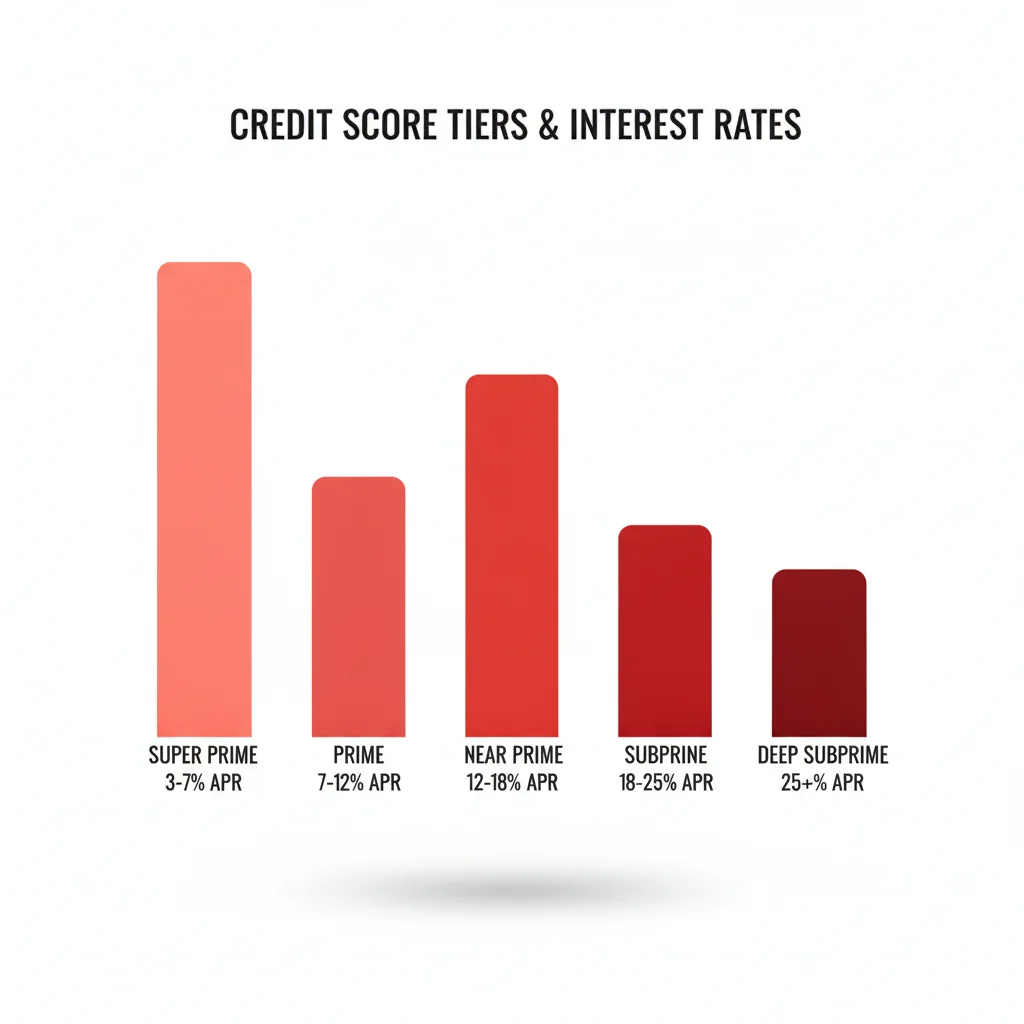
| Credit Tier | Approx. FICO Range | New Car APR (avg) | Used Car APR (avg) |
|---|---|---|---|
| Super Prime | 720+ | 5–7% | 6–8% |
| Prime | 660–719 | 7–10% | 9–12% |
| Near-Prime | 620–659 | 10–14% | 12–16% |
| Subprime | 580–619 | 14–18% | 16–20% |
| Deep Subprime | Below 580 | 18–22%+ | 20–25%+ |
Here's what that means in dollar terms. Take a $20,000 used car loan with a 60-month term:
- At 7% APR — monthly payment around $396, total interest paid: ~$3,761
- At 15% APR — monthly payment around $476, total interest paid: ~$8,548
- At 22% APR — monthly payment around $556, total interest paid: ~$13,337
The difference between a prime borrower and a deep-subprime borrower on that same vehicle is nearly $9,600 in extra interest over five years. That's money you could have put toward anything else.
New vs. Used: The Rate Gap Is Real
Used car APRs consistently run 2–4 percentage points higher than new car loans at every credit tier. While used cars have a lower sticker price, the higher rate narrows the total cost advantage. For some subprime borrowers, a certified pre-owned vehicle from a franchised dealer — which often qualifies for manufacturer-backed financing programs — can offer a better rate than a comparable private-party or independent-lot purchase.
Used car loans consistently carry higher rates than new car loans at every credit tier. That might seem counterintuitive, but lenders see used vehicles as higher-risk collateral — they depreciate faster, have more mechanical uncertainty, and are harder to value accurately. This is worth factoring in when you decide between new and used. See our coverage of financing a used car with bad credit for a deeper look at the trade-offs.
What Lenders Actually Look at Beyond Your Score
Your credit score is the starting point of any lender's evaluation — not the ending point. Once that number places you in a tier, underwriters dig into several other factors that can push your application toward approval or denial, and that can move your rate up or down within that tier.
Debt-to-Income Ratio (DTI)
Lenders want to know how much of your gross monthly income is already spoken for by debt payments. Most subprime lenders look for a DTI under 45–50%, though some will go higher with compensating factors. If your monthly take-home is $3,500 and you already owe $1,200 in monthly debt payments, adding a $500 car payment pushes you to a 49% DTI — right at the edge of what many lenders accept.
Payment-to-Income Ratio (PTI)
Separate from DTI, some lenders specifically look at how the proposed car payment compares to your gross monthly income. A common threshold is 15–20%. A $550 monthly payment on a $2,800 gross monthly income is nearly 20% — that's a flag even for subprime lenders.
Income Stability and Verification
Consistent employment history matters. Lenders want to see at least 6–12 months at your current job, or a demonstrable pattern of stable income if you're self-employed. Expect to provide recent pay stubs, bank statements, or tax returns.
Down Payment
More money down means less money the lender has at risk. For subprime borrowers, a 10–20% down payment can be the difference between approval and denial — and it almost always improves the rate you're offered. We cover this in depth in our article on down payments for bad credit car loans.
Loan-to-Value Ratio (LTV)
Lenders compare the loan amount to the vehicle's actual market value. If you're trying to finance a car worth $12,000 for $14,000 — because a dealer rolled in fees and add-ons — lenders see that negative equity upfront as a serious red flag. Subprime lenders are especially sensitive to LTV because their repossession risk is already higher.
Know Your LTV Before You Shop
Before visiting any dealership, look up the vehicle you're considering on Kelley Blue Book or Edmunds. Knowing its actual market value tells you whether the dealer's asking price leaves room for lender approval. Subprime lenders often cap loans at 100–120% of the vehicle's book value — if the dealer is pricing the car above that, you may hit a wall regardless of your other qualifications.
Cluster Your Applications to Protect Your Score
When shopping for the best rate, submit all your applications within a 14-day window. FICO scoring models recognize rate-shopping behavior and treat multiple auto loan inquiries within that period as a single inquiry. This means you can compare three or four lenders with minimal credit score damage — so never skip comparison shopping out of fear of hurting your score.
Your Realistic Borrowing Options
Not all lenders who work with bad credit borrowers are the same. Understanding who's at the table — and what each one costs — keeps you from defaulting to the most expensive option just because it was the most convenient.
Credit Unions
If you're already a member of a credit union, start here. Credit unions are member-owned nonprofits with more flexibility in how they evaluate borrowers. Some have dedicated programs for credit-challenged members with rates meaningfully lower than what a buy-here-pay-here lot would offer. Even if you're on the borderline of their cutoffs, it's worth a conversation with a loan officer rather than just an online form.
Online Subprime Lenders
Lenders like Capital One Auto Finance, Westlake Financial, and DriveTime specifically operate in the subprime and deep-subprime space. They move fast, and their digital applications let you check rates without visiting a dealer. The rates are higher than prime lenders, but they're generally more transparent than what you'll encounter at a dealership's finance office.
Dealer-Arranged Financing
When a dealer says "we'll get you financed," they typically mean they'll shop your application to a network of lenders who work with their dealership. The dealer usually earns a markup — called a dealer reserve — on the rate the lender offers. So if the lender approves you at 17%, the dealer might quote you 19% and pocket the spread. This is legal and common, but it's a cost you can negotiate down if you come in with a preapproval already in hand.
Getting preapproved with less-than-perfect credit before you walk into a dealership is one of the most effective moves available to a subprime borrower. It sets a ceiling on what the dealer can charge and shifts the conversation from "can you qualify" to "can you beat this rate."
Buy-Here-Pay-Here Dealerships
These lots act as both the seller and the lender. They don't report to a bank — they hold your loan themselves. Approval is nearly guaranteed, even for borrowers with a recent bankruptcy or repossession. The price for that: APRs that routinely run 25–30% or higher, older and higher-mileage vehicles, and aggressive repossession practices if you miss a payment.
Buy-Here-Pay-Here Can Trap You in a Cycle
BHPH dealerships rarely report on-time payments to credit bureaus — but they almost always report repossessions. That means you pay sky-high rates, get no credit-building benefit when you pay on time, and suffer full credit damage if you fall behind. Exhaust every other option before settling for a BHPH lot.
Prepayment Penalties Are a Hidden Cost
Some subprime lenders build prepayment penalties into their contracts — fees you pay if you pay off or refinance the loan early. Always ask specifically whether the loan has a prepayment penalty before signing. If it does, that clause can significantly reduce the benefit of refinancing once your credit improves.
Co-Signer Arrangements
Adding a creditworthy co-signer — typically someone with a score above 680 — can dramatically change your approval odds and interest rate. The co-signer is fully responsible for the debt if you default, so this arrangement carries real weight. Our guide on getting a co-signer for a bad credit car loan covers the mechanics and the risks in full.

How to Reduce the Cost of a Bad Credit Loan
You can't fully escape the rate penalty that comes with a low credit score, but you can absolutely shrink it. Here are the levers that actually move the needle.
Bring a Meaningful Down Payment
A 10% down payment on a $18,000 vehicle is $1,800. That's not nothing, but for many subprime borrowers it's achievable with a few months of saving. Some lenders explicitly offer lower rates when the down payment crosses the 10% or 20% threshold. Beyond the rate benefit, a larger down payment also means a smaller loan — which reduces your total interest exposure regardless of rate.
Choose a Shorter Loan Term
Longer terms — 72 or 84 months — lower your monthly payment but dramatically increase the total interest you pay. They also put you at greater risk of being underwater on the loan (owing more than the car is worth). At subprime rates, a 72-month term on a used car can mean you're paying more in interest than the car is worth by month 36. Stick to 48 or 60 months if your budget allows it.
Shop Multiple Lenders Before the Dealership
Apply to at least two or three lenders — a credit union, an online subprime lender, and one other — within a two-week window so the inquiries cluster into a single impact on your score. Then bring those offers to the dealership. You now have leverage you didn't have walking in blind.
Choose a Less Expensive Vehicle
The less you borrow, the less damage a high APR can do. A $14,000 reliable used car with a 19% rate costs significantly less in total interest than a $24,000 vehicle at the same rate. For bad-credit borrowers, keeping the purchase price modest is one of the most impactful financial decisions you can make.
Improve Your Score Before Applying
If your timeline is flexible, even a 30–60 day effort to reduce credit card balances can shift your score by 20–40 points. That kind of improvement can move you from deep subprime into subprime, which — as the rate table shows — can cut your APR by several percentage points. For a more complete picture of how the first-time process works, see Auto Loans for Bad Credit: A First-Timer's Complete Walkthrough.
Know Your LTV Before You Shop
Before visiting any dealership, look up the vehicle you're considering on Kelley Blue Book or Edmunds. Knowing its actual market value tells you whether the dealer's asking price leaves room for lender approval. Subprime lenders often cap loans at 100–120% of the vehicle's book value — if the dealer is pricing the car above that, you may hit a wall regardless of your other qualifications.
Cluster Your Applications to Protect Your Score
When shopping for the best rate, submit all your applications within a 14-day window. FICO scoring models recognize rate-shopping behavior and treat multiple auto loan inquiries within that period as a single inquiry. This means you can compare three or four lenders with minimal credit score damage — so never skip comparison shopping out of fear of hurting your score.
Red Flags and Traps to Avoid
The subprime auto lending space has more than its share of operators who know how to extract money from people who feel they have no other options. Here's what to watch for.
The Yo-Yo Financing Scam
You drive the car home, sign the paperwork, and feel like the deal is done. Then the dealer calls a few days later saying the financing "fell through" and you need to come back in to sign new paperwork — at a higher rate. This tactic is sometimes called spot delivery abuse. The original contract wasn't final; the dealer was still trying to place the loan. Your leverage at that point is to return the vehicle and walk away rather than accept worse terms.
Payment Packing
The finance manager quotes your payment as $480 per month. Sounds manageable. But buried in that payment are $2,800 in add-on products — an extended warranty, gap insurance, paint protection — that you neither asked for nor necessarily need. Always ask for the total loan amount, not just the monthly payment, and review the itemized breakdown before signing.
Excessive Loan Terms to Mask a High Price
An 84-month loan makes a $30,000 car look affordable at $550 per month. At 18% APR, you'll pay over $16,000 in interest over the life of that loan. The monthly payment is the number dealers use to close deals — your job is to focus on total cost of the transaction.
Add-Ons That Are Legitimately Overpriced
Gap insurance — which covers the difference between what you owe and what the car is worth if it's totaled — is genuinely useful for bad-credit borrowers with small down payments. But dealers routinely charge $800–$1,200 for it. You can often buy the same coverage through your auto insurance provider for $20–$40 per year. The same applies to extended warranties: compare pricing to third-party providers before accepting the dealer's version.
Buy-Here-Pay-Here Can Trap You in a Cycle
BHPH dealerships rarely report on-time payments to credit bureaus — but they almost always report repossessions. That means you pay sky-high rates, get no credit-building benefit when you pay on time, and suffer full credit damage if you fall behind. Exhaust every other option before settling for a BHPH lot.
Prepayment Penalties Are a Hidden Cost
Some subprime lenders build prepayment penalties into their contracts — fees you pay if you pay off or refinance the loan early. Always ask specifically whether the loan has a prepayment penalty before signing. If it does, that clause can significantly reduce the benefit of refinancing once your credit improves.
The Long Game: Using This Loan to Rebuild
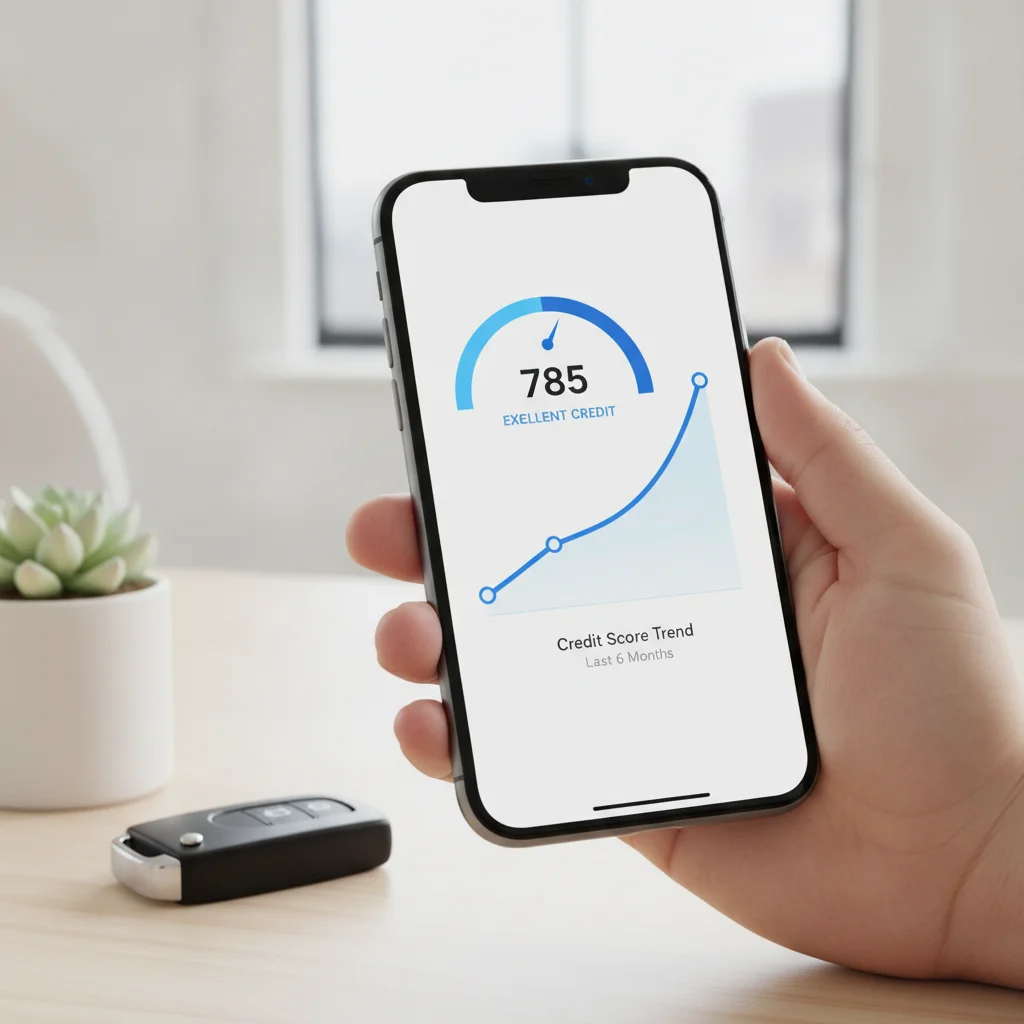
A bad-credit auto loan isn't just a means to get a car. Handled correctly, it's one of the fastest credit-building tools available to you — because installment loans (fixed payments over a set term) are weighted heavily in FICO scoring models, and auto loans are reported monthly to all three credit bureaus.
Here's what the mechanics look like in practice: payment history accounts for 35% of your FICO score — the single largest factor. Every on-time payment you make chips away at the negative history dragging your score down. After 12 months of clean payment history on an auto loan, many borrowers see score improvements in the 40–80 point range, depending on their starting point and the rest of their credit profile.
Credit mix — having different types of accounts — accounts for 10% of your score. If your current credit profile is all credit cards (revolving credit), adding an installment loan broadens your mix, which adds a modest score benefit on its own.
The traps to avoid on the rebuild path:
- Never pay late. A 30-day late payment can erase months of rebuilding progress and will stay on your report for seven years.
- Don't refinance too early. Closing a new account reduces your average account age, which can temporarily hurt your score. Wait at least 12 months of on-time payments before refinancing at a better rate.
- Do refinance when you qualify. After 12–18 months of reliable payments, check whether your improved score qualifies you for a lower rate. Refinancing at 11% instead of 19% on a remaining balance of $14,000 saves thousands of dollars over the remaining term.
For a deeper look at exactly how this works — including what borrowers commonly get wrong — see our article on how a bad credit auto loan can actually rebuild your score. And if you're still deciding where to start in the process, the Bad Credit Loans hub pulls together all the relevant guides in one place.
AnnualCreditReport.com
The only federally authorized source for free credit reports from all three bureaus. Pull yours before applying for any auto loan to check for errors and understand exactly where you stand.
Auto Loans for Bad Credit: A First-Timer's Complete Walkthrough
A step-by-step guide covering every stage of getting a car loan with poor credit — from knowing your score to signing the contract. Ideal if this is your first time navigating the subprime lending process.
Loan Preapproval Hub
Everything you need to know about getting preapproved for an auto loan — what it means, which lenders to approach, and how to use a preapproval offer as negotiating leverage at the dealership.
Kelley Blue Book Vehicle Valuation Tool
Look up the fair market value of any vehicle before you finance it. Knowing the book value protects you from overpaying and helps you understand whether the loan amount will clear lender LTV requirements.
Getting a Co-Signer for a Bad Credit Car Loan
A detailed look at how co-signer arrangements work, the risks for the co-signer, and what both parties should agree on before the paperwork is signed.
How a Bad Credit Auto Loan Can Actually Rebuild Your Score
Explains the credit-building mechanics behind installment loans and identifies the common mistakes borrowers make that undermine their own rebuilding progress.
All claims are backed by peer-reviewed research. Sources on request.