
Key Takeaways
Traffic Violation Rate Impact
When you receive a traffic violation, your insurer treats it as evidence that you're a higher-risk driver. As a result, they recalculate your premium — often upward — at your next policy renewal. The more serious the violation, and the more frequently you accumulate them, the larger the increase you'll face. This surcharge typically stays on your policy for three to five years, depending on the violation type and your state's laws.
Insurers pull your motor vehicle record (MVR) at each renewal and sometimes mid-term. They apply proprietary surcharge tables to violations, meaning two companies can respond very differently to the same ticket.
Why Insurers Care About Your Driving Record
Insurance pricing is fundamentally about predicting risk. When an insurer sets your premium, they're asking one core question: how likely is this driver to file a claim? Your driving record is one of the most direct answers to that question — it's a factual log of how you've actually behaved behind the wheel.
Every time you renew your policy, your insurer typically pulls your motor vehicle record (MVR) from your state's DMV. That report lists your violations, license suspensions, and in some states, at-fault accidents. Insurers then run that data through their own proprietary surcharge tables to determine if your rate needs adjusting.
It's worth understanding that different violations signal different risk levels. A rolling stop at a quiet intersection gets treated very differently than a DUI or a street racing charge. Insurers bucket violations into categories — minor, major, and serious — and apply surcharges accordingly. Understanding these categories helps you grasp why the rate impact varies so dramatically from one ticket to the next.
Moving vs. Non-Moving Violations
Only moving violations — those that involve your vehicle in motion — typically affect your insurance rates. Parking tickets, expired registration fines, and equipment violations (like a broken taillight) generally don't appear on your MVR in a way that triggers surcharges. When in doubt, check whether a violation is classified as "moving" under your state's traffic code.
SR-22 Coverage Gaps Are Costly
If you're required to carry an SR-22 and your policy lapses — even for a day — your insurer is required to notify the state. This can trigger an automatic license suspension in many states, compounding an already difficult situation. Set up automatic payments and confirm your coverage is continuously active throughout the SR-22 requirement period.
For a full picture of how your driving record works beyond insurance — including points, license suspensions, and how violations interact — see our explainer on what a moving violation actually does to your driving record.
The Violation Spectrum: From Minor to Catastrophic
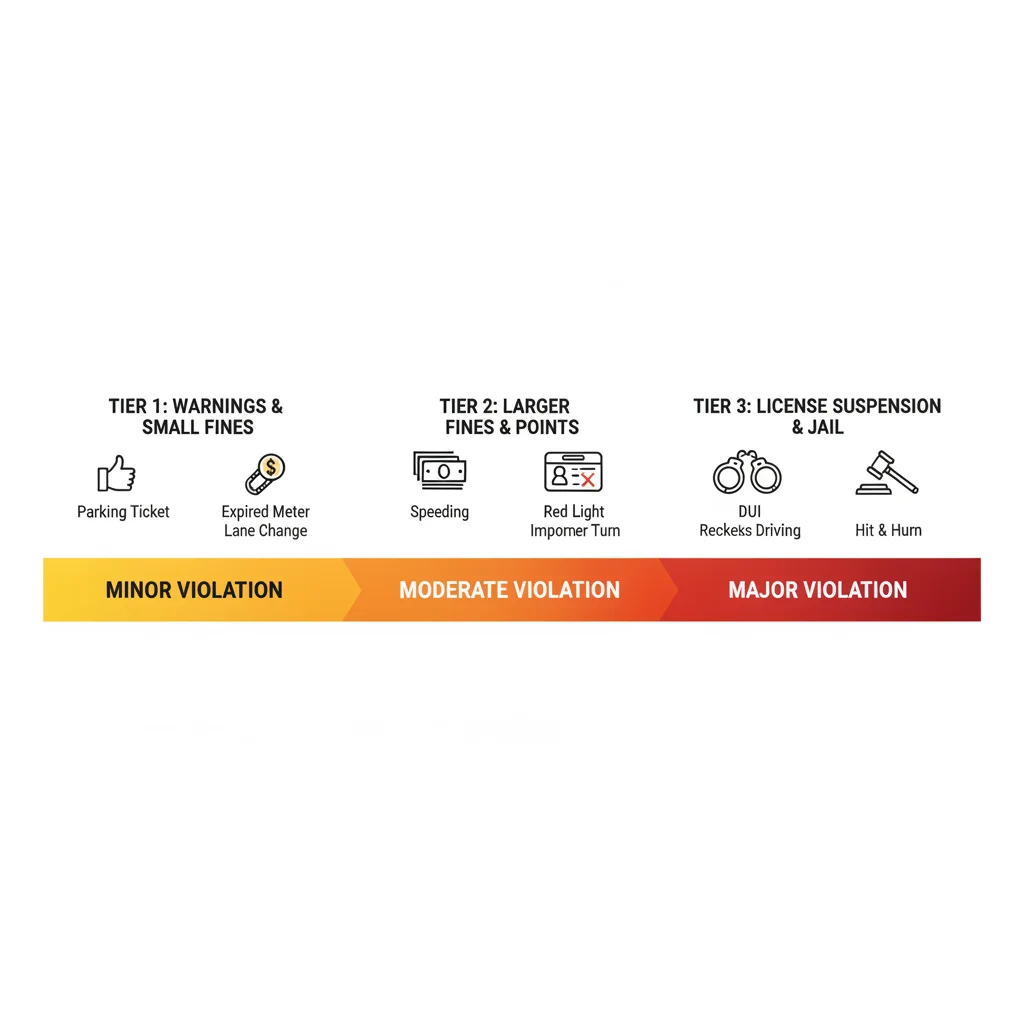
Not all traffic tickets are created equal when it comes to insurance. Here's how the typical tiering breaks down:
Minor Violations
These are the everyday slip-ups: going 1–15 mph over the limit, failing to signal a lane change, or making an illegal turn. Most insurers apply a relatively modest surcharge for a first offense — often 10–25% — and some carriers offer first-offense forgiveness that waives the surcharge entirely for long-standing customers with clean records.
Moderate Violations
Speeding 16–30 mph over the limit, running a red light caught on camera, or improper passing land in this tier. These generate more significant surcharges, typically 25–50%, and are less likely to benefit from forgiveness programs.
Major Violations
Reckless driving, hit-and-run, driving with a suspended license, and excessive speeding (30+ mph over) are major violations. Expect surcharges of 50–100% or more. Many standard insurers will non-renew your policy after one of these, forcing you into high-risk coverage markets.
Serious / Criminal Violations
DUI, DWI, and vehicular assault sit at the top of the risk ladder. A DUI conviction can increase your premium by 70–120% and trigger a requirement for an SR-22 filing — a form your insurer files with the state confirming you carry minimum required coverage. Some carriers won't insure DUI convictions at all.
~25%
Average premium increase after one speeding ticket
Based on rate analysis data aggregated across major U.S. insurers by the Insurance Information Institute.
74%
Average rate increase after a DUI conviction
According to a 2023 analysis by ValuePenguin comparing pre- and post-DUI premiums across U.S. drivers.
3 years
Typical lookback window for minor violations
Most state DMV records and standard insurer underwriting windows cover the prior 36 months for minor moving violations.
2–3x
Rate multiplier for multiple violations vs. one
Drivers with three or more violations in a 3-year period can pay two to three times more than a clean-record driver, per industry underwriting data.
How Long Violations Affect Your Rates
The surcharge timeline is one of the most important — and most misunderstood — parts of the violation-rate relationship. Here's what you need to know:
- Minor violations: Typically 3 years from the conviction date in most states
- Moderate violations: 3–5 years, depending on state law and insurer policy
- Major violations (reckless driving, hit-and-run): 5–7 years in most states
- DUI/DWI: 5–10 years, with some states maintaining DUI on your record permanently
The key date is usually the conviction date, not the date of the incident or the date you paid the fine. If your ticket went to court and you contested it, the clock starts from the court's ruling.
Good news: once a violation ages off your record, its effect on your insurance evaporates too. Your rate can actually improve automatically over time without any action on your part — violations aging off, tenure with a carrier building up, and other passive factors all move in your favor. Factors that actually improve your rate over time without you doing anything breaks down exactly how that timeline works.
Use the Renewal Window Strategically
The period between getting a ticket and your policy renewal is your best opportunity to act. Request quotes from at least three competitors, ask your current insurer about forgiveness programs, and look into defensive driving course discounts — all before your renewal date arrives and the surcharge locks in.
Set a Calendar Reminder for When Violations Age Off
Note the exact conviction date of any violation and set a reminder for when it clears your state's lookback window. Shopping for new coverage or requesting a rate review immediately after a violation drops off can yield meaningful savings — especially if your current carrier hasn't proactively adjusted your rate.
The Stacking Problem: Multiple Violations
Here's where many drivers get surprised: violations don't just add — they multiply in their impact. A driver with three minor speeding tickets within 36 months is often treated as a higher risk than a driver with a single moderate violation. Why? Because frequency signals a pattern of behavior, not a one-time lapse in judgment.
Some insurers apply a progressively steeper surcharge with each additional violation. Others will simply non-renew your policy if you accumulate more than two or three violations within a rolling 36-month window. This is especially important to understand if you've already received one ticket and then get pulled over again — your calculus should shift from "this is just another small ticket" to "this could trigger a significant policy change."

Driving record history is just one component of the broader rate equation. To see how it fits alongside other variables like your age, location, and vehicle type, the rate factors hub covers the full picture.
Timing: When Does the Rate Increase Actually Kick In?
Most drivers assume their rate jumps the moment a ticket is issued. That's not how it works. The typical sequence looks like this:
- You receive a ticket and pay the fine (or contest it in court)
- The conviction is recorded on your state DMV record
- Your insurer pulls your MVR at your next policy renewal — typically 6 or 12 months out
- The surcharge is applied to your renewed premium
This lag can feel like a grace period, but it isn't — the surcharge is coming. If you receive a ticket in March and your policy renews in October, you'll see the impact in October. The silver lining: you have that window to be proactive. Consider taking a defensive driving course, shopping competing carriers, or asking your current insurer about any forgiveness programs before renewal hits.
One exception: at-fault accidents. Many insurers respond to these more quickly — sometimes mid-term — because accident claims trigger a direct review of your record, not just a scheduled MVR pull.
“Drivers often think the ticket is the penalty. It isn't — the insurance surcharge over three to five years typically costs far more than the fine itself. The ticket is just the beginning of the financial impact.”
— J. Robert Hunter, Former Insurance Commissioner and Director of Insurance, Consumer Federation of America
Practical Steps to Limit the Rate Damage
You can't erase a conviction, but you can minimize the financial fallout. Here's what actually works:
1. Take a Defensive Driving Course
In many states, completing an approved defensive driving course earns you a point reduction on your license — and signals to insurers that you've actively addressed the behavior that led to the violation. Some carriers offer a direct discount for course completion, on top of any point reduction benefit.
2. Ask About Accident or Violation Forgiveness
Many major carriers offer first-offense forgiveness for long-standing customers with otherwise clean records. This isn't automatic — you often have to ask, or it may need to be added as an endorsement before a violation occurs. Check your current policy terms.
3. Shop the Market at Renewal
Insurers weigh violations differently. Your current carrier might apply a 35% surcharge for a speeding ticket while a competitor applies 20%. Shopping around — especially when a surcharge is new — can save you meaningfully. Get at least three quotes before renewing.
4. Consider Usage-Based Insurance
If you drive relatively few miles and have generally safe habits post-violation, a telematics or usage-based program can offset the violation surcharge with behavioral data. Not all insurers offer this, and results vary, but it's worth evaluating.
5. Wait It Out Strategically
If a violation is close to aging off your record — say, 2.5 years into a 3-year lookback window — it may be worth staying with your current carrier until it clears, then shopping for the best rate with a clean record. The timing of when you shop matters.
Use the Renewal Window Strategically
The period between getting a ticket and your policy renewal is your best opportunity to act. Request quotes from at least three competitors, ask your current insurer about forgiveness programs, and look into defensive driving course discounts — all before your renewal date arrives and the surcharge locks in.
Set a Calendar Reminder for When Violations Age Off
Note the exact conviction date of any violation and set a reminder for when it clears your state's lookback window. Shopping for new coverage or requesting a rate review immediately after a violation drops off can yield meaningful savings — especially if your current carrier hasn't proactively adjusted your rate.
SR-22 and High-Risk Coverage: What Happens in the Worst Cases
For the most serious violations — DUI, reckless driving, multiple at-fault accidents, or driving uninsured — you may find yourself in territory beyond a simple rate surcharge. Two major consequences apply here:
SR-22 Requirement
An SR-22 is not insurance itself — it's a certificate your insurer files with your state confirming that you carry at least the minimum required liability coverage. States typically require SR-22 for 2–5 years after a serious violation. If your current carrier won't file one (some won't), you'll need to find a carrier that will, and you'll pay for the filing plus the elevated premiums that come with high-risk status.
Non-Standard or High-Risk Carriers
If standard insurers decline to renew your policy, you may need to seek coverage through non-standard carriers — companies that specialize in insuring higher-risk drivers. Premiums are significantly higher, but coverage options are still available. In some states, the assigned risk pool (your state's FAIR plan equivalent for auto) is a last resort if no private carrier will cover you.
The goal is to move back into standard coverage as quickly as possible. That means keeping your record clean through the SR-22 period, avoiding any additional violations, and re-shopping the standard market as your high-risk designation ages off.

Moving vs. Non-Moving Violations
Only moving violations — those that involve your vehicle in motion — typically affect your insurance rates. Parking tickets, expired registration fines, and equipment violations (like a broken taillight) generally don't appear on your MVR in a way that triggers surcharges. When in doubt, check whether a violation is classified as "moving" under your state's traffic code.
SR-22 Coverage Gaps Are Costly
If you're required to carry an SR-22 and your policy lapses — even for a day — your insurer is required to notify the state. This can trigger an automatic license suspension in many states, compounding an already difficult situation. Set up automatic payments and confirm your coverage is continuously active throughout the SR-22 requirement period.

All claims are backed by peer-reviewed research. Sources on request.