| Federal Standard for Signs | Manual on Uniform Traffic Control Devices (MUTCD) (Federal Highway Administration (FHWA)) |
| Number of Sign Shape Categories | 9 standardized shapes (MUTCD 11th Edition, 2023) |
| School Zone Fine Multiplier | 2x standard fine (most states) (Varies by state DMV) |
| Work Zone Fine Multiplier | 2x–3x standard fine (FHWA Work Zone Safety Program) |
| HOV Lane Minimum Occupancy (most common) | 2 persons (2+), some corridors require 3+ (State DOT guidelines) |
| Years a Moving Violation Stays on MVR | 3–5 years (state dependent) (AAMVA Driver Record standards) |
| Fire Hydrant No-Parking Clearance | 15 feet (standard); some cities require more (Uniform Fire Code / local ordinances) |
| Red Light Camera Ticket Premium Impact | 20–30% rate increase (typical) (Insurance Information Institute, 2023) |
Why Drivers Get Traffic Signs Wrong
Most drivers passed their written test years — sometimes decades — ago. Since then, the rules have changed in small but meaningful ways, new sign types have been introduced, and old habits have hardened. The result: a lot of drivers operating on assumptions that don't quite match current law.
This guide is a lookup resource, not a lecture. Use it to check what a specific sign, signal, or pavement marking legally means, and what behavior it requires. If you've ever wondered whether a flashing yellow arrow means yield or stop, or what a white-painted curb actually permits, you'll find a direct answer here.
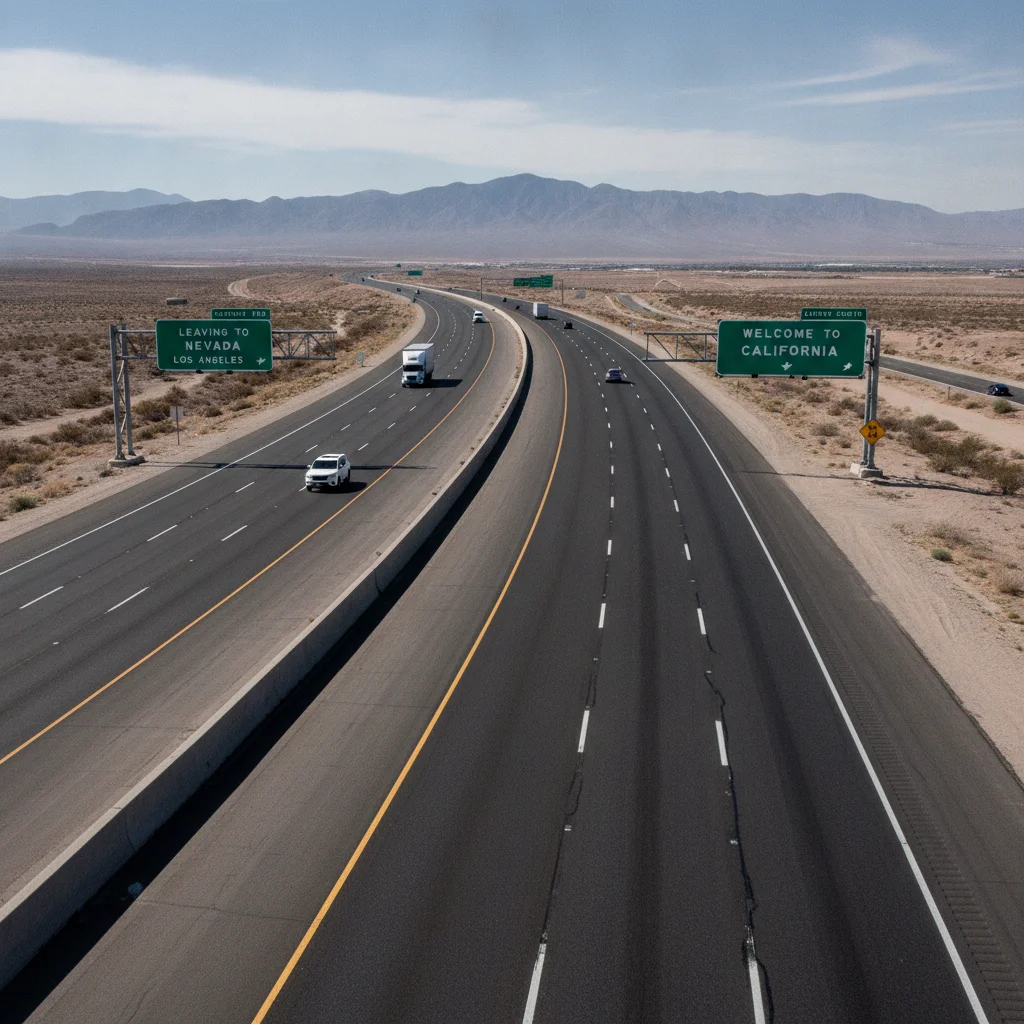
For a broader look at enforcement patterns, see our companion piece on commonly misunderstood and frequently enforced traffic laws. If you're heading across state lines, pavement markings and sign rules can also vary — check traffic law differences by state before you go.
| Federal Standard for Signs | Manual on Uniform Traffic Control Devices (MUTCD) (Federal Highway Administration (FHWA)) |
| Number of Sign Shape Categories | 9 standardized shapes (MUTCD 11th Edition, 2023) |
| School Zone Fine Multiplier | 2x standard fine (most states) (Varies by state DMV) |
| Work Zone Fine Multiplier | 2x–3x standard fine (FHWA Work Zone Safety Program) |
| HOV Lane Minimum Occupancy (most common) | 2 persons (2+), some corridors require 3+ (State DOT guidelines) |
| Years a Moving Violation Stays on MVR | 3–5 years (state dependent) (AAMVA Driver Record standards) |
| Fire Hydrant No-Parking Clearance | 15 feet (standard); some cities require more (Uniform Fire Code / local ordinances) |
| Red Light Camera Ticket Premium Impact | 20–30% rate increase (typical) (Insurance Information Institute, 2023) |
Road Sign Categories: Shape, Color, and What They Mean
The Federal Highway Administration (FHWA) standardizes road signs through the Manual on Uniform Traffic Control Devices (MUTCD). Signs are intentionally designed so that shape and color communicate meaning even before you read the text — critical at highway speeds.
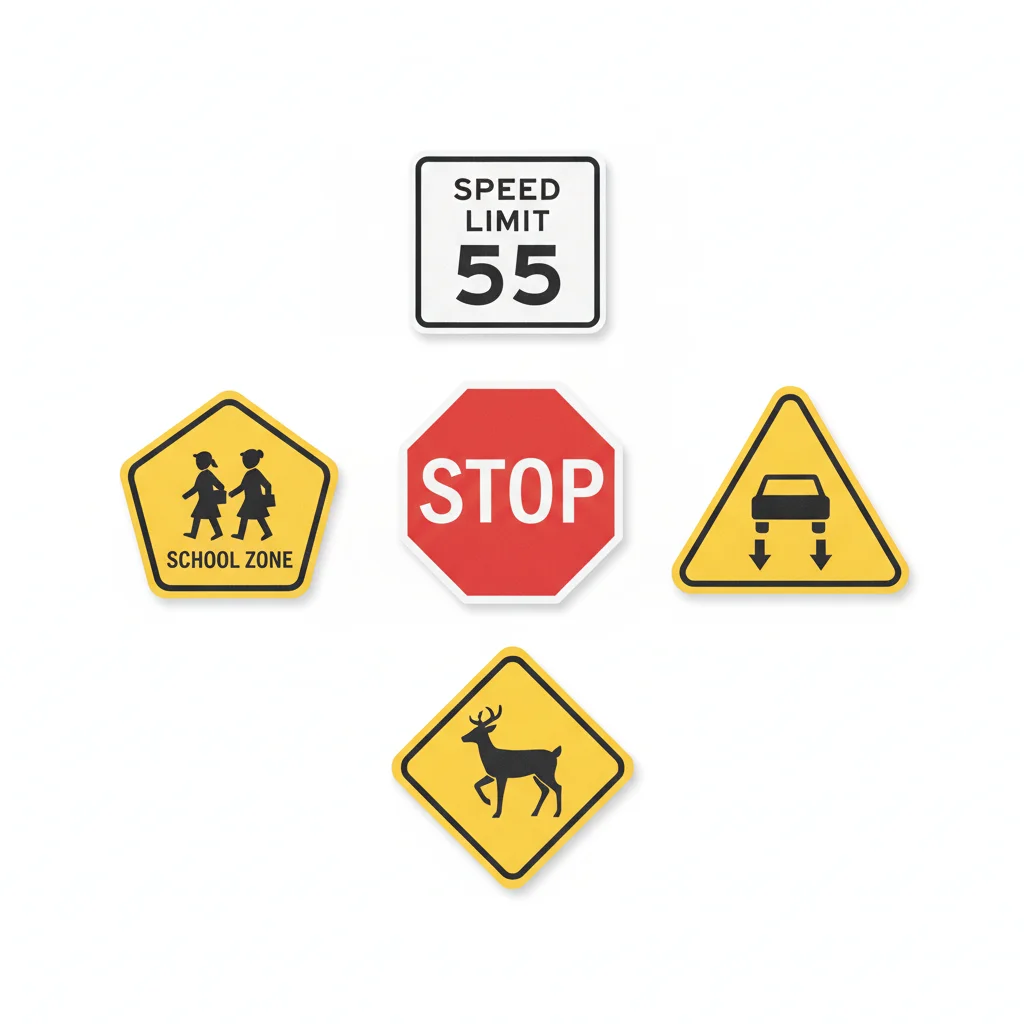
Sign Shapes
| Shape | Primary Meaning | Common Examples |
|---|---|---|
| Octagon | Stop — full, complete stop required | STOP sign |
| Triangle (point down) | Yield — give way to crossing or merging traffic | YIELD sign |
| Diamond | Warning — hazard, changing road conditions, or cross traffic ahead | Curve ahead, deer crossing, pedestrian crossing |
| Rectangle (vertical) | Regulatory — rules you must follow | Speed limit, do not pass, one way |
| Rectangle (horizontal) | Guide or informational | Street name, route marker, distance signs |
| Pentagon (point up) | School zone or school crossing | School crossing ahead |
| Crossbuck (X shape) | Railroad crossing | RR crossing warning |
Sign Colors
| Color | Meaning | Examples |
|---|---|---|
| Red | Stop, prohibition, or do not enter | STOP, YIELD, wrong way, do not enter |
| Yellow | General warning | Curve ahead, merge, school zone (older signs) |
| Orange | Work zone / construction | Road work ahead, lane closed |
| Green | Guide, direction, distance | Highway exits, street names |
| Blue | Services or motorist assistance | Rest area, hospital, fuel, lodging |
| Brown | Recreation or cultural interest | Parks, campgrounds, scenic routes |
| White | Regulatory | Speed limit, lane control, turn restrictions |
| Fluorescent yellow-green | Pedestrian, bicycle, school warning | Crosswalk ahead (newer standard) |
A quick note: older school zone signs used yellow, but the FHWA adopted fluorescent yellow-green as the current standard for maximum visibility. You'll still encounter both depending on when a jurisdiction last updated its signage.
Temporary Markings Override Permanent Ones
In active construction zones, orange paint and temporary signs take legal precedence over the white and yellow lines beneath them. If conflicting markings are visible, always follow the orange or temporary guidance. Ignoring this is one of the most common — and dangerous — errors drivers make in work zones.
Sign Standards Vary Slightly by State
While the MUTCD sets federal minimums, individual states can adopt additional or stricter standards. Curb color meanings, school zone hours, and HOV definitions are particularly variable. Always check your state DMV's driver handbook if you're unsure about a local marking. See our guide to <a href="/maintenance-and-ownership/safety-legal/traffic-laws/traffic-law-differences-across-state-lines-drivers-should-know-before-a-road-trip">state-by-state traffic law differences</a> for a practical breakdown.
Paying a Traffic Fine Is an Admission of Guilt
In most jurisdictions, submitting payment for a traffic citation is treated as a formal admission that the violation occurred. Before paying, check whether your state allows a defensive driving course for dismissal or a hearing to contest the charge — both options may keep the violation off your MVR and protect your insurance rate.
Commonly Confused Regulatory Signs
Regulatory signs carry legal weight — ignoring them is a moving violation. These are the ones that most often trip up experienced drivers.
STOP vs. YIELD
A STOP sign requires a complete stop — meaning your vehicle must reach zero miles per hour — before the stop line or, if there's no line, before the crosswalk or the edge of the intersecting roadway. A rolling stop is a violation in every state, full stop (pun intended).
A YIELD sign requires you to slow and be prepared to stop if cross traffic is present. If the road is clear, you may proceed without stopping. The key legal distinction: yield does not require a full stop unless a conflict actually exists.
Do Not Enter vs. Wrong Way
These two signs often appear together near highway ramps, but they're not the same sign. Do Not Enter is placed at the beginning of a one-way segment facing oncoming traffic — it marks the entry point you must not use. Wrong Way is placed further down the roadway, facing traffic that has already entered the wrong-way segment. If you see a Wrong Way sign, you need to stop, safely reverse course, and exit that roadway.
No U-Turn vs. No Left Turn
These are frequently confused. No U-Turn prohibits only a 180-degree reversal of direction — you can still turn left. No Left Turn prohibits turning left entirely but doesn't address U-turns explicitly (though local ordinance often does). When both signs appear together, neither maneuver is permitted.
Speed Limit vs. Advisory Speed
White rectangular speed limit signs are regulatory — the number is the legal maximum under normal conditions. Yellow diamond signs with a speed number (often seen on curves or ramps) are advisory — they recommend a safe speed for that specific condition, not a legal limit. Driving at the posted speed limit through a curve marked with a 25 mph advisory isn't illegal on its face, but if you lose control, you may face a reckless driving charge.
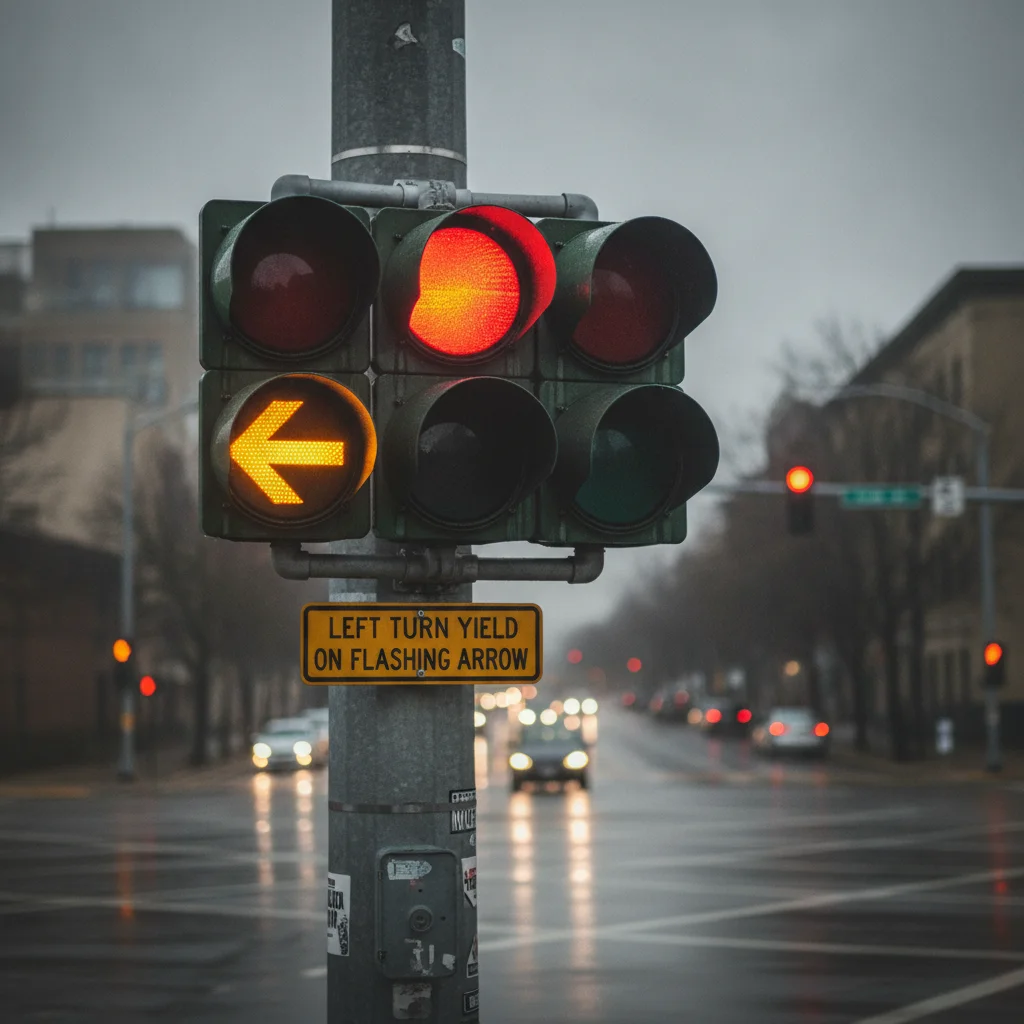
Flashing vs. Solid Red and Yellow Lights
- Solid red: Stop. Wait for green.
- Flashing red: Treat as a STOP sign — come to a complete stop, then proceed when safe.
- Solid yellow: The signal is about to turn red. Prepare to stop if you can safely do so — it is NOT a signal to accelerate.
- Flashing yellow: Proceed with caution. No stop required unless traffic or pedestrians are present.
- Flashing yellow arrow: You may turn in the direction of the arrow, but you must yield to oncoming traffic and pedestrians. This is increasingly replacing the traditional green ball for permissive left turns.
The flashing yellow arrow is the signal element drivers most consistently misread. It does not give you a protected turn — oncoming traffic is also moving, and you must yield.
MUTCD
The Manual on Uniform Traffic Control Devices, published by the FHWA. It establishes the federal standards for all signs, signals, and pavement markings on public roads in the United States. States must comply with or exceed these standards.
Regulatory Sign
A sign that legally mandates or prohibits a specific behavior, such as speed limits, turn restrictions, or stop requirements. Violating a regulatory sign is a moving violation.
Advisory Speed
A recommended speed for a specific road feature (curve, ramp, intersection), displayed on a yellow diamond sign. It is not a legal speed limit but indicates a safe speed under normal conditions.
Permissive Left Turn
A left turn made during a green ball signal or flashing yellow arrow, where the driver must yield to oncoming traffic. Contrasts with a protected left turn, where oncoming traffic is stopped by a red signal.
HAWK Signal
High-intensity Activated crossWalK beacon — a pedestrian-activated signal used at mid-block crossings. It cycles through dark, flashing yellow, solid yellow, solid red, and alternating flashing red phases.
HOV Lane
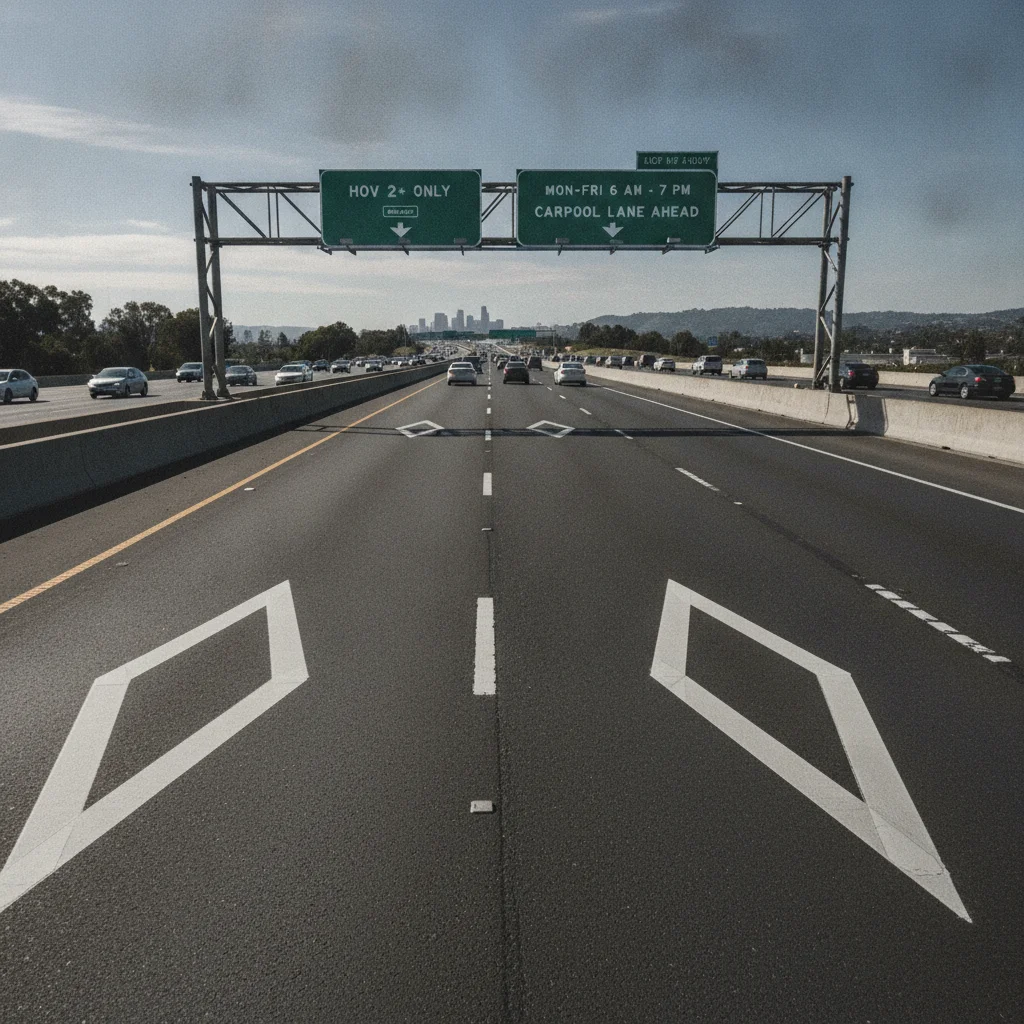
A High-Occupancy Vehicle lane reserved for vehicles with a minimum number of occupants (typically 2 or 3). Entry and exit are restricted to marked access points.
Motor Vehicle Record (MVR)
The official driving history maintained by a state DMV, including license status, violations, accidents, and suspensions. Insurers use MVRs to assess risk and set premium rates.
Channelizing Devices
Temporary traffic control equipment used in work zones — including cones, drums, and barriers — that physically guides vehicles through a changed roadway configuration.
Pavement Markings: Lines, Arrows, and Curb Colors
Pavement markings are legally binding in the same way signs are. Crossing a solid double yellow line is a violation; stopping in a red-painted curb zone can result in a ticket or tow. Here's how to read what's under your wheels.
Lane Lines
| Marking | Meaning |
|---|---|
| White dashed line | Lane boundary — may change lanes if safe |
| White solid line | Lane boundary — discouraged or prohibited lane change (common near intersections, highway exits) |
| Double white solid lines | Lane change prohibited — common in HOV or carpool lanes |
| Yellow dashed line | Center line — passing permitted when safe on a two-lane road |
| Yellow solid line (your side) | No passing from your lane |
| Double yellow solid lines | No passing in either direction |
| Broken yellow / solid yellow combination | Passing permitted only from the broken-yellow side |
Intersection and Crosswalk Markings
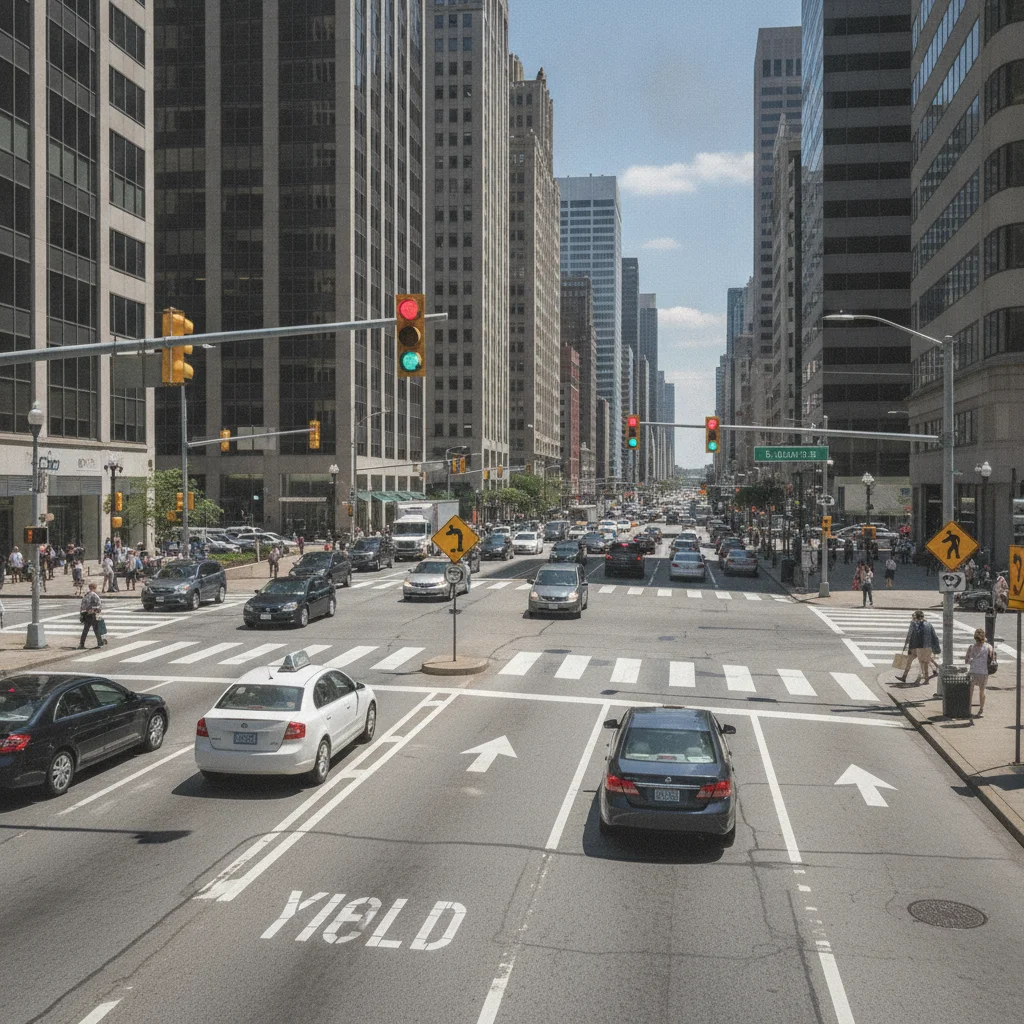
Stop line: A wide white bar across your lane. You must stop before this line — not at it, not past it. If there's no stop line, stop before the crosswalk. If there's no crosswalk, stop before the intersection edge.
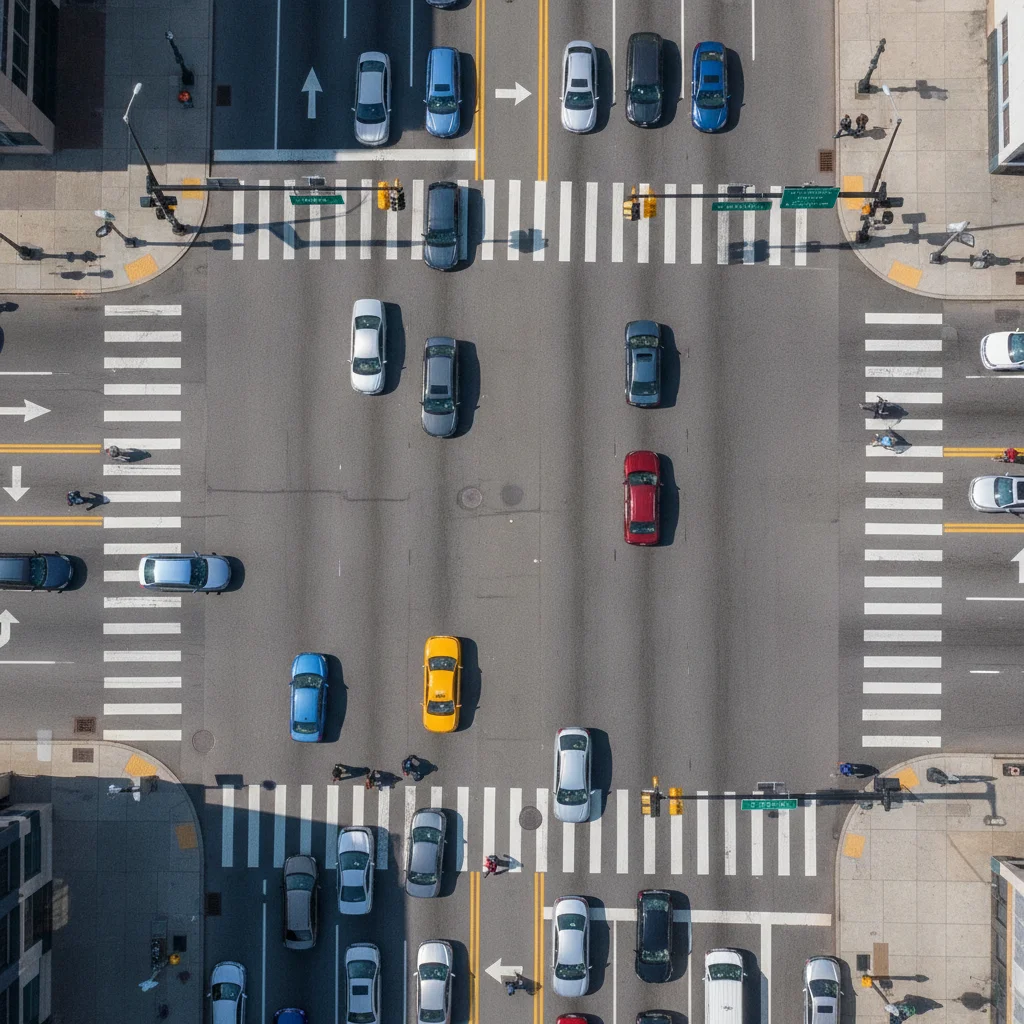
Crosswalk lines: Two parallel white lines (or ladder-style markings) mark a pedestrian crossing. In most states, pedestrians in a marked crosswalk have right of way — you must stop and remain stopped until they've fully cleared your lane, not just stepped off the curb.
Bike lane markings: A white bicycle symbol with a solid white line indicates a dedicated bike lane. You may not drive in a bike lane except for limited purposes (turning into a driveway, crossing to park), and even then, you must yield to cyclists.
Curb Colors
Curb colors are a local regulatory system, and they vary somewhat by jurisdiction, but the California model — used in many states — is the most common reference:
- Red: No stopping, standing, or parking at any time (unless a sign says otherwise)
- Yellow: Commercial loading zone — stopping permitted only for loading/unloading, usually with time limits
- White: Passenger loading only — usually 5 minutes or less, no parking
- Green: Time-limited parking — check posted signs for duration
- Blue: Accessible (ADA) parking — permit required
Unpainted curbs are not automatically free-for-all. Local ordinances, posted signs, and fire hydrant clearance rules (typically 15 feet) still apply.
40%
Of drivers who run red lights do so unintentionally
According to AAA Foundation for Traffic Safety research on intersection behavior and signal compliance.
2x–3x
Fine multiplier in most school and work zones
Enhanced penalties apply in designated safety zones in the majority of U.S. states, per FHWA work zone safety guidelines.
700+
Work zone fatalities annually in the U.S.
According to FHWA work zone safety data, underscoring why reduced speed and enhanced fines are enforced in these areas.
20–30%
Average insurance premium increase after a red-light ticket
Based on Insurance Information Institute 2023 data on the premium impact of common moving violations.
3–5 years
Duration a moving violation stays on your driving record
Varies by state and violation severity; major violations such as reckless driving may remain longer per AAMVA standards.
Special Zones and Markings You Can't Afford to Miss
Certain marked zones carry enhanced penalties — fines that are doubled or tripled, and in some cases, points that can affect your insurance premium directly. Knowing what activates them matters.
School Zones
Reduced speed limits in school zones typically apply only during designated hours — usually when children are arriving or departing. The sign will often include a time range or flashing beacon. If the beacon isn't flashing and no hours are posted, many states apply the reduced limit whenever children are present. When in doubt, slow down — fines in school zones are typically doubled, and some states add mandatory court appearances.
Work Zones (Construction Zones)
Orange signs, channeling devices, and temporary pavement markings define active work zones. Speed limits drop, and fines are doubled in most states. More importantly: temporary markings override permanent markings. If you see orange paint, follow it, not the original white or yellow lines beneath it.
Pedestrian Hybrid Beacons (HAWK Signals)
These are increasingly common near mid-block crosswalks and are notoriously confusing. The sequence:
- Dark (signal is inactive — proceed normally)
- Flashing yellow — pedestrian has activated the signal; prepare to stop
- Solid yellow — stop if you can safely do so
- Solid red — stop completely; pedestrian is crossing
- Alternating flashing red — treat like a flashing red; stop, then proceed when pedestrian has cleared
The alternating flashing red phase is where drivers most often make errors — they see the red turn to flashing and assume they must continue waiting. You may proceed once the pedestrian has cleared.
HOV and Managed Lanes
High-occupancy vehicle (HOV) lanes are marked with diamond symbols on the pavement and signs specifying minimum occupancy. Entry and exit points are designated — you typically cannot enter or exit an HOV lane from a double white line segment. Violations carry stiff fines and, in some states, are treated as moving violations that affect your driving record and insurance rates. See U.S. traffic laws every driver should know for more on how lane violations translate into legal exposure.
FHWA MUTCD Online (11th Edition)
The official, searchable online version of the Manual on Uniform Traffic Control Devices. Look up the exact federal standard for any sign, signal, or marking you encounter.
State DMV Driver Handbooks
Every state DMV publishes a driver's manual that covers state-specific sign and marking rules. A quick search for '[your state] DMV driver handbook' pulls up the current PDF — it's worth a skim even for experienced drivers.
FHWA Work Zone Safety Resources
The Federal Highway Administration's dedicated work zone safety portal covers how temporary traffic control works, what signs mean, and how to navigate construction safely.
AAA Traffic Safety Resource Center
AAA's research-backed safety hub includes guides on intersection behavior, pedestrian laws, and state-by-state rule comparisons — useful for drivers preparing for road trips.
Defensive Driving Course Finder (NHTSA)
NHTSA's resource to locate state-approved defensive driving courses. Completing one can dismiss a minor traffic violation and qualify you for an insurance discount in many states.
Quick Reference: Signs and Markings That Affect Your Insurance
Traffic violations don't just cost you the ticket — they can raise your insurance premium for three to five years depending on your state and carrier. Here's where road signs intersect directly with your wallet.
Violations That Typically Trigger Rate Increases
- Running a red light: Caught by camera or officer, this is a moving violation in virtually every state. Expect a premium bump of 20–30% with most carriers.
- Failure to stop (rolling stop): Even a $100 fine can add points. Some insurers pull your MVR annually; others do it at renewal.
- School zone or work zone speeding: Enhanced-penalty zones usually mean enhanced points. Multiple violations in these zones can trigger a license suspension review.
- Wrong-way driving: Often categorized with reckless driving — one of the fastest ways to move into a high-risk tier.
- HOV lane violation: In states where it's a moving violation, it will show on your MVR.
What to Do If You Receive a Violation
Don't automatically pay the fine — paying is an admission of guilt. In many jurisdictions, you can request a hearing or complete a defensive driving course to dismiss the violation or keep it off your record. Check your state DMV's options before writing a check.
If you're in the market for a new vehicle and wondering how traffic violations interact with financing and registration requirements, the paperwork and contracts section is worth reviewing — some states require a clean MVR for certain registration types.
The bottom line: signs and markings aren't just about safety. They're the written record of what you were required to do at a specific point on the road. Understanding them precisely — not approximately — is how you stay legal, stay safe, and keep your insurance costs where they belong.

All claims are backed by peer-reviewed research. Sources on request.