
Key Takeaways
Prima Facie vs. Absolute Speed Limits
Not all speed limits work the same way. An absolute limit means you cannot legally drive above that number under any circumstances. A prima facie limit means the posted number is presumed safe, but a driver can still be cited for speeding if conditions — weather, traffic, road damage — make that speed unreasonable, even if they're under the sign. Most states use a blend of both types depending on the road and situation.
The term 'prima facie' is Latin for 'at first glance' — in traffic law, it means the posted speed creates a rebuttable presumption of safe speed that prosecutors or officers can challenge based on prevailing conditions.
The Sign Is a Legal Floor, Not a Permission Slip
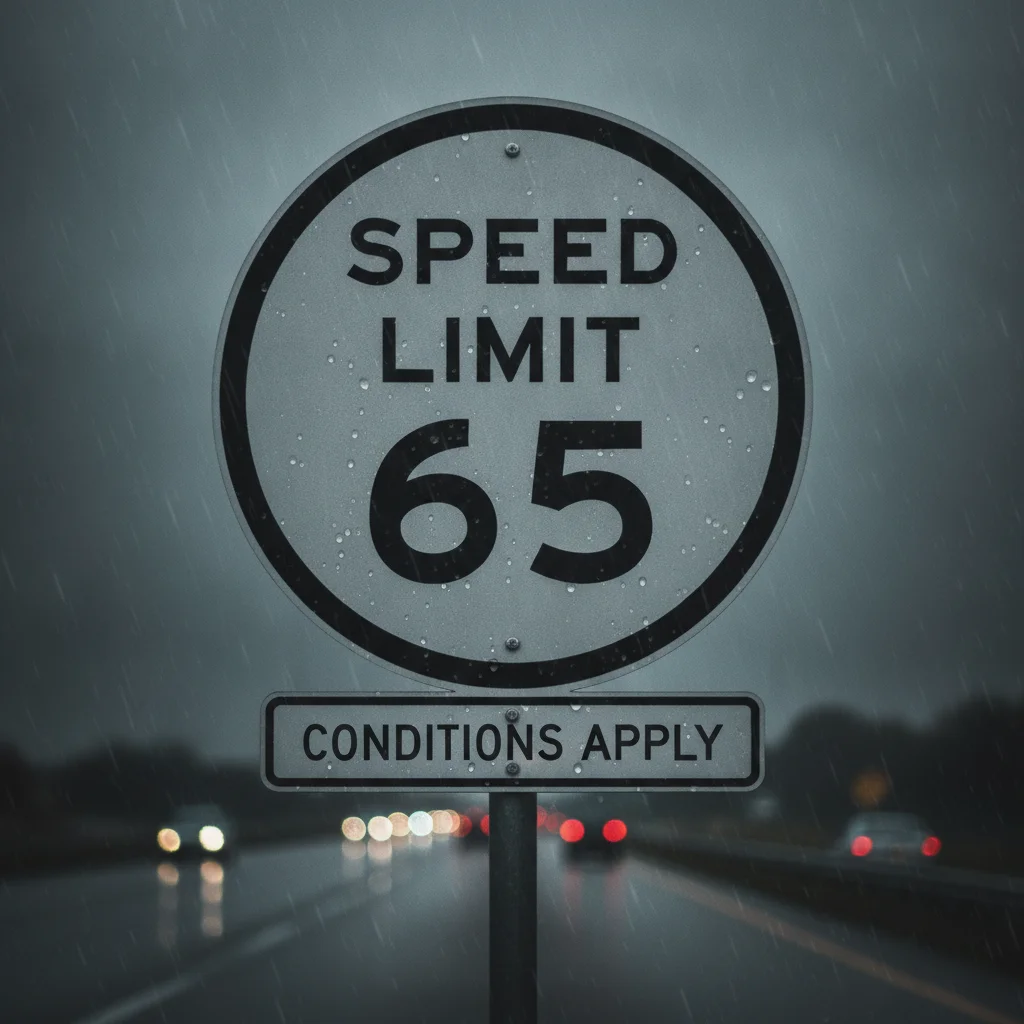
Most drivers treat the posted speed limit as the answer to a simple question: How fast can I go? That's understandable — the number is right there on a reflective green or white sign. But in traffic law, the sign sets a ceiling under ideal conditions, not a blanket authorization to drive at that speed in all circumstances.
Every state in the U.S. has what's commonly called a basic speed law — sometimes labeled the 'reasonable and prudent' standard. It requires drivers to travel at a speed appropriate for actual road conditions at that moment. Fog, rain, ice, heavy traffic, a construction crew on the shoulder, a school bus stopped ahead — all of these factors can make the posted limit an unsafe speed, and law enforcement can act on that.
This is the foundational concept that most drivers miss. The sign is a presumption, not a promise. Understanding this distinction isn't just academic — it directly affects whether you get cited, whether you're found at fault in an accident, and potentially, what your insurance premiums look like at renewal.
For a broader look at how road signs, signals, and markings carry legal weight, see our quick-reference guide to traffic signs and markings.
Two Types of Speed Limits — and Why the Difference Matters
Speed limits in the U.S. generally fall into two legal categories. Knowing which type applies to the road you're on changes how you should think about that number on the sign.
Absolute Speed Limits
Most interstate highways and many state roads operate under absolute limits. The rule is simple: exceed the posted number and you've committed a violation, full stop. There's no defense based on conditions being favorable. Going 66 mph in a 65 zone on a clear, dry day is technically a violation. Officers typically give a practical cushion, but legally the line is the number.
Prima Facie Speed Limits
Prima facie limits work differently. The posted speed is a rebuttable presumption — it's presumed safe, but that presumption can be challenged. California is the most prominent state using this model on most of its roads. Under a prima facie system, a driver going 40 mph in a 45 zone could still be cited if road conditions made 40 mph unreasonable — say, on a rain-soaked mountain curve during low visibility.
Conversely, and this is the part that surprises people, a driver slightly above the prima facie limit might theoretically argue they were driving safely given the conditions — though this defense rarely succeeds in practice and is not a strategy worth testing.
41%
Of traffic fatalities involving speeding
According to NHTSA's 2022 traffic safety data, speeding was a contributing factor in 41% of all motor vehicle crash deaths — roughly 12,151 lives.
25 mph
Common statutory residential default speed
The majority of U.S. states set a statutory default of 25 mph on residential streets even when no sign is posted, per each state's vehicle code.
2–3x
Fine multiplier in active work zones
Most states double or triple standard speeding fines in marked work zones, with some states imposing mandatory minimums for repeat offenders.
Up to 30%
Premium increase after a speeding conviction
Insurance industry data from The Zebra's 2023 State of Auto Insurance report shows a single speeding ticket can raise premiums by 10–30% depending on severity and state.
3–5 years
Duration speeding violations affect insurance
Most auto insurers apply surcharges for moving violations for three to five years following the conviction date, per standard underwriting guidelines.
Statutory (Default) Speed Limits
A third category is worth knowing: statutory limits. These are speeds set by state law that apply even where no sign is posted. Common examples include 25 mph in residential neighborhoods, 15 mph in alleys, and 55 mph on undivided rural highways. You don't need to see a sign — the law presumes you know these defaults. Ignorance of statutory limits is not a defense.
State Laws Vary Significantly
The split between prima facie and absolute speed limit systems is not uniform across the U.S. California is the most prominent prima facie state, while most others use absolute limits on highways and a blend on surface streets. Always check your state's vehicle code or DMV handbook if you're unsure which standard applies to the roads you drive most. An officer's ability to cite you below the posted limit depends entirely on your jurisdiction.
What 'Reasonable and Prudent' Actually Means
The basic speed law standard — 'reasonable and prudent for conditions' — is deliberately subjective. Courts have interpreted it to mean the speed a reasonably careful driver would choose given the specific combination of weather, road surface, visibility, traffic density, and roadway geometry present at that moment. There is no single formula. The standard is applied by officers in the field and reviewed by judges or juries after the fact.
When the Limit 'Changes' Without a New Sign
Some of the most costly traffic citations happen because a driver didn't realize the effective speed limit had changed — even though the posted sign hadn't. There are several situations where this occurs.
School Zones
In most states, reduced school zone speeds (often 15–25 mph) take legal effect during designated hours or when children are present — whether or not a flashing light is working. A broken beacon doesn't suspend the law. Our article on school zone and work zone speed laws covers how these rules vary and where fines are most severe.
Work Zones
Active work zones carry reduced limits that are legally binding even if no workers are visible at that moment. The legal test is typically whether the zone is marked, not whether a hard-hat is standing three feet from you. Fines in work zones routinely double or triple standard penalties.
Adverse Weather and Road Conditions
This is the scenario where the basic speed law does its heaviest lifting. A 65 mph highway in a whiteout blizzard isn't a 65 mph road in any practical legal sense. Officers have cited drivers for dangerous speeds at 35 mph in those conditions — and those citations have held up.
See our companion piece on speed limit vs. safe speed for a detailed look at how to judge appropriate speed across weather and road geometry scenarios.

Residential Streets Without Posted Signs
Many neighborhood streets have no posted limit at all. That doesn't mean there's no limit — the statutory default (often 25 mph) applies automatically. Drivers who assume an unposted street is unlimited are wrong in every jurisdiction in the country.
Check Flagger Instructions, Not Just Signs
In active work zones, posted speed limit signs may be supplemented — or temporarily overridden — by flaggers or variable message signs. When a flagger holds a stop sign or indicates slow, that instruction is legally binding regardless of what any permanent sign says. Treat flagger signals as you would a traffic signal.
Consider Traffic School Before Paying the Fine
Many states allow first-time or minor speeding offenders to complete a defensive driving or traffic school course in exchange for keeping the conviction off their Motor Vehicle Record. This can prevent an insurance surcharge entirely. The fine still applies, but a clean MVR is worth significantly more in premium savings over three to five years than the cost of the course.
How Speed Law Violations Affect Your Insurance
Traffic law and auto insurance intersect in ways most drivers don't anticipate until renewal time. Here's what actually happens when a speed-related violation hits your record.
The Violation Code Is What Insurers See
Insurers typically receive your Motor Vehicle Record (MVR), not a narrative of what happened. What matters to them is the conviction code — speeding, unsafe speed, basic speed law violation. A citation for unsafe speed below the posted limit carries the same actuarial weight as a standard speeding ticket in most underwriting systems. The distinction that matters to you legally often doesn't matter to your carrier at all.
At-Fault Accidents Change the Math Further
If you're in an accident and your speed — even sub-limit speed — is determined to contribute to the crash, the liability picture gets more complicated. Driving 55 mph in a 65 zone on black ice, causing a rear-end collision, can establish partial or full fault against you. That fault finding affects not just your premium but potentially your liability coverage limits and how much your insurer pays out.
“A driver who strikes a pedestrian while going 50 in a 55 zone on a wet road in poor visibility isn't protected by that posted number. The basic speed law exists precisely because conditions change faster than signs can.”
— David Strickland, Former Administrator, National Highway Traffic Safety Administration (NHTSA)
The Surcharge Timeline
Most insurers apply a surcharge for moving violations at your next renewal following the conviction date — not the citation date. Surcharges typically last three to five years depending on the state and insurer. A single speeding conviction can add 10–30% to your base premium; two or more within three years can flag you as a high-risk driver and trigger non-renewal in some markets.
Common Misunderstandings — and What the Law Actually Says
A few persistent myths about speed limits are worth addressing directly, because they lead drivers into real legal and financial trouble.
Myth: Keeping up with traffic protects you from a ticket
The 'everyone else was going that speed' argument has essentially no legal force. Each driver is individually responsible for their own speed. Officers can and do pick individual vehicles out of a flow of traffic. In states with absolute limits, the speed of surrounding vehicles is irrelevant to your violation.
Myth: The limit on the sign is always the enforceable limit
As covered above, basic speed laws and prima facie standards mean the sign is a starting point, not a ceiling. Conditions can make sub-limit speeds illegal. School and work zone rules can temporarily override posted limits without a new sign appearing.
Myth: Yellow lights mean accelerate to clear the intersection
While not strictly a speed limit issue, this connects to the same pattern of drivers misreading what signs and signals actually authorize. A yellow signal legally indicates the light is about to turn red, not an invitation to accelerate. See our breakdown of what the law actually says about yellow lights for the full picture.
Myth: Following the speed limit is enough to ensure safe following distance
Speed and following distance are related but separate obligations. Traveling at the posted speed while tailgating can still produce a citation and almost certainly establishes negligence in a rear-end crash. The science behind safe following distance is worth understanding alongside speed law.

Practical Takeaways for Everyday Driving
None of this is meant to make driving feel like a legal minefield. Most of it boils down to a few straightforward habits that simultaneously keep you safe and legally protected.
- Treat posted limits as maximums under ideal conditions. When conditions deteriorate — rain, fog, heavy traffic, road damage — your legal and physical safe speed drops below the sign. Adjust accordingly.
- Know your state's statutory defaults. Look them up once. They apply on unposted roads and you'll never be caught assuming an unsigned street is unlimited.
- Recognize the zones that change the rules. School zones and work zones carry independent legal weight. Learn the hours and treat them as binding even when signals aren't flashing.
- Don't rely on traffic flow as a legal shield. Driving at the speed of surrounding vehicles feels intuitive, but it doesn't insulate you from a citation or from fault in a crash.
- Understand the insurance implications before you contest or accept a violation. Sometimes a deferred adjudication or traffic school option keeps the conviction off your MVR entirely — which matters far more to your insurance premium than the fine amount. Talk to your insurer or an attorney before simply paying the ticket.
Check Flagger Instructions, Not Just Signs
In active work zones, posted speed limit signs may be supplemented — or temporarily overridden — by flaggers or variable message signs. When a flagger holds a stop sign or indicates slow, that instruction is legally binding regardless of what any permanent sign says. Treat flagger signals as you would a traffic signal.
Consider Traffic School Before Paying the Fine
Many states allow first-time or minor speeding offenders to complete a defensive driving or traffic school course in exchange for keeping the conviction off their Motor Vehicle Record. This can prevent an insurance surcharge entirely. The fine still applies, but a clean MVR is worth significantly more in premium savings over three to five years than the cost of the course.

All claims are backed by peer-reviewed research. Sources on request.