Key Takeaways
Take a 360-degree video walkthrough of the entire accident scene before any vehicles are moved. A continuous video captures context that individual photos miss — skid marks, debris fields, road conditions — and timestamps are built in automatically.
Adjusters and attorneys reconstruct accident dynamics from scene evidence. A continuous video establishes the full picture in a way a series of disconnected photos cannot.
When speaking to your insurer's claims adjuster for the first time, answer their questions factually but do not speculate. If you're unsure of something, say so — 'I don't know' is a complete and legally safe answer.
Speculative statements about speed, sightlines, or fault are frequently used to reduce settlement offers. Sticking to confirmed facts protects you throughout the investigation phase.
Request a copy of your insurer's claim file under your state's fair claims practices regulations. You're entitled to see the documentation they're using to evaluate your claim, and reviewing it often reveals errors or missing evidence you can correct.
Most states have enacted Unfair Claims Settlement Practices Acts that give policyholders rights to their claim documentation. Exercising this right creates accountability and frequently accelerates resolution.
The First 60 Seconds: Safety, Shock, and What to Do First
The moments immediately after a crash are chaotic. Adrenaline spikes, information comes at you fast, and your brain is wired to freeze or react impulsively. Knowing the correct sequence of actions before it happens is what keeps you protected.
Step 1: Stop Your Vehicle
Leaving the scene of an accident — even a minor one — is a criminal offense in every U.S. state. Pull over immediately to a safe location. If the accident is minor and both vehicles are drivable, move them to the shoulder or a nearby parking lot to clear traffic. If cars are immovable, turn on your hazard lights.
Step 2: Check for Injuries
Check yourself first, then passengers, then occupants of the other vehicle. Do not move anyone who may have a spinal or neck injury unless they are in immediate danger — for example, from fire or oncoming traffic. Call 911 immediately if anyone is injured or unconscious.
Step 3: Get Out of Traffic
If you're on a highway or busy road and your car is drivable, get it off the travel lanes before you do anything else. Staying in an active lane to take photos or argue with another driver is how secondary accidents happen — and they can be fatal.

Once everyone is safe and out of immediate danger, your next decisions shift from survival mode to documentation mode. That transition is where most drivers lose ground legally and financially.
Calling 911: When You Must and When You Can Skip It
Whether or not to call the police depends on the severity of the accident and your state's laws. Many states require you to report accidents that involve injury, death, or property damage above a certain dollar threshold — often $500 to $1,000.
Always Call 911 If:
- Anyone is injured, even if they claim to feel fine
- Any vehicle is not drivable
- The other driver appears intoxicated or impaired
- The other driver is aggressive, uncooperative, or flees the scene
- There is significant property damage to vehicles, structures, or objects
- You are on a highway or fast-moving road
When a Police Report Still Helps (Even If Not Required)
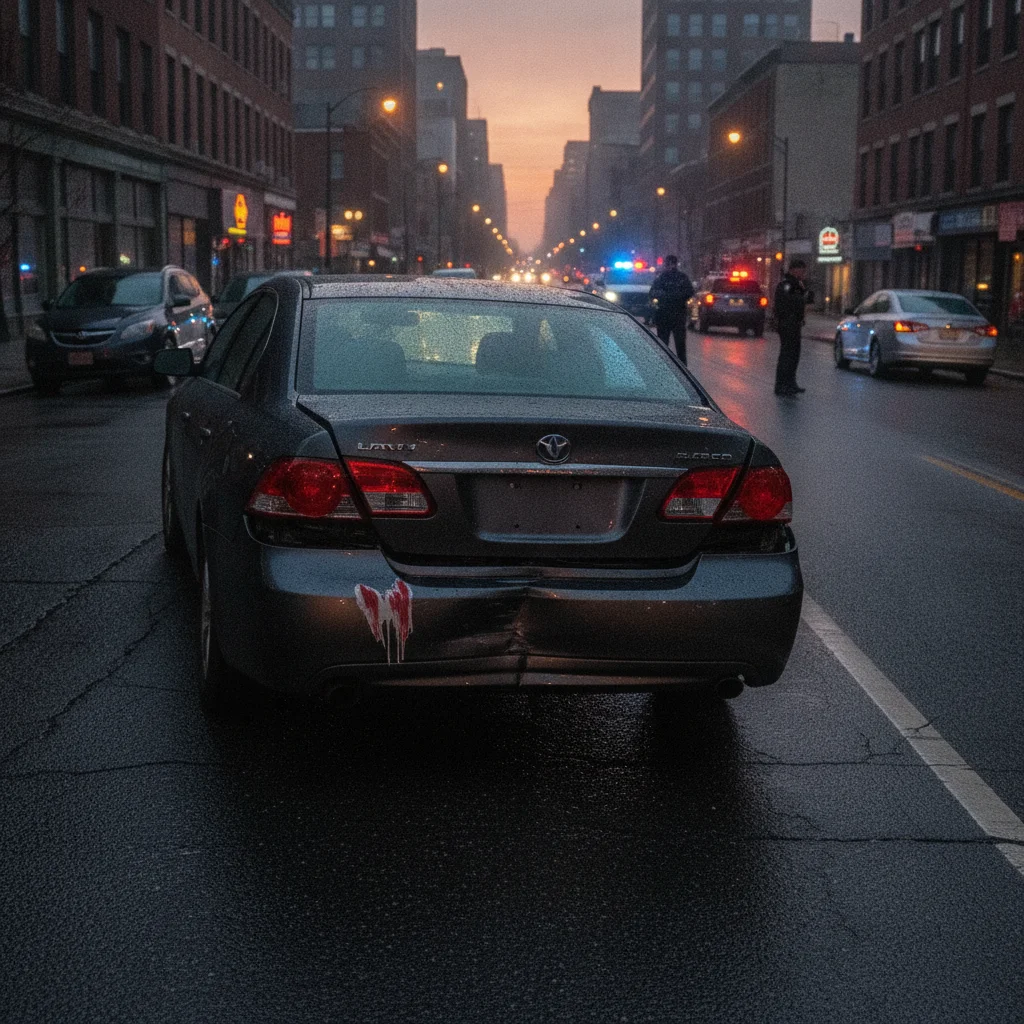
Even in low-speed fender-benders where no one appears hurt, a police report creates an official, timestamped record of what happened. That document is invaluable if the other driver later disputes the facts or if injuries appear days later — as commonly happens with whiplash and concussion symptoms.
Don't Leave the Scene Without a Report Number
Even if police can't respond in person, do not leave the scene without some form of official documentation in progress. Ask the 911 dispatcher if you can file a self-report with your state DMV. Without any official record, a disputed-fault situation becomes your word against the other driver's — and that's a fight that's hard to win.
If police cannot respond to the scene (common in minor accidents in busy jurisdictions), most states let you file a self-report — sometimes called a Driver's Report of Traffic Accident — directly with your state's DMV. Ask the 911 dispatcher about this option before leaving the scene.
See our guide to contesting a traffic ticket if the officer issues a citation at the scene that you believe is inaccurate — you have options.
Collecting Evidence at the Scene
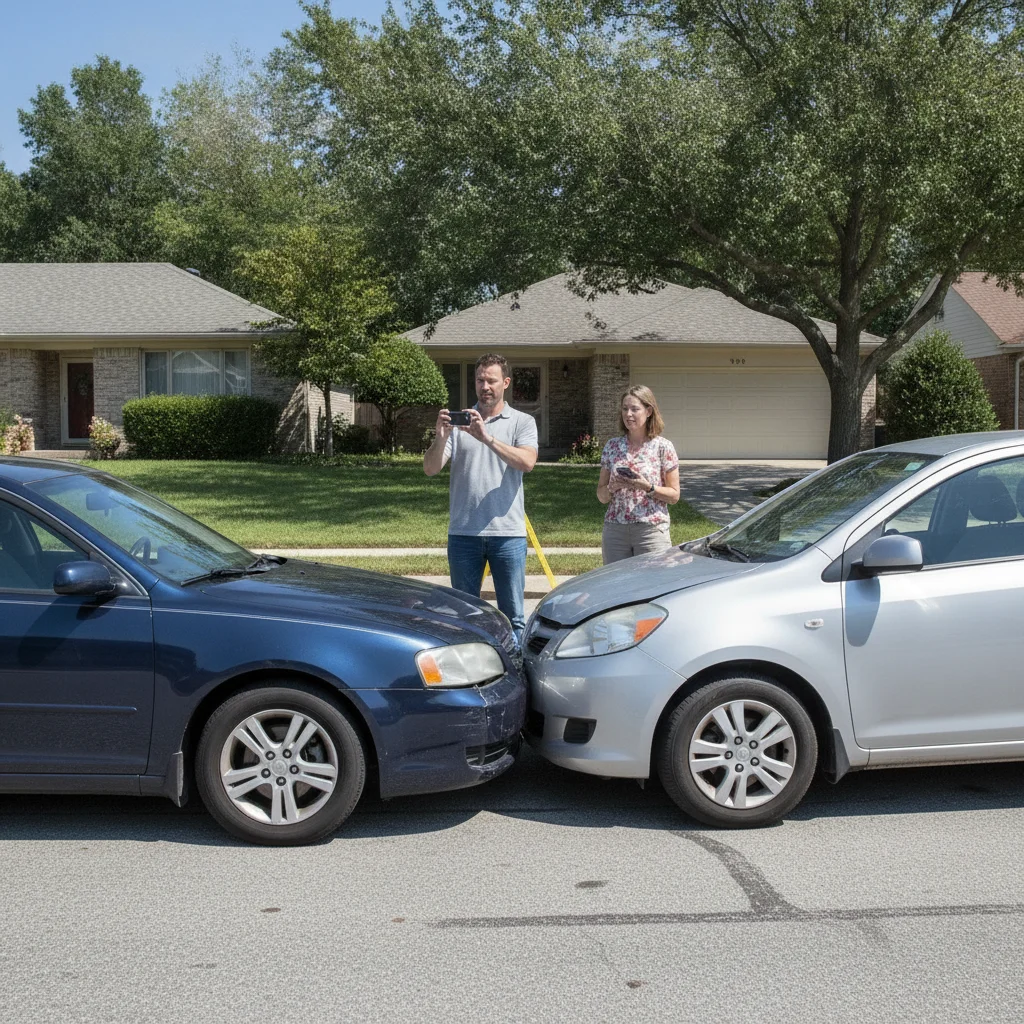
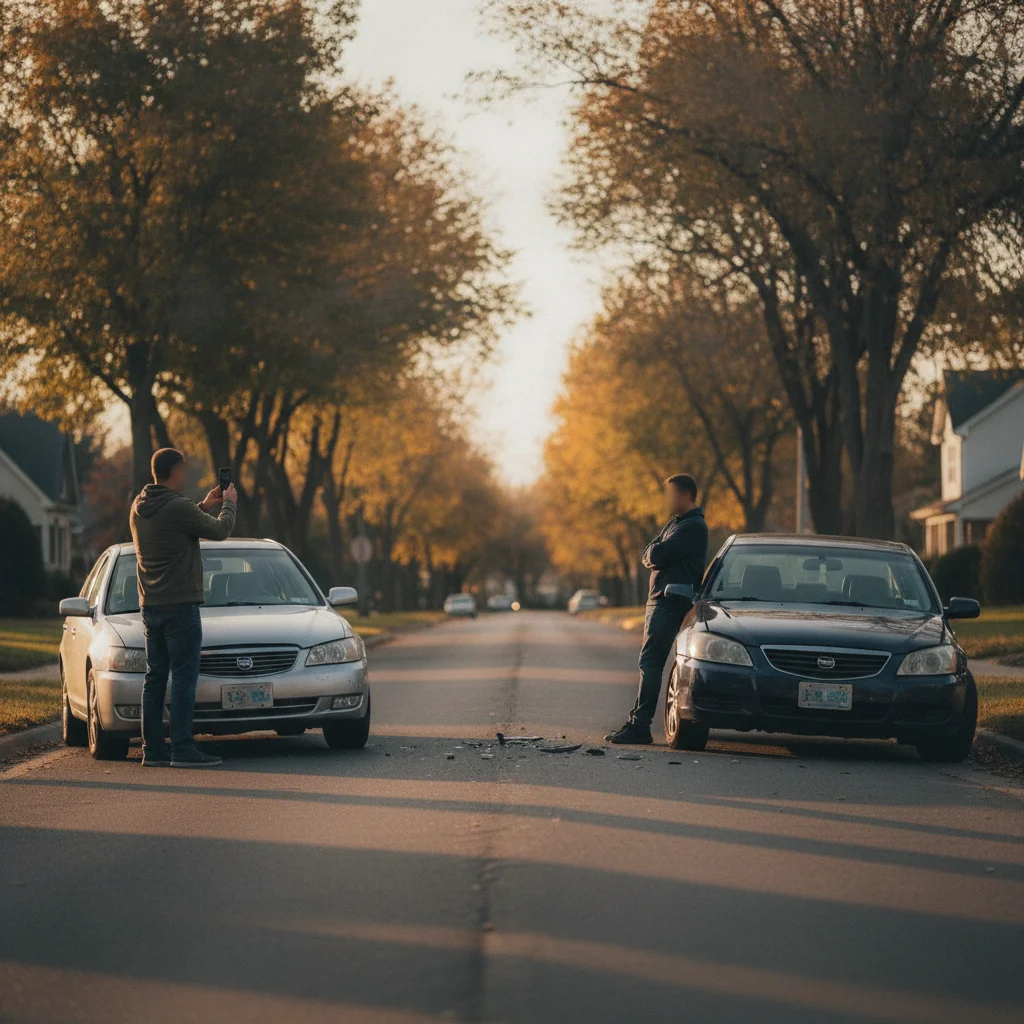
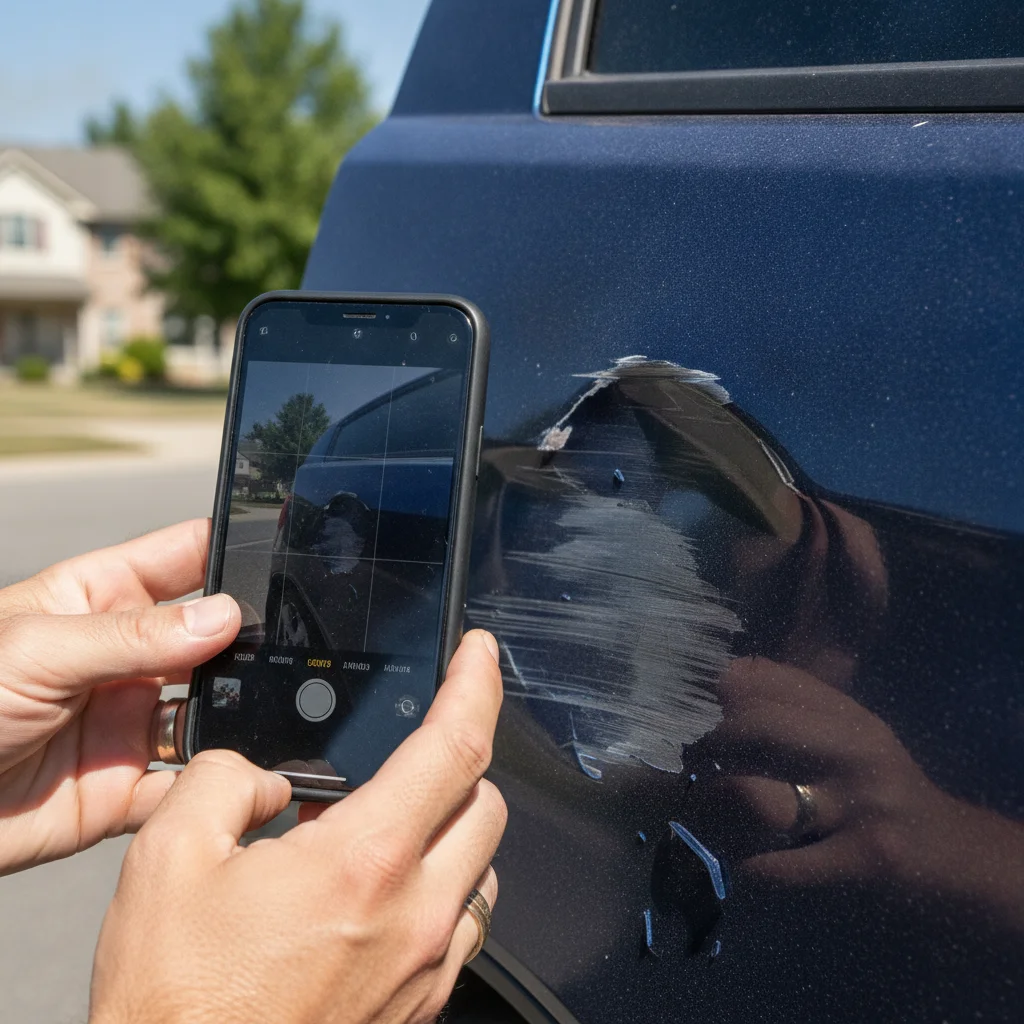
Your smartphone is your most powerful tool after an accident. Use it aggressively and systematically before vehicles are moved (if safe) and before anyone leaves.
Photo Checklist
- All four sides of both vehicles, including undamaged areas
- Close-up shots of every point of contact and visible damage
- License plates of all vehicles involved
- Tire skid marks, road conditions, and debris fields
- Traffic signals, stop signs, or lane markings at the location
- The other driver's insurance card and license (photograph them directly)
- Any visible injuries on yourself or passengers
- Wide establishing shots showing the full accident scene and intersection
Getting Witness Information
Witnesses are gold, and they disappear fast. Before they walk away, get their full name, phone number, and if possible a brief recorded statement (ask permission first). A neutral third-party account can swing a disputed liability determination significantly.
Take a 360-degree video walkthrough of the entire accident scene before any vehicles are moved. A continuous video captures context that individual photos miss — skid marks, debris fields, road conditions — and timestamps are built in automatically.
Adjusters and attorneys reconstruct accident dynamics from scene evidence. A continuous video establishes the full picture in a way a series of disconnected photos cannot.
When speaking to your insurer's claims adjuster for the first time, answer their questions factually but do not speculate. If you're unsure of something, say so — 'I don't know' is a complete and legally safe answer.
Speculative statements about speed, sightlines, or fault are frequently used to reduce settlement offers. Sticking to confirmed facts protects you throughout the investigation phase.
Request a copy of your insurer's claim file under your state's fair claims practices regulations. You're entitled to see the documentation they're using to evaluate your claim, and reviewing it often reveals errors or missing evidence you can correct.
Most states have enacted Unfair Claims Settlement Practices Acts that give policyholders rights to their claim documentation. Exercising this right creates accountability and frequently accelerates resolution.
Documenting the Police Response
Write down the responding officer's name and badge number. Ask how to obtain the accident report and when it will be available — typically 3 to 7 business days. Most states now offer online report retrieval for a small fee. You'll need this report number when you file your insurance claim.
6 million
Car accidents reported annually in the U.S.
According to the National Highway Traffic Safety Administration (NHTSA), approximately 6 million police-reported crashes occur each year in the United States.
38%
Drivers without UM/UIM coverage who face uninsured at-fault drivers
The Insurance Research Council estimates that about 1 in 8 drivers is uninsured, leaving millions of accident victims dependent on their own UM/UIM coverage for recovery.
3–7 days
Typical delay before soft-tissue injuries present symptoms
Medical professionals consistently note that whiplash, concussions, and spinal injuries often don't produce noticeable symptoms until several days after an accident.
40%
Average premium increase after a single at-fault accident
According to an analysis by the Insurance Information Institute, drivers can expect their annual premium to rise by roughly 40% on average following their first at-fault accident.
24–48 hrs
Recommended window to notify your insurer after a crash
Most major auto insurers specify in their policy terms that accidents must be reported promptly — practical guidance from claims professionals points to 24 to 48 hours as the safe window.
Exchanging Information the Right Way
State law requires drivers involved in an accident to exchange certain information. Don't rely on memory — photograph everything and write it down.
What to Collect from the Other Driver
- Full legal name
- As it appears on their driver's license, not a nickname
- Driver's license number and state
- Photograph the physical license
- Insurance company name and policy number
- Photograph the insurance card — verify it isn't expired
- Vehicle make, model, year, and color
- Confirm it matches the registration
- License plate number and state
- Already in your photos, but note it explicitly
- Contact phone number
- Cell number is more reliable than home
- Vehicle owner's name and address
- If the driver is not the registered owner, get both
You are also required to provide your own equivalent information. Give it — withholding it is illegal and creates unnecessary conflict.
If the Driver Is Not the Registered Owner
It's common for the person driving a vehicle at the time of an accident to not be the registered owner — think borrowed cars, rental vehicles, or family members sharing a car. In this case, collect information for both the driver and the owner. Insurance typically follows the vehicle first, then the driver's policy, so you may need to deal with the owner's insurer rather than the driver's.
What to Do If the Other Driver Refuses
If the other driver won't cooperate or drives away, do not chase them. Note as many details as you can — especially the license plate — and report it to 911 immediately. This becomes a hit-and-run situation. Our dedicated article on hit-and-run accidents walks through the specific steps when the at-fault driver flees.
What Not to Say After an Accident
This section might be the most financially important in this entire guide. The statements you make at the scene — to the other driver, witnesses, and even police — can be used to assign fault and affect your claim outcome.
Never Say These Things
- "I'm sorry" or "This was my fault" — Apologies are interpreted as admissions of liability, even if you're just being polite
- "I didn't see you" — Implies inattention, which signals negligence
- "I'm fine" or "No one's hurt" — You may not feel the full extent of injuries for hours or days
- "Let's just handle this without insurance" — Cash deals leave you exposed if the other party later files a claim or sues
- "My insurance will cover everything" — This is a promise you can't make and shouldn't make
Never Accept a Quick Verbal Settlement at the Scene
If the other driver offers to pay cash to settle without involving insurance, decline. This arrangement leaves you with no recourse if injuries or hidden vehicle damage emerge later. Once you accept a cash settlement and the driver leaves, your legal options are severely limited. All financial resolution should flow through documented insurance channels.
Uninsured Motorist Coverage Is Not Optional in Practice
One in eight drivers on U.S. roads carries no insurance. If an uninsured driver causes an accident that totals your vehicle or sends you to the hospital, your only reliable path to recovery is your own UM/UIM coverage. In states where it's not mandatory, many drivers skip it to save money — a decision that can result in paying thousands out of pocket for someone else's negligence.
What You Should Say
Stick to factual, unemotional statements. Exchange required information. Cooperate with police. Beyond that, keep it brief. You're not obligated to give the other driver your version of events — save that for your insurer and, if necessary, your attorney.
“After an accident, the single most damaging thing a driver can do is fill the silence with statements. Your insurer, not you, is responsible for determining fault. Let the evidence do the talking.”
— Amy Bach, Executive Director, United Policyholders — a nonprofit representing insurance consumers
If the other driver or their passengers make recorded or written statements about the accident, note what they say. Those admissions work in your favor and can be relayed to your insurer.
Notifying Your Insurer: Timing and What to Report
Most insurance policies require you to report accidents "promptly" or "as soon as reasonably possible." In practice, this means within 24 to 48 hours. Waiting too long — even if you think the accident was minor — can give your insurer grounds to deny coverage or reduce your settlement.
What to Have Ready When You Call
- The other driver's insurance and contact information
- The accident report number (or the officer's name if the report isn't ready)
- Your photos and documentation from the scene
- A clear, factual account of what happened — stick to facts, not interpretations
- Your own policy number
Your insurer will open a claim file and assign a claims adjuster. That adjuster is your main point of contact from this point forward. Our hub on filing a claim covers the full process in detail, including what adjusters are looking for and how to respond to their requests.
Call Your Insurer — Even if You're Not at Fault
Many drivers assume they only need to notify their insurer if they caused the accident. This is wrong. Your policy almost certainly requires prompt notification of any accident, and failing to report puts your coverage at risk. Even if the other driver's insurer is handling everything, a quick call to your own carrier protects your position.
Bank Accident Forgiveness Before You Need It
Add accident forgiveness to your policy now, before an accident happens. Once a claim is filed, it's too late — you can't retroactively add coverage that applies to a current incident. Many insurers offer this as a low-cost endorsement, and it can save you hundreds at renewal after your first at-fault event.
Should You File Through Your Insurer or Theirs?
If the other driver is clearly at fault and their insurer accepts liability quickly, you may be able to file a third-party claim directly with their insurance. This avoids involving your own insurer and potentially affecting your rates. However, if fault is disputed, the other insurer stonewalls, or you need quick vehicle repairs, filing through your own carrier first and letting them pursue subrogation is often the faster path.
For a deeper look at how liability claims move from scene to settlement, see our article on filing a liability claim.
Navigating the Claims Process from Start to Settlement
Once your claim is open, the process follows a predictable sequence — though timelines vary. Here's what to expect at each stage.
Stage 1: Investigation (Days 1–14)
The adjuster reviews the accident report, your photos, statements from all parties, and any available traffic or surveillance footage. They may contact witnesses. This is when fault allocation is determined. In states with comparative negligence laws, fault can be split — for example, 80/20 — and your payout is reduced by your percentage of fault.
Stage 2: Vehicle Damage Assessment
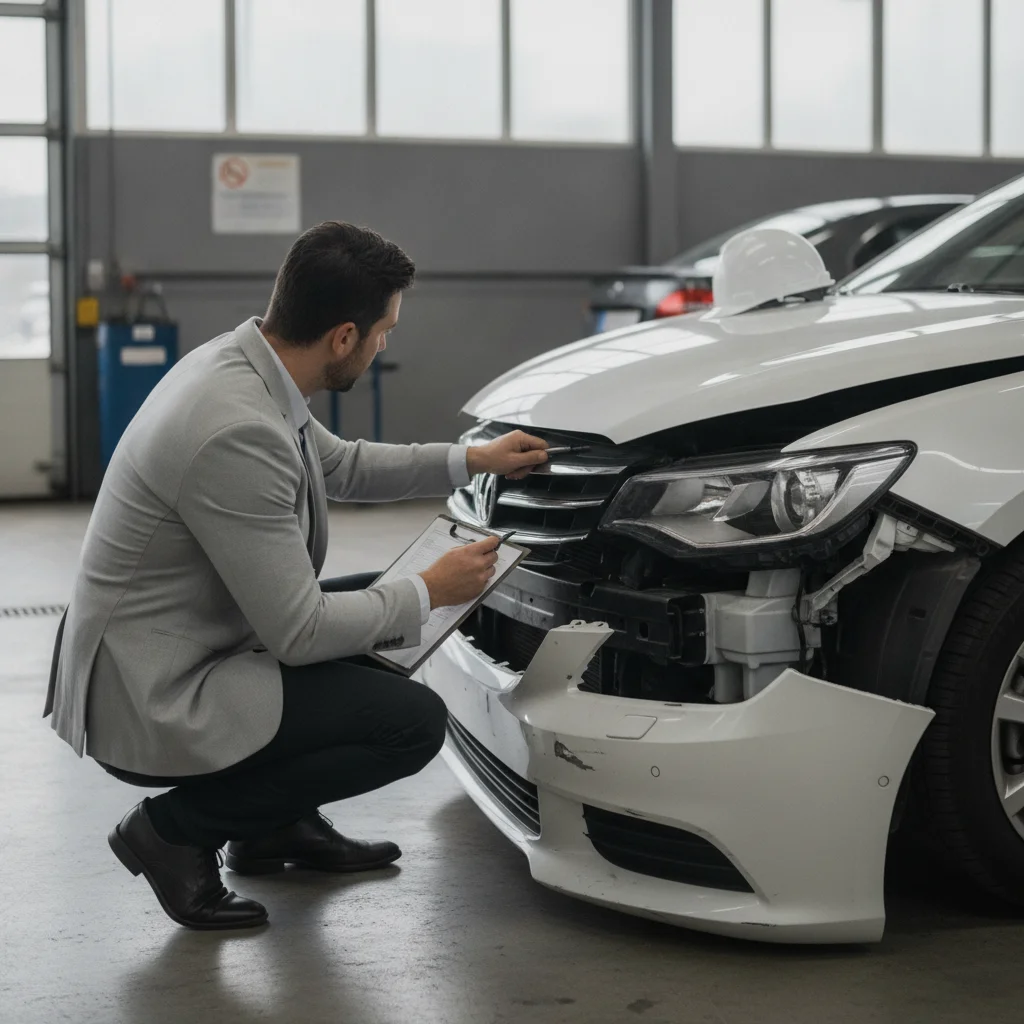
Your insurer will send an appraiser or direct you to an approved repair shop for a damage estimate. You typically have the right to choose your own repair shop, though using a network shop often speeds up the process. If your vehicle is deemed a total loss — meaning repair costs exceed a set percentage of its actual cash value — the insurer will offer a settlement based on the vehicle's pre-accident market value.
Stage 3: Medical Claims
If you were injured, medical claim processing runs parallel to property damage. Depending on your state's insurance laws — no-fault vs. tort — you may file medical claims through your own Personal Injury Protection (PIP) coverage or through the at-fault driver's liability coverage. Keep every medical record, bill, and diagnosis note. Document how injuries affect your daily life and work.
Stage 4: Settlement Offer and Negotiation
The adjuster will eventually present a settlement figure. This first offer is rarely their best offer. If the amount doesn't cover your actual losses — vehicle repair or replacement, medical bills, lost wages, pain and suffering — you have the right to negotiate. Present documentation supporting your counter. If you're stuck, a public adjuster or personal injury attorney can advocate on your behalf.
For a thorough breakdown of this entire process, our article on the complete roadmap to filing an auto insurance claim walks through every phase including repair, rental, and final settlement.
Stage 5: Closing the Claim
Once you accept a settlement, you'll sign a release — a legal document stating you will not pursue additional claims from this accident. Read this carefully. Signing releases all future claims, so do not accept a settlement until you have a clear picture of your total medical costs, including ongoing treatment.
Special Situations: Hit-and-Runs, Uninsured Drivers, and Disputed Fault
Standard procedures apply to most accidents, but three common scenarios require adjusted strategies.
Hit-and-Run Accidents
If the other driver flees, your recovery options shift to your own policy — specifically Uninsured Motorist Property Damage (UMPD) and Uninsured Motorist Bodily Injury (UMBI) coverage, if you carry them. File a police report immediately, as most insurers require it to process a hit-and-run claim. Document every detail you recall about the fleeing vehicle.
See the full breakdown in our article on hit-and-run accidents and what to do when the other driver flees.
Uninsured or Underinsured Drivers
If the at-fault driver has no insurance or insufficient coverage, your Uninsured/Underinsured Motorist (UM/UIM) coverage becomes essential. Without it, your options are limited to suing the driver personally — often a difficult and slow path to recovery. This scenario is a strong argument for carrying UM/UIM even when it's not required by your state.
Never Accept a Quick Verbal Settlement at the Scene
If the other driver offers to pay cash to settle without involving insurance, decline. This arrangement leaves you with no recourse if injuries or hidden vehicle damage emerge later. Once you accept a cash settlement and the driver leaves, your legal options are severely limited. All financial resolution should flow through documented insurance channels.
Uninsured Motorist Coverage Is Not Optional in Practice
One in eight drivers on U.S. roads carries no insurance. If an uninsured driver causes an accident that totals your vehicle or sends you to the hospital, your only reliable path to recovery is your own UM/UIM coverage. In states where it's not mandatory, many drivers skip it to save money — a decision that can result in paying thousands out of pocket for someone else's negligence.
Disputed Fault
When both drivers claim the other was responsible, insurers conduct independent investigations. If the dispute is significant, the insurers may proceed to inter-company arbitration. You can also file a complaint with your state insurance commissioner if you believe your insurer isn't handling your claim in good faith. For first-time claimants navigating this complexity, our guide to your first car accident and the claims process provides a calmer, step-by-step breakdown.
Take a 360-degree video walkthrough of the entire accident scene before any vehicles are moved. A continuous video captures context that individual photos miss — skid marks, debris fields, road conditions — and timestamps are built in automatically.
Adjusters and attorneys reconstruct accident dynamics from scene evidence. A continuous video establishes the full picture in a way a series of disconnected photos cannot.
When speaking to your insurer's claims adjuster for the first time, answer their questions factually but do not speculate. If you're unsure of something, say so — 'I don't know' is a complete and legally safe answer.
Speculative statements about speed, sightlines, or fault are frequently used to reduce settlement offers. Sticking to confirmed facts protects you throughout the investigation phase.
Request a copy of your insurer's claim file under your state's fair claims practices regulations. You're entitled to see the documentation they're using to evaluate your claim, and reviewing it often reveals errors or missing evidence you can correct.
Most states have enacted Unfair Claims Settlement Practices Acts that give policyholders rights to their claim documentation. Exercising this right creates accountability and frequently accelerates resolution.
Protecting Your Driving Record and Future Premiums
An accident — regardless of fault — can affect your insurance premiums at renewal. Understanding how to mitigate that impact is part of the post-accident process.
At-Fault vs. Not-at-Fault Impact
At-fault accidents almost always trigger a rate increase at renewal. Not-at-fault accidents are less likely to, though some insurers do raise rates regardless. Check your policy's language around "chargeable" accidents before assuming you're protected.
Accident Forgiveness
Many insurers offer accident forgiveness — either built into the policy or as an add-on — that prevents your first at-fault accident from raising your rates. If you don't have this feature, ask your agent whether it can be added proactively.
Call Your Insurer — Even if You're Not at Fault
Many drivers assume they only need to notify their insurer if they caused the accident. This is wrong. Your policy almost certainly requires prompt notification of any accident, and failing to report puts your coverage at risk. Even if the other driver's insurer is handling everything, a quick call to your own carrier protects your position.
Bank Accident Forgiveness Before You Need It
Add accident forgiveness to your policy now, before an accident happens. Once a claim is filed, it's too late — you can't retroactively add coverage that applies to a current incident. Many insurers offer this as a low-cost endorsement, and it can save you hundreds at renewal after your first at-fault event.
Defensive Driving Courses
Completing a state-approved defensive driving course can sometimes offset rate increases after an accident. Some insurers offer a direct discount; others may reduce points on your driving record. Call your insurer and ask before signing up — not all courses qualify.
Shopping Your Policy at Renewal
After an accident, your current insurer may no longer offer the best rate. Get competitive quotes at renewal — especially from insurers who don't heavily penalize a single at-fault accident in your history. Rates vary significantly between carriers for the same driving record.
Filing a Claim Hub
A comprehensive step-by-step breakdown of the auto insurance claims process, from opening a claim to receiving your final settlement check.
NHTSA Crash Reporting Tool
The National Highway Traffic Safety Administration's official resource for understanding federal crash reporting standards and accessing national accident data.
State DMV Self-Report Finder
Use your state DMV's online portal to find the correct accident self-report form if police did not respond to your crash scene.
United Policyholders Claim Help Center
A nonprofit resource offering practical guides, sample letters, and advocacy support for drivers navigating complex or disputed insurance claims.
Auto Insurance Coverage Comparison Template
A side-by-side comparison template to evaluate policies at renewal, covering liability limits, UM/UIM coverage, deductibles, and accident forgiveness terms.

Understanding your insurance paperwork — from declarations pages to endorsements — puts you in a better position to make these comparisons. Our resource on understanding car paperwork and contracts is a useful primer if policy documents feel opaque.

All claims are backed by peer-reviewed research. Sources on request.