

Key Takeaways
Assessed Vehicle Value
Assessed vehicle value is the dollar figure a state or local government assigns to your car for the purpose of calculating property taxes or registration fees. It is not the price you paid, the price you could sell it for, or the number shown on any commercial pricing tool. Governments derive this number from their own standardized depreciation schedules, applied uniformly across vehicle makes and models regardless of actual condition or mileage.
Most states rely on either the NADA Official Used Car Guide or a proprietary depreciation table to establish assessed value; a handful use purchase price as a starting point and reduce it by a fixed annual percentage.
Two Different Systems, Two Different Numbers
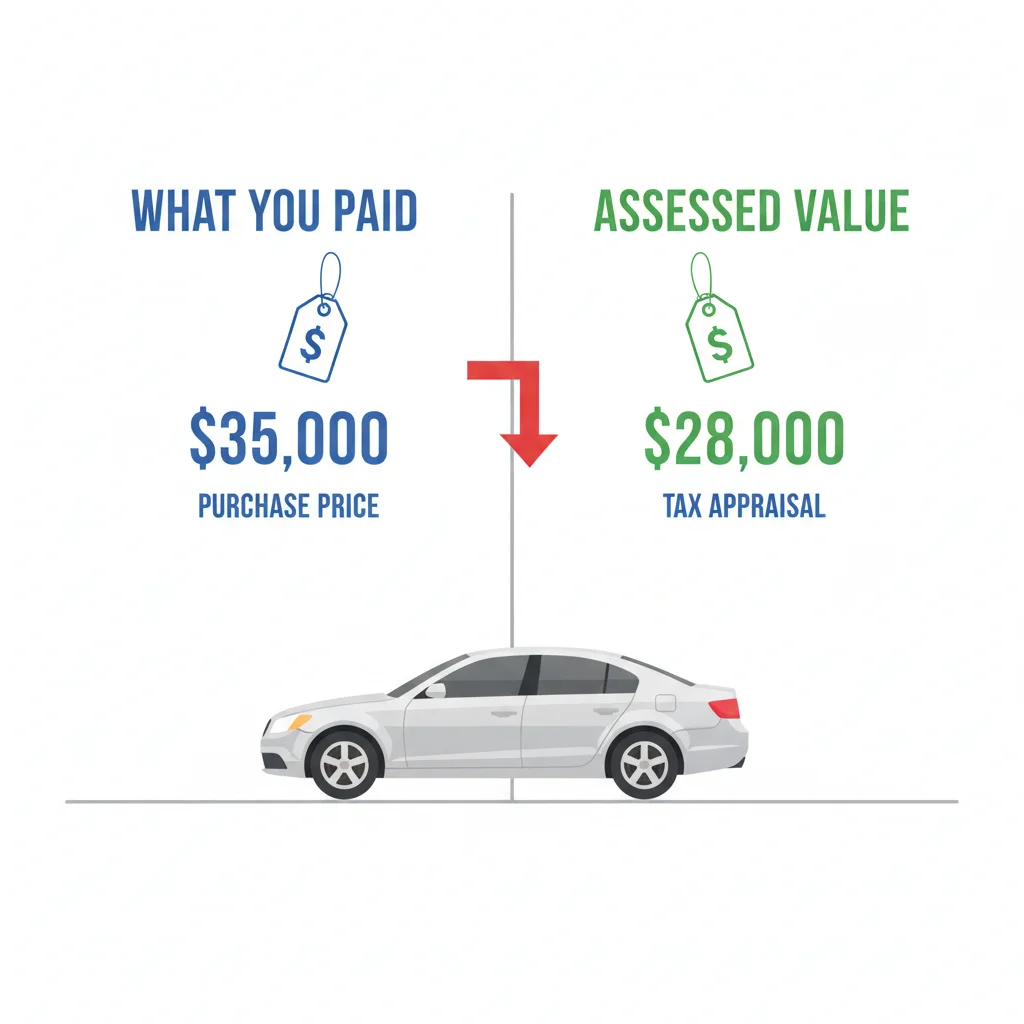
Most car owners encounter the disconnect for the first time when a property tax bill arrives in the mail. The assessed value printed on that notice looks nothing like the purchase price, and it looks nothing like the number a quick search on a pricing tool returns either. That is not an error. It is by design.
When you buy a car, three separate valuation systems immediately begin tracking that vehicle with three different methodologies and three different purposes:
- Purchase price — what you negotiated and paid at the dealership or in a private sale.
- Market value — what a willing buyer would pay a willing seller today, estimated by commercial tools like Kelley Blue Book or Edmunds. For a deeper look at why those tools themselves disagree with each other, see why car valuation tools return different numbers.
- Assessed value — what a state or local government decides your car is worth for the purpose of calculating your tax obligation, derived from a fixed depreciation formula.
These three numbers pull apart almost immediately after purchase and continue to diverge over time. Understanding why requires understanding how each system treats depreciation — and why government formulas are intentionally blunt instruments.
How Government Depreciation Schedules Work
Imagine a state revenue office trying to assign fair market values to 8 million registered vehicles every single year. Conducting individual appraisals is impossible. Relying on sale prices is incomplete — many private sales go unreported and dealer transactions involve incentives that distort the final figure. The practical solution is a depreciation table: a grid that takes a vehicle's original manufacturer's suggested retail price (MSRP) and multiplies it by a factor that shrinks each year the car ages.
Here is a simplified version of how a typical state table might work:
| Model Year Age | Assessed Value (% of MSRP) |
|---|---|
| New (current year) | 90% |
| 1 year old | 75% |
| 2 years old | 60% |
| 3 years old | 45% |
| 4 years old | 35% |
| 5 years old | 25% |
| 6+ years old | Flat floor value (e.g., $1,000–$3,000) |
The exact percentages vary enormously by state. Some states use NADA book values as their baseline rather than MSRP. A few states use your actual purchase price and reduce it by a statutory annual percentage. But the logic is consistent: a formula replaces individual judgment.
MSRP Is the Starting Point in Most States
Even if you paid thousands below sticker price, your state's assessed value formula typically anchors to the manufacturer's suggested retail price for your vehicle's year and trim. Dealer discounts, factory rebates, and trade-in credits you used to reduce your out-of-pocket cost are generally invisible to the government's calculation. This is one of the most common sources of confusion when owners first see their property tax notice.
County-Level Variation Can Be Significant
In several states — notably Virginia — the state sets the assessment methodology while individual localities set the tax rate. Two vehicles with identical assessed values registered in neighboring counties of the same state can generate meaningfully different annual bills. Always check the specific rate for your county or city, not just your state's headline figures.
This is the core reason your assessed value rarely matches what you paid. The formula does not know — or care — that you negotiated $3,000 below sticker, that you bought at the tail end of a model year when inventory was being discounted, or that your car came with high mileage. It starts from MSRP and walks backward by the calendar.
To understand the real-world depreciation your car is actually experiencing, vehicle depreciation explained covers the mechanics of how value loss actually works in the marketplace.
Why the Gap Is Largest in the First Three Years
Real-world depreciation is front-loaded. Most vehicles lose between 15% and 25% of their value in the first year alone, and the sharpest drop often happens in the first few months — the moment the car is titled and becomes a used vehicle. By the time a new car is three years old, it has typically lost 40% to 60% of its original MSRP in actual market value.
15%–25%
Typical first-year market value loss
Industry data from Edmunds and NADA consistently shows new vehicles lose this share of value within the first 12 months of ownership.
~40%–60%
Average value lost after three years
According to Carfax and iSeeCars depreciation studies, most mainstream vehicles retain only 40–60% of original MSRP after three years in the market.
~27
States with annual vehicle property taxes
The Tax Foundation estimates roughly half of U.S. states levy some form of recurring personal property tax or excise tax on registered vehicles.
$1,000+
Potential annual tax on a mid-priced vehicle
In high-rate states like Virginia and Connecticut, a vehicle assessed at $25,000–$35,000 can generate four-figure annual property tax bills.
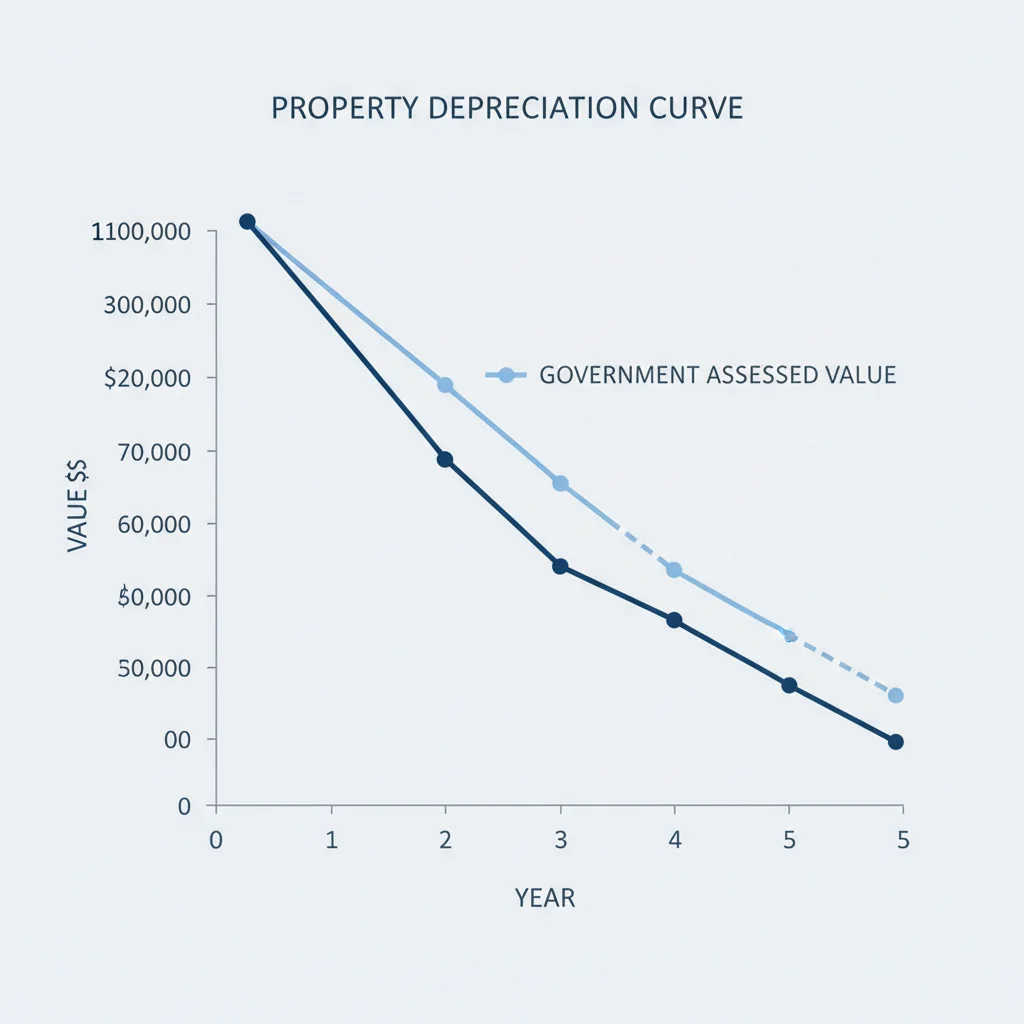
Government depreciation schedules tend to be shallower in the early years. A state might assess a two-year-old car at 60% of MSRP while the actual market value has fallen to 50% or lower. That 10-percentage-point gap represents real money on your tax bill.
There is a structural reason for this mismatch: states need predictable, stable revenue. If assessed values tracked volatile used-car markets perfectly, tax receipts would swing wildly — spiking during used-car shortages (as we saw in 2021–2022) and collapsing during recessions. The smoothed government schedule acts as a revenue stabilizer, which serves the state's interests but not necessarily yours as a taxpayer.
For practical math on how to calculate what your car is genuinely worth as it ages, calculating your car's depreciated value walks through the numbers using real inputs like mileage and condition.
Pull Your Comparable Listings Before Filing
When building an appeal, aim for at least five to eight current listings of the same year, make, model, and trim within a 100-mile radius, filtered to similar mileage. Assessors respond best to local market data, not national averages. Screenshot each listing with the URL visible so the date and source are clear.
Factor Annual Tax Into Your Purchase Budget
Before finalizing a vehicle purchase in a personal property tax state, use your county's published tax rate and the state's assessed value methodology to estimate your first-year tax bill. On a $45,000 vehicle in a mid-rate jurisdiction, this can easily be $800–$1,400 — a recurring cost that belongs in your monthly ownership math from day one.
The Role of MSRP — and Why It Penalizes Savvy Negotiators
If your state anchors assessed value to MSRP, there is an uncomfortable irony at work: the better you negotiated your purchase price, the larger the gap between what you paid and what you are taxed on. A buyer who paid full sticker price and a buyer who negotiated $5,000 below sticker will receive identical tax bills in most states — because the formula only sees the manufacturer's original retail price, not what actually changed hands.
The same principle applies to factory incentives. If an automaker offered a $3,000 cash-back rebate on your vehicle, that reduced your out-of-pocket cost — but in most states it did not reduce your assessed value, because the MSRP did not change.
“The problem with using MSRP as a tax baseline is that almost nobody actually pays MSRP. You're taxing a transaction that never happened at the price it was never completed at.”
— Adam Millsap, State and local policy researcher, author on property tax structure
This is a meaningful and often overlooked ownership cost. Over three to five years of property taxes, the cumulative difference between being taxed on MSRP versus your actual purchase price can run into several hundred dollars. When you are calculating the true total cost of owning a car, the assessed-value gap belongs in that equation.
State-by-State Variation: The Jurisdiction Problem
There is no national standard for vehicle assessed value. Each state sets its own rules, and in some states, individual counties have additional discretion. This creates situations where two identical vehicles registered in neighboring states generate very different annual tax bills — not because one owner paid more, but because they live on the other side of a state line.
A few key examples illustrate the range:
- Virginia
- Uses the NADA clean loan value for the current year as its baseline, applied at the locality level. Each city or county sets its own tax rate on top of that value, creating wide variation even within the state.
- North Carolina
- Counties use the state-published vehicle valuation manual, which is based on average retail values. A standardized county rate is then applied.
- Connecticut
- Uses 70% of the NADA average retail value as the assessed value, then applies local mill rates.
- Missouri
- Uses a percentage of the NADA clean trade-in value, which tends to track closer to actual market prices than retail-anchored approaches.
This patchwork is worth understanding before you register a vehicle, especially if you live near a state border or are relocating. what is a vehicle property tax and does your state charge one provides a broader look at which states levy this tax and how their formulas differ.
MSRP Is the Starting Point in Most States
Even if you paid thousands below sticker price, your state's assessed value formula typically anchors to the manufacturer's suggested retail price for your vehicle's year and trim. Dealer discounts, factory rebates, and trade-in credits you used to reduce your out-of-pocket cost are generally invisible to the government's calculation. This is one of the most common sources of confusion when owners first see their property tax notice.
County-Level Variation Can Be Significant
In several states — notably Virginia — the state sets the assessment methodology while individual localities set the tax rate. Two vehicles with identical assessed values registered in neighboring counties of the same state can generate meaningfully different annual bills. Always check the specific rate for your county or city, not just your state's headline figures.
How to Check — and Challenge — Your Assessed Value
Most vehicle owners accept their assessed value without question because the annual bill arrives, looks official, and the appeal process feels obscure. In reality, the process is usually straightforward, and successful appeals are common when supported by credible documentation.
Step 1: Understand what value was used
Your tax notice should reference the assessed value and usually indicates the source (NADA, state manual, or MSRP). If it does not, your county assessor's office can tell you. Once you know the number and the methodology, you can evaluate whether it is defensible.
Step 2: Gather market comparables
Pull current listings for your exact vehicle — same year, make, model, trim, and as close to your mileage as possible — from at least two or three sources. Screenshots from CarGurus, AutoTrader, or local dealer listings carry weight. Printouts from KBB and Edmunds showing estimated private-party value also help. The range of valuation tools available can help you build a complete picture of what the market actually says your car is worth.
Step 3: File the appeal with your documentation
Most jurisdictions require a written appeal filed within 30 to 90 days of the tax notice date. You will typically submit your comparable listings, any dealer appraisal you can obtain, and a completed appeal form. The assessor may adjust the value administratively, or you may be scheduled for a brief hearing.
The strongest appeals show a consistent, material gap — not a marginal one. If the assessed value is 5% above market, you will likely spend more time than the refund is worth. If it is 20% to 30% above current market comparables, an appeal is almost always worth pursuing.
Pull Your Comparable Listings Before Filing
When building an appeal, aim for at least five to eight current listings of the same year, make, model, and trim within a 100-mile radius, filtered to similar mileage. Assessors respond best to local market data, not national averages. Screenshot each listing with the URL visible so the date and source are clear.
Factor Annual Tax Into Your Purchase Budget
Before finalizing a vehicle purchase in a personal property tax state, use your county's published tax rate and the state's assessed value methodology to estimate your first-year tax bill. On a $45,000 vehicle in a mid-rate jurisdiction, this can easily be $800–$1,400 — a recurring cost that belongs in your monthly ownership math from day one.
Budgeting for Assessed Value as a Real Ownership Cost
Annual property taxes based on assessed value can be a meaningful ongoing expense — particularly in states with high tax rates and in the first several years of a vehicle's life when assessed values are highest. A $40,000 SUV assessed at 75% of MSRP ($30,000) in a jurisdiction with a 4% personal property tax rate generates a $1,200 annual tax bill. That is $100 per month — a cost many buyers do not factor into their purchase budget.
As the vehicle ages, the assessed value steps down each year, and the tax bill shrinks accordingly. But the front-loaded nature of those early-year assessments means the cumulative tax burden over the first five years can easily exceed $3,000 to $4,000 on a mid-priced vehicle in a high-tax state.
The practical takeaway for buyers is simple: before you register a vehicle in a state that levies personal property taxes, look up your county's assessment methodology and tax rate. Apply it to the vehicle you are considering, and include the projected annual tax in your total cost-of-ownership calculation — right alongside insurance, fuel, and maintenance. If you are near a state border and have flexibility in your registration address, the difference in annual tax exposure can be significant enough to factor into your decision.
The assessed value on your tax bill is not arbitrary. It is the output of a deliberate government system that serves revenue-stability goals rather than market accuracy. Understanding that system puts you in a position to budget correctly, compare jurisdictions honestly, and challenge the number when the evidence supports it.

All claims are backed by peer-reviewed research. Sources on request.