
Key Takeaways
Reliability-Driven Depreciation
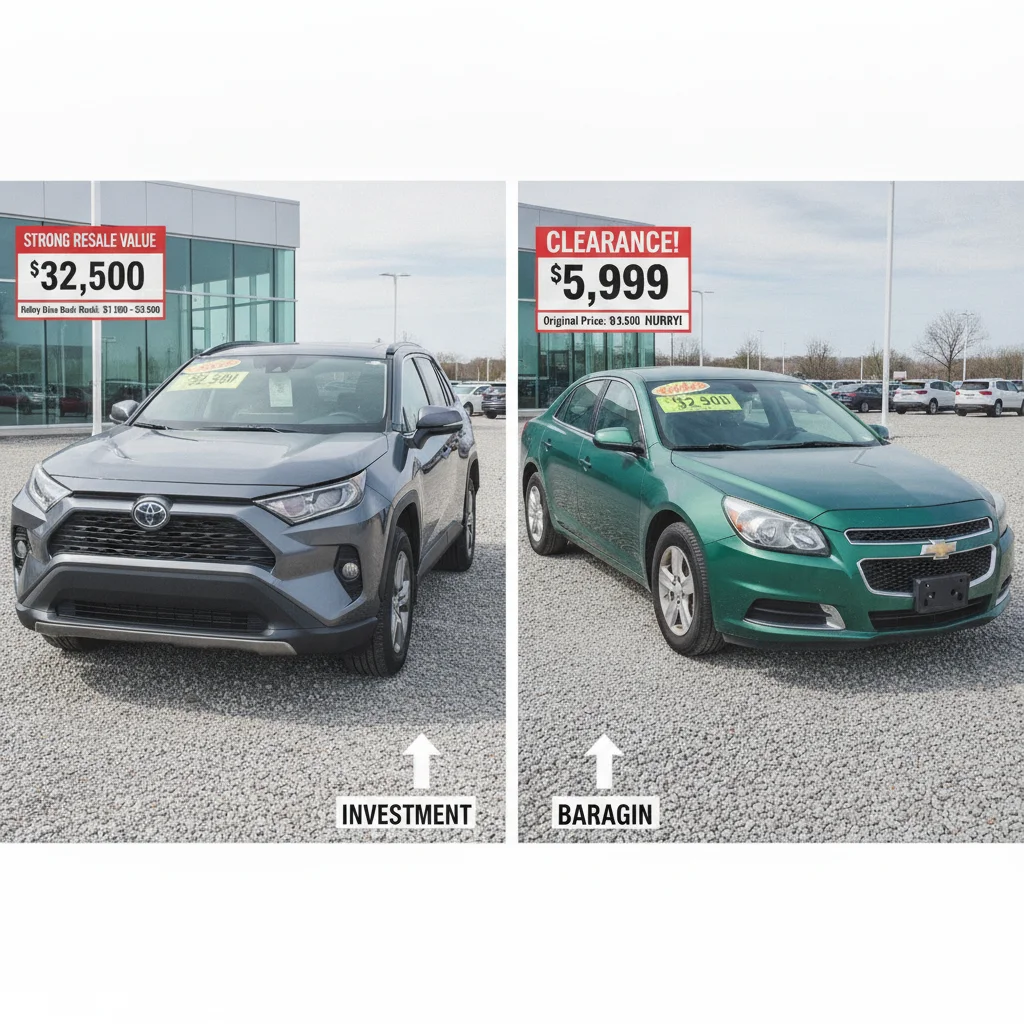
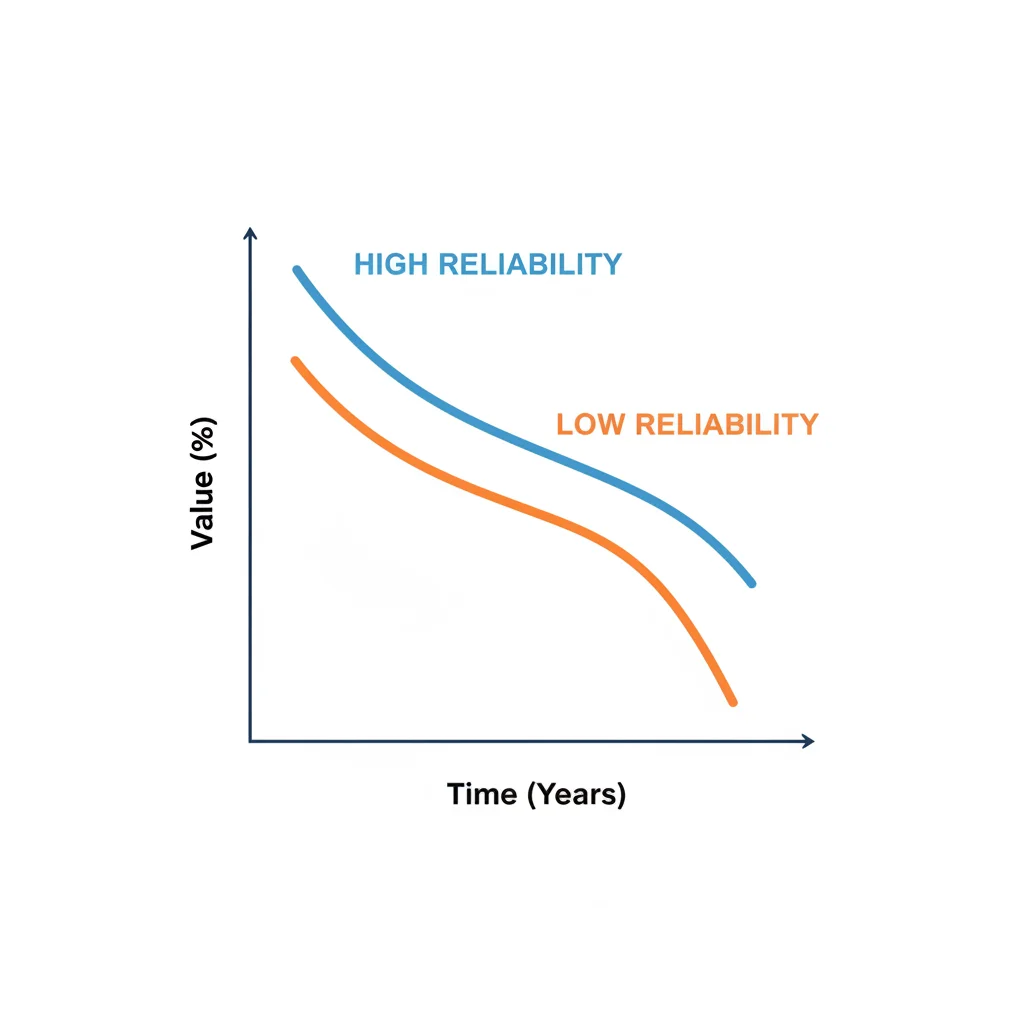
Reliability-driven depreciation describes how a vehicle's known track record for dependability directly influences the rate at which it loses market value over time. Cars that buyers trust to keep running without expensive repairs stay in higher demand on the used market, which slows value loss. Conversely, models with a history of mechanical problems tend to shed value faster because buyers demand a discount to offset the risk.
In residual value modeling, reliability scores from sources like J.D. Power and Consumer Reports are weighted inputs that lenders and auction houses use to project a vehicle's future market value — directly affecting lease rates and trade-in offers.
Why the Used-Car Market Prices in Reliability
When someone shops for a used car, they're not just buying a vehicle — they're buying a probability. What's the chance this thing leaves me stranded? What's my realistic repair bill over the next two years? Those questions drive offers, and the answers come directly from a model's reliability reputation.
Think of it this way: two identical-looking four-year-old midsize sedans pull up at an auction. One is a Toyota Camry with 55,000 miles. The other is a make with a well-documented history of transmission failures at high mileage. The Camry sells for noticeably more — not because it's shinier, but because dealers and private buyers have absorbed years of data telling them the Camry is less likely to become a money pit.
That price gap is depreciation at work. Depreciation isn't random — it's the market's collective judgment about future ownership costs. Reliability data is one of the most powerful inputs into that judgment. For a deeper look at how different vehicle segments handle this, see our piece on used car depreciation curves.

How Reliability Reputation Gets Built — and Destroyed
Reliability reputation is a slow-moving thing in both directions. It takes years of positive owner data to establish, and it can take years to rehabilitate once damaged. Here's how it accumulates:
- Owner surveys: Organizations like J.D. Power and Consumer Reports poll hundreds of thousands of owners about problems experienced over defined ownership periods. These aggregate into scores that become public shorthand for model-level quality.
- Mechanic and shop data: Repair frequency at dealerships and independent shops feeds into databases that insurers, lenders, and auction companies use to project costs.
- Long-term ownership communities: Forums, YouTube channels, and word-of-mouth from high-mileage owners contribute to public perception, particularly for models popular with buyers who keep cars 10+ years.
- NHTSA complaints and recall history: A model with a pattern of complaints — even before a formal recall — damages market confidence fast.
A reputation can be undermined by a single model year with a design defect. When a manufacturer rolls out a new engine or transmission variant that shows early failure patterns, that data hits the surveys quickly and sticks. Buyers then apply skepticism not just to that year, but to nearby model years — overcorrecting out of caution.
“Residual value is really the market's forecast of ownership risk. When buyers trust a model to keep running without drama, they bid more for it — and that confidence is built almost entirely on reliability data accumulated over years.”
— Tyson Jominy, Vice President of Data & Analytics, J.D. Power
Reliability Ratings Lag Real-World Experience
Consumer Reports and J.D. Power surveys reflect owner experiences reported after 12–36 months of ownership, meaning newly redesigned models often lack the data depth of established ones. When buying a model in its first or second year after a full redesign, treat reliability ratings with extra caution — you're extrapolating from limited data. Waiting one model year after a redesign before buying used is a simple risk-reduction strategy.
Regional Market Conditions Also Affect Values
Reliability reputation shapes depreciation nationally, but local market conditions can compress or amplify the effect. A reliable truck in a high-demand rural market may hold value even more strongly than national averages suggest. Conversely, a reliable commuter sedan in a market saturated with them may still depreciate faster than expected despite good ratings. Always check local comparable sales, not just national benchmarks.
The Depreciation Curve Difference: By the Numbers
The difference between a reliable model and an unreliable one isn't a vague impression — it shows up in measurable ways across depreciation curves. Vehicles with top-tier reliability ratings from Consumer Reports and J.D. Power routinely retain 50–60% of their original MSRP after five years. Models with below-average reliability scores can drop to 35–45% retention in the same window.
15–20%
Resale value gap between top and bottom reliability tiers
According to iSeeCars and Consumer Reports data, models rated 'Much Better Than Average' for reliability retain roughly 15–20 percentage points more of their original value at five years compared to 'Much Worse Than Average' rated models.
54%
Average five-year value retention for top reliability models
Vehicles consistently rated at the top of reliability surveys — including the Toyota Tacoma and Lexus GX — regularly retain over 54% of MSRP at the five-year mark, per Kelley Blue Book residual data.
3 years
Time for reliability damage to affect resale values
Industry analysts estimate it typically takes 2–3 model years of negative reliability data before a meaningful price correction appears consistently in used-market transaction data.
$5,250
Dollar difference on a $35,000 vehicle over 5 years
The difference between 55% and 40% five-year value retention on a $35,000 vehicle is approximately $5,250 — a gap driven primarily by reliability reputation and segment factors.
That gap widens at high mileage. At 100,000 miles, a Toyota Tacoma or 4Runner will command a premium that would surprise anyone unfamiliar with the market. Meanwhile, a truck or SUV with a known issue at that mileage bracket — say, a well-documented transfer case problem — loses buyer interest sharply past 80,000 miles.
The math matters for buyers and sellers alike. If you paid $35,000 for a vehicle and it retains 55% of its value after five years, you've lost roughly $15,750. If a comparable vehicle retains only 40%, you've lost $21,000. That $5,250 difference is real money, and reliability reputation is a primary driver of which outcome you get. For context on what factors compound these effects, see what makes a car depreciate faster.
Brand-Level vs. Model-Level Reliability: Why the Distinction Matters
Reliability reputation operates at two levels, and confusing them leads to bad decisions.
Brand-level reputation is the halo effect. Toyota as a brand has a strong reliability image, so buyers extend some of that trust to every Toyota they consider. That's useful shorthand, but it's imprecise. Some Toyota models outperform the brand average; a few have underperformed badly in specific generations.
Model-level reputation is where the real information lives. The Toyota Prius has a remarkably consistent reliability record across nearly every generation. The Toyota Tundra has had more variability. Within the Tundra lineup, specific engine and transmission combinations carry different risk profiles in different years. A buyer who stops at brand-level research is leaving meaningful information on the table.
This is especially true when comparing brands that sit below Toyota and Honda in overall rankings. A Hyundai model with a top-tier reliability score for a specific generation can be a smarter buy than a mid-tier Honda model from a weak year — but you won't know that without going model-specific.
For brand-level depreciation patterns across the industry, our article on how reliability reputation shapes depreciation across brands breaks down which manufacturers consistently win and which consistently struggle.
Check Model-Year Ratings, Not Just Model Names
Before buying used, go to Consumer Reports and filter by the specific model year — not just the model name. A model redesign, engine swap, or transmission change can shift reliability scores dramatically from one year to the next. Spending 10 minutes on this check can save you thousands in avoided repair costs and better resale value down the line.
Sell Before the Mileage Anxiety Sets In
Every model has mileage thresholds where buyer anxiety spikes — often at 60,000, 80,000, or 100,000 miles — especially if those are associated with known service intervals or failure patterns. If you're within 10,000 miles of a threshold where your model has a documented weak point, selling sooner rather than later lets you capture value before the market discounts for the risk.
Luxury Vehicles: Where Reliability's Impact Gets Amplified
In the luxury segment, reliability's effect on depreciation is more dramatic — and more expensive. A luxury vehicle that earns poor reliability scores drops in value at a rate that can surprise even experienced car buyers. The reason is simple: repair costs for luxury components are substantially higher than for mainstream vehicles. A buyer considering a 4-year-old European luxury sedan knows that a single major repair — air suspension, transmission, electronics module — can run $3,000–$8,000. That buyer discounts heavily to cover the risk.
Lexus is the clearest proof of the inverse. As Toyota's luxury division, Lexus inherits the reliability engineering culture and builds on it. Used Lexus vehicles routinely hold value at rates that match or exceed many mainstream brands — an unusual achievement for a luxury nameplate. Buyers are willing to pay a premium for the confidence that the luxury features won't become luxury repair bills.
The contrast with German luxury brands is instructive. Engineering excellence at the cutting edge often comes with complexity, and complex systems fail more. It doesn't make those vehicles worse — it makes them different risk profiles. Why luxury cars depreciate faster than economy models explains the full set of forces at work beyond reliability alone.
How to Use Reliability Data When Buying or Selling
Reliability reputation is a tool, and like any tool it's most useful when you know how to apply it precisely.
When Buying Used
- Go model-year specific: Pull Consumer Reports reliability ratings by year, not just by model name. A 2018 model's score may look very different from a 2020 model's score due to a redesign or powertrain change.
- Cross-reference sources: J.D. Power Vehicle Dependability Study measures years 3–5 of ownership, which is different from Consumer Reports' owner survey data. Using both gives you a more complete picture.
- Check owner forums for high-mileage survival rates: The most useful reliability information is often in model-specific communities discussing 150,000-mile ownership experiences.
- Factor in your ownership timeline: If you're buying and planning to resell in three years, a model that holds value well at moderate mileage matters most. If you're keeping it 10+ years, long-term durability and parts availability matter more than resale.
When Selling
- Time your sale before known problem mileage: If your model has documented weak points at 90,000–100,000 miles, selling at 75,000 miles lets you capture value before market anxiety sets in.
- Provide maintenance records proactively: For a reliable model, records confirm what buyers expect. For a model with a mixed reputation, records prove your specific vehicle was maintained properly — which can move the needle more.
- Price to the model's reputation, not just comparables: If your vehicle is a known reliable trim level or engine variant, price it at the top of the comparable range. Buyers who do their homework will pay for it.

Check Model-Year Ratings, Not Just Model Names
Before buying used, go to Consumer Reports and filter by the specific model year — not just the model name. A model redesign, engine swap, or transmission change can shift reliability scores dramatically from one year to the next. Spending 10 minutes on this check can save you thousands in avoided repair costs and better resale value down the line.
Sell Before the Mileage Anxiety Sets In
Every model has mileage thresholds where buyer anxiety spikes — often at 60,000, 80,000, or 100,000 miles — especially if those are associated with known service intervals or failure patterns. If you're within 10,000 miles of a threshold where your model has a documented weak point, selling sooner rather than later lets you capture value before the market discounts for the risk.
For a comprehensive look at how different used car segments handle depreciation differently, see slow vs. fast depreciators and the depreciation basics hub for foundational context.
The Maintenance Connection: Reliability Doesn't Work Alone
Here's the part people miss: a reliable model that's been neglected doesn't automatically get the resale premium. The reputation is the floor — your maintenance habits determine whether you hit the ceiling.
A well-documented Camry with records of every oil change, transmission service, and timing chain inspection will sell faster and for more money than the same year Camry with no paper trail. The market doesn't fully trust even a reliable car without evidence that the owner treated it that way.
The inverse is also true. A model with a below-average reliability reputation can partially recover in resale if the seller can document pre-emptive repairs to known problem areas. Fixed the transfer case issue before it became a failure? Show the receipt. That's a credibility signal that separates your car from identical-spec examples on the lot.
Think of reliability reputation as the neighborhood and maintenance records as the specific house. The neighborhood sets the baseline value. The house's condition determines where within that range you land. Both matter, and neither works as well without the other.
Reliability Ratings Lag Real-World Experience
Consumer Reports and J.D. Power surveys reflect owner experiences reported after 12–36 months of ownership, meaning newly redesigned models often lack the data depth of established ones. When buying a model in its first or second year after a full redesign, treat reliability ratings with extra caution — you're extrapolating from limited data. Waiting one model year after a redesign before buying used is a simple risk-reduction strategy.
Regional Market Conditions Also Affect Values
Reliability reputation shapes depreciation nationally, but local market conditions can compress or amplify the effect. A reliable truck in a high-demand rural market may hold value even more strongly than national averages suggest. Conversely, a reliable commuter sedan in a market saturated with them may still depreciate faster than expected despite good ratings. Always check local comparable sales, not just national benchmarks.

All claims are backed by peer-reviewed research. Sources on request.