Key Takeaways
Why Listing Red Flags Matter Before You Ever See the Car
Most buyers burn time on cars they should never have contacted. They drive 90 minutes, fall in love with a vehicle on sight, and then discover during the inspection that it sat in floodwater for two weeks. The listing told the whole story upfront — they just didn't know how to read it.
Used car listings are the seller's first impression, and they're also a map of what the seller wants to hide. A seller who took the time to photograph every angle, list the actual trim level, include the VIN, and describe recent maintenance is showing you exactly how they treated the car. A seller who posts three blurry photos, writes "runs great, no issues," and declines to share the VIN is also showing you something.
The red flags covered below apply across private party listings, dealer listings, and marketplace platforms like Facebook Marketplace, Craigslist, CarGurus, and AutoTrader. Some flags are fraud indicators. Others signal mechanical problems or title issues. A few simply mean the seller is inexperienced — but inexperience still costs you time. Learn to filter fast, and you'll spend your energy only on listings that are actually worth pursuing.

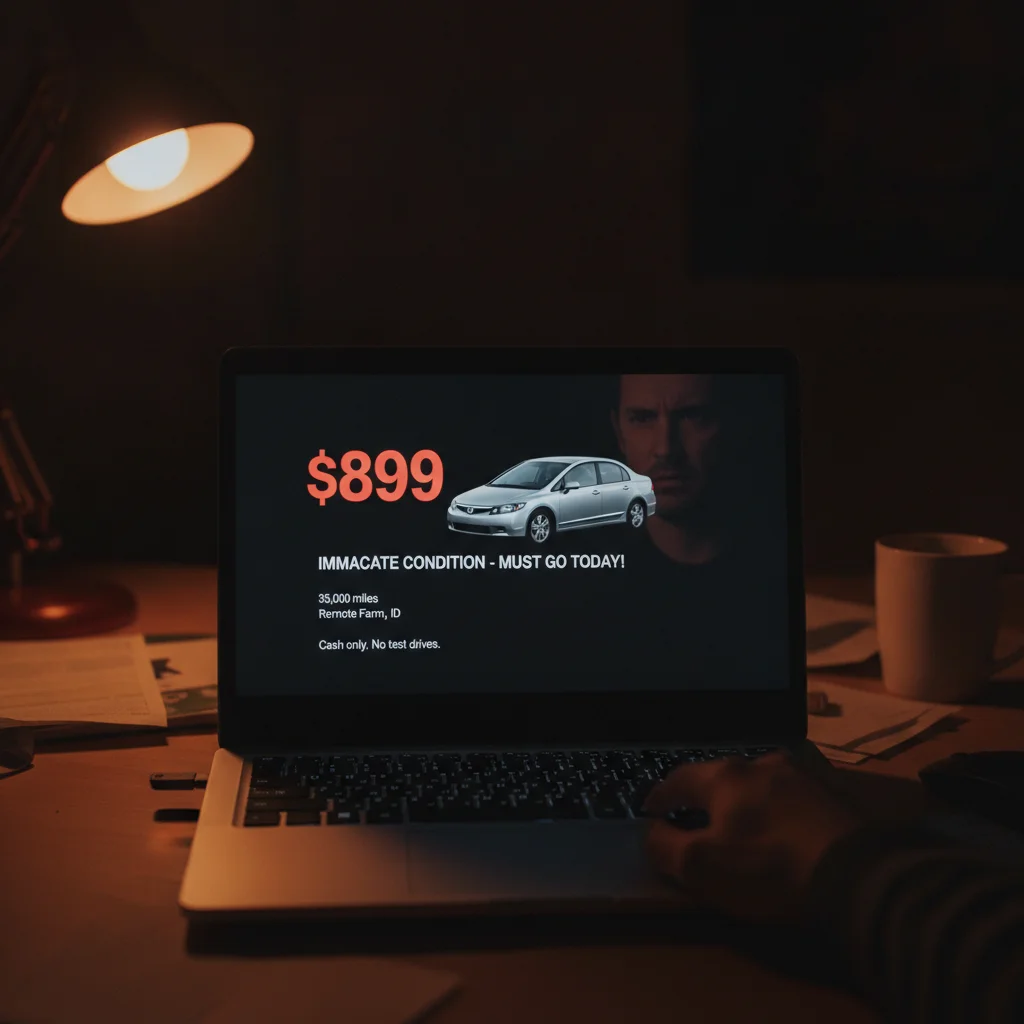
Price Is Dramatically Below Market Value
Pull up any legitimate valuation tool — Kelley Blue Book, Edmunds, or NADA — and price a used car by year, make, model, trim, mileage, and condition. If a listing comes in 20–30% below that range with no explanation, something is wrong. Either the car has a problem the seller isn't disclosing, or the listing is fraudulent.
Common explanations for extreme underpricing include:
- Salvage or rebuilt title — a vehicle that was declared a total loss and rebuilt. These trade at a significant discount for a reason.
- Flood damage — cleaned-up vehicles can look nearly normal for months. See our detailed guide on how to spot a flood-damaged car before you buy it.
- Major mechanical failure — a blown engine or destroyed transmission makes a car worth a fraction of its normal value.
- Outright scam — a non-existent vehicle listed to extract a deposit or wire transfer.
A legitimate seller pricing aggressively will tell you why — "selling quickly due to relocation," "just replaced the clutch and want to recoup," or similar. Silence on the reason is a red flag. Always benchmark against comparables within 50 miles before you get excited about a price.
If a price is 20–30% below market with no explanation, the car has a problem or the listing is fake.
No VIN in the Listing
Every vehicle sold in the U.S. since 1981 has a 17-character Vehicle Identification Number. It's stamped on the dashboard, door jamb, and engine block. Any seller who refuses to provide it, claims not to know it, or deflects when asked has removed one of your most powerful vetting tools — and that's almost certainly intentional.
With a VIN you can run a vehicle history report through CARFAX, AutoCheck, or the National Motor Vehicle Title Information System (NMVTIS). These reports surface:
- Title status (clean, salvage, rebuilt, flood, lemon law buyback)
- Reported accidents and airbag deployments
- Odometer discrepancy flags
- Number of previous owners
- Service and maintenance records (when reported to dealerships)
- Open recalls
Without the VIN, you're flying blind. Sellers with nothing to hide share it freely — often in the listing itself. If you have to ask twice, treat the hesitation as a definitive red flag and move on. A $40 vehicle history report is cheap insurance against a five-figure mistake.
[in_content_images:1]No VIN means no history report — and sellers who won't share it are almost certainly hiding something.
Stock Photos or Recycled Images Instead of Real Ones
A legitimate seller has the actual vehicle sitting in their driveway or parking lot. Taking 10–15 clear photos takes less than 10 minutes. Any listing relying on manufacturer stock images, suspiciously pristine photos with no location context, or obvious watermarks from another site is a serious warning sign.
What to look for:
- Reverse image search — right-click any photo and run it through Google Images or TinEye. If the same images appear on listings in five different states, the listing is fraudulent.
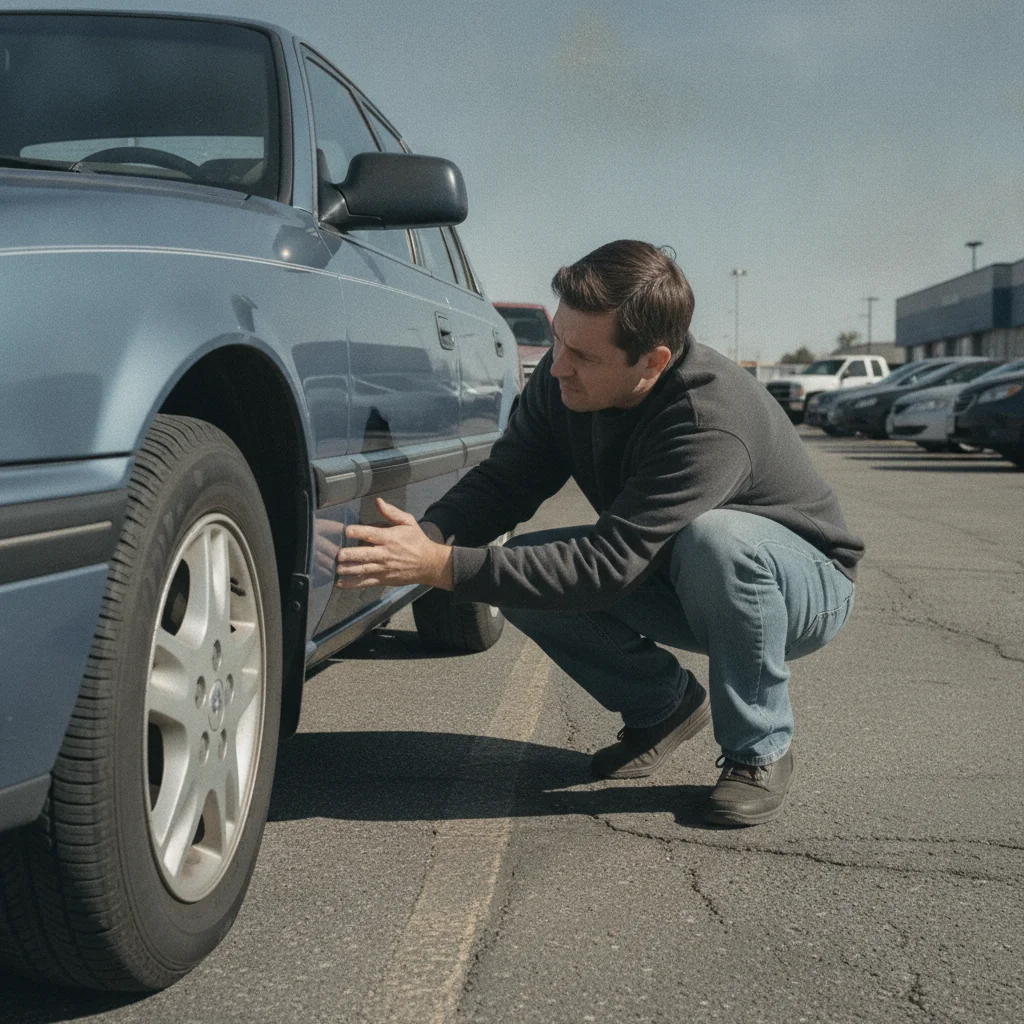
- Missing angles — legitimate sellers show all four corners, the interior, the odometer, and under the hood. Deliberately missing angles (especially the rear quarter panels or the floor mats) often conceal damage.
- Mismatched lighting or backgrounds — photos taken in a photo studio or on a pristine lot that doesn't match the seller's described location are a red flag.
- No odometer photo — mileage is one of the most frequently misrepresented data points. A real seller shows it.
If the listing has fewer than 6–8 actual photos of the specific vehicle, ask for more before scheduling a visit. A seller who resists providing additional real images is not a seller worth pursuing.
Run a reverse image search on listing photos — fraud listings frequently recycle images from other states or sites.
Vague or Generic Vehicle Description
"Runs great. Well maintained. No issues. Selling because I need the money." This description tells you almost nothing about the actual vehicle and everything about the seller's intent to avoid transparency. Compare that to: "2018 Toyota Camry SE, 67,400 miles, one owner, original tires replaced at 52k, oil changed every 5k at Toyota dealer, minor scratch on rear bumper from parking lot, never in an accident."
Specific detail signals a seller who knows the vehicle's history and isn't afraid to share it. Vague language signals one of two things: the seller knows something damaging they're omitting, or they're running a scam and never actually had the car.
Descriptions worth scrutinizing:
- No mention of known cosmetic or mechanical issues
- Trim level not specified ("it has everything" is not a trim level)
- No mention of service history or maintenance
- Copy-paste boilerplate that reads like an advertisement rather than a personal account
- Oddly formal or AI-generated language that doesn't match a typical private seller's voice
When you see vague listings, ask pointed questions before committing to a visit: "When was the last oil change and where?" "Has it been in any accidents?" "What's the exact trim level?" Evasive or nonspecific answers confirm your suspicion.
Vague descriptions aren't just lazy — they're often intentional omissions designed to get you in front of the car before you know the truth.
Seller Urgency and Pressure Tactics
"Must sell today." "I have three other buyers interested." "Price drops tomorrow if not sold." These phrases exist to compress your decision-making window and override your due diligence instincts. Legitimate sellers who need to sell quickly still have time to answer questions and accept an offer after an inspection. Scammers and sellers with problematic vehicles need you to act before you think.
The most dangerous urgency script goes like this: the seller claims to be out of state or overseas (military deployment, job relocation, missionary work), says they'll ship the car to you if you wire a deposit, and assures you it's all handled by eBay Motors or another escrow service that doesn't actually exist. This is a well-documented scam that costs buyers thousands of dollars with no car delivered.
Legitimate urgency looks different. A seller who is genuinely time-pressed will still meet you in person, accept a reasonable inspection, and negotiate in good faith. They won't demand upfront payment before you've seen the vehicle. They won't refuse a test drive. And they won't claim the price is only good for the next two hours.
Any time you feel rushed in a listing interaction, slow down deliberately. That impulse to act fast is exactly what the seller — or scammer — is counting on.
Urgency tactics are designed to override your judgment — the right response is always to slow down, not speed up.
Unusual or Suspicious Payment Requests
How a seller asks to be paid tells you almost everything about the legitimacy of the transaction. Standard private party sales in the U.S. are settled with cash, cashier's check from a local bank, or — increasingly — bank-to-bank transfer for well-documented transactions. Anything outside those norms is a red flag.
Watch for these specific requests:
- Wire transfers — once the money leaves, it's gone. Wire transfers are irreversible and the preferred method for vehicle scams.
- Gift cards — no legitimate seller asks for Visa gift cards, Apple Pay gift cards, or any similar instrument. Full stop.
- Zelle or Venmo for the full amount — these platforms offer limited fraud protection and are increasingly used in vehicle scams.
- Third-party escrow you didn't initiate — scammers create fake escrow sites that mimic legitimate services. Always initiate your own escrow verification.
- Partial payment before seeing the car — no legitimate seller needs a deposit before an in-person inspection.
For large transactions, use a cashier's check from your bank and verify it in person at the seller's bank before signing over the title. It adds 30 minutes and removes most payment fraud risk.
Wire transfers and gift card payment requests are instant disqualifiers — no legitimate car seller needs either.
Title Issues Hidden in Plain Sight
Sometimes sellers disclose title problems — they just bury them or use language they hope buyers won't understand. A few terms to know before you browse:
- Salvage title — the vehicle was declared a total loss by an insurance company. It was damaged to the point where repair costs exceeded a threshold (typically 75–100% of ACV, depending on state). Rebuilt salvage vehicles can be safe, but they carry permanent resale penalties and are often uninsurable or insurable only at very high rates.
- Rebuilt/reconstructed title — a salvage vehicle that was repaired and passed a state inspection. Better than salvage-only, but still a discount vehicle with limited financing options.
- Lemon law buyback — the manufacturer repurchased the vehicle due to a defect that couldn't be fixed after multiple attempts. These must be disclosed and branded on the title in most states.
- Non-transferable title or no title — walk away. If a seller can't produce a clean title in their name, you cannot legally transfer ownership. "Lost title" situations are possible but add significant risk and complexity.
Run the VIN through NMVTIS (available free through some state DMV sites) and purchase a full vehicle history report before committing to any offer. Title fraud — where a clean-looking title is forged or a salvage brand is washed through another state's DMV — does happen. Scrutinize the physical document at closing.
[in_content_images:2]Title washing — transferring a salvage vehicle through states with looser title laws — is a real fraud that catches buyers off guard.
Refusal to Allow a Pre-Purchase Inspection
This is perhaps the most definitive red flag on this list, because it eliminates all ambiguity. A seller with nothing to hide welcomes a pre-purchase inspection (PPI). They've already disclosed what they know, and an independent mechanic confirming it helps close the deal. A seller who refuses, delays, or adds conditions to a PPI is protecting something.
Common deflection tactics:
- "I've already had it inspected" — offer to use that report as a starting point, but still request your own independent one.
- "The mechanic is too far away" — you're offering to pay for the inspection. Distance is not a barrier if the car is legitimate.
- "I have other buyers who don't need an inspection" — let them sell to that buyer. This is a pressure tactic.
- "I'll only allow an inspection at my location" — fine, if the location is a legitimate independent shop. Not fine if it means you can't take the car to a trusted mechanic.
A proper PPI costs $100–$200 at most independent shops and typically covers compression, brake thickness, fluid conditions, frame straightness, and diagnostic trouble codes. It's the best money you'll spend in a used car transaction. Any seller who won't accommodate it is showing you exactly what they're afraid you'll find.
For more on what to check before committing, see the used car pre-drive checklist — it pairs directly with a PPI to give you complete coverage.
A seller who refuses a pre-purchase inspection is telling you the car won't pass one.
Mileage That Doesn't Add Up
Odometer fraud is federally illegal, but it still happens — particularly on high-value vehicles where rolling back 40,000 miles could mean a $4,000–$8,000 price bump. The vehicle history report will flag reported odometer discrepancies, but history reports only capture what's been reported to databases. Here's how to cross-check independently:
- Wear relative to mileage — a 60,000-mile vehicle should have noticeable pedal wear, steering wheel wear, and seat bolster wear. A "60,000-mile" vehicle with a factory-fresh interior deserves scrutiny.
- Service stickers — check the windshield corner sticker and door jamb sticker from the last oil change. If it shows 94,000 miles and the odometer reads 62,000, you have a problem.
- Tire date codes — tires have a four-digit date code on the sidewall. Original tires on a 30,000-mile vehicle should match the manufacturing year to the car's model year. Tires from three years ago on a "15,000-mile" car are suspicious.
- Brake rotor wear — visible through most wheel spokes. Significant grooving or lip on the rotor edge at low claimed mileage is inconsistent.
Cross-referencing two or three of these signals gives you a reliable mileage reality check before any money changes hands.
Check service stickers, tire date codes, and interior wear — they tell you what the odometer might be hiding.
Listing Contact Details That Don't Match
The contact profile is the last layer of the listing — and it's frequently where fraud becomes obvious if you look carefully. Legitimate private sellers have a consistent identity: a name, a local phone number, and a plausible reason for selling. When those elements don't align, be suspicious.
Specific inconsistencies to watch for:
- Account created the same week as the listing — brand-new accounts with no history on marketplace platforms are a common fraud signal.
- Phone number that traces to a different state — use a free reverse phone lookup tool. A seller claiming to be in Phoenix with a Georgia area code and a car from Florida deserves an explanation.
- Only communicates via text or app messaging, refuses calls — scammers avoid voice contact because it's harder to maintain a false identity.
- Generic name paired with only an email address — no phone number, no verifiable identity, no meeting in person. Classic fraud profile.
- Multiple listings of the same car across different platforms at different prices — a reverse image search can surface this quickly.
For the seller's perspective on what legitimate buyer inquiries look like, the guide on red flags in private car sale inquiries is useful context — it shows you both sides of a legitimate transaction.
[in_content_images:3]A brand-new marketplace account with no history and no phone number is nearly always a fraud indicator.
Put Your Shortlist Through a Final Filter
After filtering for listing red flags, the cars that survive your initial review still need to be vetted in person. A clean-looking listing doesn't guarantee a clean car. Use our used car pre-drive checklist when you show up — that guide walks through the exterior, interior, and under-hood details that even well-photographed listings can conceal.
If you're financing the purchase, keep the same skepticism you applied to the listing and apply it to the loan offer. Red flags in a preapproval offer — like unusually high APRs buried in fine print or dealer-only financing terms — can cost you just as much as a bad car deal.
Online Listings vs. In-Person Reality
Listing red flags are a screening tool, not a verdict. A listing with minor issues — few photos, brief description — might simply be an inexperienced seller with a legitimate car. Use the flags to prioritize your outreach and ask pointed questions. The goal is to qualify or disqualify quickly, not to assume the worst about every imperfect post. Our related guide on <a href="/buying-a-car/car-buying-process/online-car-buying/red-flags-to-watch-for-when-browsing-online-car-listings">red flags in online car listings</a> covers platform-specific nuances worth reviewing alongside this list.
Dealer Listings Have Their Own Red Flags
The red flags above apply most directly to private party listings, but dealers are not immune. Dealer listings that omit prior rental or fleet use, don't disclose certified pre-owned status accurately, or show dramatically low prices that later include undisclosed dealer fees are also problematic. If you're comparing private party to dealer purchases, our overview of <a href="/buying-a-car/new-vs-used-cars/buying-new-cars">buying new cars from dealerships</a> covers the dealer dynamic in more depth.
Dashboard Warning Signs After Purchase
Once you own the vehicle, the vetting process doesn't fully stop. Some sellers clear dashboard warning lights temporarily before a sale using a code reader. If warning lights appear in the first few days of ownership, document them immediately. Our resource on <a href="/maintenance-and-ownership/vehicle-maintenance/warning-signs">vehicle warning signs</a> covers what those alerts mean and how urgently each one needs attention.
The best deals in the used car market go to buyers who do their homework at every stage: the listing, the in-person inspection, the vehicle history, and the financing. Treat each step as a filter, and you'll dramatically narrow your exposure to bad outcomes.
Build a Listing Checklist Before You Browse
Before opening listings, write down your non-negotiables: minimum photo count, VIN required, price within X% of market value, local seller only. Applying criteria before you get emotionally invested in a car keeps your screening disciplined. A car you've already imagined yourself driving is much harder to walk away from — even when the listing tells you to.
Use Multiple Valuation Tools in Parallel
Don't rely on a single pricing source. Run the vehicle through KBB, Edmunds, and NADA simultaneously and note where the ranges overlap. The overlap zone is the true fair market value for that vehicle. A listing priced below all three ranges — with no disclosed reason — is always worth additional scrutiny before you respond.

All claims are backed by peer-reviewed research. Sources on request.