
| MSRP Definition | Manufacturer's Suggested Retail Price — the sticker price set by the automaker (Monroney Act (Public Law 85-473), 1958) |
| Invoice Price | Amount listed on the manufacturer's bill to the dealer — not the dealer's true cost |
| Typical Holdback Range | 1%–3% of MSRP returned to dealer by manufacturer after sale (Edmunds industry data) |
| Avg. MSRP-to-Invoice Gap | Roughly 5%–8% on most mainstream vehicles (Consumer Reports, 2023) |
| Market Adjustment (Markup) | Dealer-added charge above MSRP on high-demand models — can range $500–$10,000+ |
| Reasonable Negotiation Target | $200–$500 over true dealer cost on non-in-demand vehicles |
| Invoice Data Sources | Edmunds, TrueCar, Consumer Reports Build & Buy |
| Dealer Floor Plan | Loan dealers use to finance vehicle inventory; sometimes subsidized by manufacturers |
Why These Three Numbers Matter Before You Walk In
Most buyers show up at a dealership knowing one number: the price they saw in an ad or on the manufacturer's website. That number is the MSRP — the Manufacturer's Suggested Retail Price. It sounds authoritative. It's printed right there on the window sticker. But if you're negotiating based only on MSRP, you're leaving money on the table before the conversation even starts.
There are at least three distinct price points in any new car transaction: MSRP, invoice price, and true dealer cost. Each one means something different, and each one gives you different leverage. Understanding all three doesn't require a finance degree — it requires about ten minutes of reading and the willingness to ask uncomfortable questions at the right moment.
This reference breaks down each number precisely, explains where the gaps between them come from, and tells you which one to anchor your negotiation to. If you want a broader look at how MSRP functions as a baseline, see what MSRP actually means and why it's just a starting point.
| MSRP Definition | Manufacturer's Suggested Retail Price — the sticker price set by the automaker (Monroney Act (Public Law 85-473), 1958) |
| Invoice Price | Amount listed on the manufacturer's bill to the dealer — not the dealer's true cost |
| Typical Holdback Range | 1%–3% of MSRP returned to dealer by manufacturer after sale (Edmunds industry data) |
| Avg. MSRP-to-Invoice Gap | Roughly 5%–8% on most mainstream vehicles (Consumer Reports, 2023) |
| Market Adjustment (Markup) | Dealer-added charge above MSRP on high-demand models — can range $500–$10,000+ |
| Reasonable Negotiation Target | $200–$500 over true dealer cost on non-in-demand vehicles |
| Invoice Data Sources | Edmunds, TrueCar, Consumer Reports Build & Buy |
| Dealer Floor Plan | Loan dealers use to finance vehicle inventory; sometimes subsidized by manufacturers |
MSRP: The Suggested Price (That Nobody Has to Pay)
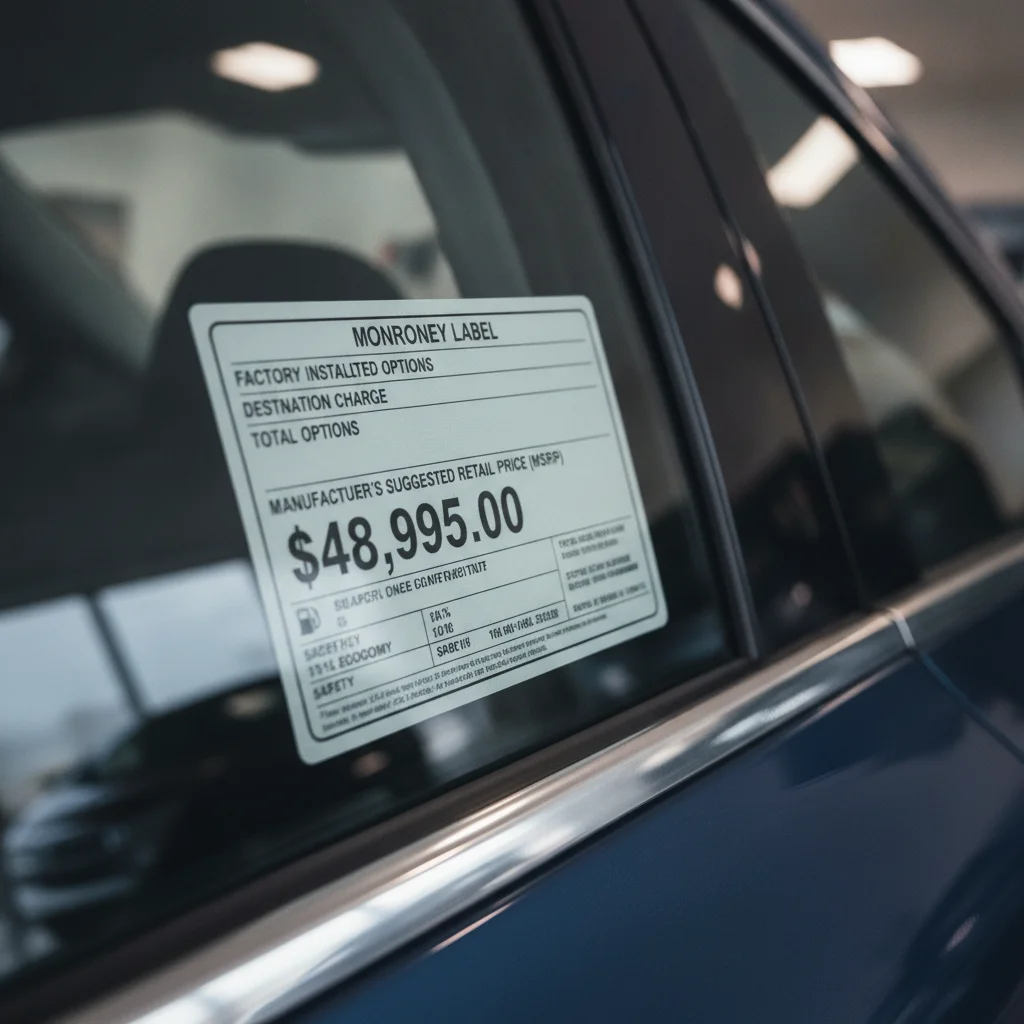
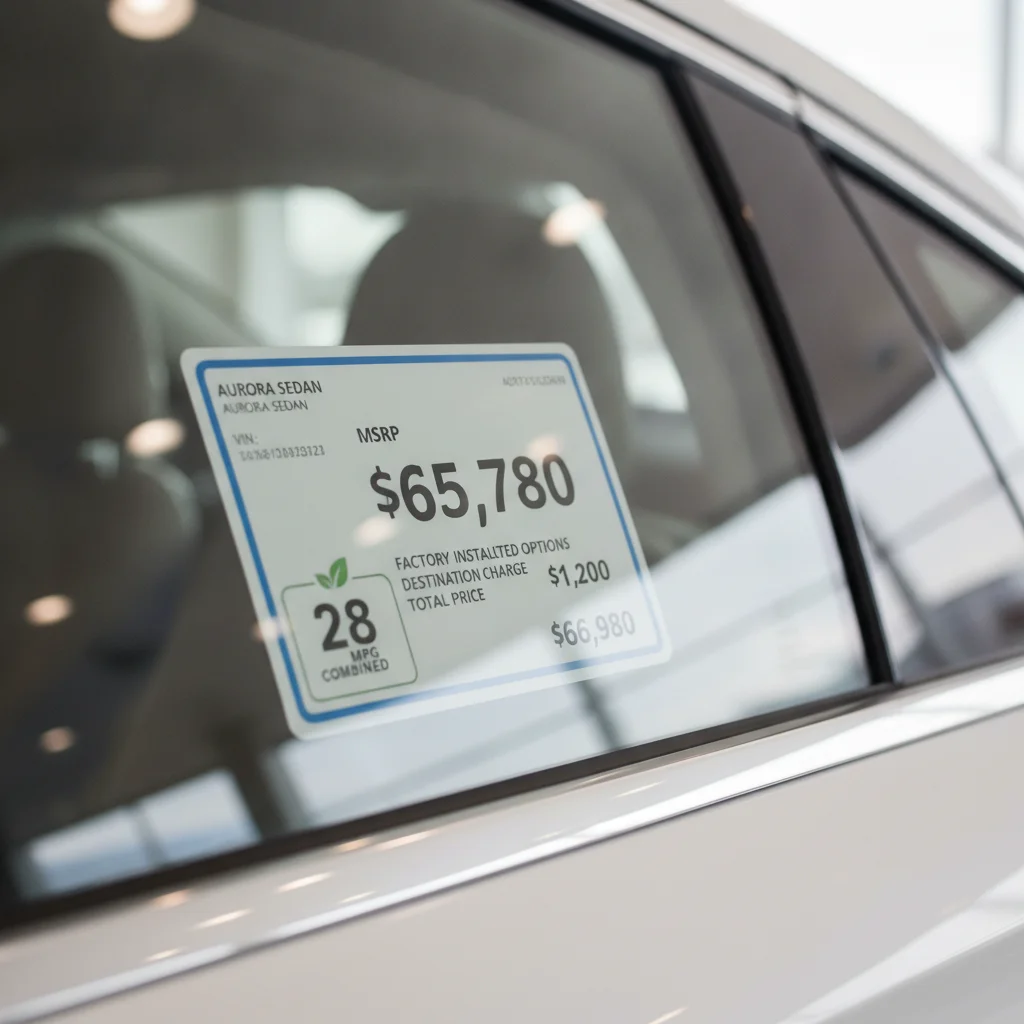
MSRP stands for Manufacturer's Suggested Retail Price. The operative word is suggested. Federal law — specifically the Monroney Act of 1958 — requires that this sticker be affixed to every new passenger vehicle. The sticker must show the base price, the cost of installed options, transportation charges, and the total MSRP. What it doesn't tell you is what the dealer paid.
MSRP serves two purposes. For manufacturers, it's a floor that protects brand value and keeps dealers from competing purely on price. For dealers, it's the opening position in a negotiation. For buyers, it's frequently mistaken for the fair price — which is exactly what dealers want.
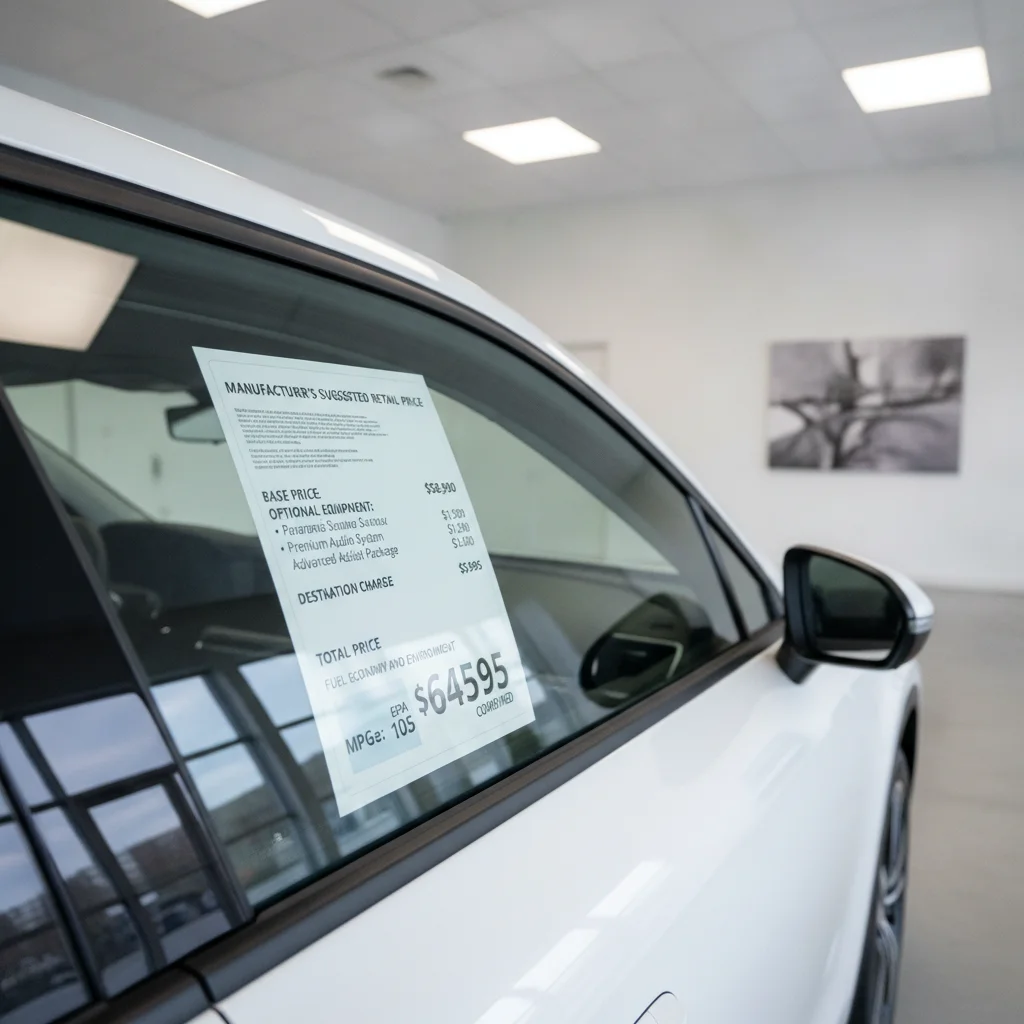
On high-demand vehicles — a popular truck, a newly launched SUV — dealers will sometimes charge above MSRP. This is called a market adjustment or dealer markup. On slow-moving or heavily inventoried models, the final selling price can land several thousand dollars below MSRP. The sticker is a ceiling in a buyer's market and a floor in a seller's market. Understanding which market you're in is step one of any smart negotiation.
For a deeper look at what gets buried inside that sticker price, check out what the sticker price doesn't tell you.
MSRP
Manufacturer's Suggested Retail Price — the price the automaker recommends dealers charge for a vehicle. It is printed on the Monroney sticker required by federal law but is not a fixed selling price.
Invoice Price
The price listed on the manufacturer's invoice to the dealership. Often published by third-party services, it approximates but does not equal the dealer's true cost because of holdback and incentives.
Holdback
A percentage of MSRP — usually 1%–3% — that the manufacturer refunds to the dealer after a vehicle sells. Holdback exists to help dealers manage cash flow and is not reflected in the invoice price.
True Dealer Cost
The actual net cost a dealer incurs for a vehicle after subtracting holdback, dealer cash incentives, and floor plan assistance from the invoice price. This is the real floor for negotiation.
Dealer Cash
Direct monetary incentives paid by manufacturers to dealers to encourage moving specific models. Unlike customer rebates, these are not publicly disclosed and can vary by region and time period.
Market Adjustment
An additional markup added by a dealer above MSRP on high-demand vehicles. Entirely at the dealer's discretion and fully negotiable when market conditions allow.
Floor Plan
A revolving line of credit dealers use to finance their vehicle inventory. Each car on the lot is essentially financed until it sells; manufacturers sometimes subsidize this interest cost as an incentive.
Out-the-Door Price
The total amount a buyer pays to drive the vehicle off the lot, including selling price, taxes, registration fees, and any add-ons. This is the only number that meaningfully reflects what you're spending.
Invoice Price: What the Dealer Paid (Sort Of)
The invoice price is the amount listed on the manufacturer's invoice to the dealer — the document that shows what the dealership paid to take a vehicle into inventory. For years, this was treated as a closely guarded secret. Today, services like Edmunds, TrueCar, and Consumer Reports publish invoice data for most models, which has fundamentally shifted negotiating power toward informed buyers.
Here's what buyers commonly get wrong: invoice price is not the dealer's true cost. It's closer to true cost than MSRP, but it's still not the floor. Several programs exist that push the dealer's effective cost below invoice:
- Holdback: A percentage — typically 1% to 3% of MSRP — that the manufacturer pays back to the dealer after a vehicle is sold. On a $45,000 truck, that's $450 to $1,350 the dealer quietly pockets regardless of your negotiated price.
- Dealer cash and incentives: Manufacturers periodically offer dealers direct cash payments to move specific models. These are separate from customer rebates and are not disclosed on any sticker.
- Floor plan assistance: When dealers finance their inventory (called a floor plan), manufacturers sometimes subsidize the interest cost, reducing the dealer's carrying expense and effectively lowering their break-even point.
5%–8%
Typical gap between MSRP and invoice price
On most mainstream new vehicles, the invoice price runs roughly 5%–8% below MSRP, according to Consumer Reports pricing data.
$1,350
Maximum holdback on a $45,000 vehicle at 3%
A dealer selling a $45,000 truck with a 3% holdback receives $1,350 back from the manufacturer — money invisible to the buyer during negotiation.
$2,000+
Average dealer cash incentive on slow-selling models
Manufacturer-to-dealer cash incentives on slow-moving models can exceed $2,000 per unit, according to Edmunds incentive tracking data.
72 months
Most common new car loan term in 2024
According to Experian's State of the Automotive Finance Market report, the average new vehicle loan term has stretched to roughly 72 months — giving dealers more room to bury margin in rate.
The practical implication: if you negotiate down to invoice price on a popular model, the dealer is almost certainly still making money. Negotiating to invoice is a reasonable goal on most vehicles. On slower-selling models where manufacturer incentives are running high, you may be able to push below invoice and still leave the dealer profitable.
Want to understand how all the moving parts of a car deal fit together from the dealer's perspective? The anatomy of a car deal breaks down exactly how dealers track each variable.
True Dealer Cost: The Real Floor
True dealer cost is the invoice price minus all backend income the dealer expects to receive on that unit. It's not published anywhere — it's a number you have to estimate. Here's the math:
True Dealer Cost = Invoice Price − Holdback − Dealer Cash − Floor Plan Assistance
Let's run that on a real example. Say you're looking at a midsize SUV with:
- MSRP: $42,000
- Invoice price: $39,500
- Holdback (2% of MSRP): $840
- Current dealer cash incentive: $1,000
- Floor plan assistance: $200 (estimate)
True dealer cost works out to approximately $37,460. MSRP is $4,540 higher. If you negotiate to invoice thinking that's the dealer's cost, you've given them a $2,040 margin you didn't have to give.
That doesn't mean you should demand to pay true dealer cost. Dealers have legitimate overhead — salespeople's commissions, facility costs, administrative staff. A reasonable deal gives the dealer some room while not giving away thousands unnecessarily. Historically, shooting for $200–$500 over true dealer cost on a non-in-demand vehicle is a realistic target. On hot-selling models, expect to pay more.
Hot Models Play by Different Rules
On vehicles with waiting lists or limited inventory — think popular electric trucks, performance variants, or newly launched models — invoice price and even MSRP may be non-negotiable. Dealers in tight supply situations will add market adjustments freely. Your leverage depends heavily on supply. Check regional inventory levels before deciding how hard to push on price.
Rebates Are Separate From Negotiated Price
Manufacturer rebates offered directly to customers (cash-back offers) come off the final price after your negotiated selling price is set. They are not a substitute for negotiating. Always negotiate the selling price first, then apply any qualifying rebate on top of that savings. A dealer who says 'we can't negotiate because of the rebate' is conflating two separate transactions.
For a side-by-side comparison of how invoice price, MSRP, and market value interact, see invoice price, MSRP, and market value — knowing the difference saves you money.
How Dealers Blur These Numbers (And What to Do About It)
Experienced finance managers know that most buyers anchor to monthly payment, not price. The classic move is to shift your attention from the vehicle's selling price to a monthly number as early as possible. Once you're thinking in monthly payments, it becomes very easy for the dealer to absorb a lower selling price by stretching the loan term — or to inflate the interest rate to recover front-end margin lost in negotiation.
Keep these three rules in mind:
- Negotiate the out-the-door price first, in writing, before discussing financing. Until you have an agreed selling price, any finance conversation is premature. See why the out-the-door price is the only number that matters to understand everything that feeds into that final number.
- Research invoice price before you arrive. Free tools like Edmunds True Market Value and the Consumer Reports Build & Buy service give you invoice data and recent transaction prices in your zip code. Know your number before you sit down.
- Watch your APR separately. Even after negotiating a strong selling price, dealers have discretion over the interest rate they offer on financing — and a rate that's 1%–2% higher than what you qualify for can cost you more over a 60- or 72-month loan than you saved on price. For a full breakdown of how rate markups work, review the hub on interest and APR.

One more tactic to know: dealers sometimes bundle accessories or protection packages into the selling price before you arrive, then frame removing them as a concession they're making for you. Always confirm which options are factory-installed versus dealer-added, and check that invoice price reflects only what you're actually buying.
Your Quick Reference: What to Know Before the Negotiation
Here's a condensed checklist for applying this knowledge when it counts:
- Before you visit any dealership: Pull the invoice price from Edmunds or TrueCar for the exact trim, packages, and color you want. Note the MSRP shown on that same listing so you know the spread.
- At the dealer: Start your offer at or just above your estimated true dealer cost. Don't explain your math — just make the number.
- If the salesperson says they're losing money at your number: Ask to see the invoice. Many dealers will show it. If they won't, that's information too.
- Watch for dealer-added items on the window sticker: Paint protection, nitrogen fill, window tinting, and VIN etching are high-margin add-ons with minimal real value. Most can be declined or removed before signing.
- Don't confuse a low monthly payment with a good deal: Run your own numbers. Know the loan amount, the rate, and the term before you agree to anything in the finance office.
Edmunds True Market Value (TMV)
Provides invoice price data, recent transaction prices by zip code, and dealer incentive information for new vehicles. One of the most reliable free tools for pre-negotiation research.
Consumer Reports Build & Buy
Shows invoice price and connects buyers with dealers who have agreed to transparent pricing. Useful for buyers who want verified pricing without cold-calling multiple dealerships.
TrueCar Pricing Report
Generates a detailed report showing what others paid for the same vehicle in your area, giving you a realistic range for negotiation rather than a single point estimate.
Dealer Negotiation Hub
A comprehensive resource covering every stage of dealership negotiation — from opening offer to finance office tactics — with practical, no-fluff guidance for buyers at every experience level.
Out-the-Door Price Calculator Guide
Walks through exactly how taxes, title, registration, and dealer fees stack onto the selling price — so you know the real total before you sign anything.
For a thorough walkthrough of how dealers structure the entire negotiation across price, trade, rate, and down payment, go deeper with the anatomy of a car deal. And if you want to understand the full negotiating landscape, the dealer negotiation hub covers every major tactic and counter-tactic.
All claims are backed by peer-reviewed research. Sources on request.