

Key Takeaways
Why Dealers Want Everything Bundled Together
Walk into most dealerships and the finance manager will ask within the first five minutes: "Will you be trading anything in?" That question isn't small talk. It's the first move in a game designed to pool all the numbers — trade value, new car price, financing rate, and monthly payment — into one giant negotiation where the dealer controls the mixer.
Here's the core mechanic. A salesperson who gives you $2,000 too little on your trade can hand that same $2,000 back to you as a discount on the new car without losing a dollar of profit. The monthly payment barely moves, you feel like you got a deal on both ends, and the dealer keeps the margin. This is sometimes called the "shell game" — the money moves around but the house total stays the same.
The classic execution vehicle is the four-square worksheet. If you've sat across from a finance desk, you've likely seen it: a sheet divided into four boxes — vehicle price, trade-in value, down payment, and monthly payment. The design is intentional. A skilled F&I manager can move numbers between boxes and distract you with whichever one you're currently focused on. Lower your trade offer? Drop the monthly payment. Raise the purchase price? Increase the trade allowance. The math all balances — for the dealer.
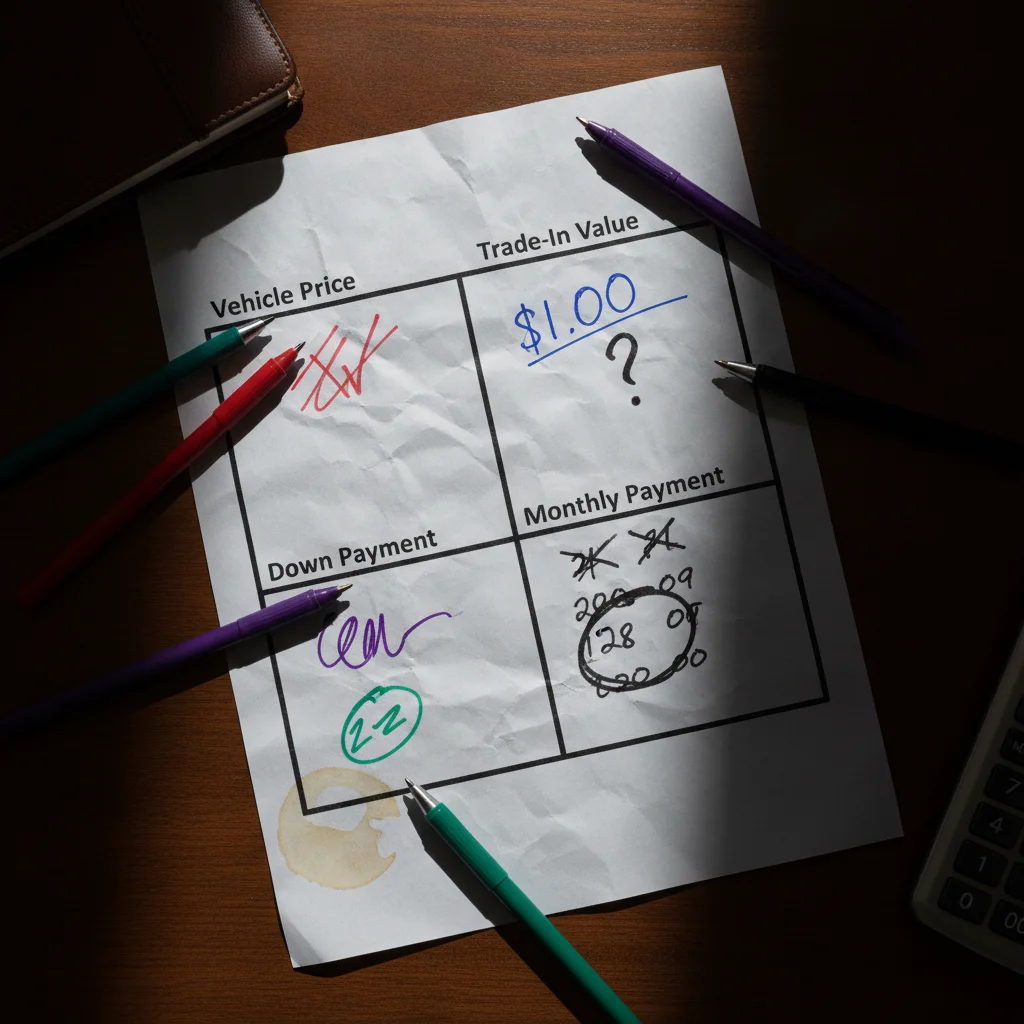
This is why the only effective counter-strategy is to refuse to play on their terms. You treat the trade-in as a completely separate sale, negotiate the new car price as if you're paying cash, and only bring the trade into the room once the purchase number is locked in writing. Everything else flows from that discipline.
For a deeper look at the specific tactics used to erode your trade value, see The Dealer Tactics That Eat Into Your Trade-In Value — understanding those moves makes the counter-strategies below land harder.
Revealing Your Trade Too Early Costs Money
The moment a dealership knows you have a trade, every number they show you will be calibrated with that knowledge. Salespeople are trained to use the trade as a pressure release valve — lowering the trade offer lets them offer a deeper "discount" on the purchase while maintaining identical total profit. Withholding trade information until the purchase price is signed is not deceptive; it's sound negotiation.
Negative Equity Can Derail the Separation Strategy
If you owe more on your current vehicle than it's worth, the outstanding balance doesn't disappear — dealers will roll it into the new loan, inflating the amount you finance. Know your payoff balance before you arrive, and be realistic about whether trading while upside down makes financial sense. Rolling $4,000 in negative equity into a new 72-month loan adds significant total interest cost and leaves you underwater on two consecutive vehicles.
What You Need Before You Walk In
Preparation is where this strategy actually wins or loses. Showing up without outside appraisals means you're negotiating your trade value in a vacuum — and the dealer knows the local market far better than you do in that moment.
What you will need
Your trade-in floor price should come from at least two of the sources below before you contact a single dealership:
- CarMax or Carvana instant offer — These are real, written, 7-day offers. Bring the printout. This is your walk-away number.
- KBB Instant Cash Offer — Participating dealers are bound by this number. It anchors the conversation.
- Dealer appraisals from non-competing stores — Get one or two appraisals from dealers who don't sell the brand you're buying. They have no incentive to lowball your trade.
You also need the out-the-door price on the new vehicle nailed down before your first visit. Research invoice pricing on sites like Edmunds True Market Value, find any manufacturer incentives, and know exactly what dealer add-ons (paint sealant, wheel locks, nitrogen fill) you intend to refuse. These are pure margin items tacked onto the back end of the deal.
CarMax or Carvana Instant Offer
Provides a documented, time-limited written appraisal that serves as a competitive floor for your trade-in negotiation.
Edmunds True Market Value (TMV)
Establishes what buyers in your local market are actually paying for the new vehicle, giving you a realistic purchase price target.
KBB Instant Cash Offer
A participating-dealer cash offer for your trade-in, redeemable at thousands of dealerships as an alternative to a private sale.
Lender Payoff Statement
Required if your trade-in has an outstanding loan — the payoff amount determines whether you have positive equity or are upside down.
State DMV or Tax Authority Website
Look up your state's trade-in tax credit rules to calculate the real net value of trading versus selling privately.
Notepad or Deal Tracking Spreadsheet
Track every number offered and agreed upon in sequence so nothing gets quietly revised once combined into the final buyer's order.
Once you have a written outside appraisal, your trade is no longer just "a car." It's an asset with a documented market value. That changes the psychology of the conversation significantly — for both sides.
For a comprehensive checklist of the verification steps to run before and during any trade-in deal, see The Trade-In Negotiation Checklist Every Buyer Should Run Through.
The Step-by-Step Separation Method
The following steps represent the exact sequence to follow. Order matters here — deviating from it hands the dealer back the control you're trying to remove.
Obtain at least two written outside appraisals
Before contacting the selling dealer, get documented offers from CarMax, Carvana, or a competing dealership. These written appraisals — valid for 7 days in most cases — establish a market floor that removes the dealer's ability to low-anchor your trade value. Screenshot the offers, print them if possible, and bring them to the showroom.
Research and set your target new car price before arrival
Use Edmunds TMV, TrueCar, or manufacturer invoice data to identify what others are paying in your market. Set a specific target price — not a range. A range gives the dealer a landing zone; a specific number forces a yes or no. Factor in any manufacturer incentives, loyalty rebates, or conquest cash you qualify for and subtract them from your target.
Do not mention your trade-in at initial contact
When you arrive at the dealership or engage online, do not volunteer that you have a trade. If asked directly, say: "I haven't decided yet — let's focus on the vehicle first." This keeps both transactions cleanly separate from the opening moment. Dealers who know you have a trade will structure their early numbers with that in mind.
Negotiate the new car price to agreement — in writing
Work the purchase price down to your target using the market data you prepared. Negotiate on the out-the-door price, not the monthly payment. The out-the-door figure includes all taxes, fees, and dealer add-ons. Get the agreed number signed or initialed on a buyer's order before proceeding. The key phrase: "I'd like that in writing before we discuss anything else."
Introduce your trade-in as a separate transaction
Only after the purchase price is in writing do you disclose your trade. Say: "Great — now let's talk about the car I'm selling. I have written offers from [CarMax/Carvana] for $X. What can you do?" By framing it as a sale rather than a trade, you set a competitive dynamic. The dealer is now bidding against documented market prices.
Evaluate the trade offer against your outside appraisals
If the dealer's trade offer matches or beats your CarMax/Carvana number, the deal makes sense. If they come in $500–$1,000 below, factor in the sales tax offset for your state — in many cases the difference narrows enough to justify the trade. If they're more than $1,500 below your documented offers with no tax benefit to close the gap, walk away from the trade and sell privately.
Verify the final buyer's order before signing
Before you enter the F&I office, confirm that the buyer's order reflects exactly the purchase price you agreed on minus the trade-in value you accepted — with no other adjustments. Check every line item. Dealer add-ons, documentation fees above your state's average, and mandatory protection packages are common places where margin reappears after you've negotiated it out. Cross out or initial-out anything you didn't agree to.
After completing these steps, you'll have two clean numbers on paper: what you paid for the new car and what you received for your trade-in. Both are verifiable, both are independent, and neither one can be used to subsidize the other.
For a detailed walkthrough of executing this sequence inside an active dealership visit, Negotiating Trade-In Value on a New Car Purchase: A Step-by-Step Approach goes through each stage in granular detail.

Handling the Pushback You Will Definitely Get
Dealers don't like this approach. Expect resistance, and know in advance how to respond without caving.
"We need to know about the trade to structure the deal."
Response: "I understand — once we've agreed on the vehicle price, I'm happy to discuss the trade. Let's lock the purchase number first." Hold the line. There is no legitimate reason the purchase price depends on whether you have a trade.
"Our appraisal department is backed up — let's just get started on the new car together."
This is a delay tactic designed to get you emotionally invested in the new vehicle before the trade is appraised. Response: "No problem, I'll wait. I already have outside offers in hand so this shouldn't take long." The mention of outside offers usually speeds things up considerably.
"We can give you more on the trade if you finance with us."
This is bundling coming in through the back door. If the trade offer is genuinely better only when you use dealer financing, that "extra" trade value is being paid for with a higher interest rate spread — the dealer earns a kickback from the lender on every point above the buy rate. Run the total interest cost across the loan term and you will almost always find that you're paying back more than you gained on the trade. Separate the financing conversation the same way you separated the trade.
Never Sign a Combined Worksheet
If a dealer presents a single document that bundles your trade-in allowance, new vehicle price, financing terms, and monthly payment onto one worksheet — do not sign it without dissecting every line. Ask for each component in writing on separate lines with no rounding or blending. A bundled worksheet is the primary tool used to obscure where dealership profit is coming from. Once you sign it, the "deal" is set regardless of how the numbers were moved to get there.
"That CarMax offer isn't what we'd get at auction."
Response: "That's a real written offer valid for seven days — I can sell it there today if this doesn't work out." The CarMax offer is your legitimate alternative. The dealer can match it, beat it, or let you walk. But they can't argue it away.
For a broader look at how the bundled-deal structure works against buyers in every scenario, Separating the Trade-In from the New Car Deal breaks down the mechanics in detail.
When a Dealer Trade-In Actually Makes Sense
Private-party sales deliver more cash in almost every scenario, but they're not always the right move. Here's an honest accounting of when a dealer trade-in is worth accepting even at a lower number.
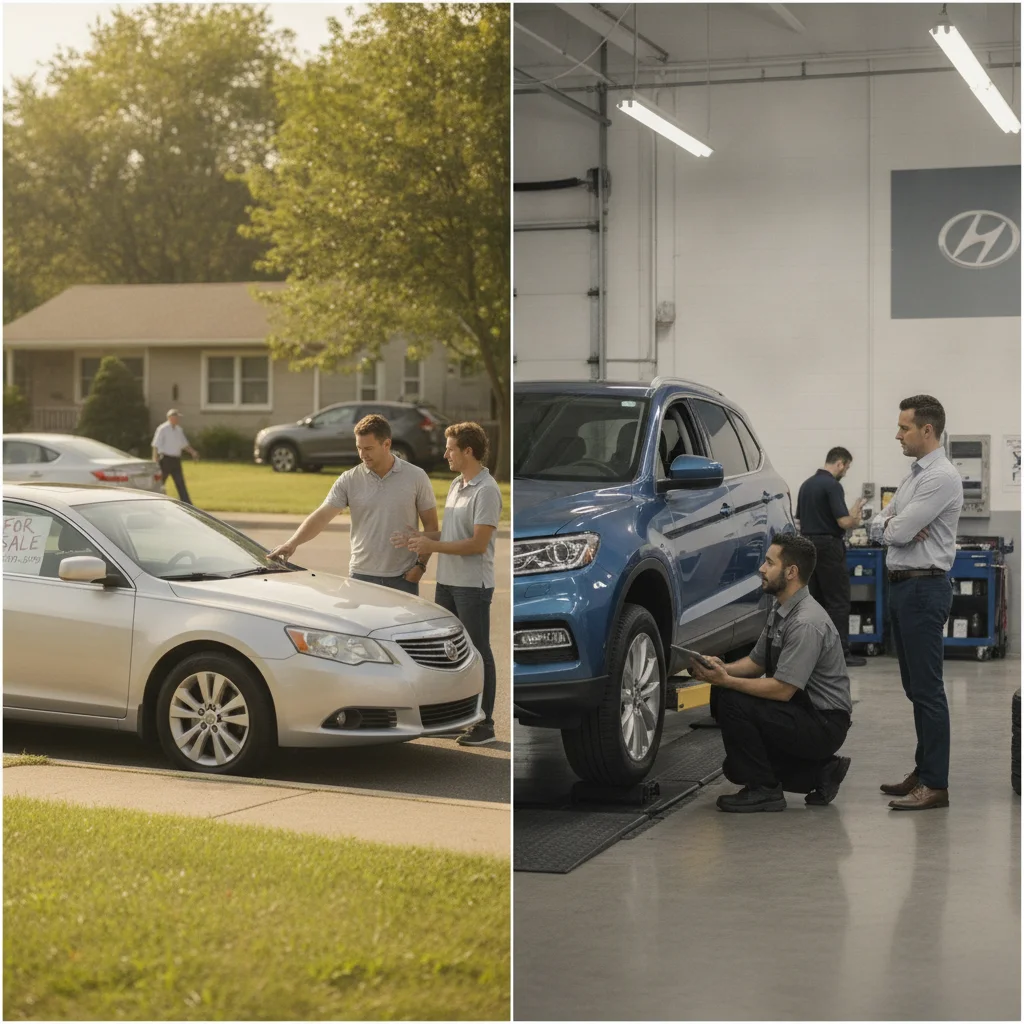
Sales Tax Offset
In most states, trading in a vehicle reduces the taxable purchase price of the new car. If you're buying a $45,000 vehicle and your trade is worth $15,000, you typically pay sales tax only on $30,000. At a 7% tax rate, that's a $1,050 savings — real money that narrows the gap between the dealer offer and a private sale. Run this math for your state before deciding.
The Vehicle Has Known Issues
If your current car needs $2,000 in repairs that a private buyer will negotiate off the price, the convenience of handing the keys to the dealer and walking away has genuine dollar value. Disclose known mechanical problems upfront — hiding them creates legal exposure in most states and dealers will find them during inspection anyway.
Time and Hassle Have Real Costs
A private-party sale means listing the car, fielding calls from flaky buyers, coordinating test drives, and handling paperwork. If you're comparing a $1,500 difference against two weeks of logistics overhead, some buyers will correctly decide the trade-in is the better choice for their situation.
The key is that this decision should be made with clear numbers in front of you — not as a reflex because it seemed easier at the dealership. Understand the dealer trade-in process in full before committing to any channel.
Time Your Appraisals Strategically
Used vehicle values fluctuate based on wholesale auction results, seasonal demand, and fuel prices. Trucks and SUVs are worth more in spring; sedans can soften in summer. Get your appraisals within 48 hours of your intended dealership visit to make sure the numbers are current and the offers are still valid.
Consider the Tax Math Before Going Private
In most U.S. states, trading in a vehicle reduces the taxable base of your new car purchase dollar for dollar. On a $15,000 trade in a state with 8% sales tax, that's a $1,200 savings you won't get from a private sale. Run the actual numbers for your state before assuming private sale is always the better financial move.
The separation strategy described in this article applies regardless of which path you choose. Even if you decide to trade at the dealership, keeping the two transactions cleanly separate means you know exactly what you got for your car and what you paid for the new one. That clarity protects you whether the deal is great or mediocre. For further context on maximizing trade-in value at every stage of the buying process, the Trade-In Strategies hub is a useful resource to bookmark before and after your dealership visit.
All claims are backed by peer-reviewed research. Sources on request.