

Key Takeaways
Why Buyers Start at a Disadvantage
Most car buyers enter a dealership once every three to five years. The salesperson sitting across from them does this every single day. That information and experience gap is the root of every deal where a buyer paid more than they needed to.
Dealers have a structural edge: they know their cost, their floor, their incentive stack, and exactly how much flexibility exists in the deal. The buyer typically knows the sticker price and not much else. The whole negotiation theater — the four-square worksheet, the manager disappearing to "check with my boss" — is designed to keep it that way.
Leverage doesn't mean being aggressive or confrontational. It means changing the information and behavioral conditions so that you hold more of the cards. Every tactic in this article is about doing exactly that.

Before you focus on what to say at the table, understand that most of your leverage is built before you arrive. The buyer who walks in with a pre-approval letter, a competing quote, and a solid read on market pricing is already playing a different game than one who walks in cold.
The Conditions That Create Real Leverage
Leverage isn't a single thing — it's a combination of factors that, when stacked together, make the dealer more motivated to work with you than against you. Here are the conditions that matter most:
Secure a competing offer on the same or equivalent vehicle before entering any negotiation.
A competing offer converts your walk-away threat from abstract to concrete. Dealers know that a buyer holding a written quote from another store can leave and close elsewhere within the hour. That urgency shifts to them, not you.
Know the dealer invoice price and current manufacturer incentives before you negotiate the purchase price.
Invoice price is the documented cost the dealer paid for the vehicle. It isn't the floor — dealers have holdback and manufacturer bonuses below invoice — but it's a credible anchor that removes the mystery from sticker price. Incentives and rebates are money the manufacturer pays to close deals, and buyers who don't know about them simply don't get them.
Get pre-approved for financing before stepping into the dealership.
Pre-approval establishes your actual market rate so you can evaluate any dealer financing offer on a level playing field. It also signals to the finance manager that rate markup isn't available, which often shifts their focus to closing the deal rather than padding the back end.
Obtain at least two external trade-in appraisals before discussing your trade with the dealer.
Without an external benchmark, you have no way to know whether a dealer's trade-in offer is fair or low. Competing appraisals create a documented floor the dealer must beat or match, and they prevent the trade value from being used as a hidden variable in the overall deal.
Negotiate the out-the-door price, not the monthly payment.
Monthly payment negotiation hides the total cost of the vehicle and gives the dealer multiple levers — price, rate, term, and add-ons — to work with while appearing to accommodate you. Out-the-door price locks in one number and forces transparency on everything else.
Time your purchase around dealer quota pressure periods.
Sales managers face monthly unit quotas, and deals get softer as the month closes and targets are still unmet. Model-year transitions create additional inventory pressure that benefits buyers. Timing your visit to coincide with these windows costs you nothing but converts dealer urgency into your advantage.
None of these conditions require confrontation. They require preparation. The buyer who has done the work signals to an experienced sales team that the usual tactics won't land — and that changes how the negotiation runs.
If you're shopping for a used vehicle specifically, see our tactics for negotiating used car prices for a deeper look at how to apply comparable data and walk-away discipline in that market.
Timing: When You Buy Matters as Much as How You Buy
Dealer salespeople and finance managers are on monthly quotas. When a month is ending and they're short of target, they'll deal. When it's the 3rd of the month and they just reset the board, not so much.
~18%
Buyers who negotiate vs. pay sticker
According to Consumer Reports, roughly 18% of new car buyers pay full sticker price — meaning the majority who negotiate save meaningful money simply by asking.
$1,800+
Average dealer reserve on a 60-month loan
A 2-percentage-point dealer markup on a $35,000, 60-month loan adds approximately $1,800 in total interest cost that flows directly to dealership profit.
3–5%
Average discount below MSRP for end-of-month buyers
Industry data from Edmunds suggests buyers who close deals in the final two days of a month typically achieve discounts 3–5% greater than those who buy mid-month.
Beyond the monthly cycle, pay attention to model-year transitions. When the new model year hits the lot — typically August through October for most brands — dealers need to move the prior year's inventory fast. Manufacturers stop reimbursing carrying costs, and floor plan interest accumulates daily. A two-year-old model sitting on the lot is a cost center, not an asset.

The same logic applies to slow sales periods. February is historically the quietest car-buying month in the U.S. Foot traffic is low, salespeople are hungry, and the buyers who show up often get better deals simply by being there. Summer holidays around July 4th can also work — dealers run promotions and the sales floor is less competitive.
The Best Time to Buy Is When They Need to Sell
The last two business days of any month are consistently productive for buyers. Dealerships track units-sold daily and sales managers will often authorize discounts in the final hours that weren't available earlier. If your timeline is flexible, build your visit around this window — it's one of the easiest concessions to extract without any additional negotiating skill required.
Document Every Commitment Before Entering the F&I Office
Once you've agreed on price, trade value, and financing, write all three numbers on paper and confirm them before following anyone into the finance office. The F&I manager's job includes selling extended warranties, GAP insurance, paint protection, and other add-ons. Walk in knowing your final three numbers cold, and decline add-ons individually and firmly rather than as a package.
The practical implication: if your timeline is flexible, plan your purchase around the last two business days of a slow month, during a model-year transition, or in the post-holiday January or February window. That's not manipulation — that's reading the market the same way any smart buyer would.
The Trade-In Trap and How to Avoid It
The trade-in is where more buyers lose money than anywhere else in the deal. Not because the value isn't there — but because it gets bundled into a single negotiation where the dealer can give with one hand and take with the other.
Classic example: you negotiate the purchase price down $1,200. The dealer agrees. Then they come back with a trade-in number that's $1,200 lower than their initial estimate. Net result: you're in the same spot, but you feel like you won. This works because most buyers track "monthly payment" rather than each individual number.
Invoice Price Is Not the Dealer's True Cost
Dealer invoice is a useful anchor, but it's not the whole picture. Dealers also receive manufacturer holdback — typically 2–3% of MSRP — paid quarterly, plus volume bonuses for hitting unit targets. A dealer can sell at or even below invoice and still turn a profit. This means invoice price is the floor of your negotiation starting point, not a guarantee of dealer pain.
Separating Negotiations Protects Every Number
When you negotiate trade-in, purchase price, and financing simultaneously, the dealer has three variables to adjust in ways that aren't immediately visible. Any movement in your favor on one can be quietly offset on another. Handling each as a standalone transaction — and writing the agreed number down before moving to the next — keeps each commitment locked in.
Silence Is a Negotiating Tool, Not Rudeness
In dealership culture, trained salespeople are coached to fill silence with conversation — often with additional information about their flexibility or motivation to close. After you make an offer or respond to a counter, simply stop talking and wait. It's not impolite; it's effective. Many buyers have received an improved offer simply by pausing and saying nothing.
The fix is structural: negotiate the trade-in separately before you discuss the purchase price. Get an outside appraisal first — dealer trade-in appraisals from competing dealers, or an offer from a direct-to-consumer buying service like CarMax or Carvana. When you have a written competing offer in hand, you've established a floor the dealer has to beat or match.
Once you have a firm number on the trade, set it aside and start fresh on the purchase price. Keep the two deals in separate columns on paper. This forces transparency and eliminates the dealer's ability to play the numbers against each other.
For a complete framework on this, see our hub on trade-in strategies — it covers how to sequence the conversation and what documentation strengthens your position.
Financing: The Hidden Profit Center You Can Neutralize
Dealer financing is convenient. It's also one of the most profitable parts of the transaction — for the dealer. When a dealer arranges your loan, they earn a "dealer reserve" — the spread between the rate the lender approved you at and the rate they quote you. On a $35,000 loan over 60 months, a 2-point markup on the interest rate adds roughly $1,800 to your total cost. You'd never know it happened.
“The dealer's finance office is a profit center. Every minute you spend there without a competing rate in your hand, you're negotiating blind. The single best thing a buyer can do is pre-arrange their own financing and treat the dealer's offer as an optional upgrade.”
— Philip Reed, Senior Consumer Advice Editor, Edmunds
The counter is straightforward: get pre-approved through your bank, credit union, or an online lender before you go to the dealership. This does two things. First, it tells you your actual rate, so you have a benchmark. Second, it removes the dealer's monopoly on financing. They can try to beat your rate — and sometimes they do, because manufacturer-subsidized programs can be competitive — but now you're comparing apples to apples instead of accepting a number you can't evaluate.
When you walk in pre-approved, you're essentially a cash buyer from the dealer's perspective. That shifts the entire dynamic. They know they're competing on price alone, not burying profit in a rate you can't see.
Behavioral Leverage: What You Do (and Don't) Say
Information asymmetry cuts both ways. Dealers gain leverage from what they know about you. The less you reveal about your urgency, your budget ceiling, and your attachment to a specific vehicle, the stronger your position.

A few behavioral rules that experienced buyers follow:
- Never reveal your monthly payment target first. The moment you say "I'm looking to stay under $500 a month," the dealer has all they need to structure a deal that hits $499 while padding the price, rate, and term in your blind spots.
- Don't fall in love publicly. If you say "this is exactly what I've been looking for," the salesperson knows you're motivated to close. Treat every vehicle like it's one of several you're evaluating — because it should be.
- Use silence. After a counter-offer, pause. Don't fill the silence with concessions. Silence is uncomfortable, and salespeople are trained to fill it — often with a better number.
- Anchor low, but not insultingly. If you know the dealer paid $28,500 for a car priced at $32,000, opening at $27,000 is a non-starter that stalls the conversation. Opening at $29,200 is aggressive but negotiable, and it anchors the midpoint in your favor.
Invoice Price Is Not the Dealer's True Cost
Dealer invoice is a useful anchor, but it's not the whole picture. Dealers also receive manufacturer holdback — typically 2–3% of MSRP — paid quarterly, plus volume bonuses for hitting unit targets. A dealer can sell at or even below invoice and still turn a profit. This means invoice price is the floor of your negotiation starting point, not a guarantee of dealer pain.
Separating Negotiations Protects Every Number
When you negotiate trade-in, purchase price, and financing simultaneously, the dealer has three variables to adjust in ways that aren't immediately visible. Any movement in your favor on one can be quietly offset on another. Handling each as a standalone transaction — and writing the agreed number down before moving to the next — keeps each commitment locked in.
Silence Is a Negotiating Tool, Not Rudeness
In dealership culture, trained salespeople are coached to fill silence with conversation — often with additional information about their flexibility or motivation to close. After you make an offer or respond to a counter, simply stop talking and wait. It's not impolite; it's effective. Many buyers have received an improved offer simply by pausing and saying nothing.
The walk-away is the ultimate behavioral lever — but only if it's real. Saying "I'll have to think about it" while clearly wanting the car signals a bluff. Physically standing up, thanking the salesperson, and heading for the door is a different message. Dealers know most buyers who walk away don't come back, and that knowledge motivates them to make one more move before you leave.
If you're navigating the nuances of new versus CPO vehicles, our guide on negotiating new vs. CPO vehicles breaks down where the leverage points differ and how to adjust your approach accordingly.
Stacking Your Leverage Before You Walk In
Individual tactics work. Combined tactics work better. The buyer with the strongest position going into a negotiation typically has several of these elements in place simultaneously:
- A pre-approval letter from a credit union or bank showing a competitive rate
- Written trade-in offers from at least two competing sources
- A dealer invoice price pulled from a third-party source (Edmunds, TrueCar, or the manufacturer's build sheet)
- Knowledge of current manufacturer incentives and rebates for the specific model
- At least one competing quote on the same or equivalent vehicle from another dealer
- A flexible timeline — not a hard deadline forcing you to buy this week
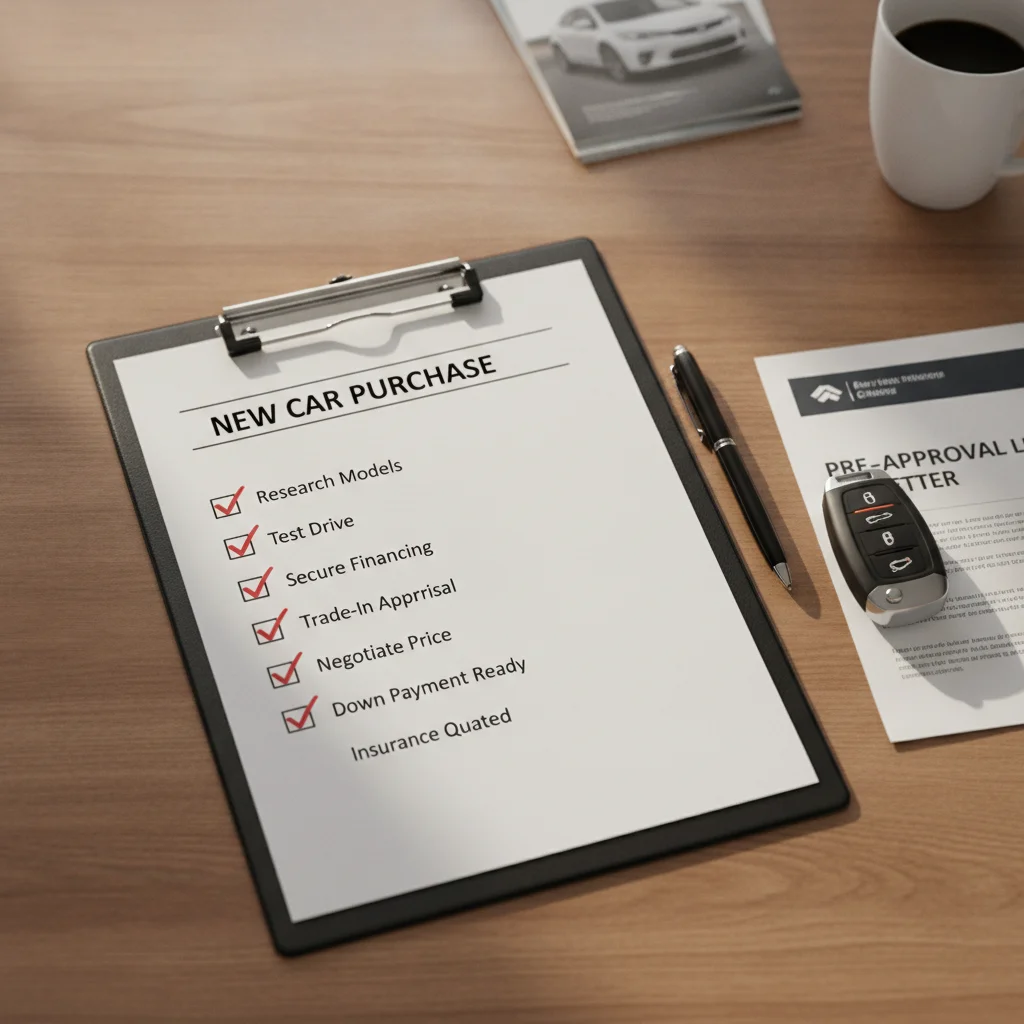
You don't need all six. But each one you have narrows the dealer's room to maneuver. Two or three of these in combination fundamentally changes the conversation you're walking into.
The goal isn't to "win" against the dealer. Most salespeople are doing their job, and an adversarial attitude rarely produces better outcomes. The goal is to eliminate the information gaps and time pressure that allow a bad deal to happen — so the transaction you end up with reflects fair value for both sides.
The Best Time to Buy Is When They Need to Sell
The last two business days of any month are consistently productive for buyers. Dealerships track units-sold daily and sales managers will often authorize discounts in the final hours that weren't available earlier. If your timeline is flexible, build your visit around this window — it's one of the easiest concessions to extract without any additional negotiating skill required.
Document Every Commitment Before Entering the F&I Office
Once you've agreed on price, trade value, and financing, write all three numbers on paper and confirm them before following anyone into the finance office. The F&I manager's job includes selling extended warranties, GAP insurance, paint protection, and other add-ons. Walk in knowing your final three numbers cold, and decline add-ons individually and firmly rather than as a package.
For buyers considering private-party transactions or instant-offer platforms, the leverage dynamics change but the underlying principles hold: know your alternatives, control information, and never let urgency work against you. See our guides on negotiating with private buyers and negotiating with instant offer platforms for context-specific strategies.
All claims are backed by peer-reviewed research. Sources on request.