
Key Takeaways
Buyer's Order
A buyer's order is the first official contract you sign when purchasing a vehicle from a dealership. It itemizes the vehicle price, fees, taxes, trade-in credits, and any add-on products you've agreed to. Once both you and the dealer sign it, the document is legally binding — meaning the numbers and terms on it are what you've committed to pay.
In some states, a buyer's order also functions as a conditional sales contract, making it enforceable before financing is finalized. It is distinct from — but feeds directly into — the final retail installment sales contract (RISC) used for financed purchases.
Why the Buyer's Order Deserves Your Full Attention
Most car buyers focus their negotiating energy on the sticker price or monthly payment. By the time the buyer's order slides across the desk, they're tired, excited, and ready to sign. That's exactly when the document matters most — and when it's easiest to miss something important.
The buyer's order is the contractual foundation of your car purchase. It's where the negotiated price becomes official, where fees get locked in, and where add-on products appear — sometimes for the first time. Once you sign it, you're agreeing to every number on that page.
This article walks you through each section of a typical buyer's order so you can read it quickly, confidently, and catch anything that doesn't match what was agreed upon. For a broader look at all the paperwork you'll encounter at a dealership, see every document you'll sign at a car dealership.

The Anatomy of a Buyer's Order: Section by Section
Buyer's orders vary by dealership and state, but they all contain the same core categories. Here's how to read each one.
Vehicle Identification
At the top of the form, you'll find the vehicle's year, make, model, trim level, and VIN (Vehicle Identification Number). Confirm that the VIN matches the car you actually test-drove and agreed to purchase — not a similar model with a different configuration. This is especially important for vehicles that were ordered from the factory or transferred from another lot.
Purchase Price
This line should reflect the negotiated selling price, not the MSRP (Manufacturer's Suggested Retail Price). If you negotiated $2,000 below sticker, that discount should appear here — either as a line-item reduction or reflected in the final price. If the number looks wrong, stop and ask before reading further.
Trade-In Credit
If you're trading in a vehicle, the agreed trade-in value appears here, along with the outstanding loan balance on that vehicle (if any). The key figure is the net trade: the trade-in value minus what you still owe. If you owe more than the trade-in value (negative equity), that difference is added to your new purchase amount — increasing how much you finance.
Negative Equity Can Quietly Inflate Your Loan
If your trade-in vehicle is worth less than you owe on it, that difference — called negative equity or being 'underwater' — gets rolled into your new loan. It will appear on the buyer's order as an addition to the purchase price. This is legal and common, but it means you're borrowing more than the car is worth from day one. Make sure you understand this number before signing.
Verbal Agreements Have No Legal Weight
If a salesperson promises a discount, a free accessory, or a specific rebate during negotiation, that promise is only enforceable if it appears in writing on the buyer's order. Courts and arbitrators rely on signed documents, not recollections of conversations. If someone promised you something, insist it appears as a line item before you sign anything.
Dealer-Added Accessories
This section lists any physical products added to the vehicle by the dealer: window tint, floor mats, nitrogen-filled tires, paint sealant, or a tracking device. These items are often pre-installed and already on the lot, which means they appear on the buyer's order regardless of whether you requested them. You are not required to pay for them unless you agree to them.
Finance and Insurance (F&I) Products
These are optional protection products sold in the F&I office: extended warranties (service contracts), GAP insurance, tire-and-wheel protection, credit life insurance, and similar add-ons. Each should be listed with its individual price. If you agreed to any of these during the F&I conversation, verify the amounts match what you were quoted. If products appear that you didn't discuss, remove them before signing.
Decline First, Ask Questions Second
When F&I products appear on the buyer's order, your default position should be to decline them until you understand exactly what each one covers, what it costs over the full loan term, and whether you can purchase equivalent coverage elsewhere for less. Extended warranties and GAP insurance in particular are often available through third parties at lower prices.
Photograph the Buyer's Order Before You Leave
Take a clear photo of every page of the buyer's order as soon as you receive your copy. This gives you a timestamped record of what you agreed to, which is useful if a dispute arises later about what was included or excluded from the deal. Store it alongside your loan contract and insurance documents.
Fees
Fees fall into two categories:
- Government fees: Sales tax, DMV title and registration, and state-mandated fees. These are non-negotiable and determined by the state.
- Dealer fees: Documentation fee ("doc fee"), dealer prep, advertising fee, and similar charges. These vary widely by dealer and state. Some states cap doc fees; others don't. Ask for a breakdown of every dealer fee by name.
Down Payment
If you're making a cash down payment or applying a manufacturer rebate, it appears here as a credit against the purchase price. Confirm the amount is correct and that any rebate you're entitled to is applied at its correct value.
Total Amount Due (or Financed)
The bottom line shows either the total cash price (if you're paying outright) or the amount to be financed. This number feeds directly into your loan contract. Reading your auto loan contract carefully starts with confirming this number matches what's on the buyer's order.
What the Numbers Look Like in Practice
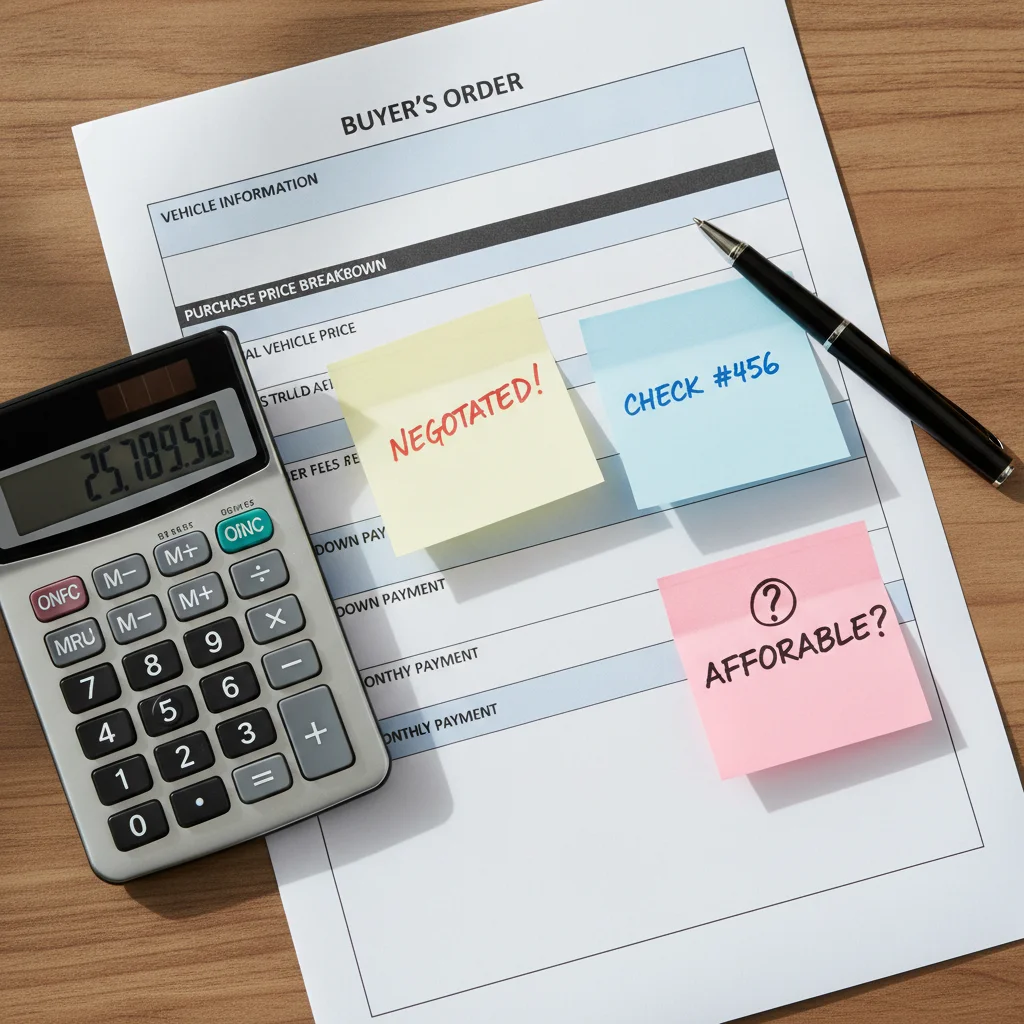
Abstract line items are easier to understand when you see how they interact. Below is a simplified example of how a buyer's order might flow for a financed purchase.
43%
Buyers who didn't review all fees before signing
A 2023 Consumer Reports survey found that nearly half of recent car buyers reported not fully reviewing all line-item fees on their dealership paperwork before signing.
$1,800+
Average F&I product revenue per vehicle sold
According to National Automobile Dealers Association (NADA) data, dealers earn an average of over $1,800 per vehicle from Finance and Insurance products — products that appear as optional line items on the buyer's order.
$495
Median dealer documentation fee
Edmunds research shows the median doc fee in the U.S. sits around $495, though it can range from under $100 to over $900 depending on the state and dealership.
1 in 4
Buyers who found errors in their paperwork
A J.D. Power study indicated approximately one in four buyers reported discovering at least one discrepancy between what was negotiated and what appeared in their final dealership paperwork.
Consider a vehicle with a negotiated price of $32,500. The dealer adds a $299 documentation fee and a $199 nitrogen tire charge that appeared without discussion. The buyer has a trade-in worth $8,000, on which they still owe $6,500 — leaving $1,500 in net equity. After applying a $1,000 manufacturer rebate and a $2,000 cash down payment, the financed amount works out to approximately $28,498 plus state taxes and registration.
Each of those inputs is its own line on the buyer's order. If the nitrogen charge was never agreed to, removing it saves $199. If the trade-in payoff was recorded incorrectly, the financed balance shifts accordingly. Small errors compound — which is why reading every line matters.
The Most Common Errors to Catch Before You Sign
Dealership paperwork is processed quickly and under time pressure. Mistakes happen — and some are not accidental. Here are the most frequent discrepancies buyers encounter.
Price Doesn't Match What Was Negotiated
The vehicle price on the buyer's order should reflect any agreed-upon discounts, price-match commitments, or promotional pricing. If the number is higher than what you negotiated verbally or in writing, do not proceed. Ask for the revised document.
Phantom Add-Ons
Dealer-installed accessories or F&I products can appear on the buyer's order without ever being mentioned in conversation. Scan every line item and ask about anything you don't recognize.
Trade-In Payoff Discrepancy
The dealer pulls your payoff amount from the lender, but that number can shift slightly if it takes a few days to finalize. Confirm the payoff figure is accurate and ask what happens if the final payoff differs from the estimate.
Duplicate Fees
Some dealers list similar charges under different names — for example, a "dealer prep" fee alongside a "vehicle reconditioning" fee that cover overlapping services. Ask what each fee covers specifically.
Missing Credits
Manufacturer rebates, loyalty discounts, or agreed trade-in credits that were promised verbally but don't appear on the document. If a discount was negotiated, it should be visible as a line item — not just absorbed silently into a lower price with no documentation.
“The moment a buyer stops treating a form as 'just paperwork' and starts reading it as a contract is the moment they start protecting themselves. Every number on that buyer's order is a number you agreed to — whether you meant to or not.”
— Rosemary Shahan, President, Consumers for Auto Reliability and Safety (CARS)
Before you reach the buyer's order, use a pre-signing checklist to organize what you've agreed to, so you have a reference point when the paperwork appears.
How the Buyer's Order Connects to the Rest of Your Paperwork
The buyer's order doesn't exist in isolation. It sits at the center of a document chain that starts with your initial quote and ends with your title transfer.
The full paperwork timeline shows how each document connects to the next. Here's the short version of how the buyer's order fits in:
- Quote or price sheet: An informal document with no legal weight. It's a starting point for negotiation.
- Buyer's order: The binding agreement on price, fees, trade-in, and add-ons. Both parties sign here.
- Retail installment sales contract (RISC): The financing document, which incorporates the financed amount from the buyer's order and adds the interest rate, loan term, and monthly payment.
- Title and registration paperwork: Processed after purchase to transfer legal ownership into your name.
If the financed amount on your RISC doesn't match the buyer's order total, that's a red flag. The two documents should be consistent. Any discrepancy — even a small one — is worth pausing and resolving before you sign the loan contract.
If you're purchasing online, the document flow is similar but handled digitally. Digital paperwork in online car buying explains what the e-signature version of this process looks like and what to verify remotely.
Decline First, Ask Questions Second
When F&I products appear on the buyer's order, your default position should be to decline them until you understand exactly what each one covers, what it costs over the full loan term, and whether you can purchase equivalent coverage elsewhere for less. Extended warranties and GAP insurance in particular are often available through third parties at lower prices.
Photograph the Buyer's Order Before You Leave
Take a clear photo of every page of the buyer's order as soon as you receive your copy. This gives you a timestamped record of what you agreed to, which is useful if a dispute arises later about what was included or excluded from the deal. Store it alongside your loan contract and insurance documents.
Your Rights When Reviewing the Buyer's Order
Dealership finance offices are designed to move efficiently — and that efficiency can feel like pressure. Understand your rights before you walk in.
You Can Take Your Time
There is no legal clock ticking while you read. Ask for a few minutes to review the document without a salesperson hovering. If you need to step outside, do so. A legitimate dealership will accommodate you.
You Can Ask for Explanations
Every line item on a buyer's order has a name and a purpose. If you don't understand a charge, ask what it covers, whether it's required by law, and whether it can be removed. Write the answers down if it helps.
You Can Request a Revised Document
If something is wrong, you are not obligated to sign a corrected version the same day. Ask for a revised buyer's order and read it again from the top. Changes made by hand should be initialed by both you and the dealer representative.
You Can Walk Away
Until your signature is on a binding document, you remain free to leave. If pressure tactics escalate or the paperwork consistently doesn't match what was agreed, leaving is a legitimate and sometimes necessary option.
Negative Equity Can Quietly Inflate Your Loan
If your trade-in vehicle is worth less than you owe on it, that difference — called negative equity or being 'underwater' — gets rolled into your new loan. It will appear on the buyer's order as an addition to the purchase price. This is legal and common, but it means you're borrowing more than the car is worth from day one. Make sure you understand this number before signing.
Verbal Agreements Have No Legal Weight
If a salesperson promises a discount, a free accessory, or a specific rebate during negotiation, that promise is only enforceable if it appears in writing on the buyer's order. Courts and arbitrators rely on signed documents, not recollections of conversations. If someone promised you something, insist it appears as a line item before you sign anything.
Understanding the buyer's order is the most practical thing you can do to protect yourself at a dealership. The numbers in that document follow you through financing, into your monthly payment, and onto your credit report. Taking 10 minutes to verify every line can save you from months — or years — of overpaying.

All claims are backed by peer-reviewed research. Sources on request.