
Key Takeaways
Mandatory Arbitration Clause
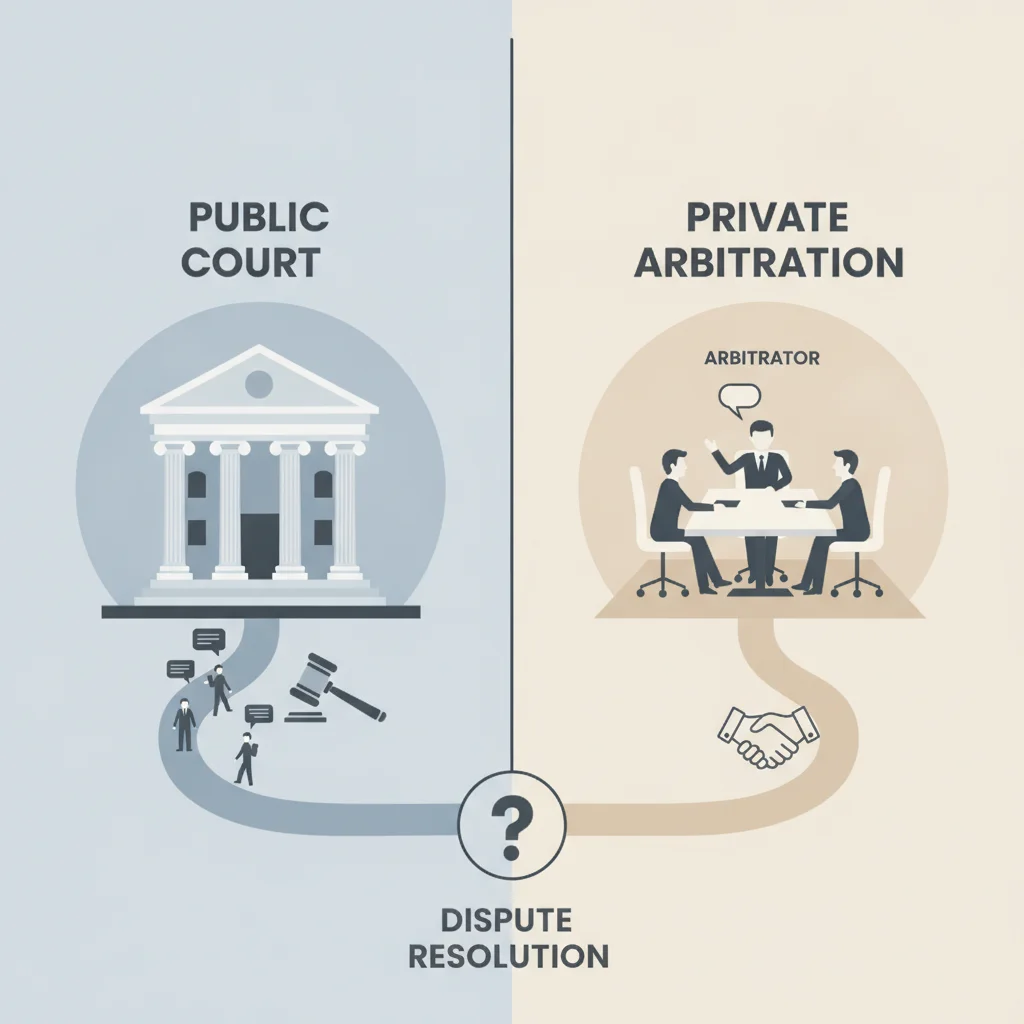
A mandatory arbitration clause is a provision in a contract that requires both parties to resolve any disputes through a private arbitration process instead of a public court. By signing a contract with this clause, you agree upfront — before any dispute even arises — to give up your right to sue the dealership in court. Instead, a neutral third-party arbitrator (typically a private company) hears both sides and issues a binding decision.
Most dealership arbitration clauses also include a class action waiver, which prevents you from joining or leading a group lawsuit against the dealer or lender, even if many other buyers experienced the same harm.
Why Arbitration Clauses Show Up in Almost Every Car Contract
When you sit down in the finance office at a dealership, you'll sign a stack of documents. Most buyers focus on the interest rate and the monthly payment. The arbitration clause — usually buried in a dense block of fine print on the back of the contract or tucked into a separate addendum — rarely gets a second glance.
That's exactly the problem.
Arbitration clauses became widespread in consumer contracts during the 1990s, after the U.S. Supreme Court expanded the reach of the Federal Arbitration Act (FAA) of 1925. The FAA was originally intended to govern commercial disputes between businesses. But a series of Supreme Court rulings transformed it into a tool that allows companies — including auto dealerships — to insert binding arbitration requirements into standard consumer agreements.
Today, the vast majority of new and used car purchase agreements, retail installment contracts, and dealer financing addenda include mandatory arbitration language. Dealers include them for a straightforward reason: arbitration is private, less expensive, and statistically more favorable to repeat-player businesses than open-court litigation.

Understanding why these clauses exist is the first step toward understanding what you're actually giving up when you sign. See our full guide to dealership paperwork for a complete breakdown of every document in the stack.
What You Specifically Give Up by Signing
An arbitration clause is not just a procedural technicality. It represents a meaningful transfer of legal rights away from you. Here's exactly what you're waiving:
Your Right to a Court Trial
By agreeing to mandatory arbitration, you give up the right to have a judge or jury hear your case. All disputes covered by the clause — whether about a fraudulent add-on, a misrepresented vehicle history, a payment calculation error, or a Fair Credit Reporting Act violation — must go to a private arbitrator instead of a courtroom.
Public Accountability
Court proceedings are public record. Anyone can look up a filed lawsuit, review the complaint, and see the outcome. Arbitration proceedings are almost always confidential. This means a dealership can engage in the same fraudulent practice with dozens of buyers and face no public scrutiny — because each case is resolved in private, with no accessible record.
Class Action Participation
Most arbitration clauses include a class action waiver. This means if 500 buyers were all overcharged the same hidden fee, none of them can band together to file a class action suit. Each person must arbitrate individually, which makes pursuing small-dollar harms economically impractical.
Your Choice of Arbitrator
The contract typically specifies which arbitration company handles disputes — almost always a large, national provider like the American Arbitration Association (AAA) or JAMS. These companies derive significant revenue from business clients. Some consumer advocates argue this creates a structural incentive to rule in favor of businesses over time.
“Mandatory arbitration clauses strip consumers of their most powerful tool against corporate wrongdoing: the courthouse door. The confidentiality of arbitration doesn't just hide the outcome — it hides the pattern.”
— F. Paul Bland Jr., Executive Director, Public Justice, consumer advocacy organization
Appeals Are Nearly Impossible
In court, you can appeal an unfavorable verdict. In binding arbitration, the arbitrator's decision is almost final. Courts will overturn an arbitration award only in very narrow circumstances — fraud by the arbitrator, clear legal misconduct, or decisions that exceed the arbitrator's authority. Disagreeing with the outcome is not enough.
The Federal Arbitration Act: A Brief Explainer
The Federal Arbitration Act (FAA) of 1925 was originally passed to allow commercial businesses to resolve disputes outside of congested courts. A series of Supreme Court decisions — most notably AT&T Mobility LLC v. Concepcion (2011) — extended its reach to consumer contracts and held that states cannot broadly prohibit class action waivers. This makes it very difficult for individual states to protect consumers from arbitration clauses at the legislative level.
Arbitration Providers Are Not Government Agencies
The American Arbitration Association (AAA) and JAMS are private companies, not government bodies. They operate under their own rules, and while both have consumer protection protocols, they are fundamentally businesses. If your contract specifies one of these providers, look up their consumer arbitration rules online before your proceeding — knowing the process is the first step to navigating it effectively.
When to Consult an Attorney
If you believe a dealer committed fraud, misrepresented the vehicle, or violated federal consumer protection laws (like the Truth in Lending Act or the Magnuson-Moss Warranty Act), consult a consumer protection attorney before assuming arbitration is your only option. An attorney may identify grounds to challenge the clause itself or find that your specific claim falls outside the clause's scope.
How to Spot Arbitration Language in Your Contract
Dealership arbitration clauses are rarely labeled with a friendly heading like "Arbitration — Please Read Carefully." More often, they appear under headings like "Dispute Resolution," "Resolution of Disputes," or simply as a numbered paragraph with no special emphasis at all.
Here's what to look for when reviewing your contract:
- The word "arbitration": Search every page of the contract for this word. If it appears, read the full surrounding paragraph before moving on.
- Waiver language: Phrases like "waive your right to a jury trial" or "you agree to resolve all disputes through binding arbitration" are direct signals.
- Class action waiver: Look for language saying you "waive your right to participate in any class or collective action."
- Opt-out instructions: Some contracts include a window to opt out. This will appear as a deadline (e.g., "You may opt out within 30 days of signing by sending written notice to..."). If you find this, photograph it immediately.

Also check every addendum, not just the main purchase agreement. Dealers sometimes attach a separate "Arbitration Agreement" as a standalone document. This is still binding even if it's a single page.
It's also worth knowing that verbal promises about dispute resolution mean nothing legally. Dealership contracts often don't reflect what was verbally agreed — what's in the written document is what controls.
Photograph Every Page Before You Sign
Before signing any dealership document, use your phone to photograph every page — front and back. This gives you a pre-signature record you can compare against your copy if anything changes. Pay special attention to addenda and separate attached documents, which is where arbitration clauses often appear.
Send Opt-Out Notices by Certified Mail
If your contract includes an opt-out window, send your notice via USPS certified mail with return receipt requested. This gives you a postmarked, signed delivery confirmation — critical proof if the dealer or lender later claims they never received your opt-out. Keep all paperwork in a dedicated file with your contract documents.
The Statistics: Who Actually Wins in Arbitration?
To make an informed decision about signing an arbitration clause, it helps to look at the data on how these proceedings actually play out for consumers.
75%+
Major dealership contracts containing arbitration clauses
Consumer advocacy research estimates that the large majority of franchise dealership contracts in the U.S. include mandatory arbitration provisions.
25x
More likely businesses win in arbitration vs. consumers
A 2015 CFPB study of consumer financial arbitration found businesses prevailed significantly more often than individual consumers in decided cases.
$5,389
Average class action settlement per consumer
The CFPB's arbitration study found class action settlements returned an average of $5,389 per consumer — far exceeding typical individual arbitration recoveries.
30 days
Typical opt-out window after signing
When opt-out provisions exist, most retail installment contracts give consumers 30 days or fewer to send a written opt-out notice before the arbitration clause becomes permanent.
140M+
Americans bound by arbitration clauses
The Economic Policy Institute estimates more than 140 million Americans are subject to mandatory arbitration clauses across various consumer contracts, including auto loans.
The Consumer Financial Protection Bureau (CFPB) conducted a landmark study of consumer arbitration in 2015 and found significant disparities in outcomes between businesses and individual consumers. In arbitration cases involving financial products, businesses won far more frequently than consumers. The study also found that class action settlements — which arbitration waivers eliminate — returned far more money per consumer than individual arbitration claims.
None of this means arbitration is always the wrong outcome. For a clear-cut small claim — say, a dealer charged you for a warranty you explicitly declined — arbitration can be faster and cheaper than filing a lawsuit. But for complex disputes involving fraud, discriminatory lending, or systemic overcharges, the loss of class action rights is a serious disadvantage.
Understanding how dealerships negotiate helps put this in context: dealers use every structural advantage available, and arbitration clauses are one of the most consequential tools in that arsenal.
Negotiating or Removing an Arbitration Clause Before You Sign
Here's the part most buyers don't realize: arbitration clauses are not always immovable. Some dealers will remove or modify them if you ask directly and calmly. Here's how to approach that conversation.
Ask Before You're in the Finance Office
By the time you're sitting across from the finance manager, you've already invested hours in the deal. That's a psychologically weak position for negotiating contract terms. Ask about arbitration during the deal-structure conversation, before you've committed emotionally to the purchase.
Put Your Request in Writing
Say clearly: "I would like to cross out the arbitration clause before signing." Then write it on the contract itself — draw a line through the arbitration section, initial it, and ask the dealer to countersign. If they agree, you have documentation that the clause was removed by mutual consent.
Know That Some Dealers Won't Budge
Many large franchise dealers have been instructed by corporate legal teams never to waive arbitration. If that's the case, your options are to accept the clause, walk away, or buy elsewhere. There is no legal obligation for a dealer to remove it — and there's no obligation for you to sign it.
Check for an Opt-Out Provision
If you already signed a contract with an arbitration clause, search it immediately for an opt-out provision. If one exists, send your opt-out notice via certified mail and keep proof of delivery. Do not wait — these windows are typically 30 days or fewer.
Photograph Every Page Before You Sign
Before signing any dealership document, use your phone to photograph every page — front and back. This gives you a pre-signature record you can compare against your copy if anything changes. Pay special attention to addenda and separate attached documents, which is where arbitration clauses often appear.
Send Opt-Out Notices by Certified Mail
If your contract includes an opt-out window, send your notice via USPS certified mail with return receipt requested. This gives you a postmarked, signed delivery confirmation — critical proof if the dealer or lender later claims they never received your opt-out. Keep all paperwork in a dedicated file with your contract documents.
If you find other issues in your signed contract, our guide on what to do when you find an error after signing walks through your options step by step.
When Arbitration Clauses Can Be Challenged or Voided
Even after signing, arbitration clauses aren't always bulletproof. Courts have voided them in specific circumstances, though the bar is high.
Unconscionability
If a court finds the arbitration clause is so one-sided that enforcing it would be fundamentally unfair, it may declare it unconscionable and void it. Courts look at both procedural unconscionability (was the clause hidden or presented in a deceptive way?) and substantive unconscionability (are the terms so lopsided they shock the conscience?).
Fraud in the Inducement
If the dealer lied to you specifically about the arbitration clause itself — for example, telling you "this just means we can't take each other to small claims court" when it actually waives all litigation rights — that could form the basis for voiding the clause on fraud grounds.
State Law Protections
A handful of states have laws that limit the enforceability of arbitration clauses in auto sales contracts or require specific disclosure language. California, in particular, has had ongoing litigation over the scope of the FAA's preemption of state consumer protection rules.
If you believe an arbitration clause was improperly included in your contract, consult a consumer protection attorney. Many offer free initial consultations, and some work on contingency. The National Association of Consumer Advocates (NACA) maintains a directory of attorneys who specialize in auto fraud cases.
The Federal Arbitration Act: A Brief Explainer
The Federal Arbitration Act (FAA) of 1925 was originally passed to allow commercial businesses to resolve disputes outside of congested courts. A series of Supreme Court decisions — most notably AT&T Mobility LLC v. Concepcion (2011) — extended its reach to consumer contracts and held that states cannot broadly prohibit class action waivers. This makes it very difficult for individual states to protect consumers from arbitration clauses at the legislative level.
Arbitration Providers Are Not Government Agencies
The American Arbitration Association (AAA) and JAMS are private companies, not government bodies. They operate under their own rules, and while both have consumer protection protocols, they are fundamentally businesses. If your contract specifies one of these providers, look up their consumer arbitration rules online before your proceeding — knowing the process is the first step to navigating it effectively.
When to Consult an Attorney
If you believe a dealer committed fraud, misrepresented the vehicle, or violated federal consumer protection laws (like the Truth in Lending Act or the Magnuson-Moss Warranty Act), consult a consumer protection attorney before assuming arbitration is your only option. An attorney may identify grounds to challenge the clause itself or find that your specific claim falls outside the clause's scope.
See also our article on when dealers ask you to sign a power of attorney — another document where knowing your rights before signing makes all the difference.
Real-World Scenarios: What the Clause Actually Changes
Abstract legal rights can be hard to visualize. Here's what the presence or absence of an arbitration clause concretely means in common dealership disputes:
In each of these scenarios, the arbitration clause doesn't prevent you from getting any remedy — it changes the venue and process for seeking one. Sometimes that difference is minor. Sometimes, especially when a class action would have been your best path, it's the difference between meaningful recovery and nothing at all.
For a broader picture of how instant offer platforms and resale agreements handle similar provisions, our glossary of key terms in instant offer agreements covers arbitration language you'll see on the seller's side too.
Bottom Line: Read Before You Sign
Arbitration clauses are legal, widespread, and — once signed without an opt-out provision — very difficult to undo. The finance office is a high-pressure environment designed to move quickly. Slowing down to read the full contract, locate arbitration language, and ask whether it can be removed is not rude. It is your right as a buyer.
Here's a simple checklist for your next dealership visit:
- Ask the sales manager before entering the finance office whether the contract contains an arbitration clause.
- Read every document before signing — not just the signature line.
- Look for opt-out provisions and note the deadline immediately.
- If you want the clause removed, ask in writing and get the dealer's agreement in writing.
- If you can't get it removed and you're uncomfortable, you are always allowed to walk away.
No car deal is worth surrendering meaningful legal protections you don't fully understand. Signing with clarity — knowing exactly what you're agreeing to — is always the better outcome.

All claims are backed by peer-reviewed research. Sources on request.