Key Takeaways
Why Contract Errors Happen — and Why They Matter
Car purchase contracts are dense, multi-page documents generated under time pressure in a dealership finance office. Finance managers juggle dozens of deals a week, and even reputable dealerships make mistakes. Some errors are innocent — a transposed digit in a VIN, a misspelled street address, or a wrong model year on a lease addendum. Others are more consequential: an interest rate a full percentage point higher than what you were quoted, a warranty product you explicitly declined now appearing as a line item, or a loan term stretched from 60 months to 72 without your knowledge.
The distinction matters because the remedy depends on the type of error. A clerical mistake with no financial impact is relatively easy to correct. An error that costs you money — or that was arguably inserted intentionally — is a different situation entirely and may require you to involve a third party.
Before we walk through the correction process, understand this: a signed contract is legally binding in most circumstances. Courts do not treat buyer's remorse as a contract defect. What courts do recognize are mutual mistakes, fraud, misrepresentation, and unconscionable terms. Knowing which category your error falls into shapes every step you take next.

Also worth noting: many buyers believe they can simply return the car within three days of signing. That "cooling-off" rule does not apply to auto purchases in most states. Once you sign and drive off, your options narrow significantly — which is why acting quickly when you spot an error is so important.
Types of Errors and What Each Means for You
Not every mistake in a contract is equally serious. Grouping errors by type helps you set realistic expectations before you pick up the phone.
Clerical and Typographical Errors
These are data-entry mistakes with no financial consequence: a wrong home address, a misspelled name, an incorrect phone number, or a transposed digit in the VIN that doesn't affect your title filing. Dealerships will almost always correct these without resistance because they create liability for the dealer too — a wrong VIN, for instance, can complicate title transfer and lender perfection of the security interest.
See which paperwork errors buyers most commonly overlook to understand just how frequently these slip through, even at busy franchise stores.
Financial Term Errors
These are the high-stakes mistakes: a different APR than what the finance manager quoted you verbally, a loan term you didn't agree to, a down payment amount that doesn't match what you paid, or a vehicle price that differs from the buyer's order you signed earlier in the process. These errors directly affect how much you pay over the life of the loan — sometimes by thousands of dollars.
Add-On and Product Errors
You declined the extended warranty, gap insurance, or paint protection package — but it shows up on the contract anyway. Or the opposite: you agreed to gap coverage but it's missing, and you've now had an accident. These errors affect both your monthly payment and your coverage status.
Title and Registration Errors
Wrong lienholder name, incorrect registered owner spelling, or a missing co-borrower on the title can create serious problems when you try to sell or refinance. A single mistake on a title can make it legally unusable — so treat these with the same urgency as financial errors.
What You'll Need Before You Contact the Dealership
Walking into a dispute without documentation is the single biggest mistake buyers make. The dealership has a full paper trail. You need one too. Gather everything listed below before you make your first call or visit.
What you will need
Signed Retail Installment Contract (RIC)
The primary document you'll reference to identify exactly what the contract states versus what was agreed.
Original Buyer's Order
The earlier sales-desk document that should match the contract's vehicle price, trade-in value, and add-ons.
Written Rate or Payment Quote
Any paper or digital quote showing the APR or monthly payment you were shown before signing.
Down Payment Proof
Bank records or receipt showing exactly what you paid upfront, to dispute any discrepancy in the contract's down payment line.
CFPB Complaint Portal Access
Used to file a federal complaint if a lender fails to correct a disclosure error after you've escalated properly.
State Attorney General Consumer Complaint Form
Used to report dealership misconduct or refusal to correct material errors to your state's consumer protection office.
Step-by-Step: How to Get a Contract Error Corrected
Once you've identified the error and assembled your documentation, follow these steps in order. Moving too fast — or skipping straight to threats — often hardens the dealership's position and slows your resolution.
Document the Error Precisely
Before you contact anyone, write down exactly what the contract says and exactly what you believe it should say. Be specific: note the field name, the incorrect value, and the correct value you expected. For example: "Contract APR: 9.9%. Finance manager quoted 8.4% in writing on the rate sheet dated [date]." Vague complaints are easy to dismiss. A line-by-line comparison with supporting documentation is not.
If the error involves a number, calculate the financial impact. For a rate discrepancy, use an online auto loan calculator to show the difference in total interest paid over the loan term. This figure will be important if the dispute escalates.
Contact the Finance Manager First
Your first call should go to the finance manager who handled your paperwork. This is the right person to fix the error and the one with the authority to initiate a contract amendment. Be direct and factual — explain what you found, reference your documentation, and ask what the correction process looks like.
Keep this conversation professional. Most errors at this stage are resolved without confrontation because the finance manager has an incentive to correct legitimate mistakes before they become regulatory issues.
Escalate to the General Manager If Needed
If the finance manager dismisses your concern, denies the error, or stops responding, escalate to the dealership's general manager. GMs have final authority over contract disputes and a stronger incentive to avoid regulatory complaints. Send a brief, factual written summary of the issue — what the error is, what documentation you have, and what resolution you're requesting.
Give the dealership a reasonable deadline to respond — five to seven business days is standard. State the deadline clearly in your written communication.
Contact the Lender Directly for Financial Errors
If the error involves a financial term — APR, loan amount, payment — contact the lender (the bank, credit union, or captive finance company that now holds your loan) directly. The lender received the contract from the dealer and may be unaware of any discrepancy between what was quoted and what was submitted.
Lenders take TILA disclosure errors seriously because they carry federal liability. Explain the discrepancy, provide documentation of the correct agreed-upon terms, and ask the lender to investigate. Many lenders have a formal dispute intake process for exactly this situation.
Request a Written Contract Amendment
Once the dealership or lender agrees to a correction, insist that the fix comes in the form of a written contract amendment — sometimes called an addendum or correction agreement. This document should clearly state the original incorrect value, the corrected value, and be signed by both you and an authorized dealership representative.
Do not drive away, make payments, or consider the matter closed until you have this signed document in your hands. A promise to mail the corrected paperwork is not sufficient — request it in person or via email with a scan before you leave.
File a Complaint If the Dealership Refuses
If the dealership refuses to correct a legitimate, documented error — especially one with financial consequences — file formal complaints through official channels. Start with your state attorney general's consumer protection office and your state's motor vehicle dealer licensing board. These agencies can investigate and apply regulatory pressure that individual buyers cannot.
If a lender is involved and the error involves a disclosure violation, file a complaint with the Consumer Financial Protection Bureau (CFPB) at consumerfinance.gov. CFPB complaints are forwarded to the company and require a formal response within a defined timeframe.
If you work through all these steps and still cannot get the dealership to correct a legitimate financial error, your remaining options include filing a complaint with your state attorney general's consumer protection division, contacting your state's department of motor vehicles or motor vehicle dealer licensing board, reaching out to the Consumer Financial Protection Bureau (CFPB) if a lender is involved, and consulting a consumer protection attorney — many of whom offer free initial consultations for contract disputes.
Never Accept a Verbal Correction as Final
A dealership representative saying "we'll fix that" over the phone or in person is not a legally binding commitment. Contract terms can only be changed through a written, signed amendment. Do not make payments, register the vehicle as correctly contracted, or close the matter in your own records until you hold a signed correction document. Verbal assurances that are never followed up in writing have no enforceability.
Financial Disclosure Errors May Violate Federal Law
The Truth in Lending Act (TILA) requires lenders to clearly disclose the APR, total finance charge, total of payments, and other key terms before you sign. If your signed contract shows a different APR than what was disclosed during negotiation and documented in writing, that is a potential TILA violation — not just a paperwork error. Document everything and contact the CFPB if the lender does not respond to your complaint within a reasonable timeframe.
Special Situation: The Error Benefits the Dealership — Was It Intentional?
Most errors are genuine mistakes. But if you find an error that consistently favors the dealership — a higher rate than quoted, a fee that wasn't disclosed, a product added without consent — it's reasonable to ask harder questions. Dealers are legally required to give you a complete TILA (Truth in Lending Act) disclosure before you sign. If the APR on your contract differs from what was quoted, that is a potential federal disclosure violation, not just a paperwork hiccup.
Document everything and escalate to the lender directly if the dealership is unresponsive. Lenders don't want regulatory exposure from a dealer's misrepresentation and may intervene on your behalf. Your state's dealer licensing board is another avenue — repeated consumer complaints can trigger audits and license reviews.
Do Not Ignore Errors Hoping They Resolve Themselves
Contract errors do not self-correct over time — they compound. An incorrect APR means every payment is calculated on the wrong rate. An unauthorized add-on means you're financing a product you didn't want. The longer you wait, the more you pay and the harder it becomes to prove what was originally agreed. Act within days of discovering any error, not weeks.
Watch for Retaliation or Pressure Tactics
Some dealerships respond to correction requests by suggesting the buyer agreed to the terms, claiming the buyer's order is not binding, or threatening to unwind the entire deal. These are pressure tactics. If a dealer threatens to "undo" your purchase because you're disputing a legitimate error, document the threat and consult a consumer protection attorney — this behavior is itself a potential unfair trade practice.
Keep Every Document the Dealership Gives You
From the initial window sticker and the first payment quote to the final signed contract — keep everything, even items that seem unimportant at the time. These documents become your evidence trail if any dispute arises. Store originals in a folder and scan digital copies to cloud storage immediately after purchase.
Request Your Contract Before You Drive Off the Lot
In most states, you have the right to a copy of every document you sign at the time of signing. Do not leave the dealership without a complete copy of your retail installment contract, all addenda, and the buyer's order. If you're told copies will be mailed, push back — delays give errors more time to create problems and make it harder to prove what you originally received.
Use Online Calculators to Verify Your Numbers
Before you sign — and again if you suspect an error afterward — plug your loan amount, interest rate, and term into a simple auto loan calculator. The monthly payment it produces should match your contract exactly. If it doesn't, you've found a discrepancy worth investigating. Even a small difference can indicate a rate or term error that adds up to hundreds of dollars over the life of the loan.
It's also worth reviewing your credit report after a new auto loan appears. Inaccurate information on your credit report can inflate your effective borrowing cost even after the contract is corrected, particularly if the original wrong terms were reported to the bureaus before the amendment was filed.
How to Avoid This Situation Next Time
The most effective remedy for a contract error is catching it before you sign. That sounds obvious, but buyers routinely skip this step because they're tired after hours of negotiation, feel social pressure in the finance office, or assume the numbers have already been agreed upon. Finance offices know this — and the best ones will walk you through every line regardless. The worst ones count on you not reading carefully.
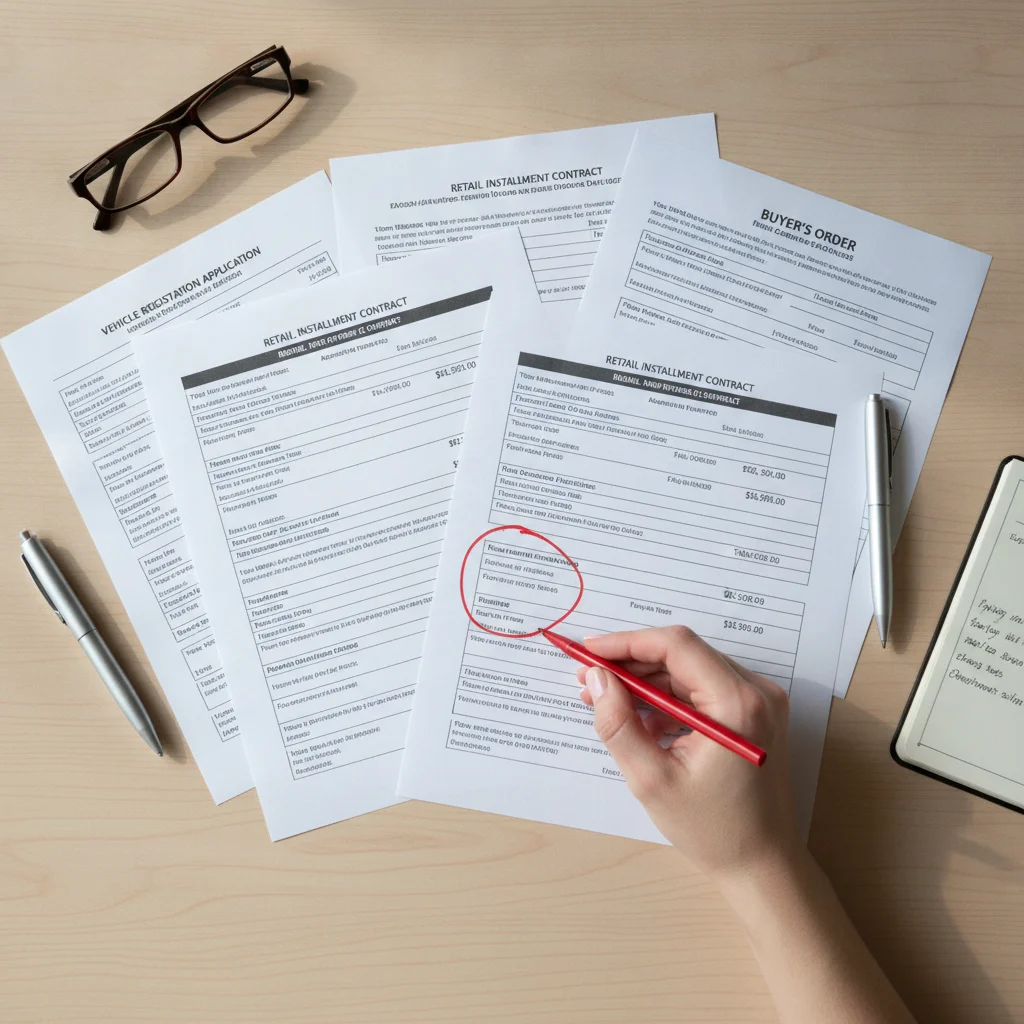
Use a structured approach every single time. A pre-signing checklist that covers price, rate, term, and add-ons takes less than ten minutes and puts every key number in front of you before your pen touches the paper. Compare the buyer's order you signed at the sales desk to the retail installment contract in the finance office — these should match. If they don't, stop and ask why before you sign anything.
Request copies of every document you sign before you leave. In most states, dealers are legally required to provide these. If the finance manager says they'll mail them, that's a red flag — insist on taking copies with you the same day.

Finally, know that the finance office is a profit center. Extended warranties, gap insurance, tire protection plans, and other add-ons can be valuable — but they should be your decision, made with full knowledge of the cost. Verify every line item against your own notes from the negotiation, not just against the finance manager's verbal summary.

All claims are backed by peer-reviewed research. Sources on request.