Key Takeaways
How a Bad Auto Loan Hides in Plain Sight
Most people don't scrutinize their auto loan the way they scrutinize a car purchase. You've spent hours researching trim levels, test-driving models, and negotiating the sticker price — and then you sign a stack of financing paperwork in fifteen minutes in the business manager's office. By that point, you just want to drive home.
That's exactly when lenders — particularly dealership finance offices — count on your attention being elsewhere. And the consequences can be significant. A rate that's even two percentage points higher than what you qualified for could cost you $1,500 to $3,000 in extra interest over a five-year loan on a $25,000 vehicle. That's not a rounding error; that's a car payment's worth of money disappearing every month.
The good news: recognizing a bad deal after the fact is still useful. Unlike a bad trade-in value or a padded dealer fee you already paid, a high-interest auto loan can often be fixed through refinancing. But you need to know what you're looking for first.
Below are the most reliable signs that your original auto loan wasn't your best deal — and what each one means for your next move.

Your APR is significantly higher than current market rates
The most direct measure of whether you overpaid for financing is the gap between your current APR and what lenders are offering today for borrowers with your credit profile. If that gap is two percentage points or more, you almost certainly left money on the table.
Let's put a number on it. On a $28,000 loan over 60 months:
- At 4.9% APR: Total interest paid ≈ $3,620
- At 7.1% APR: Total interest paid ≈ $5,330
That 2.2-point difference costs you over $1,700. And if your rate is even higher — which is common for buyers who financed with poor credit or through certain dealer-arranged lenders — the gap widens further.
To benchmark your rate, check current average auto loan rates from sources like the Federal Reserve's consumer credit data or credit union rate sheets. Remember to compare apples to apples: used car rates are typically higher than new car rates, and longer terms carry higher rates than shorter ones.
A two-point rate gap on a $28,000 loan can cost you over $1,700 in extra interest.
Your credit score was lower when you bought the car
Auto loan rates are heavily tied to your credit score at the time of application. Lenders tier borrowers into categories — super prime, prime, near prime, subprime, and deep subprime — and each tier carries a meaningfully different rate. If your score has climbed since you bought the car, you may now qualify for a tier that would have saved you real money from day one.
Credit score movement is more common than people realize. Paying down other debt, resolving collection accounts, or simply maintaining on-time payments for 12 to 18 months can shift a score by 50 to 80 points. That kind of movement can push a borrower from a subprime rate (often 10–15% APR) into a near-prime range (typically 6–9% APR).
[in_content_images:1]
If you were in a financial rough patch when you purchased — a job change, medical bills, a recent delinquency — and things have stabilized since, your original rate was probably the best you could get at the time. That doesn't mean it's the best you can get now. Refinancing exists precisely for this situation.
Check what rate you'd receive today before assuming your current loan is fixed. Loan preapproval resources can help you understand the rate tier you currently occupy without committing to a new loan.
A 60-point credit score gain since purchase could move you into a meaningfully lower rate tier.
You financed through the dealership without shopping first
Dealership financing is convenient, but convenience has a price. When you finance through a dealer, the dealer submits your application to one or more lenders and often marks up the rate above what those lenders actually require. That markup — sometimes called the "dealer reserve" — goes directly to the dealership as compensation for arranging the loan. It's legal, it's common, and it's almost never disclosed in plain language.
The markup can range from 0.5 to 2.5 percentage points above the lender's actual buy rate. On a $25,000 loan over 60 months, a 2-point dealer markup adds roughly $1,300 in extra interest you'll pay over the life of the loan — money that goes nowhere near your car.
If you walked into the dealership without a preapproval from a bank or credit union, you had no leverage to push back on the rate you were offered. The finance manager presented a payment, you agreed, and the deal was done. That's the scenario where dealer markups are most likely to stick.
Red flags in a car deal often extend into the finance office — not just the sales floor. If you can't recall being shown a rate comparison or being told what your buy rate was, assume the markup was there.
Dealer finance markups can add over $1,300 in extra interest on a typical mid-size loan.
Your loan term is unusually long
Loan terms have stretched significantly over the past decade. Seventy-two and 84-month loans are now common, marketed as a way to keep monthly payments manageable on more expensive vehicles. What they actually do is dramatically increase the total interest you pay — and they often pair with higher rates, because lenders consider longer-term loans riskier.
Here's the math on a $30,000 loan at 6.5% APR:
- 48 months: Monthly payment ≈ $713 | Total interest ≈ $2,230
- 72 months: Monthly payment ≈ $503 | Total interest ≈ $6,216
- 84 months: Monthly payment ≈ $447 | Total interest ≈ $7,548
The 84-month loan saves you $266 per month compared to the 48-month option — but costs you over $5,300 more in total interest. And for most of that 84-month period, you'll likely owe more than the car is worth, which is a problem if you need to sell or if the vehicle is totaled.
If you were steered into a longer term primarily to hit a monthly payment target, your original deal probably wasn't in your best financial interest. Refinancing to a shorter term — even if your monthly payment increases slightly — can save you significantly on total cost.
An 84-month loan at the same rate as a 48-month loan can cost over $5,000 more in total interest.
You didn't review the full loan agreement before signing
Rushed closings are one of the most common reasons buyers end up in unfavorable loans. The finance office is designed to move quickly — there's a stack of documents, a lot of explanation at speed, and an implicit pressure to wrap up. If you didn't read your loan agreement in full before signing, there's a real chance it contains terms you wouldn't have agreed to had you noticed them.
Common buried terms worth checking now:
- Prepayment penalties: Some loans charge a fee if you pay off early. This directly affects your ability to refinance without cost.
- GAP insurance rolled in: GAP coverage is useful, but buying it through the dealership typically costs far more than purchasing it through your insurer. If it was added to your loan principal, you're paying interest on it too.
- Extended warranties financed into the loan: Like GAP, dealer-sold warranties are often marked up significantly and increase your loan balance.
- Variable rate terms: Less common in auto loans than mortgages, but worth verifying your rate is fixed for the loan term.
Reviewing your auto loan term agreement is much easier to do in advance — but even after the fact, knowing what your contract contains helps you plan your refinancing strategy. If you financed GAP or an extended warranty into the loan, account for that when calculating your payoff amount.
GAP insurance and warranties rolled into your loan balance are also costing you interest every month.
Interest rates have dropped since you took out the loan
Even if your credit was solid and your dealer was scrupulously fair, market conditions may have simply moved in your favor since you signed. Auto loan rates track broader interest rate movements set by the Federal Reserve. When rates fall, borrowers who locked in higher rates during a peak period can often refinance into meaningfully better terms.
[in_content_images:2]
This is analogous to mortgage refinancing after a rate drop — the same logic applies to auto loans, just with shorter timelines and smaller balances. If you purchased during a period of elevated rates and the market has since shifted downward, checking today's rates against your current APR is a straightforward exercise that takes about 15 minutes.
Keep in mind that the benefit of a rate drop diminishes as your loan ages. If you're in month 48 of a 60-month loan, most of the interest has already been paid. The earlier you catch a favorable rate environment relative to your purchase date, the more you stand to save by acting on it.
Rate drops after your purchase date are a legitimate refinancing trigger, even if your original deal was fair.
Your monthly payment feels high relative to your income — and always has
A loan payment that strains your monthly budget from the start is often a sign that the financing terms weren't structured in your best financial interest — regardless of how the numbers were presented to you. If you've been stretching to make payments since month one, it's worth examining whether the rate, not just the price of the car, is partly responsible.
There's an important distinction here. A payment that feels high because you bought more car than you could afford is a budgeting issue, not a loan issue. But a payment that feels high because your rate inflated the cost of financing — particularly if you were a first-time buyer, had thin credit, or were a target for predatory auto lending — may be reducible through refinancing.
Run this quick check: use an online loan calculator to estimate what your payment would be at a rate 2–3 points lower than your current APR, keeping the remaining balance and remaining term the same. If the monthly savings are $40 or more, refinancing is worth a serious look. That's $480 per year — and potentially $2,000 or more over the remaining loan life.
If you are genuinely over-extended on the vehicle itself, consider early payoff strategies to build equity faster and reduce the time you're paying on a high-balance loan.
A 3-point rate reduction on a $22,000 remaining balance can cut your monthly payment by $50 or more.
What to Do Once You've Spotted the Problem
Identifying a bad loan is the first step — acting on it is what actually saves you money. Here's a short framework for moving forward.
Step 1: Pull your current loan details. Find your original contract or log into your lender's portal. Note your remaining balance, current APR, monthly payment, and remaining term. Also check whether your loan has a prepayment penalty — if it does, factor that cost into any refinancing calculation.
Step 2: Check your credit score today. Your credit score at the time of purchase may have been very different from where it sits now. Even a 40- to 60-point improvement can qualify you for a meaningfully lower rate. Getting preapproved for a refinance loan before you apply gives you a concrete benchmark without a hard credit hit.
Step 3: Shop at least three lenders. Credit unions consistently offer lower rates than dealership financing for borrowers with fair-to-good credit. Banks and online lenders are also worth including. Don't rely on a single quote — the spread between the highest and lowest offers can be two or more percentage points on the same loan amount.
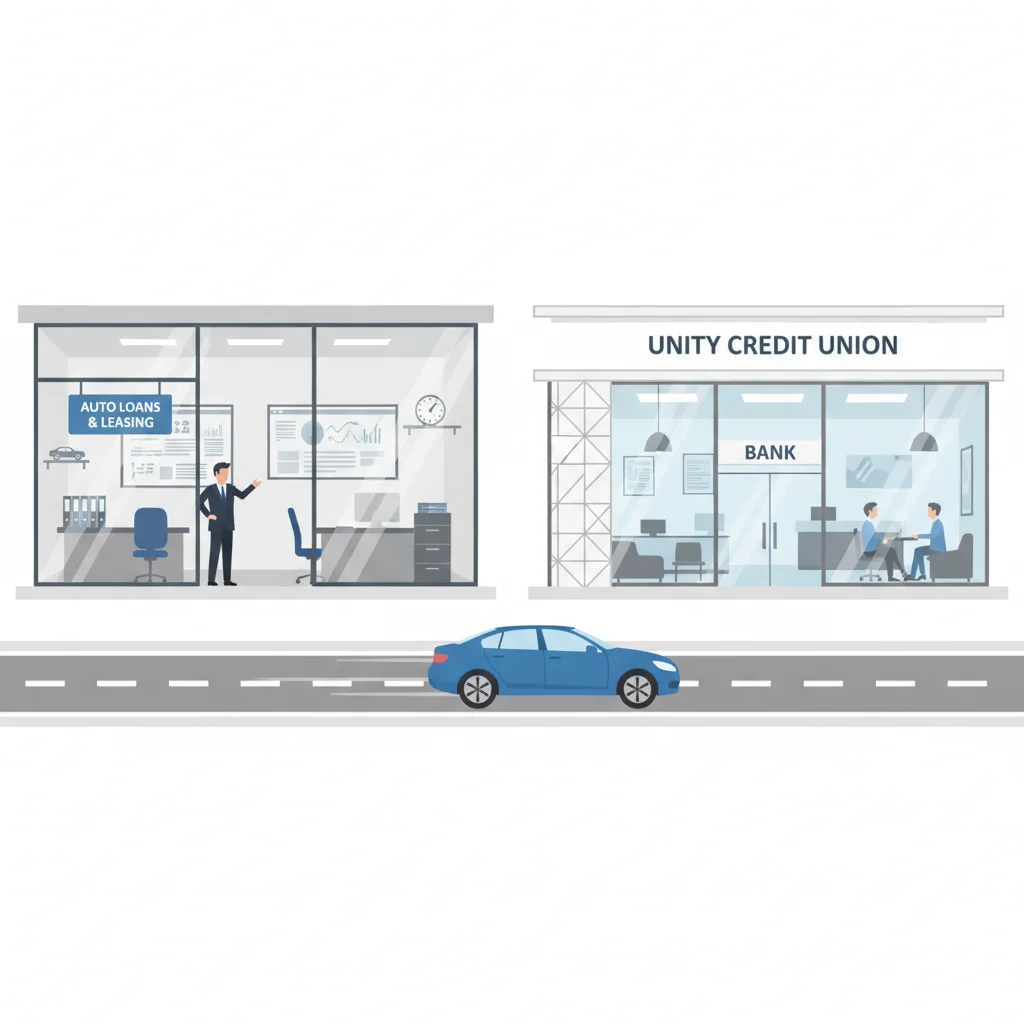
Get Preapproved Before You Contact Your Current Lender
Before calling your current lender to discuss refinancing, collect competing offers from at least two or three other institutions. Credit unions in particular often offer rates significantly below what dealerships arrange. Having a competing offer in hand gives you leverage — and gives you a clear answer about whether your current lender is willing to match the market.
Step 4: Run the numbers honestly. Use an auto refinance calculator to compare total interest paid under your current loan versus a refinanced one. A lower monthly payment isn't always the goal — sometimes a shorter term at the same payment saves more in the long run. Comparing dealership financing to refinancing with a bank or credit union is a useful exercise even if you decide to stay with your current loan.
Refinancing Has a Small, Temporary Credit Impact
When you apply for a refinance loan, the lender will perform a hard credit inquiry, which can temporarily lower your credit score by a few points. However, if you submit multiple applications within a short window (typically 14–45 days depending on the scoring model), the bureaus treat them as a single inquiry for rate-shopping purposes. This impact is minor and usually recovers within a few months of on-time payments.
The financial case for refinancing is strongest when you're in the early-to-middle portion of your loan. Because most auto loans are structured so that interest payments are front-loaded, you capture the biggest savings by refinancing before you've already paid the bulk of the interest. If you're in the final 12 months of your loan, the math usually doesn't favor a switch.

All claims are backed by peer-reviewed research. Sources on request.