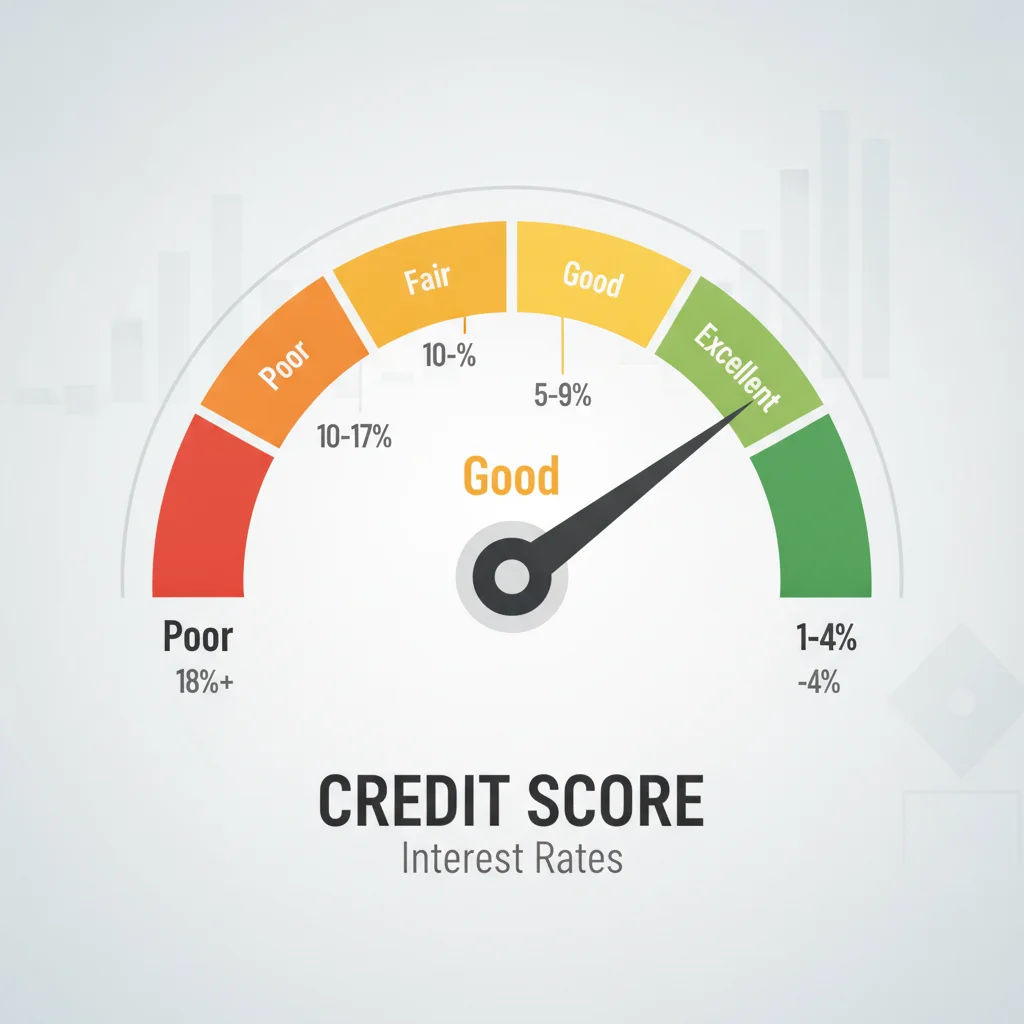

| Deep Subprime Score Range | Below 580 (Experian State of the Automotive Finance Market, 2023) |
| Subprime Score Range | 580–619 (Experian State of the Automotive Finance Market, 2023) |
| Near-Prime Score Range | 620–659 (Experian State of the Automotive Finance Market, 2023) |
| Prime Score Range | 660–780 (Experian State of the Automotive Finance Market, 2023) |
| Superprime Score Range | 781 and above (Experian State of the Automotive Finance Market, 2023) |
| Most Common Loan Term (New Cars) | 72 months (Edmunds Q4 2023 Industry Report) |
| Average New Car APR (Superprime) | ~5.2% (Experian, Q4 2023) |
| Average New Car APR (Deep Subprime) | ~14.2% (Experian, Q4 2023) |
| Typical Down Payment Required (Subprime) | 10%–20% of vehicle price |
| Maximum Term Most Lenders Offer | 84 months (7 years) |
Why Your Credit Score Tier Is the Starting Point for Every Loan Offer
Before a lender quotes you a rate or tells you how long you have to repay, they run your credit. What comes back doesn't just influence your interest rate — it determines which loan products you're eligible for in the first place. Understanding the five standard credit tiers helps you walk into a financing conversation knowing exactly where you stand and what to expect.
| Deep Subprime Score Range | Below 580 (Experian State of the Automotive Finance Market, 2023) |
| Subprime Score Range | 580–619 (Experian State of the Automotive Finance Market, 2023) |
| Near-Prime Score Range | 620–659 (Experian State of the Automotive Finance Market, 2023) |
| Prime Score Range | 660–780 (Experian State of the Automotive Finance Market, 2023) |
| Superprime Score Range | 781 and above (Experian State of the Automotive Finance Market, 2023) |
| Most Common Loan Term (New Cars) | 72 months (Edmunds Q4 2023 Industry Report) |
| Average New Car APR (Superprime) | ~5.2% (Experian, Q4 2023) |
| Average New Car APR (Deep Subprime) | ~14.2% (Experian, Q4 2023) |
| Typical Down Payment Required (Subprime) | 10%–20% of vehicle price |
| Maximum Term Most Lenders Offer | 84 months (7 years) |
Lenders use these tiers as a quick-risk framework. A borrower in the superprime tier is statistically unlikely to default, so the lender competes for their business with low APRs and flexible terms. A borrower in the deep subprime tier carries meaningfully higher default risk, so the lender charges more to offset that exposure — and often limits which loan structures are available at all.
This matters for more than just your monthly payment. It affects how much vehicle you can realistically afford, how much total money you'll spend on financing over the life of the loan, and whether you'll end up "underwater" on your car before you've paid it down. For a deeper look at how lenders interpret your score before ever setting a rate, see what your credit score actually means to a car lender.
Credit Score Tier Breakdown: APR and Term Access by Range
The table below outlines what borrowers in each tier typically encounter when applying for an auto loan. Keep in mind these are representative ranges — actual offers vary by lender, loan amount, vehicle type, and current market rates.
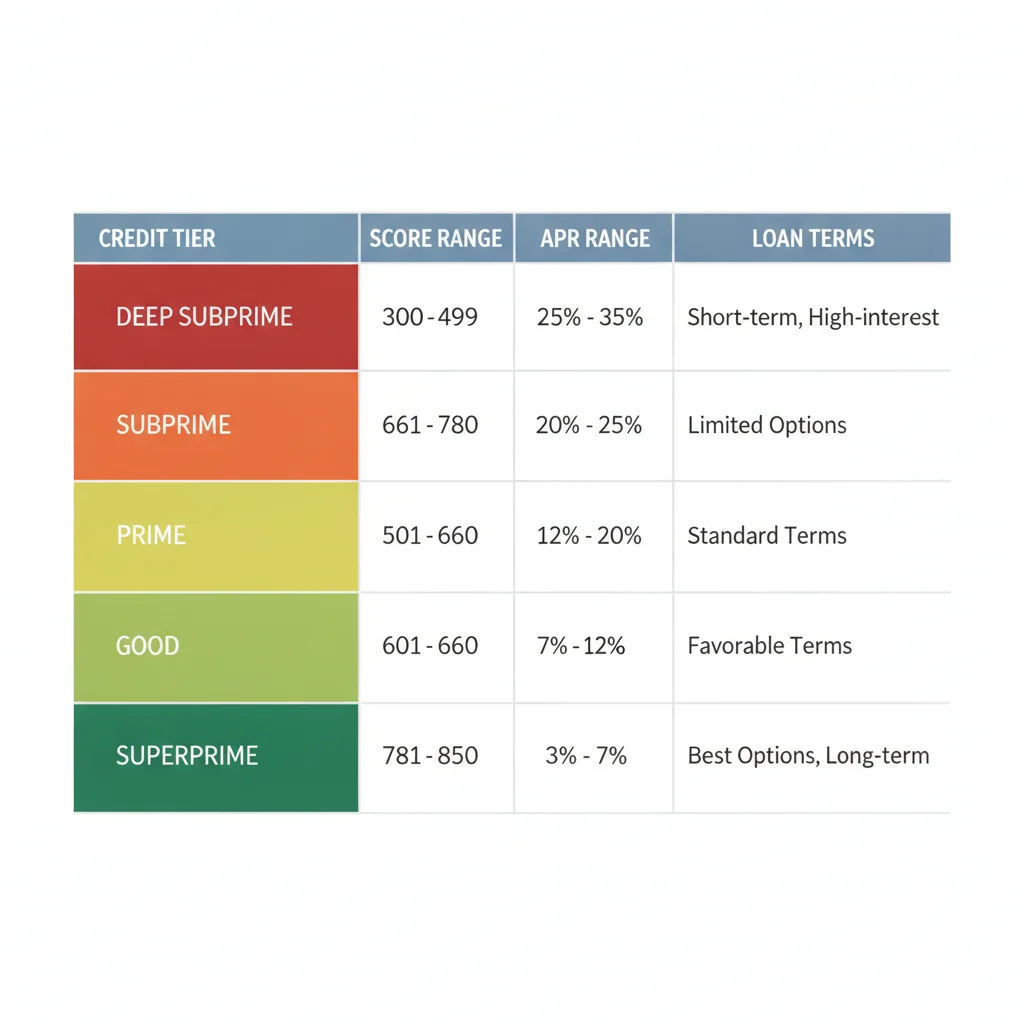
Deep Subprime (Below 580)
Borrowers in this range face the steepest financing costs in the market. APRs on new vehicles often run between 12% and 16%, and used-vehicle rates can climb even higher. Term options are frequently limited to 48 or 60 months — lenders are reluctant to extend 72- or 84-month terms because a longer loan at this risk level dramatically increases default exposure. Down payments of 10%–20% are commonly required. Some lenders in this tier are "buy here, pay here" dealers rather than traditional banks or credit unions, which introduces additional consumer risk.
Subprime (580–619)
This tier sees slightly better rates than deep subprime — typically 10%–14% APR on new vehicles — but terms remain constrained. Many traditional lenders begin accepting applications at this level, though conditions are strict. Borrowers may access 60-month terms more reliably, but 72-month terms often come with higher fees or require a stronger down payment. The credit score ranges lenders use when evaluating auto loan risk explains why these cutoffs exist from the lender's perspective.
Near-Prime (620–659)
The near-prime range is where the financing landscape starts to open up meaningfully. APRs on new vehicles typically fall between 7% and 10%, and most traditional lenders participate. Borrowers at this tier can usually access 60- and 72-month terms without major obstacles. The monthly payment relief from a longer term becomes accessible, though the total interest cost tradeoff is real and worth calculating before accepting a longer term just because it's available.
Prime (660–780)
Prime borrowers represent the broadest segment of financed car buyers. APRs in this range typically run between 5.5% and 8%, and the full menu of term lengths — 48, 60, 72, and often 84 months — is generally available. Lenders compete for prime-tier customers, which gives borrowers in this range negotiating leverage, especially if they come in with a preapproval from a bank or credit union before visiting a dealership. To see how rates shift throughout this wide band, see the auto loan rates by credit score breakdown.
Superprime (781 and Above)
Superprime borrowers get the lowest rates and the most choice. APRs regularly fall below 5.5% for new vehicles, and some captive lenders run promotional financing (0%–2.9%) specifically targeted at this tier. All term lengths are available, and lenders often waive requirements like large down payments. The primary risk for superprime borrowers isn't rate — it's choosing terms that work against them financially by stretching repayment to 84 months when a shorter payoff would cost less overall.
Score Ranges Vary by Lender and Model
The tier cutoffs described in this article reflect industry-standard ranges used by most major auto lenders, but individual banks, credit unions, and captive finance arms (like Toyota Financial or Ford Motor Credit) may draw boundaries differently. Always check preapproval terms from multiple lenders rather than assuming a single score places you in a given tier universally.
FICO vs. VantageScore: Lenders Mostly Use FICO
Most auto lenders pull a FICO Auto Score, not the generic FICO score or VantageScore you see on free monitoring apps. Your FICO Auto Score is weighted more heavily toward your auto loan repayment history. The number you see on Credit Karma or your bank app may differ — sometimes by 20–40 points — from what a lender actually pulls.
Term Length Availability Also Depends on Vehicle Age
Your credit score isn't the only factor that limits term length. Lenders frequently cap available terms on older used vehicles. A 10-year-old car may only be eligible for a 48- or 60-month term even if your credit score would otherwise qualify you for 84 months. This is because lenders want the loan paid off before the vehicle's useful life ends.
How Loan Term Length Changes What You Actually Pay
Many buyers focus entirely on the monthly payment without ever calculating what they'll pay in total. That's understandable — it's the number that shows up in your budget every month. But the term length is what determines how that monthly number translates into total cost, and lenders know that extending the term is one of the most effective ways to make an expensive car seem affordable.
~9%
APR gap between deep subprime and superprime borrowers
According to Experian's Q4 2023 automotive finance data, the spread between the highest and lowest credit tiers on new car loans is nearly 9 percentage points.
$6,000+
Extra interest paid on a 72-month vs. 48-month loan
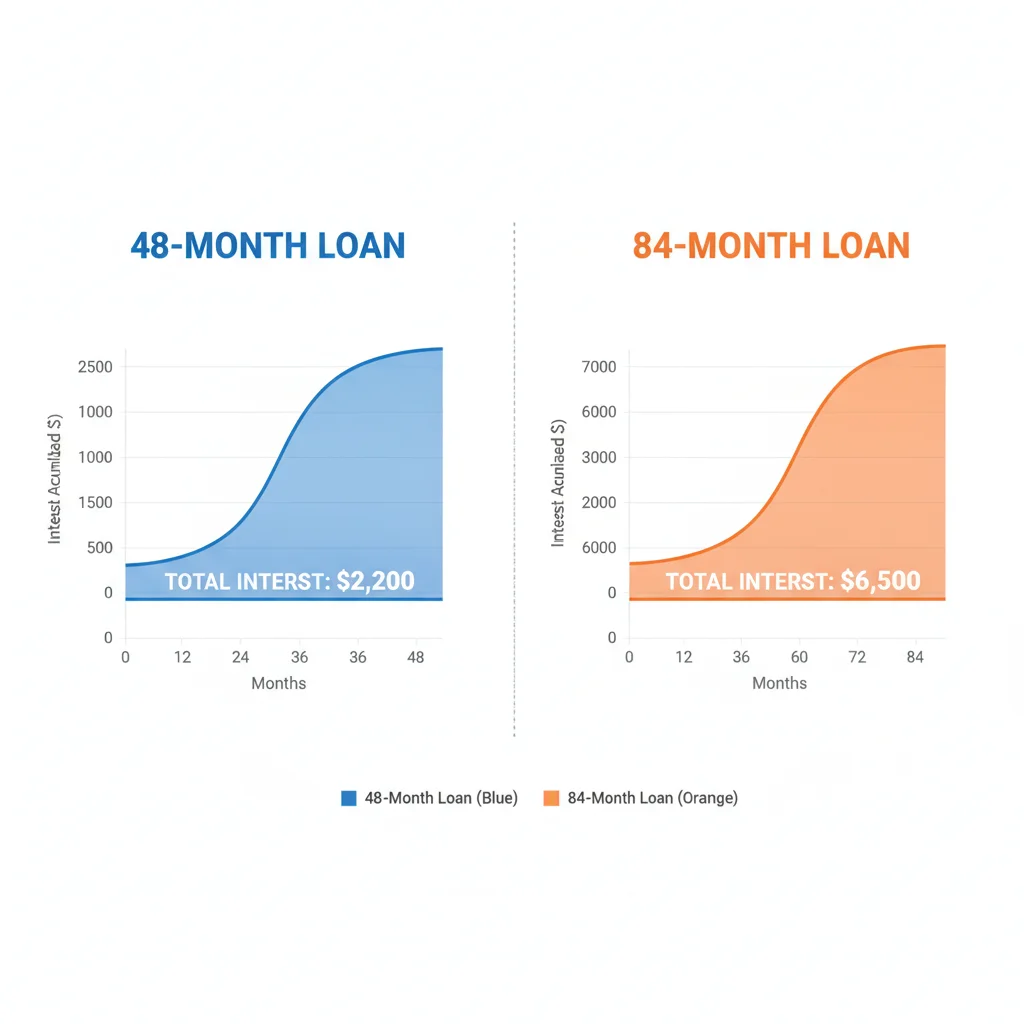
On a $35,000 loan at 8% APR, extending from 48 to 72 months adds over $6,000 in total interest paid over the life of the loan.
73%
Share of new car loans with terms of 60 months or longer
Edmunds data from 2023 shows the vast majority of new car buyers now choose terms of five years or more, increasing long-term interest exposure.
3x
Higher likelihood of negative equity with 84-month loans
Borrowers who take 84-month terms are approximately three times more likely to carry negative equity during the first four years of ownership compared to 48-month borrowers.
780+
Score needed to consistently access best available terms
Across most major lenders, borrowers need a score at or above 780 to reliably qualify for the lowest APR tier and full flexibility on term length.
Here's a straightforward example. Suppose you're financing $32,000 at 7% APR:
- 48-month term: ~$766/month — Total paid: ~$36,768 — Interest: ~$4,768
- 60-month term: ~$634/month — Total paid: ~$38,040 — Interest: ~$6,040
- 72-month term: ~$547/month — Total paid: ~$39,384 — Interest: ~$7,384
- 84-month term: ~$486/month — Total paid: ~$40,824 — Interest: ~$8,824
Moving from a 48-month to an 84-month term saves you $280 per month — but costs you an additional $4,056 in interest over the life of the loan. That's money that buys you nothing. No additional car, no features, no value.
The calculation gets worse when your APR is higher. A deep subprime borrower paying 14% APR on that same $32,000 over 72 months pays over $16,000 in interest alone. Term length and APR compound each other, which is why borrowers in lower credit tiers should be especially cautious about accepting the longest available term just to lower the monthly payment.
APR (Annual Percentage Rate)
The total yearly cost of borrowing, expressed as a percentage. For auto loans, APR includes both the interest rate and any lender fees, making it the most accurate number to compare across loan offers.
Loan Term
The length of time you have to repay your auto loan, typically expressed in months (e.g., 48, 60, 72, or 84 months). Longer terms lower your monthly payment but increase total interest paid.
Credit Tier
A category lenders use to group borrowers by credit score range. Common tiers include deep subprime, subprime, near-prime, prime, and superprime, each carrying different rate and term expectations.
Subprime Borrower
A borrower with a credit score generally below 620. Subprime borrowers are considered higher risk and typically face significantly higher interest rates, stricter loan terms, and larger down payment requirements.
Debt-to-Income Ratio (DTI)
The percentage of your gross monthly income that goes toward debt payments. Lenders use DTI alongside your credit score to assess whether you can realistically handle additional loan payments.
Amortization
The process by which each loan payment is divided between paying down the principal balance and paying interest. In early payments, most of your money goes toward interest rather than the loan balance itself.
Superprime
The highest credit tier, typically reserved for borrowers with scores of 781 or above. Superprime borrowers receive the lowest available APRs and the most flexible loan term options.
Total Interest Paid
The sum of all interest charges over the full life of a loan. This figure can be dramatically different between a 48-month and an 84-month loan, even when the APR is identical.
What to Do With This Information Before You Apply
Knowing your credit tier before you walk into a dealership or submit a loan application changes the dynamic entirely. Here's how to put this knowledge to work:
Pull Your Own Credit First
Use AnnualCreditReport.com to access your reports from all three bureaus (Experian, Equifax, TransUnion) for free. Dispute any errors you find before applying — an incorrect delinquency or a fraudulent account can artificially push you into a lower tier and cost you thousands in unnecessary interest.
Get Preapproved Before the Dealership
A preapproval from your bank or credit union tells you exactly what tier you're in and what rate you'll be offered. Dealers will often try to beat that rate — but you'll only know if they're actually offering something better if you have a number to compare against. Credit score ranges and what they mean for your preapproval odds walks through how different tiers affect your chances of getting approved at all.
Don't Let a Low Monthly Payment Be the Only Goal
Dealerships often quote financing in monthly payment terms rather than total cost — it's easier to sell a $550/month car than a $40,000 car. Always ask for the total amount financed, the APR, and the total interest you'll pay over the life of the loan before signing anything. If the finance manager can't or won't give you these numbers upfront, that's a red flag.
Consider the Impact on Your Broader Financial Picture
Your credit score affects your loan terms, but your full financial profile — including income, existing debts, and employment history — shapes the final offer. What lenders look at beyond your credit score covers what else goes into the lender's calculation, and how to present your application in its strongest form.
Finally, if your current score places you in the near-prime or subprime range, it's worth asking whether waiting 6–12 months to build your credit would meaningfully reduce your financing cost. Dropping from 13% APR to 7% APR on a 5-year loan isn't a small difference — it can represent $5,000–$8,000 in savings, depending on the loan size. That's a decision worth doing the math on before you sign.
Auto Loan Rates by Credit Score: A Range-by-Range Breakdown
See exactly how interest rates shift across credit tiers and what each range typically costs you per month. Pairs directly with this reference article.
Credit Score Ranges and What They Mean for Your Preapproval Odds
Understand how your credit tier affects not just your rate but your likelihood of being approved at all — useful before you start shopping.
What Lenders Look at Beyond Your Credit Score
Income, debt-to-income ratio, and down payment all shape your final loan terms. This guide covers the full lender evaluation picture.
Consumer Financial Protection Bureau: Auto Loans
The CFPB's auto loan resource hub explains borrower rights, how to compare loan offers, and how to spot predatory lending terms in dealer financing.

All claims are backed by peer-reviewed research. Sources on request.