

Key Takeaways
Thin Credit File
A thin credit file means you have very little credit history on record — typically fewer than three to five accounts, or a credit history shorter than two years. Lenders rely on past borrowing behavior to predict how you'll handle new debt. When that track record is sparse, they can't make that prediction confidently, which makes them cautious — even if you've never missed a payment.
Credit scoring models like FICO require at least one account that's been open for six months and one account that has been reported to the bureau within the last six months to generate a score at all. Consumers without these minimums are considered "unscorable."
Why a Thin File Creates a Different Problem Than Bad Credit
Most people assume that if they've never been late on a bill, lenders will happily approve them for a loan. That assumption works fine once you've built a credit history — but it doesn't hold when you're starting from scratch or returning after a long gap.
Lenders aren't in the business of taking chances. Their entire approval process is built around predicting risk using past behavior. When there's no past behavior to analyze, the model breaks down. You're not flagged as a problem borrower; you're flagged as an unknown, and unknowns make underwriters nervous.
This is why a thin credit file is a fundamentally different challenge than bad credit. Bad credit borrowers are dealing with a damaged record. Thin-file borrowers are dealing with an empty one. The solutions, the lenders who can help, and the terms you can realistically expect are all different.
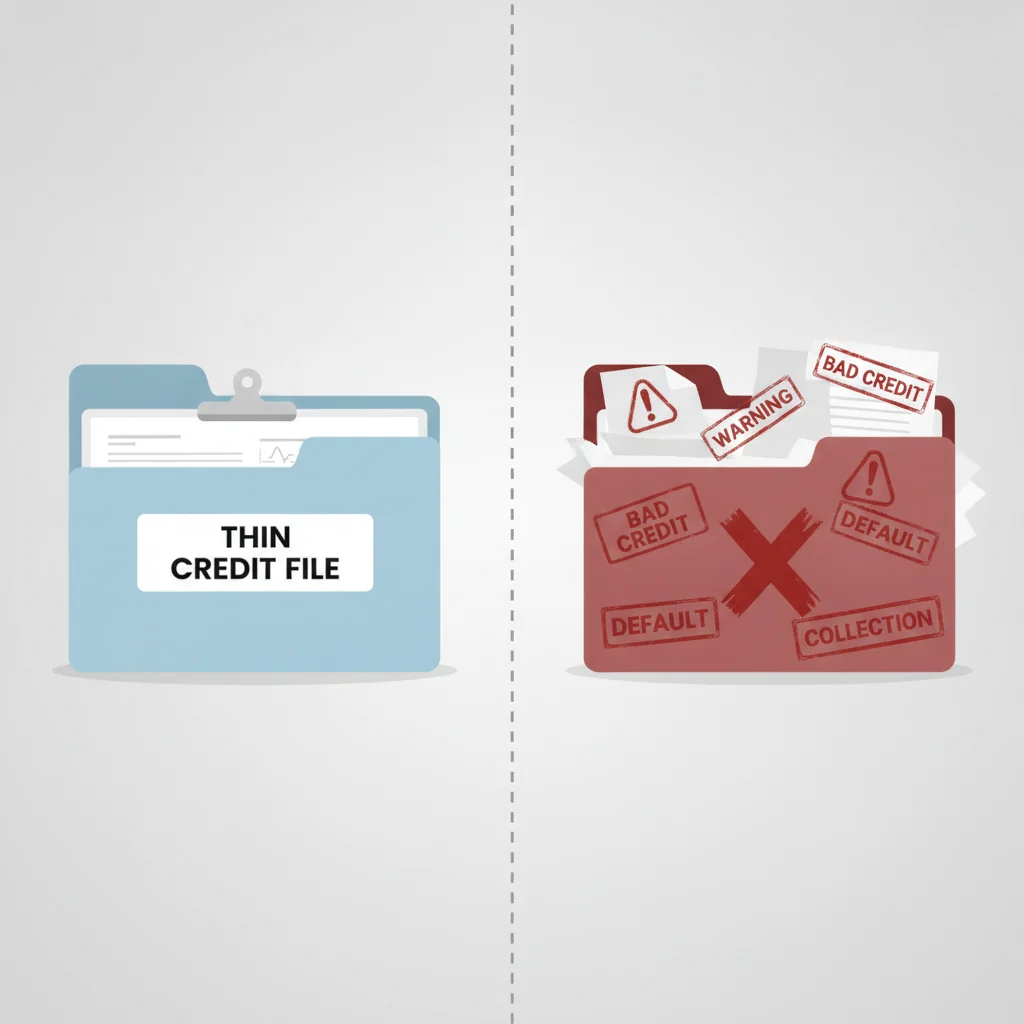
The practical effect at the dealership is similar in some ways: you'll likely face higher interest rates than a borrower with a 750 FICO score. But the ceiling on how good your terms can get — especially after building a few months of history — is much higher than it is for someone recovering from a foreclosure or a string of charge-offs.
Thin File vs. Bad Credit: Different Paths Forward
If you've been declined and you're unsure whether the issue is thin credit or damaged credit, pull your full credit reports from all three bureaus before your next application. Thin-file applicants will see very few accounts and a short history. Bad-credit applicants will typically see late payments, collections, or public records. The distinction matters because the lenders who help each group — and the strategies that work — differ significantly.
Credit Inquiries and Rate Shopping
When you apply to multiple auto lenders within a 14–45 day window (the exact window depends on the scoring model), FICO treats those inquiries as a single event. This means you can — and should — shop multiple lenders without worrying that each application compounds the damage to your file. Don't let fear of inquiries stop you from comparing offers.
Watch Your Debt-to-Income Ratio
When credit history is sparse, lenders lean harder on income-based metrics. Most prefer your total monthly debt payments — including the new car payment — to stay below 40%–50% of your gross monthly income. If the car you're eyeing pushes you past that threshold, a smaller loan, a higher down payment, or a less expensive vehicle will improve your odds more than almost anything else.
What Lenders Actually See When They Pull Your File
When a lender requests your credit report, the bureau sends back a file containing your account history, payment record, current balances, and inquiries. For a thin-file borrower, that report might show one credit card with a $500 limit opened eight months ago, or nothing at all.
Scoring models like FICO 8 and VantageScore 3.0 need a minimum amount of data to generate a number. FICO requires at least one account open six months or longer, plus at least one account reported to the bureau in the past six months. If you don't meet those minimums, you're "unscorable" — which means a lender sees a blank where your score should be.
Unscorable is not the same as zero. But many automated underwriting systems reject applications that return no score. This is why going directly to a credit union or community bank — where a human underwriter can review your full financial picture — matters so much for thin-file borrowers.
26 million
Americans with thin or no credit file
According to the Consumer Financial Protection Bureau, approximately 26 million U.S. adults are "credit invisible" or have insufficient credit histories to generate a score.
3.5%+
Average APR premium for thin-file vs. prime borrowers
Industry data from Experian's State of the Automotive Finance Market reports consistently show near-prime and non-prime borrowers paying 3–8 percentage points above prime rates.
$5,100
Extra interest paid over 60 months at 13% vs. 7%
Calculated on a $25,000 auto loan: a 7% rate costs approximately $4,953 in total interest; a 13% rate costs approximately $10,073 — a difference of over $5,100.
35%
FICO score weight given to payment history
MyFICO.com confirms that payment history is the single largest component of a FICO score, making consistent on-time loan payments the fastest legitimate way to build credit.
20%+
Down payment target for thin-file applicants
Lending industry guidelines and multiple lender policies suggest that a 20% or greater down payment substantially reduces denial rates for borrowers with limited credit histories.
If you do have a score but it's based on limited data, it may show up as a number in the 600s even though your financial habits are solid. That's because the score is generating a conservative estimate with high uncertainty. A single 30-day late payment could tank it significantly; a few more accounts paid on time could push it into the 700s fairly quickly.
Before you apply for any auto loan, check your reports at AnnualCreditReport.com and verify exactly what's on file. Errors on thin files are especially damaging because there's no offsetting positive history to dilute the impact. If you find a mistake, dispute it before submitting any loan applications. See this checklist for what to verify before hitting submit.
Realistic Rate Ranges for Thin-File Auto Loan Borrowers
Let's put real numbers on this. Interest rates on auto loans vary by lender, loan term, vehicle age, and your specific profile — but here's a realistic picture of where thin-file borrowers land relative to the broader market.
| Borrower Profile | Typical New Car APR | Typical Used Car APR |
|---|---|---|
| Prime (720+ FICO) | 5.5%–7.5% | 6.5%–9% |
| Near-prime (660–719) | 7%–10% | 9%–13% |
| Thin file (limited/no score) | 8%–15% | 10%–18% |
| Deep subprime (below 580) | 14%–22%+ | 18%–26%+ |
Notice that thin-file rates overlap with near-prime and the lower end of subprime — not the worst territory, but meaningfully more expensive than what a borrower with a 740 score gets. On a $25,000 loan over 60 months, the difference between a 7% rate and a 13% rate is roughly $85 per month and over $5,100 in total interest paid.
That's real money. Which is exactly why it's worth spending three to six months building credit before you buy if your timeline allows it. See our guide on strengthening a thin credit file for practical steps you can take before applying.
“Lenders don't hate thin-file borrowers — they're just priced for uncertainty. Reduce the uncertainty and the price comes down with it.”
— Jordan Delray, Former dealership finance manager and auto loan specialist
Used vehicles add another layer of complexity. Lenders are already cautious about collateral risk on older cars — if you add a thin credit file to a 2015 vehicle with 90,000 miles, some lenders will decline outright. Vehicle age and mileage restrictions are worth understanding before you fall in love with a specific car.
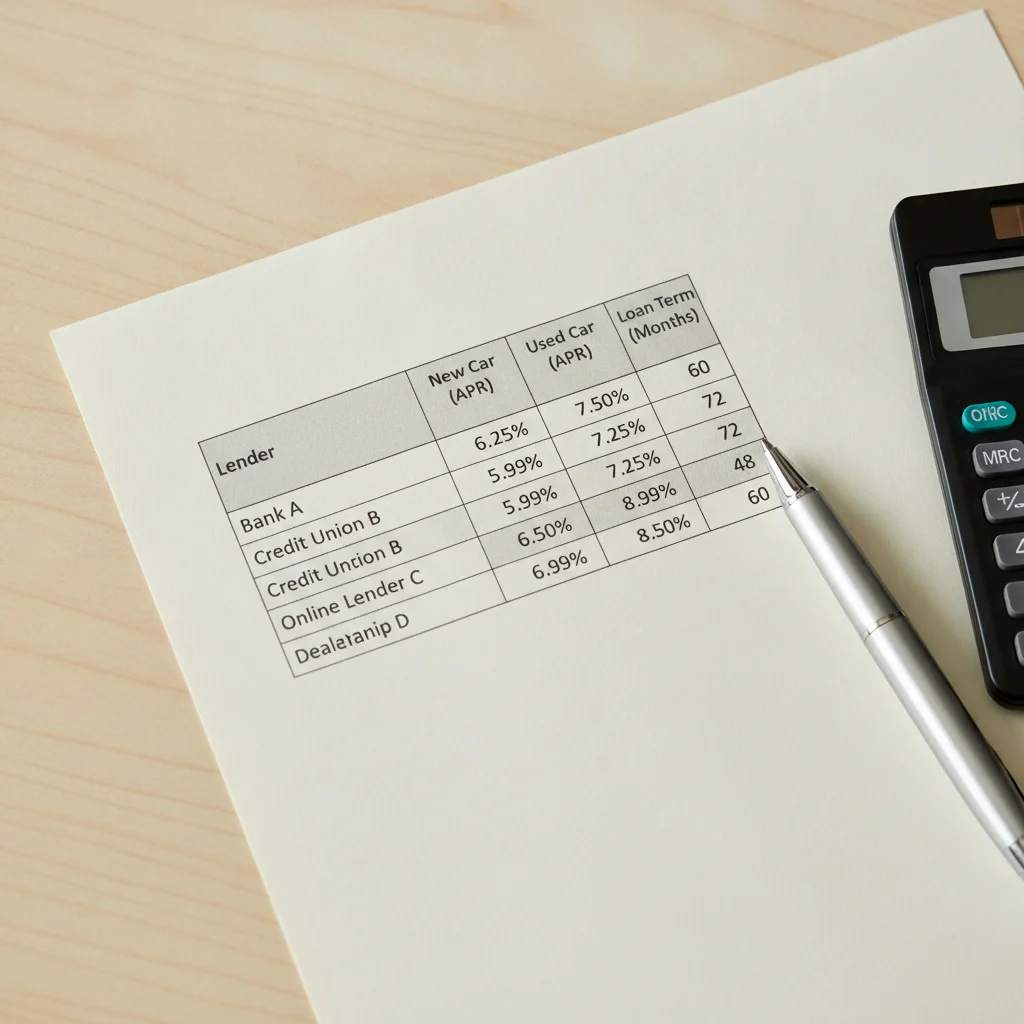
The Lenders Worth Approaching — and the Ones to Avoid
Not every lender handles thin-file applications the same way. Automated systems used by many big banks will reject an unscorable application without a human ever looking at it. That doesn't mean you're out of options; it means you need to target lenders whose underwriting process allows for nuance.
Credit Unions
Credit unions are consistently the most favorable option for thin-file borrowers. Because they're member-owned and not-for-profit, their lending decisions are often made by people who can look at your full picture: steady income, savings, employment history, and payment patterns on utilities or rent. Membership requirements vary, but many are broadly accessible through employer affiliation, geography, or even a small membership fee.
Community Banks
Similar to credit unions in their willingness to do manual underwriting. Smaller local or regional banks often have more flexibility than national institutions and may have programs specifically designed for first-time borrowers.
Online Lenders Specializing in Non-Prime
Platforms like Capital One Auto Finance, OpenRoad Lending, and similar services accept a range of credit profiles, including thin files. Rates vary widely — compare at least three offers and watch for origination fees or prepayment penalties buried in the terms.
Dealership Financing (Use With Caution)
Dealers can submit your application to multiple lenders simultaneously, which sounds efficient. The problem is that dealers earn a "dealer reserve" — a markup on the rate they quote you versus the rate the lender actually approved. On a thin-file loan where rates are already elevated, that markup can add hundreds of dollars. Get preapproved elsewhere first, then let the dealer compete. Preapproval gives you a benchmark the dealer has to beat, not a blank slate they can fill in.
Use Preapproval as a Price Anchor
Before you set foot on a dealership lot, apply to at least two lenders — ideally a credit union and an online lender — and get written preapproval letters. These give you a concrete rate to benchmark against whatever the dealer's finance office proposes. If the dealer can't beat your preapproved rate, you already have your financing in place.
Refinance After 12 Months of On-Time Payments
If you accept a higher rate now to get into a vehicle, set a calendar reminder for 12 months out to check refinancing options. By then, your payment history on the loan — plus any other credit building you've done — may have pushed your score into a range where refinancing at a lower rate saves real money. Just check your original loan for prepayment penalties before you plan this move.
Strategies That Meaningfully Improve Your Approval Odds
A thin credit file isn't a wall — it's a hurdle. Here are the approaches that actually move the needle, ranked roughly by impact.
Add a Co-Signer
A co-signer with strong credit effectively lends you their credit history for the purposes of this loan. The lender evaluates both of you, and if your co-signer has a 740 FICO and consistent income, you may qualify for near-prime rates. The catch: your co-signer is equally liable for the debt. If you miss payments, their credit takes the hit. This is a significant favor to ask and one that should come with a clear repayment commitment on your part.
Increase Your Down Payment
A larger down payment reduces the lender's loan-to-value (LTV) exposure. If a car is worth $20,000 and you put $5,000 down, the lender is financing $15,000 — 75% of the vehicle's value. That's a much safer position than financing 100% or more. For thin-file borrowers, reaching 20% down can be the difference between approval and rejection, and it reliably brings the rate down even when approval isn't in question.
Choose a Newer, Lower-Mileage Vehicle
Lenders feel more confident about collateral they can easily value and resell. A three-year-old car with 35,000 miles is a much cleaner piece of collateral than a ten-year-old car with 120,000 miles. If your credit file is thin, don't compound the risk by asking the lender to finance a high-risk asset at the same time.
Document Your Income Thoroughly
Thin-file underwriting often shifts weight from your credit score to your income and debt-to-income ratio. Come prepared: two months of pay stubs, your most recent tax return if you're self-employed, and bank statements showing consistent deposits. The more clearly you can demonstrate that your income comfortably covers the payment, the more comfortable a human underwriter becomes.
Get Preapproved Before Visiting a Dealer
Dealers read borrowers who arrive without financing. Walking in preapproved — even at a rate you'd like to improve — frames the entire conversation differently. See how this process works for borrowers with credit challenges: getting preapproved with less-than-perfect credit.
Use Preapproval as a Price Anchor
Before you set foot on a dealership lot, apply to at least two lenders — ideally a credit union and an online lender — and get written preapproval letters. These give you a concrete rate to benchmark against whatever the dealer's finance office proposes. If the dealer can't beat your preapproved rate, you already have your financing in place.
Refinance After 12 Months of On-Time Payments
If you accept a higher rate now to get into a vehicle, set a calendar reminder for 12 months out to check refinancing options. By then, your payment history on the loan — plus any other credit building you've done — may have pushed your score into a range where refinancing at a lower rate saves real money. Just check your original loan for prepayment penalties before you plan this move.
Rate-Shop Within a Tight Window
Apply to multiple lenders — ideally three to five — within a 14-day window. The credit bureaus treat all auto loan inquiries made during that period as a single inquiry, so your credit file doesn't compound the damage. This gives you real competing offers without outsized cost to your file.
Building Credit Before or After Your Loan
If you have three to six months before you need a vehicle, that window is worth using. A few strategic moves can shift your credit profile from thin to functional and bring your loan rate down substantially.
The fastest tools available to thin-file borrowers:
- Secured credit card: Deposit $300–$500 with a bank or credit union as collateral, get a card with that limit, use it for small recurring charges, and pay it in full every month. After six months of on-time payments, many issuers upgrade you to an unsecured card and return your deposit.
- Credit-builder loan: Offered by many credit unions, this product works in reverse — the "loan" amount is held in a savings account while you make payments. At the end of the term, you've built a payment history and walked away with savings. Purpose-built for exactly this situation.
- Becoming an authorized user: If a family member with good credit adds you to an existing credit card account as an authorized user, that account's history may appear on your report. Even without using the card, the positive history helps establish your file.
- Experian Boost: This free tool allows you to add on-time utility, streaming, and phone payments to your Experian credit report. It won't work for all lenders, but it can generate or lift a thin score meaningfully.
Once you have your auto loan, it becomes a powerful credit-building tool in its own right. An installment loan paid on time every month adds to your payment history — the single largest factor in your FICO score at 35%. Refinancing six to twelve months later, once your score has improved, is a legitimate strategy to lower your rate. Just watch for prepayment penalties in your original loan agreement before you plan that move.

Thin File vs. Bad Credit: Different Paths Forward
If you've been declined and you're unsure whether the issue is thin credit or damaged credit, pull your full credit reports from all three bureaus before your next application. Thin-file applicants will see very few accounts and a short history. Bad-credit applicants will typically see late payments, collections, or public records. The distinction matters because the lenders who help each group — and the strategies that work — differ significantly.
Credit Inquiries and Rate Shopping
When you apply to multiple auto lenders within a 14–45 day window (the exact window depends on the scoring model), FICO treats those inquiries as a single event. This means you can — and should — shop multiple lenders without worrying that each application compounds the damage to your file. Don't let fear of inquiries stop you from comparing offers.
Watch Your Debt-to-Income Ratio
When credit history is sparse, lenders lean harder on income-based metrics. Most prefer your total monthly debt payments — including the new car payment — to stay below 40%–50% of your gross monthly income. If the car you're eyeing pushes you past that threshold, a smaller loan, a higher down payment, or a less expensive vehicle will improve your odds more than almost anything else.
What to Watch Out For When You Have Limited Credit History
Thin-file borrowers are a profitable target for predatory lenders precisely because they're desperate for approval and don't have a good benchmark for what fair terms look like. Here are the warning signs worth knowing before you sign anything.
Yo-Yo Financing
Also called "spot delivery," this is when a dealer lets you drive the car home before the financing is finalized, then calls you back a week later claiming the deal fell through and you need to sign a new contract — at a higher rate. It's legal in most states and preys on buyers who don't know their rights. Never treat a contract as final until you receive written confirmation that financing is fully approved and funded.
Excessive Loan Terms
84-month (7-year) auto loans have become common because the lower monthly payment makes expensive cars seem affordable. On a thin-file loan at 13% APR, stretching to 84 months means you'll pay nearly double the sticker price in total. Stick to 48 or 60 months whenever possible, and buy a vehicle that fits your budget at that term length.
Add-On Products Rolled Into the Loan
Dealers often add GAP insurance, extended warranties, paint protection, and credit life insurance to the back end of the loan. Each one increases the principal you're financing and the interest you'll pay over the life of the loan. Some of these products have value; many are overpriced. Evaluate each one separately and decline anything you don't understand or need.
Dealers Marking Up Your Approved Rate
If a lender approves you at 10% and the dealer quotes you 13%, the 3% difference goes into the dealer's pocket as dealer reserve. This is legal but not disclosed. The only defense is knowing your approved rate before you sit down in the finance office — which is exactly what preapproval provides. Review the bad credit loans hub for more on working with lenders who serve non-prime borrowers.
Thin File vs. Bad Credit: Different Paths Forward
If you've been declined and you're unsure whether the issue is thin credit or damaged credit, pull your full credit reports from all three bureaus before your next application. Thin-file applicants will see very few accounts and a short history. Bad-credit applicants will typically see late payments, collections, or public records. The distinction matters because the lenders who help each group — and the strategies that work — differ significantly.
Credit Inquiries and Rate Shopping
When you apply to multiple auto lenders within a 14–45 day window (the exact window depends on the scoring model), FICO treats those inquiries as a single event. This means you can — and should — shop multiple lenders without worrying that each application compounds the damage to your file. Don't let fear of inquiries stop you from comparing offers.
Watch Your Debt-to-Income Ratio
When credit history is sparse, lenders lean harder on income-based metrics. Most prefer your total monthly debt payments — including the new car payment — to stay below 40%–50% of your gross monthly income. If the car you're eyeing pushes you past that threshold, a smaller loan, a higher down payment, or a less expensive vehicle will improve your odds more than almost anything else.
All claims are backed by peer-reviewed research. Sources on request.