Key Takeaways
FICO Auto Score
A FICO Auto Score is a specialized credit score that lenders use specifically when evaluating applications for car loans. It is calculated using the same underlying credit data as a standard FICO score, but it weights certain factors — particularly your history with auto loans — more heavily. The result is a number that can be meaningfully higher or lower than the general-purpose FICO score you might check on a consumer app.
FICO produces multiple Auto Score versions (FICO Auto Score 2, 4, 5, and 8), each tied to a specific credit bureau. A lender pulling from all three bureaus may see three different FICO Auto Score numbers for the same borrower.
Why Two Different Scores Exist for the Same Borrower
Most people discover the FICO Auto Score the hard way: they check their credit score, feel confident walking into a dealership, and then get offered a rate that doesn't match what they expected. When they ask why, the finance manager might mention something about the score the lender used. That score is rarely the one you checked.
FICO — the Fair Isaac Corporation — doesn't produce one score. It produces dozens of them, each calibrated for a specific lending decision. Mortgage lenders use FICO scores optimized for housing credit risk. Credit card issuers use versions weighted toward revolving debt behavior. And auto lenders use FICO Auto Scores, which are deliberately engineered to predict whether a specific borrower will repay a vehicle loan.
The logic is straightforward: a person's history with auto debt is the single best predictor of how they'll handle future auto debt. A general credit score treats a missed car payment and a missed credit card payment roughly the same. A FICO Auto Score does not.
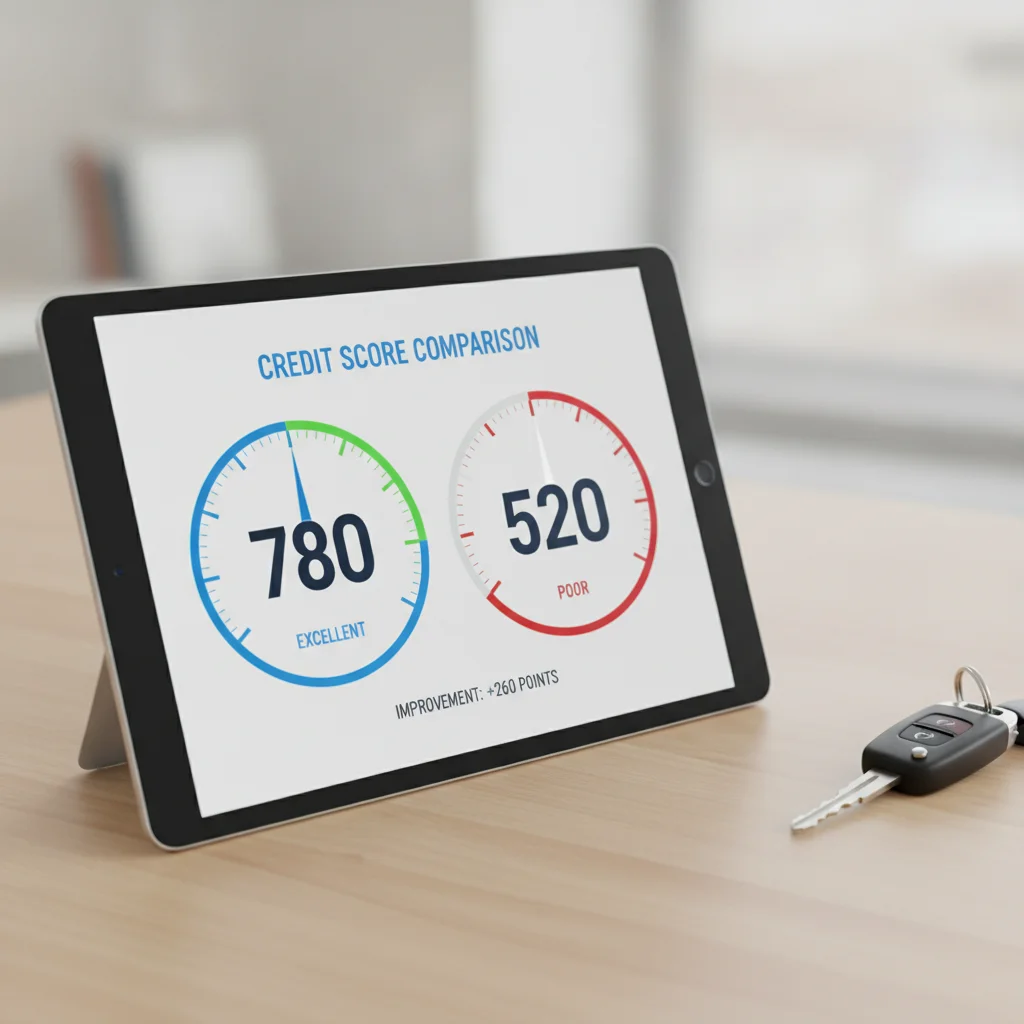
This specialization creates real divergence. According to FICO, the Auto Score versions in wide use — FICO Auto Score 2 (Experian), FICO Auto Score 4 (TransUnion), and FICO Auto Score 5 (Equifax) — all amplify auto-loan-specific signals in your credit file. FICO Auto Score 8 is also used by some lenders and is built on the more modern general scoring framework. The result is that two borrowers with identical general FICO scores can look very different to an auto lender.
For a deeper look at how lenders choose between scoring models, including the comparison between FICO and VantageScore, see FICO Score vs. VantageScore: Which One Do Auto Lenders Actually Use?.
What the FICO Auto Score Actually Weights Differently
Both the general FICO score and the FICO Auto Score pull from the same five categories of credit data: payment history, amounts owed, length of credit history, new credit, and credit mix. The difference is in how much each category contributes to the final number when auto lending is the use case.
Past Auto Loan Performance Is King
In a general FICO score, all payment history is weighted roughly equally — a late mortgage payment is treated similarly to a late auto payment. In a FICO Auto Score, your track record on previous vehicle loans is weighted disproportionately. If you have paid off two car loans without a single late payment, that history gives your auto score a meaningful boost compared to your general score.
Conversely, any auto-specific derogatory marks — a repossession, a charged-off auto loan, chronic late payments on a vehicle account — hit the FICO Auto Score harder than the same event hits your general score. This is the scenario that creates the most unpleasant surprises at the dealership.
4
FICO Auto Score versions in active use by lenders
FICO Auto Score versions 2, 4, 5, and 8 are each tied to specific credit bureaus and lender preferences, according to FICO's published scoring model documentation.
20–50 pts
Potential score gap from a past auto repossession
Borrowers with a repossession on file may see their FICO Auto Score run significantly lower than their general FICO score, as auto-specific negative marks carry amplified weight in the auto model.
$4,600+
Extra interest from one credit tier drop on a $35K loan
On a 60-month, $35,000 loan, the difference between a 7.5% and 12.0% APR — the gap between prime and near-prime tiers — amounts to approximately $4,600 in additional finance charges.
45 days
Rate-shopping window before inquiries compound
FICO's deduplication rule treats multiple auto loan inquiries within a 45-day period as a single inquiry, protecting borrowers who shop across lenders for the best rate.
~80%
Auto lenders using FICO-based scoring models
The vast majority of U.S. auto lenders, including captive financing arms of major automakers, use FICO Auto Score versions rather than general consumer credit scores or VantageScore models.
Credit Mix and Auto Loan Experience
The general FICO score rewards having a variety of credit types (installment loans, revolving credit, etc.). The FICO Auto Score goes further by specifically valuing demonstrated experience managing installment debt structured like a car loan. Borrowers who have only ever used credit cards, even with perfect payment history, may find their auto score slightly below their general score simply because they lack the specific loan type experience.
Which Bureau Score Gets Used?
Lenders pulling from all three bureaus will receive three different FICO Auto Score numbers — one from Experian, one from TransUnion, and one from Equifax — because each bureau holds slightly different data. Many lenders use the middle score of the three when making their decision, similar to mortgage lending practice. If your scores vary significantly across bureaus, it's worth investigating whether any bureau has an error in your file.
Credit-Based Insurance Scores Are a Separate System
The credit score that affects your auto insurance premium is not the same as your FICO Auto Score. Insurance companies use credit-based insurance scores — a separate model designed to predict claim likelihood, not loan repayment. The inputs overlap but the calculations differ. Improving one does not automatically improve the other, though good overall credit hygiene tends to help both.
How Inquiries Are Treated
FICO Auto Scores use the same rate-shopping deduplication rule as general scores: multiple auto loan inquiries within a 45-day window are typically treated as a single inquiry. This means you can shop among lenders without compounding credit damage. Don't let fear of credit pulls stop you from comparing rates — that's exactly the behavior the scoring model is designed to protect.
Shop Multiple Lenders Within 45 Days
FICO's rate-shopping policy treats all auto loan inquiries within a 45-day window as a single inquiry on your credit report. Apply to your bank or credit union, at least one online lender, and the dealership's finance department — then compare the actual offers. Getting multiple quotes costs you nothing on your score and can save you thousands in interest.
Check Your Auto Score Before the Dealer Does
Pull your FICO Auto Score from myFICO.com before you step foot in a dealership. Knowing your number in advance tells you which rate tier to realistically expect and gives you a benchmark to evaluate any offer you receive. If a dealer quotes you a rate that implies a much lower tier than your score suggests, you'll know to push back.
The Score Gap: How Big Is It and What Does It Cost You?
The gap between your general FICO score and your FICO Auto Score can range from negligible to significant. Borrowers with long, clean auto loan histories often see their auto score run 15–30 points above their general score. Borrowers with a past repossession or an auto-specific late payment cluster may see their auto score run 20–50 points below their general score.
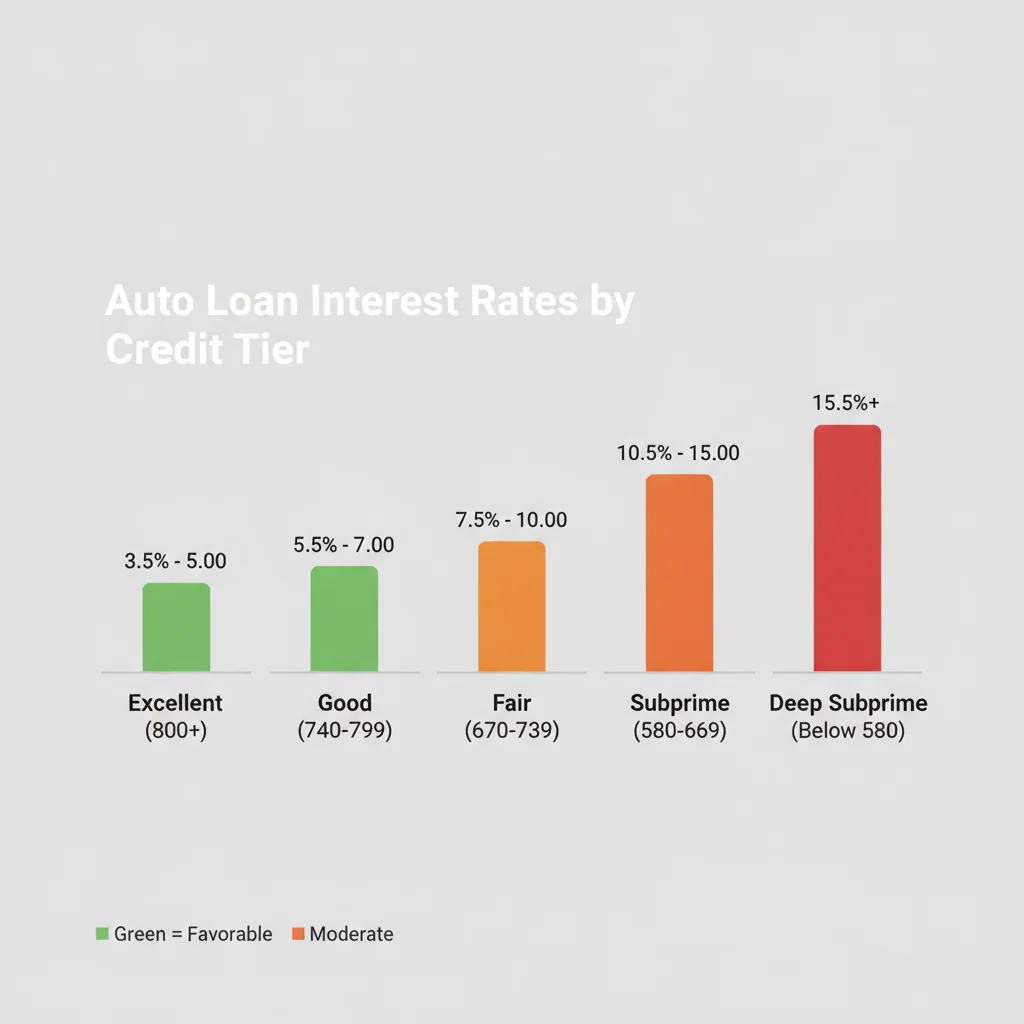
Those differences aren't academic. Auto lenders use score tiers to assign interest rates, and those tiers are usually structured with meaningful jumps at thresholds like 720, 680, 660, and 620. Landing even one tier lower than expected can cost real money over the life of a loan.
| FICO Auto Score Range | Typical Tier Label | Approximate New Car APR Range (2024) |
|---|---|---|
| 750 and above | Super Prime | 5.5% – 7.5% |
| 720–749 | Prime | 7.0% – 9.0% |
| 680–719 | Near Prime | 9.0% – 12.0% |
| 640–679 | Subprime | 12.0% – 17.0% |
| Below 640 | Deep Subprime | 17.0% – 25.0%+ |
To put a dollar figure on this: on a $35,000 loan over 60 months, the difference between a 7.5% APR and a 12.0% APR is approximately $4,600 in additional interest. A 30-point score gap that drops you one tier is not a minor inconvenience — it's a material cost.
For a broader view of how your score interacts with loan type, see How New and Used Car Loan Rates Respond Differently to Your Credit Score.
How to Find Your Actual FICO Auto Score
The consumer tools most people use — Credit Karma, Mint, even many bank apps — show a general FICO score (often FICO Score 8 or 9) or a VantageScore 3.0. None of these are the FICO Auto Score that most dealers' lenders will pull. You cannot infer your auto score from these numbers with precision.
myFICO.com
The most direct route is purchasing your scores through myFICO.com. Their plans give you access to FICO Auto Score versions from each bureau. It's not free, but if you're about to finance a $30,000+ vehicle, knowing your actual score before the lender does is worth the cost of a report.
Credit Unions and Banks
Some credit unions — especially those with a strong auto lending focus — provide members access to their FICO Auto Score as part of online banking. If yours doesn't, it's worth calling and asking; many add this quietly.
Ask the Lender Directly
After applying and getting a decision, you have the right to know which score the lender used under the Fair Credit Reporting Act's adverse action rules. If you're declined or get a worse rate than expected, the lender must tell you the score used, the model name, and the score range. Use that information — it tells you exactly where you stand on the scale they care about.
“The score a consumer sees and the score a lender sees are often from different models entirely. Knowing which model your lender uses before you apply is one of the most underutilized advantages available to car buyers.”
— Ethan Decker, Former dealership finance and insurance director, auto lending industry consultant
Understanding what your score means to the lender, not just what it means to a consumer app, is the key insight here. See What Your Credit Score Actually Means to a Car Lender for the lender's-eye view.
Improving Your FICO Auto Score Specifically
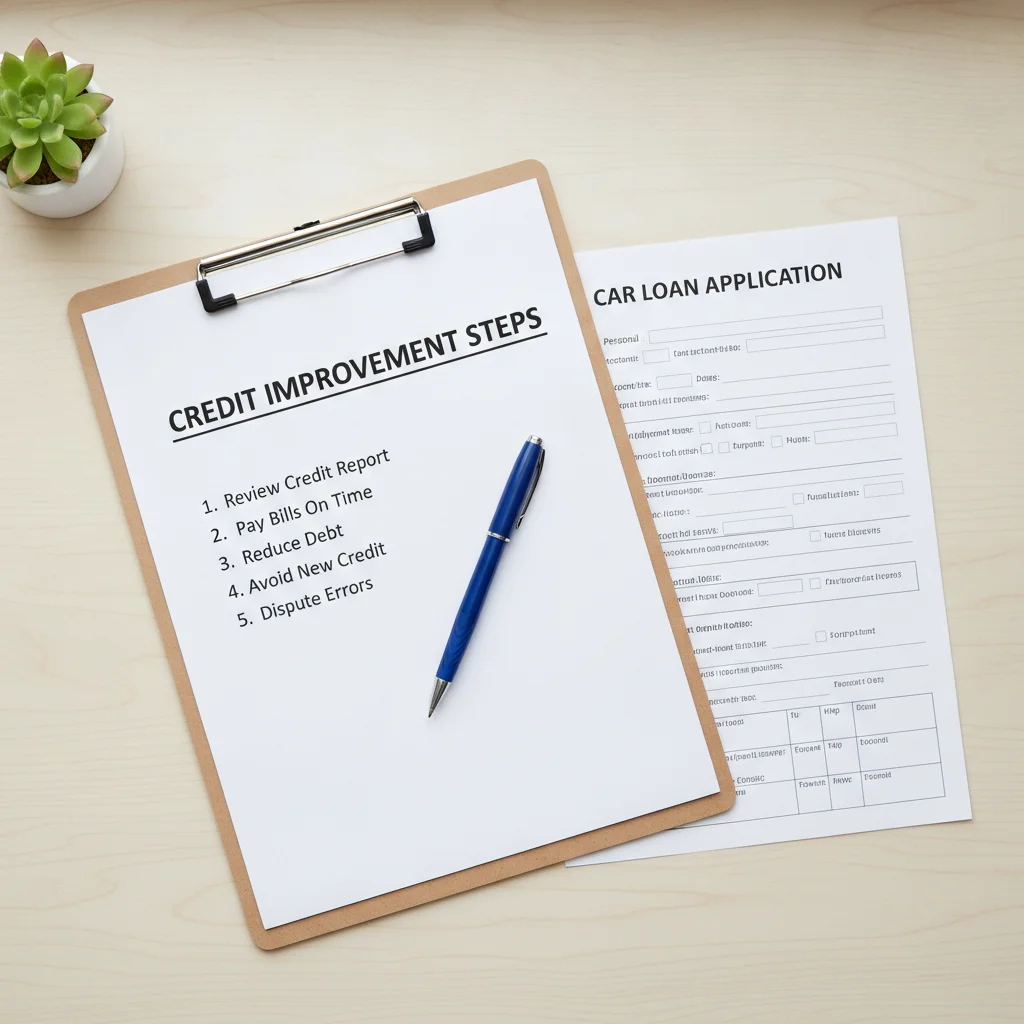
General credit score advice — pay down revolving balances, keep utilization low, don't open unnecessary accounts — still applies. But to move your FICO Auto Score specifically, you need to address the factors it weights most heavily.
The Fastest Lever: Fix Auto-Specific Negatives
If your credit file contains an auto loan late payment, a repossession, or a charged-off vehicle account, these marks are dragging your auto score disproportionately. You can't erase accurate negative history, but you can mitigate it by building positive auto loan history on top of it. A small, manageable new auto loan — paid perfectly for 12–24 months — begins to dilute the negative signals.
Build Installment Loan History If You Have None
If you've only ever used revolving credit (credit cards), your auto score may suffer simply because the model has less auto-specific data to evaluate. A credit-builder loan from a credit union is one low-risk way to establish installment loan history before you apply for vehicle financing.
Rate Shopping Without Penalty
Apply to multiple lenders — banks, credit unions, online lenders — within the same 45-day window. The FICO scoring model treats this cluster of inquiries as a single event. You get to compare real loan offers without multiplying the credit damage. This is one of the most practical credit behaviors buyers consistently underuse.
Shop Multiple Lenders Within 45 Days
FICO's rate-shopping policy treats all auto loan inquiries within a 45-day window as a single inquiry on your credit report. Apply to your bank or credit union, at least one online lender, and the dealership's finance department — then compare the actual offers. Getting multiple quotes costs you nothing on your score and can save you thousands in interest.
Check Your Auto Score Before the Dealer Does
Pull your FICO Auto Score from myFICO.com before you step foot in a dealership. Knowing your number in advance tells you which rate tier to realistically expect and gives you a benchmark to evaluate any offer you receive. If a dealer quotes you a rate that implies a much lower tier than your score suggests, you'll know to push back.
Also understand that where you apply matters beyond just the score. Dealer financing and bank financing treat the same credit score differently — the same FICO Auto Score can produce different offers depending on the channel.
Finally, keep in mind that your credit score interacts with other loan variables. The interest rate and APR framework affects how much your score tier ultimately costs you, and a stronger down payment changes the lender's risk exposure even when your score stays fixed. See our down payment guide for how these levers work together.
One More Score You May Not Know About: The Insurance Version
While this article focuses on the FICO Auto Score for loan decisions, it's worth a brief note that a different type of score — a credit-based insurance score — is used by most auto insurance carriers when setting your premium. That score is calculated differently and responds to different inputs than either your general FICO score or your FICO Auto Score.
Conflating them is a common mistake. If you've been told your credit affects your insurance rate, that's true — but the mechanism is not the same as how your credit affects your loan rate. For a clear breakdown of how these two scoring systems differ, see Credit-Based Insurance Scores vs. Lending Credit Scores.
Which Bureau Score Gets Used?
Lenders pulling from all three bureaus will receive three different FICO Auto Score numbers — one from Experian, one from TransUnion, and one from Equifax — because each bureau holds slightly different data. Many lenders use the middle score of the three when making their decision, similar to mortgage lending practice. If your scores vary significantly across bureaus, it's worth investigating whether any bureau has an error in your file.
Credit-Based Insurance Scores Are a Separate System
The credit score that affects your auto insurance premium is not the same as your FICO Auto Score. Insurance companies use credit-based insurance scores — a separate model designed to predict claim likelihood, not loan repayment. The inputs overlap but the calculations differ. Improving one does not automatically improve the other, though good overall credit hygiene tends to help both.
All claims are backed by peer-reviewed research. Sources on request.