Key Takeaways
Why Your Tool Selection Matters Before Job One
Here's the thing about DIY car repair that nobody tells you upfront: the job rarely fails because you lack skill. It fails because you're halfway through pulling a caliper bolt and you realize the socket you own is the wrong drive size. Then you improvise. That's when things go sideways.
I've watched plenty of capable people wreck a perfectly good repair — stripped bolt heads, cracked plastic, a brake line that got nicked — because they grabbed whatever was closest instead of the right tool. The car doesn't care how motivated you are. It only responds to the correct tool, applied correctly.
This list isn't about filling your garage with every gadget in the catalog. It's about the tools that show up on every job, the ones that earn their keep on day one and keep paying you back for years. Whether you're just getting started or you've been wrenching casually and want to build a real toolkit, this is where to put your money first.
If you're brand new to working on vehicles, our beginner's primer on DIY car repairs gives you the foundational mindset alongside the hardware. And before any actual work begins, run through this pre-repair safety checklist — tools are only part of the equation.
The Essential DIY Mechanic Toolkit
Socket Set with Ratchet (3/8" and 1/2" Drive)
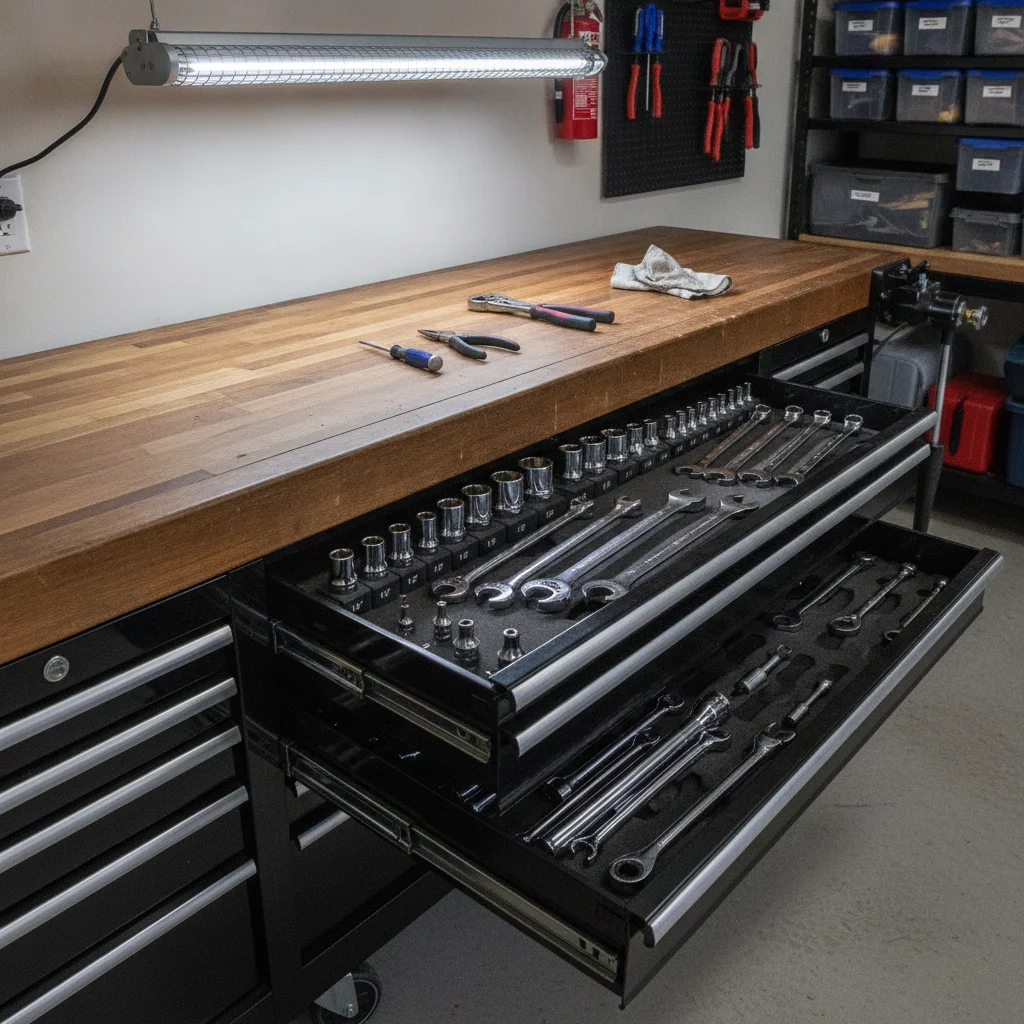
This is the foundation. If you only buy one thing, a quality socket set with both a 3/8" and 1/2" drive ratchet covers the overwhelming majority of fasteners you'll encounter on any passenger vehicle. Look for a set that includes both SAE and metric sizes — modern vehicles lean metric, but you'll still run into SAE on older American trucks and certain accessories.
The 3/8" drive handles most under-hood work: spark plugs, sensor bolts, valve cover bolts. The 1/2" drive is your go-to for suspension, wheel lug nuts, and anything that requires serious torque. A good set runs from 8mm to 19mm in metric, and you'll want deep sockets for spark plugs and recessed fasteners.
- What to look for: 72-tooth or higher ratchet mechanism (finer swing arc in tight spots), chrome vanadium steel, a hard case for organization
- Brands worth considering: Gearwrench, Tekton, Craftsman (the USA-made line), or a used Snap-on/Mac set if you find one at a garage sale
- Skip: Any no-name 200+ piece combo set under $40 — the metal is soft and the tolerances are loose, which rounds bolt heads
A quality socket set covers the majority of fasteners on any vehicle — it's the one tool worth spending real money on.
Combination Wrench Set
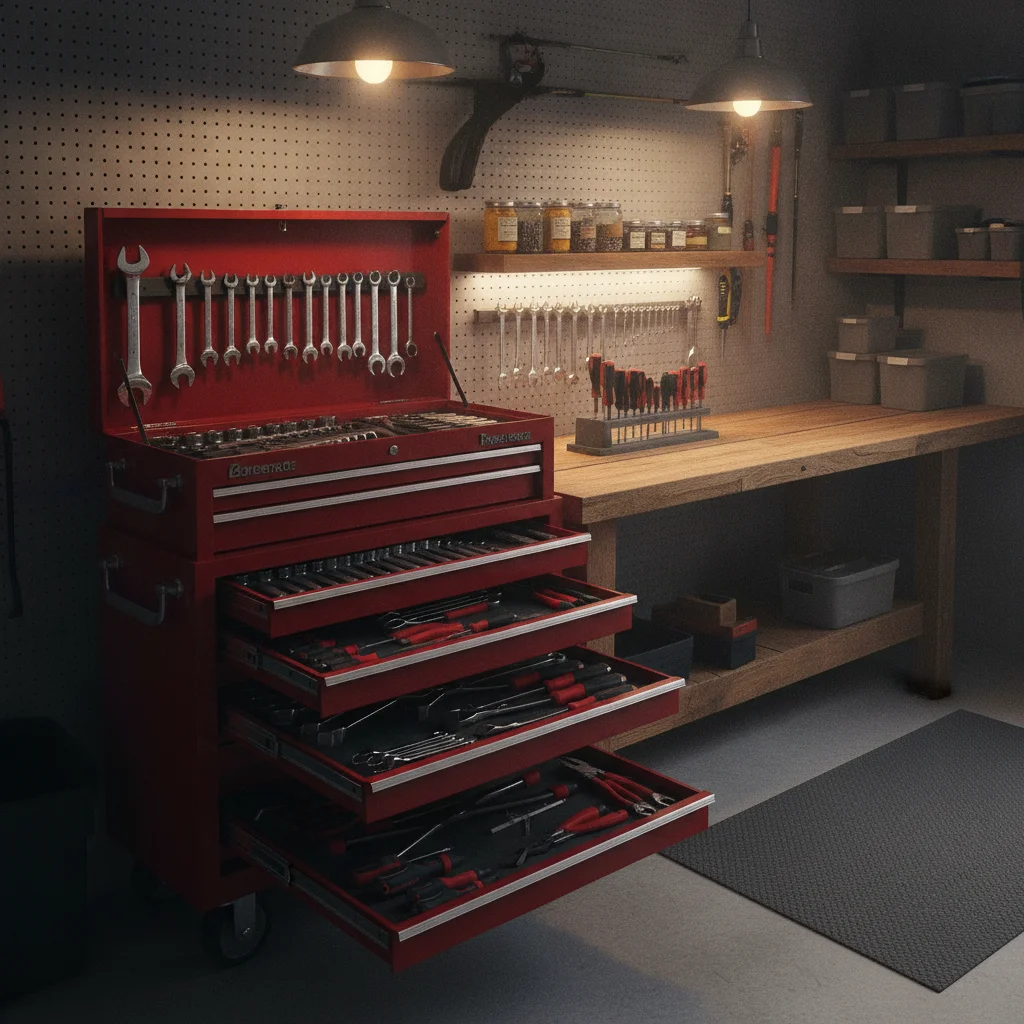
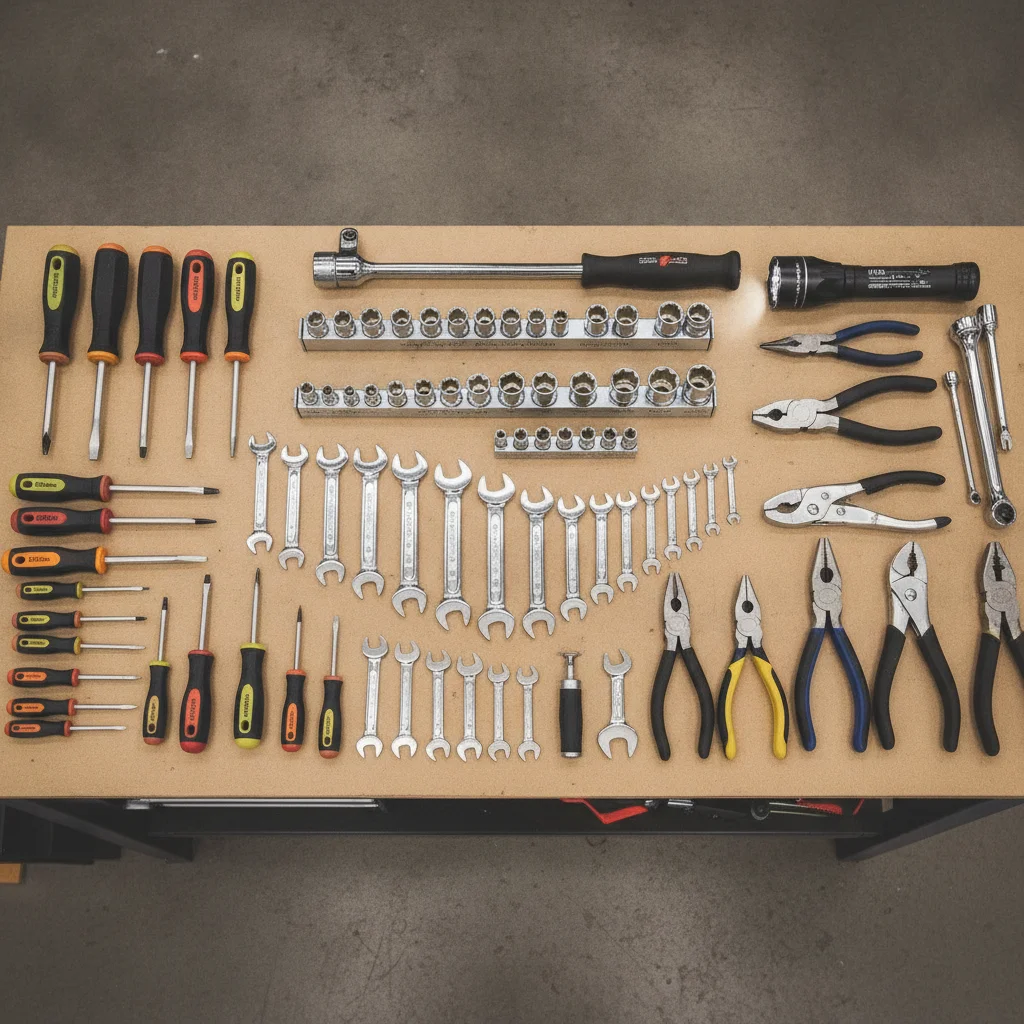
Sockets can't reach everything. Combination wrenches — open-end on one side, box-end on the other — get you into tight engine bays, around obstacles, and onto fasteners where a ratchet simply won't fit. They're also your backup when a bolt head is slightly rounded and you need a better bite than a socket can give you.
A set from 8mm to 19mm handles most jobs. Longer wrenches give you more leverage; shorter ones get into tighter spaces. Some mechanics prefer a set with ratcheting box ends, which speed up work considerably when you're in an awkward position.
[in_content_images:1]Keep them sorted and stored together. A wrench you can't find in 30 seconds might as well not exist when you're elbow-deep in an engine bay.
Combination wrenches reach fasteners that sockets can't — always have both in the box.
Floor Jack and Jack Stands
I'm going to be direct about this one: jack stands are not optional. A floor jack is a lifting tool, not a support tool. Hydraulic seals fail. Jacks slip. People die under cars that rolled off a floor jack. Every single time you put your body under a vehicle, it needs to be on rated jack stands, period.
For most passenger cars, a 2-ton floor jack and a pair of 3-ton jack stands are sufficient. For trucks and SUVs, step up to 3-ton jack and 6-ton stands. Position the jack on the vehicle's designated lift points — check your owner's manual, because the wrong spot can crack sills and punch through floor pans.
- Jack placement tip: Always work on a level, hard surface. Concrete is ideal. Asphalt is acceptable. Gravel is not.
- Use both stands: Place one under each side of the axle whenever possible. Never rely on a single stand.
- Bonus item: A set of wheel chocks costs about $15 and prevents the car from rolling when only the front or rear is raised.
Before you do any under-car work, run through this safety checklist — it covers jack points, stand placement, and a dozen other things worth confirming before you slide underneath.
Jack stands save lives — a floor jack alone is never a safe support when you're working underneath a vehicle.
Torque Wrench
Over-tightening is as damaging as under-tightening. Lug nuts cranked beyond spec warp brake rotors and snap wheel studs. Head bolts over-torqued pull threads out of aluminum heads. Spark plugs torqued too tight crack porcelain or seize in aluminum heads — and getting a seized spark plug out of a Toyota 4.7L V8, for example, is a nightmare you genuinely want to avoid.
A click-type torque wrench in the 1/4" to 1" range (or more practically, a 3/8" drive for 10–80 ft-lb and a 1/2" drive for 20–150 ft-lb) covers nearly everything in a typical garage. When the wrench clicks, stop. That click is the whole point.
Every manufacturer publishes torque specs in their service manual, and most are available free through ALLDATA DIY or a quick search of your model's forums. Look them up. Write them down. Use them every time.
A torque wrench isn't about being precise for fun — it's about not destroying the thing you're trying to fix.
OBD-II Scanner
That check engine light is your car talking. An OBD-II scanner is how you listen. Every vehicle sold in the US after 1996 has an OBD-II port, usually under the dash near the steering column, and any scanner plugs right into it to pull diagnostic trouble codes (DTCs).
Basic scanners read and clear codes, which alone is worth the $30–$80 price of entry. Mid-range tools ($100–$200) add live data streaming — real-time sensor readings that tell you whether your oxygen sensor is cycling correctly, whether your MAF readings look right, or whether your coolant temp sensor is feeding the ECU bad data. That live data capability is what separates a useful diagnostic tool from a code reader.
[in_content_images:2]Bluetooth-based scanners paired with apps like Torque Pro or OBD Fusion are excellent for intermediate users. If you want a standalone unit, Autel and Launch both make reliable mid-range options.
One practical note: if you're evaluating a used car purchase and wondering what's hiding under the hood, an OBD-II scan paired with a physical inspection covers a lot of ground. Here's what to look at under the hood even if you don't know engines.
An OBD-II scanner pays for itself the first time it saves you a $150 dealer diagnostic fee.
Screwdriver Set (Flathead and Phillips, Multiple Sizes)
It sounds obvious, but an incomplete screwdriver set is one of the most common reasons DIY jobs go slowly. You need multiple sizes of both flathead and Phillips — a large Phillips for battery terminals and airbox covers, a small one for interior trim screws, a stubby for tight spaces. A few Torx and hex-key drivers belong in the same drawer, because modern vehicles use both extensively on everything from brake caliper guides to seat rail bolts.
Magnetic tips are a minor but worthwhile feature — they hold screws in place when you're working in areas where dropping a fastener means fishing it out of the intake manifold with a magnet on a stick.
Don't use a screwdriver as a pry bar. That strips the tip and rounds the screw head. If something won't budge, reach for a penetrating oil like PB Blaster and wait 15 minutes. Patience is a tool too.
Multiple sizes of Phillips and flathead drivers — plus a few Torx — cover more fasteners than most people expect.
Breaker Bar
Sometimes a ratchet just doesn't have enough leverage. Lug nuts torqued at the shop with an impact gun, rusty exhaust manifold studs, crankshaft bolts — these require serious force, and a ratchet pushed beyond its limits will either round the bolt or break the ratchet mechanism. A breaker bar, typically 18" to 24" long, gives you the leverage to break those fasteners loose without destroying tools or injuring yourself.
The 1/2" drive breaker bar is the most universally useful. If you're working on lug nuts, a 24" bar gives you enough mechanical advantage to pop most factory-torqued lugs by hand, even after a shop used an impact driver. Extensions and universal joints work with a breaker bar the same way they do with a ratchet, so your existing socket collection carries over.
A breaker bar turns a stuck bolt into a solvable problem — a ratchet pushed too hard just becomes another broken tool.
Pliers Set (Including Needle-Nose and Channel-Lock)
Pliers are the grab-and-hold tools of the toolbox. You need several types because each is shaped to grab something different. Standard slip-joint pliers for general gripping, needle-nose for reaching into tight spaces and grabbing small clips or wires, and channel-lock (tongue-and-groove) pliers for large-diameter gripping like hose clamps, coolant hoses, and large fittings.
A pair of locking pliers — Vise-Grips — rounds out this category. They clamp onto a fastener or component and hold it hands-free, which is invaluable when you need three hands and only have two. They're also useful for turning a stripped bolt head when nothing else will get purchase.
Keep pliers away from electrical connectors and delicate sensors. The jaws aren't designed for precision, and it's easy to crush a wiring connector that costs $80 to replace if you squeeze in the wrong spot.
Needle-nose, channel-lock, and locking pliers together cover nearly every grabbing task in the engine bay.
Oil Drain Pan and Funnel
An oil change is the single most important maintenance task you can do for your engine, and it's completely within reach for any home mechanic. But you need somewhere to put the old oil. A wide, low-profile drain pan — at least 6 quarts capacity, preferably more — catches oil cleanly when you pull the drain plug. Shallow and wide is better than deep and narrow; oil comes out fast and at an angle, and a narrow pan misses the first pour.
A funnel keeps fresh oil going in the fill tube and not down the side of the valve cover. Sounds trivial, but spilled oil on a hot exhaust manifold smells awful and creates a fire hazard. Get a long-neck funnel that seats firmly in the fill port.
Used oil needs to go somewhere legal: most auto parts stores accept it for free recycling. A sealed, resealable container for transport is worth having.
A good drain pan and funnel make oil changes clean and fast — the foundation of every well-maintained vehicle.
Work Light or LED Headlamp
You cannot fix what you cannot see. This is one of those painfully obvious statements that still trips people up. A quality LED work light — either a rechargeable drop light on a magnetic base or a corded flood lamp — illuminates the engine bay far better than your phone flashlight and keeps your hands free. A rechargeable headlamp is the other half of this equation, for work that requires you to look directly where your hands are going.
Look for lights with at least 500 lumens, a diffuse beam (not a spotlight), and a flexible neck or magnetic mount. The magnetic mount is surprisingly useful — it sticks to the firewall, the hood, or the side of the engine block and stays where you point it.
Good lighting also helps you catch developing problems: a fresh oil stain on a dry engine becomes obvious when you can actually see it. Mechanics who never get stranded twice make a habit of looking at the whole engine bay every time they're under the hood, and that habit only works in good light.
You cannot diagnose or fix what you cannot see — a quality work light is non-negotiable in any real shop setup.
Buy Tools Before You Need Them
The worst time to buy a tool is the middle of a repair when your car is already torn apart. Build your toolkit before you start any job, and you'll avoid making rushed, low-quality purchases at the local parts store for twice the price. Even buying one or two quality tools per month adds up fast — within six months you'll have a legitimate working set.
Used Quality Beats New Budget
A used Snap-on ratchet found at a garage sale or estate sale will outperform a brand-new no-name set bought off a discount bin. Professional-grade tools from major brands are built to last decades. If you find quality used tools at a reasonable price, buy them — condition matters more than the 'new' sticker.
Specialty Tools Are Job-Specific
This list focuses on universal tools that apply across nearly every repair. There are also job-specific specialty tools — harmonic balancer pullers, valve spring compressors, cam phaser lock tools — that you only need for specific repairs. Rent these from auto parts stores before buying; most offer a tool loaner program that lets you deposit the retail price, use the tool, and get a full refund when you return it.
Check Your Vehicle's Service Manual
Every vehicle has its own quirks — specific socket sizes, torque specs, and required specialty tools. Many manufacturers publish factory service manuals that are available for free or low cost through model-specific forums. A subscription to ALLDATA DIY or Mitchell1 is another option that gives you access to factory repair data for your specific year, make, and model. This information prevents a lot of guesswork and expensive mistakes.
Building Smart: Prioritize, Then Expand
You don't need everything on this list on day one. Start with the socket set, combination wrenches, jack stands, and a floor jack. Those four cover oil changes, brake jobs, battery swaps, and spark plug replacements — essentially everything in the beginner tier. Add the torque wrench and OBD-II scanner as soon as the budget allows, because they prevent the most expensive mistakes.
As you take on more complex work, the specialty tools — breaker bars, code readers with live data, compression testers — pay for themselves fast. A single saved diagnostic visit to the dealer can cover the cost of several tools on this list.
Quality matters more than quantity. A mid-grade socket set from a reputable brand will outperform a cheap 300-piece set every time. Avoid the temptation to buy the massive combo kit at a discount store. Buy fewer, better tools, and they'll last decades.
Good maintenance habits don't just keep your car reliable — they protect its value. If you're thinking about resale down the road, check out the detailing and repairs guidance to understand which fix-up steps actually move the needle on your car's worth. And for a bigger picture look at everything a non-expert can safely handle at home, The Complete At-Home Car Maintenance Playbook walks you through it end to end.

All claims are backed by peer-reviewed research. Sources on request.