| Legal framework | Right-of-way is defined through yield obligations, not entitlements |
| Primary crash factor | Failure to yield is one of the top cited causes in intersection crashes (NHTSA Crash Statistics) |
| Unmarked crosswalk rule | Pedestrians have legal right-of-way at any intersection, marked or not (Uniform Vehicle Code, adopted in most states) |
| Left-turn rule | Left-turning drivers must yield to all oncoming traffic posing a hazard |
| Four-way stop tie-breaker | Simultaneous arrival: driver on the left yields to driver on the right |
| Emergency vehicle rule | Pull to the right and stop — applicable in all 50 states |
| Roundabout priority | Circulating traffic always has priority over entering vehicles (IIHS Roundabout Safety Research) |
| Highway merge rule | Highway traffic has right-of-way; merging driver must yield |
Right-of-Way Is a System, Not a Privilege
Ask most drivers what "right-of-way" means, and they'll say something like: "It means I get to go first." That's not wrong, exactly — but it's incomplete in a way that causes real crashes. Right-of-way is better understood as a crash-prevention protocol: a set of rules that assigns the order of movement at conflict points so that two vehicles don't try to occupy the same space at the same time.
The most important thing to understand about right-of-way is this: no driver is ever legally entitled to take it. Every state's vehicle code is structured around the concept of yielding — the obligation one driver has to let another proceed. You don't "have" the right-of-way so much as other drivers are required to yield it to you. This distinction matters enormously when something goes wrong.
If you are legally in the right — say, proceeding through a green light — but a pedestrian is crossing against the signal and you strike them, you may still face civil liability if a court finds you could have reasonably avoided the collision. The right-of-way system describes expected behavior, not legal immunity.
| Legal framework | Right-of-way is defined through yield obligations, not entitlements |
| Primary crash factor | Failure to yield is one of the top cited causes in intersection crashes (NHTSA Crash Statistics) |
| Unmarked crosswalk rule | Pedestrians have legal right-of-way at any intersection, marked or not (Uniform Vehicle Code, adopted in most states) |
| Left-turn rule | Left-turning drivers must yield to all oncoming traffic posing a hazard |
| Four-way stop tie-breaker | Simultaneous arrival: driver on the left yields to driver on the right |
| Emergency vehicle rule | Pull to the right and stop — applicable in all 50 states |
| Roundabout priority | Circulating traffic always has priority over entering vehicles (IIHS Roundabout Safety Research) |
| Highway merge rule | Highway traffic has right-of-way; merging driver must yield |
The rules covered in this reference apply to standard U.S. traffic scenarios. State laws vary in specific language, but the underlying logic is consistent across all 50 states and the District of Columbia. For deeper coverage of how these rules apply specifically to intersections, see our breakdown of right-of-way rules at intersections.
The Core Rules: A Plain-Language Reference
Most right-of-way conflicts happen because drivers apply a half-remembered version of a rule — one that was roughly correct for a simpler situation — to a more complex one. Here are the foundational rules, stated precisely.
Right-of-Way
The legal right of one road user to proceed ahead of another in a given situation. In practice, it is framed as an obligation on one party to yield rather than an entitlement for the other to proceed regardless of conditions.
Yield
To slow or stop as required to let another vehicle, cyclist, or pedestrian proceed before you. A yield obligation is conditional on the presence of conflicting traffic — if none exists, you may proceed without stopping.
Uncontrolled Intersection
An intersection with no traffic signals, stop signs, or yield signs governing any approach. Drivers must use right-of-way rules based on arrival order and the yield-to-the-right principle.
Unmarked Crosswalk
A legally recognized pedestrian crossing that exists at the intersection of any two public roads, even without painted markings. Drivers are typically required to yield to pedestrians in unmarked crosswalks just as they would in marked ones.
Contributory Negligence
A legal doctrine in a minority of states that bars a plaintiff from recovering any damages if they contributed any fault to the accident, regardless of the other party's greater share of blame.
Comparative Negligence
The prevailing fault standard in most U.S. states, under which a plaintiff's damages are reduced proportionally by their percentage of fault in causing the accident.
Merging Vehicle
A vehicle entering a roadway from an on-ramp, shoulder, or side street. In nearly all U.S. jurisdictions, the merging vehicle must yield to traffic already traveling in the lane being entered.
Roundabout
A circular intersection where entering traffic must yield to vehicles already circulating within the circle. Unlike a traffic signal, roundabouts use continuous flow rather than stopping all directions of traffic.
Stop Signs and Four-Way Stops
At a standard two-way stop, the vehicles on the uncontrolled road (the one without stop signs) have right-of-way. Drivers at the stop sign must yield to all traffic on the through road before proceeding — not just traffic approaching from the left.
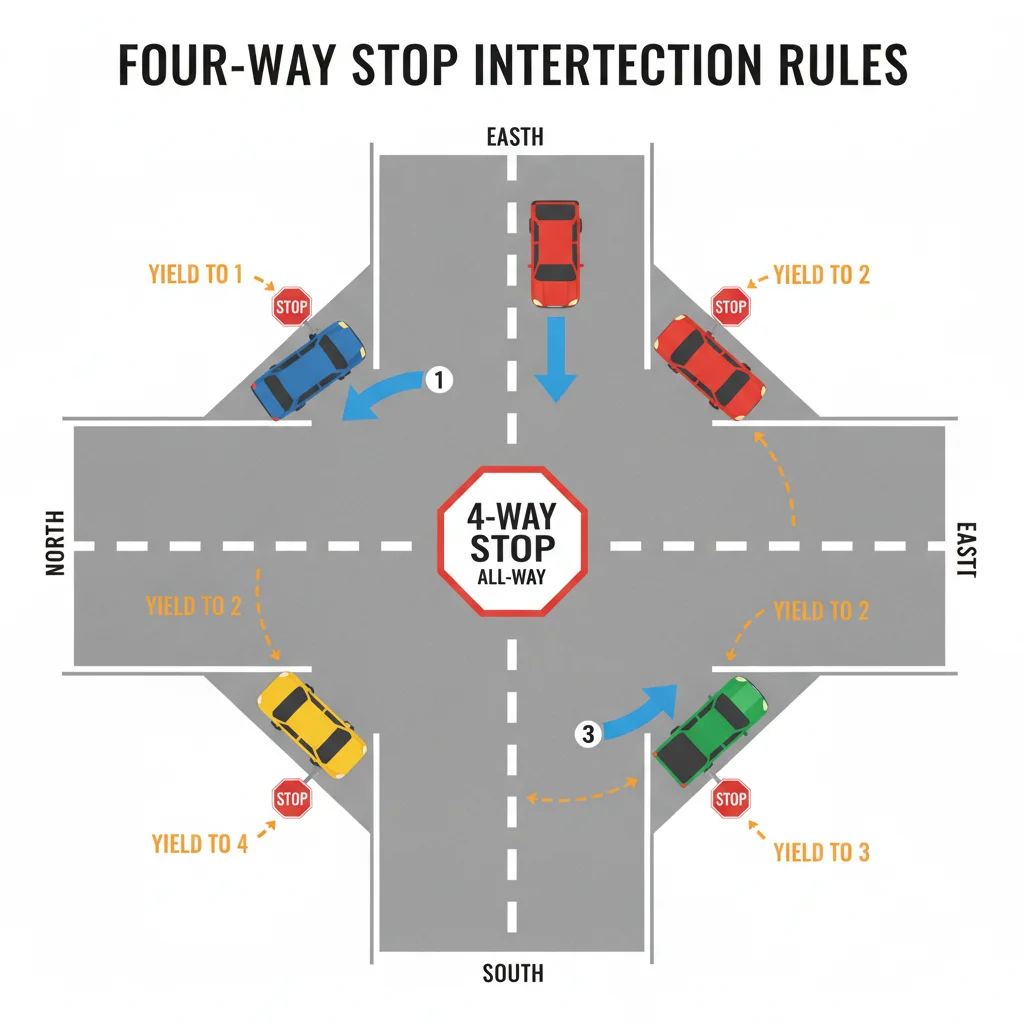
At a four-way stop, the rule is first-arrived, first-served. If two vehicles arrive simultaneously, the driver on the left yields to the driver on the right. If vehicles are directly across from each other and both going straight, they may proceed simultaneously. If one is turning left across the other's path, the left-turning driver yields.
Yield Signs
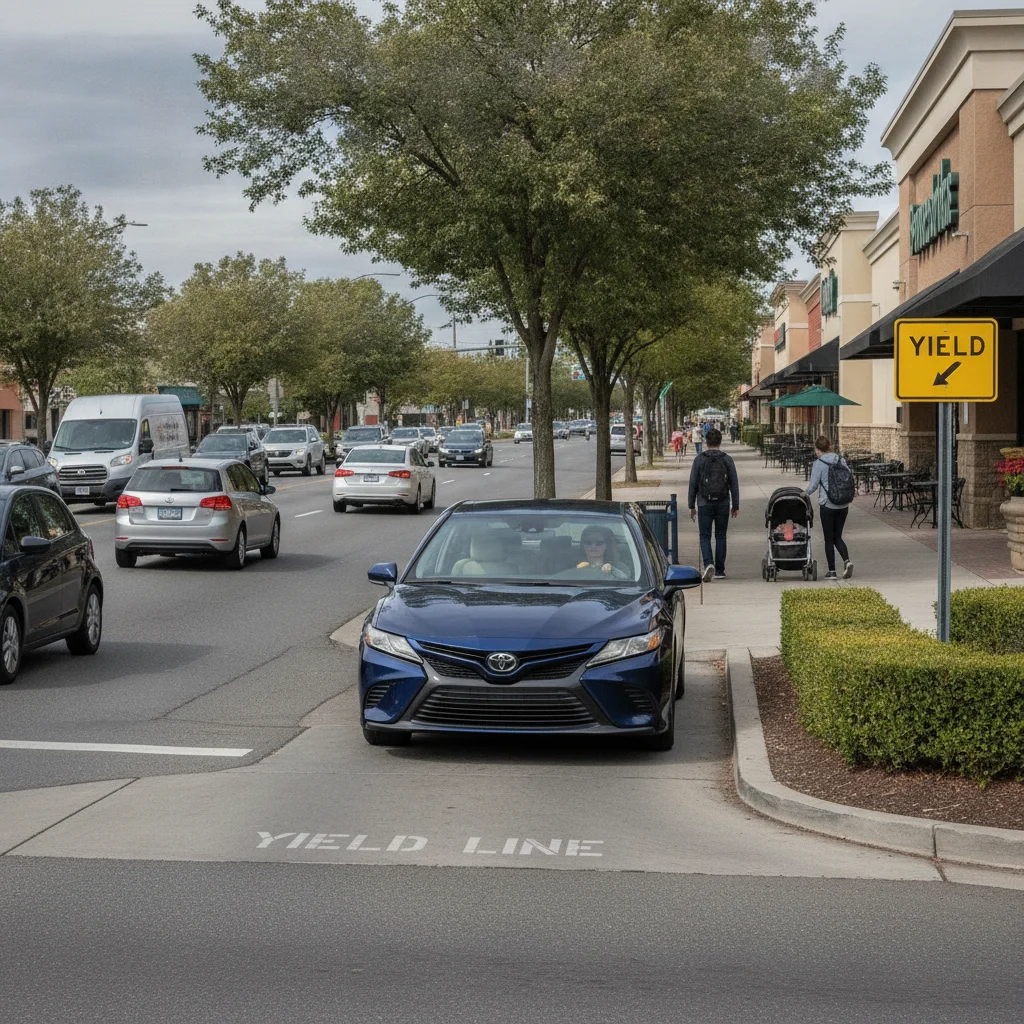
A yield sign requires you to slow — and stop if necessary — to let conflicting traffic pass. Unlike a stop sign, you aren't required to come to a complete stop if the way is clearly clear. The error most drivers make: treating a yield as a suggestion rather than a conditional stop requirement.
Uncontrolled Intersections
When there are no signs or signals at all, every driver must treat the intersection as a yield situation. The right-of-way goes to the vehicle that arrived first. If simultaneous arrival, yield to the driver on your right. These are among the most dangerous intersections precisely because many drivers don't know this rule exists — they simply slow and hope.
Left Turns
A left-turning vehicle must yield to all oncoming traffic that is close enough to constitute a hazard. This is one of the most consistently misapplied rules on the road. "Close enough" is not defined in most statutes — it requires judgment. The NHTSA data on intersection fatalities consistently shows left turns as a disproportionate crash contributor. When in doubt, wait.
Merging onto a Highway
Vehicles on the highway have right-of-way over merging vehicles. You are responsible for matching speed and finding a gap — highway traffic is not required to make room for you, though courteous drivers often do. Many drivers invert this rule entirely, merging at low speed and expecting others to brake.
Roundabouts
Traffic already circulating inside the roundabout has right-of-way. Entering vehicles must yield. This is the foundational rule of every modern roundabout, yet it's still violated with remarkable frequency — particularly by drivers who were trained primarily on signal-controlled intersections.
High-Frequency Mistakes: Where Drivers Go Wrong
Right-of-way errors aren't random. Research from the Insurance Institute for Highway Safety (IIHS) and federal crash databases identifies a consistent set of scenarios where drivers make predictable mistakes. Understanding the pattern is the first step to breaking it.
40%
Of all traffic crashes occur at intersections
According to NHTSA, approximately 40% of all U.S. crashes happen at or near intersections, where right-of-way disputes are the dominant causal factor.
~3,500
Annual U.S. pedestrian deaths at intersections
NHTSA pedestrian safety data shows thousands of fatalities annually occur at or near intersections, many involving failure to yield to pedestrians.
22%
Of intersection crashes involve left turns
Federal Highway Administration research identifies left-turn maneuvers as a disproportionate contributor to serious intersection crashes.
75%
Reduction in injury crashes at roundabouts vs. signalized intersections
IIHS studies consistently show roundabouts — which enforce right-of-way through design — dramatically reduce serious injury crashes compared to traffic signals.
The "Courtesy Wave" Problem
A driver stopped in traffic waves you through a turn or into a lane. You proceed — and get struck by a vehicle in the adjacent lane that couldn't see the wave and had no reason to yield. This scenario, sometimes called the "blocked sight-line" crash, is a direct consequence of treating a courtesy wave as a legal right-of-way transfer. It isn't one. No individual driver can grant you right-of-way on behalf of traffic they don't control.
Pedestrians at Unmarked Crosswalks
Most drivers know they must stop for pedestrians at marked crosswalks. Fewer know that pedestrians have right-of-way at any intersection — marked or not — once they've stepped into the crosswalk on their side of the street. An "unmarked crosswalk" legally exists at the intersection of any two public roads, even if no paint is present. This surprises a significant number of drivers when it comes up in insurance claims or litigation.
Right-of-Way Does Not Equal Legal Immunity
Having the legal right-of-way does not eliminate your duty to exercise reasonable care. Courts in most states have held that a driver who had right-of-way can still be found partially or fully liable if they failed to take reasonable evasive action when a hazard was clearly visible. The right-of-way system describes expected behavior under normal conditions — it doesn't override the basic duty to avoid foreseeable harm.
State Law Variations to Know
While right-of-way logic is consistent nationwide, specific statutory language varies by state. Some states require a complete stop before yielding at certain intersections; others don't. A handful of states have specific roundabout statutes. If you drive regularly across state lines, check the driver's manual for each state — they are available free from each state's DMV website and are typically under 100 pages.
Cyclists and E-Bikes Have Road Rights Too
In most U.S. states, bicycles operated on public roads have the same right-of-way rights as motor vehicles in equivalent positions. E-bikes classified as Class 1 or Class 2 generally follow the same rules. This means a cyclist proceeding through a green light or crossing an intersection with right-of-way must be yielded to — failing to do so creates the same liability exposure as failing to yield to another car.
Emergency Vehicles
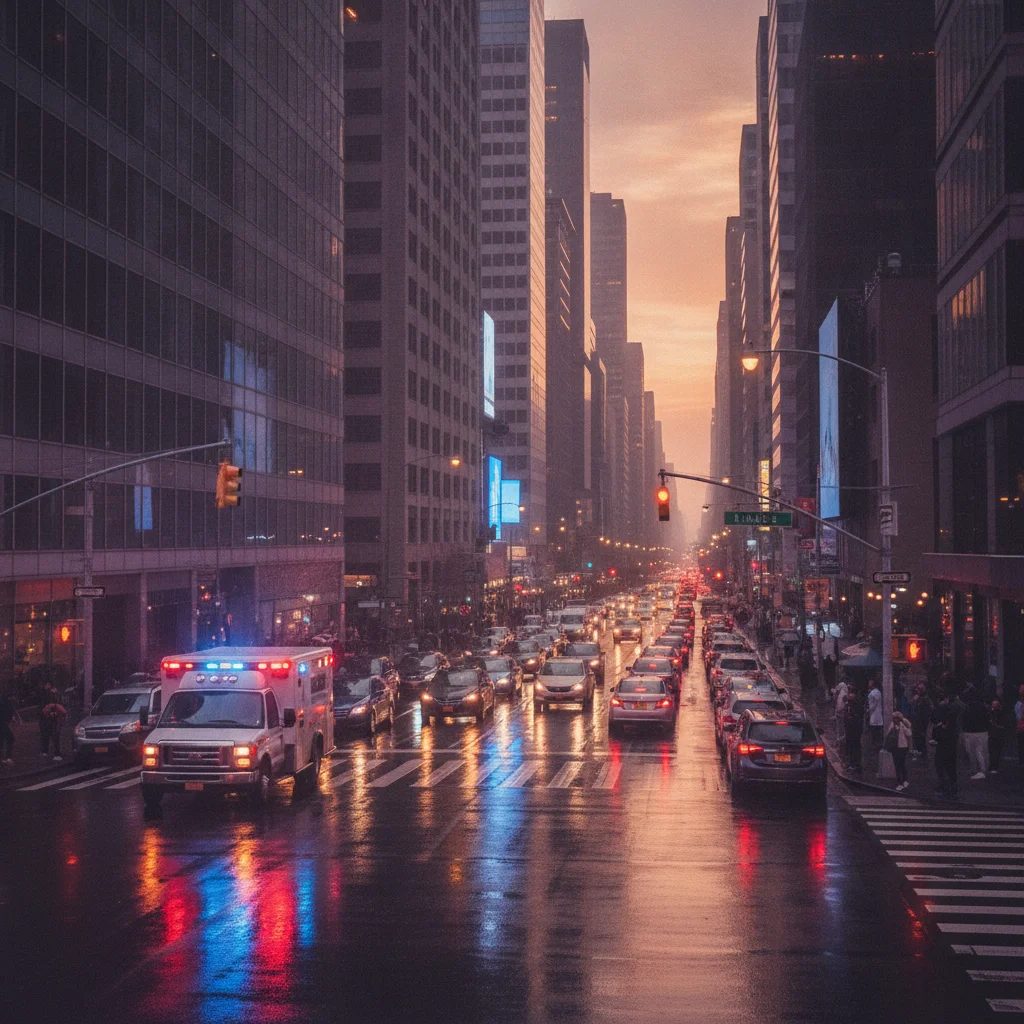
When a fire truck, ambulance, or police vehicle approaches with lights and sirens active, the rule is straightforward in statute but poorly executed in practice: pull to the right and stop. Not slow down. Not pull left. Not brake in the lane. Pull right and stop until the vehicle passes. Many drivers brake or drift left — sometimes directly into the path of the emergency vehicle. For a full breakdown of what the law requires, see our guide to emergency vehicle traffic laws.
T-Intersections
At a T-intersection with no signage, the vehicle on the terminating road (the one that ends) must yield to traffic on the through road. Many drivers treat this as a four-way stop situation and take turns — which works until a through-road driver who knows the rule doesn't stop and a collision results.
Driveways and Parking Lots
Vehicles exiting a driveway or parking lot onto a public road must yield to all traffic on that road — including cyclists and pedestrians on sidewalks. This seems obvious but is violated constantly, particularly in parking lots where drivers treat internal drive lanes as equivalent to public roads with negotiated right-of-way.
How Right-of-Way Errors Affect Insurance and Liability
Right-of-way violations don't just create crash risk — they create legal and financial exposure. In most states, if an investigator or insurer determines that you failed to yield when required, you'll bear significant or primary fault for the resulting collision. That finding affects your insurance claim, your rates, and potentially your license.
Fault determination in rear-end collisions — one of the most common crash types — follows right-of-way logic even when no intersection is involved. The trailing driver is presumed at fault in most jurisdictions because following traffic is obligated to maintain safe stopping distance. But this presumption can be rebutted: if the lead vehicle brake-checked, cut off, or merged unsafely, the fault picture changes.
It's also worth understanding that commonly misunderstood traffic laws — including right-of-way rules — are among the most frequently cited in police reports following crashes. Officers are trained to reconstruct which driver had right-of-way and use that as the primary fault indicator. If you're cited for failing to yield, expect it to appear on your driving record and in your insurer's claims calculation.
One frequently overlooked issue: contributory and comparative negligence. In contributory negligence states (a small minority), any fault on your part — even if the other driver violated right-of-way — can bar you from recovery entirely. In the majority of states using comparative negligence, your recovery is reduced by your percentage of fault. Knowing which standard applies in your state matters if you're ever in a serious crash.
NHTSA Intersection Safety Resources
The National Highway Traffic Safety Administration publishes crash data and driver education materials specifically focused on intersection behavior and right-of-way errors. Useful for understanding the statistical scope of the problem.
Your State DMV Driver's Manual
Every state DMV publishes a free driver's manual covering the exact statutory language of right-of-way rules in that jurisdiction. Essential reading if you've never reviewed it since your original license exam.
IIHS Roundabout Safety Research
The Insurance Institute for Highway Safety has published extensive research on roundabout safety outcomes compared to signal-controlled intersections, including how right-of-way design reduces crash severity.
AAA Foundation for Traffic Safety — Driver Research
The AAA Foundation publishes regular research reports on driver behavior, including studies on right-of-way comprehension and intersection decision-making across age groups.
Practical Rules to Drive By
Knowing the law is necessary but not sufficient. The gap between knowing a rule and applying it correctly under time pressure — often in under two seconds — is where driving habits are built. The following principles translate right-of-way law into practical behavior.
Yield to Avoid, Not to Win
The purpose of right-of-way rules is crash avoidance. If yielding when you technically have the right-of-way prevents a collision, yield. You'll never regret it. "But I had the right-of-way" is not a useful thing to say from a hospital bed or a deposition.
Establish Eye Contact at Ambiguous Points
At four-way stops, roundabout entries, and uncontrolled intersections, make a genuine attempt to establish visual confirmation with other drivers before proceeding. Don't assume your read of the situation is shared by everyone at the intersection.
Never Assume a Courtesy Is a Right
Any time another driver waves you through — whether at a turn, a lane change, or a parking exit — verify that the gesture controls the relevant traffic before moving. It often doesn't.
Treat Unfamiliar Intersection Types as Yields
If you encounter an intersection type you're uncertain about — a traffic circle, an uncontrolled rural cross-street, a flashing yellow-red combination — default to yielding and observing before proceeding. Overconfidence about rules you're not certain of is a documented crash factor.
For readers interested in a deeper look at how specific intersection configurations create right-of-way confusion, our companion reference on right-of-way rules most drivers misread covers uncontrolled crossings, multi-lane yield scenarios, and more. And for broader context on traffic laws that affect your driving record and insurance, our full topic hub is a useful starting point.
Right-of-way isn't complicated — but it demands accuracy. A rough approximation of the rules will serve you well most of the time, until the one situation where it doesn't. Knowing the precise rule, in advance, is the difference between a near-miss and a claim.

All claims are backed by peer-reviewed research. Sources on request.