
Key Takeaways
Summary
22 items · 20–40 minutes
Why CPO Doesn't Mean Risk-Free
Certified pre-owned programs were designed to give buyers confidence — a manufacturer or dealer stamps a vehicle as inspected, reconditioned, and backed by an extended warranty. That sounds reassuring, and often it is. But the word "certified" can mean wildly different things depending on who issued the certification. A franchise dealer selling a manufacturer-backed CPO Toyota is a very different animal from an independent lot calling a car "certified" because they changed the oil and vacuumed the interior.
Even legitimate manufacturer CPO programs have gaps — exclusions buried in warranty fine print, mileage ceilings that make the coverage almost worthless on a higher-mileage car, and deductibles that add up fast if you need repairs. And dealers, even reputable ones, are still businesses looking to maximize margin.
The red flags in this checklist fall into four categories: vehicle history issues, warranty and paperwork problems, dealer behavior, and physical inspection concerns. Work through each one before you sign anything. For a broader pre-signing review, see our CPO buyer's pre-purchase checklist — it pairs well with this guide.
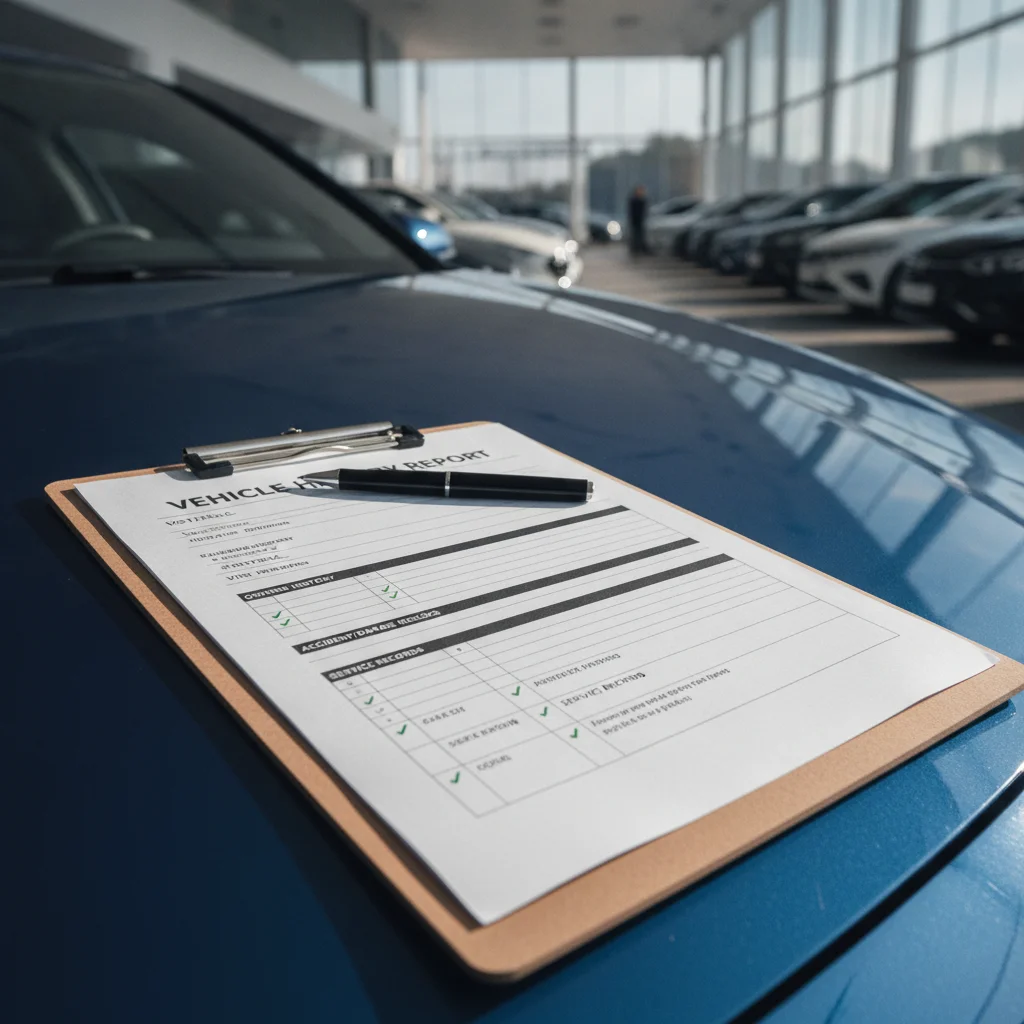
What You Need Before You Start
You cannot evaluate a CPO deal from the showroom floor alone. Bring or access the following tools before your dealership visit — ideally before you even schedule a test drive on a specific vehicle.
Carfax or AutoCheck Report
Pulls the vehicle's full history including accidents, title events, mileage records, and service visits based on the VIN.
CPO Warranty Contract (manufacturer's actual document)
The binding document detailing what is and isn't covered — not a dealer summary sheet, which can omit key exclusions.
CPO Inspection Report (technician's checklist)
The itemized form completed by the certifying technician showing which components were tested and what condition they were in.
Independent Pre-Purchase Inspection (PPI)
A $100–$150 inspection by a mechanic of your choosing that reveals issues the CPO inspection may have missed or overlooked.
Market Value Tool (Edmunds TMV or KBB)
Provides a fair-market price range for the specific vehicle so you can assess whether the CPO premium is reasonable.
Third-Party Extended Warranty Quotes
Lets you compare the CPO program's cost-benefit against purchasing a non-CPO used car with an aftermarket warranty.
Having these resources in hand puts you on equal footing with the dealer. A seller who refuses to accommodate any of these requests — particularly the inspection report and vehicle history report — is itself a red flag worth noting.
The Red Flags: Full Checklist
Work through each group below. A single "must" red flag is usually enough to walk away. Multiple "should" flags in the same category deserve serious reconsideration — even if no single one is disqualifying on its own.
Vehicle History Red Flags
Warranty and Certification Documentation Red Flags
Dealer Behavior Red Flags
Physical Inspection Red Flags
Dealer-Certified Is Not the Same as Manufacturer-Certified
Any dealer can call a car "certified" without meeting any standardized criteria. Manufacturer-backed CPO programs (Toyota Certified, Honda Certified, GM Certified Service) require specific inspection checklists and are backed by the manufacturer's warranty infrastructure. A dealer-certified label carries no such requirement — the "certification" may amount to little more than a basic safety check. Always ask: "Is this manufacturer-backed CPO or dealer-certified?" and get the answer in writing.
Don't Let the Monthly Payment Hide the Total Cost
Dealers sometimes fold CPO add-on products into the monthly payment quote before you realize what you've agreed to. A $40/month addition sounds minor — but over 60 months that's $2,400 for a product you may not need or want. Always ask for the out-the-door price of the vehicle itself, separate from any finance and insurance products.
For broader deal-level red flags that apply to any car purchase — not just CPO — review our article on red flags in a car deal that should make you pause. Many of those signals apply here too.
Digging Into the Warranty Fine Print
The warranty is what you're paying a premium for. If the coverage doesn't hold up under scrutiny, the CPO price premium isn't justified. Here's how to dissect it:
Powertrain vs. Bumper-to-Bumper
Most manufacturer CPO programs offer two tiers: a limited powertrain warranty covering engine, transmission, and drivetrain, and a shorter bumper-to-bumper (comprehensive) warranty covering most other systems. The bumper-to-bumper period is typically shorter — sometimes just 12 months or 12,000 miles. If the car is near the end of that window, your coverage quickly reverts to powertrain only.
What's Actually Excluded
Read the exclusions list, not the coverage list. CPO warranties almost universally exclude: wear items (brakes, tires, wiper blades), maintenance services, cosmetic damage, and any pre-existing conditions noted at inspection. Some also exclude infotainment systems, in-vehicle technology, and hybrid or EV battery packs unless specifically listed.
Deductibles Per Visit vs. Per Repair
A $200 deductible per visit is very different from $200 per repair order line item. If your car needs three separate repairs diagnosed on the same day, a per-item deductible could cost you $600 out of pocket before warranty coverage kicks in. Ask explicitly: "Is this deductible per visit or per repair?"

Transferability
If you plan to resell the vehicle before the warranty expires, transferability matters. Some CPO warranties transfer to subsequent owners automatically; others expire at first resale or require a transfer fee. A non-transferable warranty reduces the car's resale value — which affects your total cost of ownership.
Structural Damage Is a Hard No — Every Time
No CPO certification overrides a structural or frame damage notation in the vehicle history. Frame repairs compromise crash safety in ways that are difficult to fully restore, and they are almost never disclosed on the showroom floor. If your vehicle history report shows frame or structural damage, walk away immediately — the certification badge is irrelevant.
CPO Warranty Starts at the Original In-Service Date
Manufacturer CPO warranties count mileage and time from the original sale date, not from when you purchase the CPO vehicle. A three-year-old car with 30,000 miles may have substantially less bumper-to-bumper coverage remaining than the dealer implies. Always calculate coverage from the original in-service date shown on the warranty document, not from today.
CPO add-ons sold at the dealer — extended service contracts, paint protection, tire-and-wheel coverage — are separate products, not part of the manufacturer warranty. These have their own exclusions and their own profit margins. We cover these in detail in our piece on hidden costs of buying CPO — read it before the finance office conversation.
When the Math Doesn't Add Up
Sometimes the vehicle and the warranty both check out, but the numbers still don't justify the CPO premium. Here's a quick framework to run at the dealership:
| Scenario | CPO Price | Comparable Non-CPO Used | CPO Premium | Worth It? |
|---|---|---|---|---|
| Low mileage, long warranty remaining | $28,500 | $25,800 | $2,700 | Likely yes |
| Near mileage ceiling, short warranty left | $24,000 | $21,500 | $2,500 | Probably not |
| Powertrain-only coverage, high deductible | $22,000 | $19,000 | $3,000 | No — buy used + third-party warranty |
If the CPO premium exceeds what a comparable third-party extended warranty would cost on a non-CPO version of the same car, you are paying for a brand name, not superior coverage. This is a financial decision worth running the numbers on before you get emotionally attached to a specific vehicle.
Financing red flags deserve equal attention. If the dealer's CPO loan rate seems high relative to your credit score, or if the finance manager is steering you hard toward in-house financing, review our article on red flags in a preapproval offer — the same deceptive structures can appear in CPO financing.
How to Use This Checklist at the Dealership
Print or download this checklist before you go. Here's the sequence that works best:
- Run the vehicle history report at home using the VIN from the dealer's online listing — before you drive to the lot. Structural damage, flood history, or a lemon law buyback should end the conversation before it starts.
- Request the CPO inspection report when you arrive. A dealer who cannot produce it or who "needs to find it" is stalling. Give them five minutes; then move on.
- Read the warranty contract — the actual document, not the summary sheet. Ask the sales manager for a copy to review privately.
- Schedule an independent pre-purchase inspection at a shop of your choosing. This typically costs $100–$150 and is worth every dollar. A dealer who refuses to allow it has something to hide.
- Compare total cost: CPO sticker price plus any add-ons versus a comparable private-party or auction-sourced used car plus an aftermarket warranty.
Walking away is always an option — and often the right one. Inventory turns over. Another CPO vehicle, possibly a better one at a fairer price, will appear. The dealer knows this deal is harder to replace than you are. Use that leverage.
For a comprehensive list of everything to verify before signing on a CPO, see our full CPO pre-purchase checklist.

All claims are backed by peer-reviewed research. Sources on request.