Key Takeaways
Keeps you in a deal you've already invested in
You've spent time finding the car, arranging the inspection, and potentially traveling to see it. When findings are manageable, negotiating recovers that investment rather than abandoning it.
Converts repair costs into real price reductions
A documented $800 brake job or $600 leak repair is a concrete, unemotional basis for asking $700–$800 off the price — and most motivated sellers will accept it rather than lose the deal.
Separates informed buyers from naive ones
Sellers and dealers expect some pushback after an inspection. Arriving with specific repair estimates signals that you're a serious buyer who won't be pushed around — which often produces better outcomes.
Avoids restarting a time-consuming search
Finding a suitable used car, arranging viewings, and paying for inspections takes hours and real money. If the underlying vehicle is sound and findings are manageable, negotiating beats starting over.
Gives you leverage you wouldn't otherwise have
Without inspection findings, you're negotiating off the asking price in the abstract. With them, you have specific, documented justification for a lower number — that's a much stronger position.
Sunk-cost bias clouds clear thinking
Once you've paid for a PPI and emotionally committed to a vehicle, it's easy to rationalize staying in a bad deal. The inspection fee is gone regardless — don't let it drive your decision.
Negotiating on serious findings often leaves risk on the table
A price reduction on structural damage or a flood-history vehicle only partially compensates for ongoing problems — insurance limitations, future repair costs, and diminished resale value persist regardless of what you paid.
Sellers may accept your offer but resent the process
A grudging acceptance after hard negotiating sometimes means less cooperation on paperwork, title transfer timing, or included accessories. A seller who feels squeezed may become difficult to work with at closing.
Overplaying findings damages your credibility
Demanding $3,000 off for $400 in routine maintenance items makes sellers defensive and torpedoes goodwill. Overreaching on cosmetic findings undermines your leverage on the issues that actually matter.
You may still inherit undisclosed problems
Even a thorough PPI can miss intermittent faults, early-stage failures, or issues that only surface under specific driving conditions. A negotiated discount doesn't eliminate future repair risk — it only quantifies the known portion.
Walking away preserves negotiating power for the next deal
Buyers who walk away from bad deals consistently end up with better vehicles at better prices. Staying in a compromised deal out of fatigue often means accepting conditions you shouldn't.
Our Verdict
The inspection report is your single most powerful tool in a used car transaction — but only if you know how to read it. Cosmetic issues and normal wear are negotiating chips; structural damage, flood history, and hidden title problems are reasons to leave and never look back. Use a clear framework to sort findings into categories before you decide, and let documented repair costs drive your counter-offer rather than gut instinct.
Best for buyers who have already received a pre-purchase inspection report and need a structured way to decide whether to negotiate a price reduction or walk away entirely.
Why the Inspection Report Is the Real Negotiating Table
Most buyers treat the test drive as the moment of truth. It isn't. The pre-purchase inspection (PPI) is. A qualified independent mechanic running a vehicle through a systematic check will surface things no test drive ever will — hidden rust, deferred maintenance, compression loss, or a salvage history the seller conveniently forgot to mention.
The question after the inspection isn't "Should I buy this car?" It's "What do these findings actually mean for me, and what should I do next?" Those are two very different questions, and conflating them is how buyers end up either walking away from perfectly good deals or getting locked into expensive lemons.
This article gives you a practical framework: how to categorize inspection findings, when negotiating makes sense, and when the only smart move is to leave. See our guide on presenting inspection findings in negotiation for the tactical side of the conversation once you've decided to stay at the table.
Step One: Categorize Every Finding Before You React
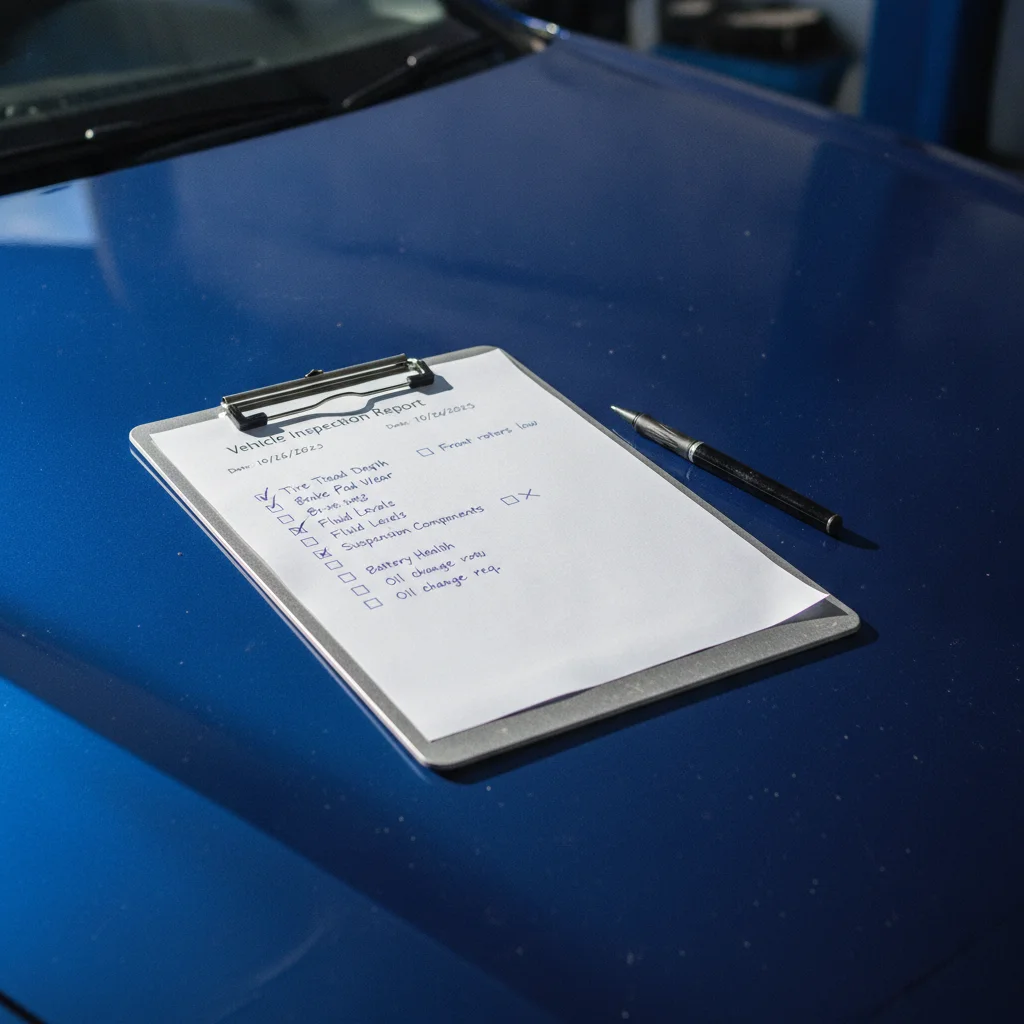
Emotional reactions to inspection reports cost buyers money — in both directions. Some walk away from solid vehicles because a mechanic flagged worn brake pads (a $200 fix). Others overlook a vague line item about "frame irregularities" because everything else looked clean.
Before you decide anything, sort every finding into one of three buckets:
- Safety-critical or structural: Frame damage, airbag faults, brake system failures, steering component issues, severe rust on load-bearing areas.
- Significant mechanical: Engine or transmission problems, coolant leaks, oil consumption, major suspension wear, failing CV joints, timing chain issues.
- Cosmetic or routine maintenance: Worn tires, brake pads or rotors, minor fluid flushes, small exterior dents, cracked trim pieces, aged wipers.
Bucket one findings are almost always walk-away triggers. Bucket three findings are negotiating chips — cheap, predictable repairs you can price out in five minutes. Bucket two is where you need to think hardest.
Get Repair Estimates Before You Negotiate
Don't walk into a negotiation with vague complaints about "the mechanic found some issues." Call two local shops with the specific findings from the inspection report and get written estimates before you call the seller back. Concrete numbers make concrete conversations. A written $1,150 estimate is far more persuasive than a general sense that something needs fixing.
Seller Offers to Fix It? Proceed With Caution
When a seller offers to fix inspection findings before the sale, it sounds cooperative — but it creates real risk. You lose control over repair quality, parts sourcing, and whether the work is actually done correctly. If you accept this offer, insist on using a shop of your choosing, get written documentation of all work performed, and require a reinspection before closing. If the seller won't agree to those terms, opt for a price reduction instead and handle the repairs yourself.
Get written repair estimates for every bucket-two finding before you make any decision. A verbal shrug from the seller about a "minor transmission issue" becomes a lot more concrete when you have a $3,400 quote from a transmission shop in your hand.
The Case for Negotiating: Pros of Staying at the Table
When inspection findings are in buckets two or three — documented, priceable, and not structurally compromising — negotiating is almost always the right move. Here's why it usually makes sense to work the deal rather than exit.
Keeps you in a deal you've already invested in
You've spent time finding the car, arranging the inspection, and potentially traveling to see it. When findings are manageable, negotiating recovers that investment rather than abandoning it.
Converts repair costs into real price reductions
A documented $800 brake job or $600 leak repair is a concrete, unemotional basis for asking $700–$800 off the price — and most motivated sellers will accept it rather than lose the deal.
Separates informed buyers from naive ones
Sellers and dealers expect some pushback after an inspection. Arriving with specific repair estimates signals that you're a serious buyer who won't be pushed around — which often produces better outcomes.
Avoids restarting a time-consuming search
Finding a suitable used car, arranging viewings, and paying for inspections takes hours and real money. If the underlying vehicle is sound and findings are manageable, negotiating beats starting over.
Gives you leverage you wouldn't otherwise have
Without inspection findings, you're negotiating off the asking price in the abstract. With them, you have specific, documented justification for a lower number — that's a much stronger position.
The key to making any of these advantages real is preparation. Document every finding, get at least one written repair estimate, and enter the negotiation with a specific number — not a vague request for "something off the price." Our article on used car negotiating tactics that actually hold up covers exactly how to structure that conversation.
The Case for Walking Away: Cons of Pushing Through a Bad Deal
Sometimes the rational choice looks irrational in the moment. You've driven to see the car twice, paid for the inspection, and emotionally committed to the idea of owning it. Walking away feels like losing. It isn't. Here's when staying at the table is the bigger mistake.
Sunk-cost bias clouds clear thinking
Once you've paid for a PPI and emotionally committed to a vehicle, it's easy to rationalize staying in a bad deal. The inspection fee is gone regardless — don't let it drive your decision.
Negotiating on serious findings often leaves risk on the table
A price reduction on structural damage or a flood-history vehicle only partially compensates for ongoing problems — insurance limitations, future repair costs, and diminished resale value persist regardless of what you paid.
Sellers may accept your offer but resent the process
A grudging acceptance after hard negotiating sometimes means less cooperation on paperwork, title transfer timing, or included accessories. A seller who feels squeezed may become difficult to work with at closing.
Overplaying findings damages your credibility
Demanding $3,000 off for $400 in routine maintenance items makes sellers defensive and torpedoes goodwill. Overreaching on cosmetic findings undermines your leverage on the issues that actually matter.
You may still inherit undisclosed problems
Even a thorough PPI can miss intermittent faults, early-stage failures, or issues that only surface under specific driving conditions. A negotiated discount doesn't eliminate future repair risk — it only quantifies the known portion.
Walking away preserves negotiating power for the next deal
Buyers who walk away from bad deals consistently end up with better vehicles at better prices. Staying in a compromised deal out of fatigue often means accepting conditions you shouldn't.
Walking away is psychologically harder than it looks on paper — especially when you've invested time and inspection fees. But consider the math: a $150 PPI that saves you from a $4,000 transmission repair is one of the best returns on investment you'll ever get. And if a seller is unwilling to negotiate on documented, legitimate findings, that tells you something important about how they've approached the rest of the transaction too. For more on using the walk-away as a deliberate strategy, see our piece on why walking away is often the most powerful move.

The Non-Negotiables: Findings That Should End the Deal
There's a category of inspection findings where negotiating isn't a strategic choice — it's a mistake. These are the situations where no price discount makes the vehicle worth buying:
Structural or Frame Damage
Frame damage affects handling, crash safety, and long-term reliability in ways that are often impossible to fully remediate. A car that has had significant structural repair may never align properly, and even good body shops will tell you that a bent frame is never truly straight again. Unless you're a specialty buyer with full knowledge of what you're getting, this is a walk-away finding.
Flood Damage History
Water intrusion into a vehicle's electrical system creates problems that appear weeks, months, or years later — corroded connectors, failing sensors, mold. A VIN check through Carfax or AutoCheck can surface flood titles, but not all flood-damaged cars receive salvage titles. If the mechanic finds evidence of water intrusion (salt deposits under carpets, corrosion on non-exposed connectors, musty odor from the HVAC system), leave.
Salvage or Rebuilt Title
A salvage or rebuilt title means the vehicle was declared a total loss at some point. Financing becomes nearly impossible, insurance coverage is often restricted, and resale value is permanently impaired — typically 20–40% below a clean-title equivalent. The discount you'd need to justify a salvage title purchase is rarely offered.
Odometer Discrepancy
If the mechanical condition of the car doesn't match its stated mileage — or if the inspection reveals tampered odometer components — that's fraud. Full stop. No negotiation applies.
Seller Refuses to Allow Inspection
This one happens before the PPI, but it belongs in the non-negotiable list: any seller who won't allow a pre-purchase inspection from an independent mechanic is hiding something. This applies to private party sellers and dealers alike. Walk away before you spend the inspection fee.
~$1,200
Average cost of issues found in pre-purchase inspections
Industry estimates from independent inspection services suggest the average PPI surfaces between $800 and $1,500 in deferred maintenance or needed repairs on used vehicles.
20–40%
Typical value discount on salvage-title vehicles
Salvage and rebuilt-title vehicles typically trade at a 20–40% discount to equivalent clean-title examples, according to valuation guides including Kelley Blue Book and NADA.
$150–$200
Typical pre-purchase inspection cost
A standard PPI at an independent mechanic generally runs $100–$200 depending on region and vehicle type — a fraction of what it can save on a flawed purchase.
1 in 4
Used cars with undisclosed prior damage
A Carfax analysis of used vehicle history reports found that roughly one in four used cars has a history of prior damage not voluntarily disclosed by the seller.
How to Build a Counter-Offer From Inspection Findings
If you've decided to negotiate, do it with numbers — not emotions. Here's a practical method:
- List every finding the mechanic flagged and assign a repair cost to each. Get at least one real quote from a shop, not an estimate off the top of your head.
- Total the legitimate repair costs. Cosmetic items like small scratches don't count if the car is fairly priced for its condition. Focus on mechanical and safety items that weren't disclosed upfront.
- Request a discount equal to 75–100% of documented repair costs. You're not trying to get the repairs done for free — you're adjusting the purchase price to reflect actual condition. On a $15,000 car with $1,200 in legitimate findings, asking for $1,000–$1,200 off is entirely reasonable.
- Present it clinically, not accusatorially. "The mechanic found a leaking valve cover gasket and worn front rotors — I have quotes totaling $1,150. I'd like to adjust the price to reflect that" lands better than implying the seller was dishonest.
- Be willing to split the difference. If the seller comes back at $600 off on $1,200 in repairs, that's still a real saving. Don't blow up a fair deal over $600 on a $15,000 purchase.
Negotiating after an inspection requires precise framing — how you present the findings matters as much as the findings themselves. Overplaying minor issues will undermine your credibility on the ones that matter.

What Seller Behavior Tells You
How a seller responds to inspection findings is itself a data point. It often tells you more about the transaction risk than the findings themselves.
| Seller Response | What It Usually Means | Your Move |
|---|---|---|
| Acknowledges findings, open to price adjustment | Straightforward transaction, motivated seller | Negotiate and close |
| Disputes findings but offers partial discount | Defensive but not dishonest — they may genuinely not know | Get a second opinion on disputed items, then decide |
| Refuses any adjustment, insists "as-is" | Either knows about the issues or is inflexible; either is a problem | Walk away or accept current price only if findings are minor and price already reflects condition |
| Gets hostile or pressures you to skip the mechanic's report | Red flag — likely concealing something significant | Walk away immediately |
| Offers to fix the issues before sale | Risky — you lose visibility into how repairs are done | Only accept if the shop is your choice and you can reinspect after |
The "I'll fix it myself" offer from a private seller deserves particular skepticism. You have no control over repair quality, parts used, or whether the repair is actually completed as described. If you want the issue fixed, either negotiate a price reduction and handle it yourself, or — rarely — agree to seller-performed repairs only with a reinspection right and written documentation of what was done.
Get Repair Estimates Before You Negotiate
Don't walk into a negotiation with vague complaints about "the mechanic found some issues." Call two local shops with the specific findings from the inspection report and get written estimates before you call the seller back. Concrete numbers make concrete conversations. A written $1,150 estimate is far more persuasive than a general sense that something needs fixing.
Seller Offers to Fix It? Proceed With Caution
When a seller offers to fix inspection findings before the sale, it sounds cooperative — but it creates real risk. You lose control over repair quality, parts sourcing, and whether the work is actually done correctly. If you accept this offer, insist on using a shop of your choosing, get written documentation of all work performed, and require a reinspection before closing. If the seller won't agree to those terms, opt for a price reduction instead and handle the repairs yourself.
The Financial Logic: Is the Discount Worth the Remaining Risk?
Even when findings are negotiable and the seller is cooperative, ask yourself one final question before signing: Even at the adjusted price, am I comfortable with the remaining risk?
Here's a simple framework:
- Known repair costs: You've priced them. They're budgeted. This risk is quantified.
- Unknown repair costs: What did the inspection not catch? Even a good PPI misses intermittent electrical gremlins, early automatic transmission slip under load, or a head gasket that's weeping but not yet failing. Build in a buffer — typically 5–10% of the purchase price for a high-mileage vehicle.
- Your cash position: Can you absorb a surprise $2,000 repair in the first six months? If not, a vehicle with multiple deferred maintenance items is higher risk than it looks even at a discounted price.
Think about the total cost of ownership, not just the sticker. A $12,000 car needing $2,500 in near-term repairs is effectively a $14,500 car. If comparable clean examples are selling for $13,500, the math doesn't work — and no amount of negotiating will make it work unless the seller comes down far enough to offset the real cost.
Running a trade-in negotiation checklist follows a similar logic — always compare the effective cost of the deal against realistic alternatives, not against the asking price alone.

All claims are backed by peer-reviewed research. Sources on request.