
Key Takeaways
Credit Score Threshold
A credit score threshold is a specific point on the scoring scale where lenders shift a borrower into a different risk tier, triggering a meaningfully different interest rate. In auto lending, these are not smooth, gradual transitions — they are hard cutoffs. A score of 660 and a score of 661 may look nearly identical to you, but they can land you in completely different rate buckets at the lender's desk.
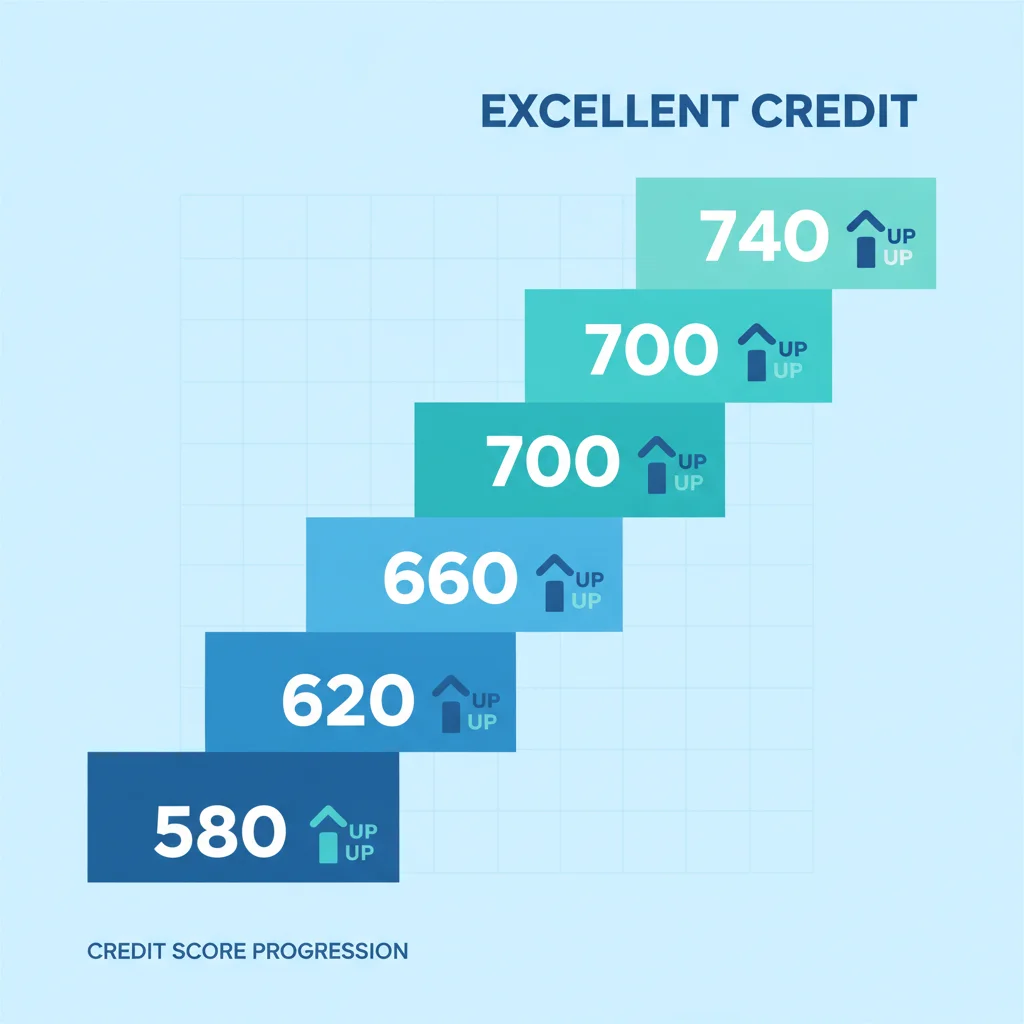
Most auto lenders use FICO Auto Score 8 or 9, which can differ from the base FICO score displayed by credit monitoring apps. The tier boundaries themselves vary by lender, but the most commonly cited breakpoints in auto lending fall near 580, 620, 660, 700, and 740.
Why Auto Loan Rates Don't Move in a Straight Line
Most people think of their credit score as a dial — the higher it goes, the better the rate they get, point by point. That's not how auto lending works. Lenders sort borrowers into discrete risk tiers, and each tier carries a fixed rate range. The transition between tiers is where the real money is.
Think of it like a staircase, not a ramp. You can stand anywhere on a single step and nothing changes. But step up to the next level — even by a single point — and your rate drops. That step-up moment is the threshold.
This structure exists because lenders price loans based on statistical default risk at each tier. A borrower with a 699 score doesn't pose meaningfully different risk than one with a 700 score, but the lender's model draws the line somewhere, and whoever lands on the wrong side pays more. Knowing exactly where those lines are — and how close you are to the next one — is one of the most useful pieces of information a car buyer can have before walking into a dealership or applying online.
For a full breakdown of how lenders label each tier — from deep subprime all the way to super prime — see credit score ranges lenders use when evaluating auto loan risk. Understanding the tier labels is the foundation before we look at the dollar impact of each jump.
The Specific Thresholds That Actually Matter
Industry data and lender behavior point to several score ranges where the rate environment shifts noticeably. Here are the thresholds most worth understanding:
Below 580: Deep Subprime
At this level, many prime lenders won't touch the loan at all. Those that do often charge APRs in the 16–22% range on used cars. Terms may be restricted, down payments required, and lender choices narrow significantly. If you're here, the priority is reaching 580+ before anything else.
580–619: Subprime
You have more lender options, but rates are still punishing — typically 12–18% on used vehicles, 10–15% on new. This tier also tends to come with strict loan-to-value requirements. A small amount of credit work that pushes you past 620 can open considerably better options.
620–659: Near-Prime
This is where a lot of buyers end up, and where staying just a little longer actually costs a lot of money. Rates in the 8–13% range are common. Crossing 660 often unlocks a different lender tier entirely, with rates dropping 2–4 percentage points in many cases.
660–699: Prime
The prime tier brings rates roughly in the 6–9% range for new vehicles and 7–11% for used. Most major banks and credit unions are competing for your business here. The gap between 660 and 700 is meaningful but smaller in dollar terms than the jump up from near-prime.
700–739: High Prime
Rate offers improve further, typically 5–7.5% on new cars from competitive lenders. At this point, you're getting access to manufacturer promotional rates on qualifying models and the best credit union offers.
740 and Above: Super Prime
This is where the lowest advertised rates live — often 4–6% on new vehicles (and lower during promotional periods). The practical difference between 740 and 800 is usually minimal from a rate perspective; you're already at the top tier.
$9,000+
Interest saved crossing 580 to 660
On a $30,000 used car loan over 60 months, moving from a deep-subprime rate (~18%) to a prime rate (~8%) eliminates over $9,000 in interest charges.
2–4 pts
APR drop at the 660 threshold
Industry lending data shows the 620-to-660 and 660-to-700 score jumps typically produce 2–4 percentage point reductions in offered APR — the largest per-point gains on the scale.
45 days
Time to see utilization improvements
According to FICO, reducing revolving credit utilization — the fastest-acting credit factor — typically shows up in your score within one to two billing cycles, or roughly 30–45 days.
14–45 days
Safe rate-shopping window
FICO and VantageScore both count multiple auto loan inquiries within a 14–45 day window as a single inquiry, allowing buyers to compare lenders without stacking hard-pull damage.
~$44/mo
Monthly savings: 659 to 660 crossing
On a $30,000 60-month loan, the monthly payment difference between an 11% (near-prime) and 8% (prime) rate is roughly $44 — or $2,640 over the life of the loan.
The takeaway: the jumps that produce the biggest rate improvement per point gained are from 580 to 620, and from 620 to 660. If you're in those zones, a few months of focused credit work has a disproportionate return. Above 700, you're getting incremental gains, not step-changes.
Translating Rate Differences Into Real Dollars
Percentages are abstract. Let's make this concrete with a $30,000 loan over 60 months — a fairly typical transaction for a used car in today's market.
| Score Range | Estimated APR (Used) | Monthly Payment | Total Interest Paid |
|---|---|---|---|
| Below 580 | 18% | $761 | $15,660 |
| 580–619 | 14% | $698 | $11,880 |
| 620–659 | 11% | $652 | $9,120 |
| 660–699 | 8% | $608 | $6,480 |
| 700–739 | 6.5% | $586 | $5,160 |
| 740+ | 5.5% | $574 | $4,440 |
Note: APR estimates are illustrative approximations based on published lender data and industry benchmarks. Your actual rate will vary by lender, loan term, vehicle type, and market conditions.
Look at the jump from the 620–659 range to the 660–699 range: you save roughly $2,640 in total interest and $44 a month. That's not trivial. Now look at the jump from below 580 to 660+: over $9,000 in total interest savings. That's the kind of number that makes waiting a few months to improve your score one of the highest-return financial moves available to a car buyer.
“The single most expensive minute in auto buying is the minute you sign a finance contract without knowing what rate you actually qualified for. Most buyers have no idea they were one tier away from a rate that could have saved them thousands.”
— Jordan Delray, Former Dealership Finance Manager and Auto Lending Analyst
If you're within striking distance of one of these thresholds, the credit score factors that move the needle most before a car loan are worth reviewing before you apply. Not all credit improvements are created equal — some take months, others can register in a billing cycle.
Target the Threshold, Not the Perfect Score
You don't need a 780 to get a good rate. You need to be on the right side of the next tier cutoff. If you're at 645, your effort should be laser-focused on reaching 660 — not on a broader credit overhaul. Knowing where your nearest threshold is and directing all your credit work toward crossing it is more efficient than trying to maximize your score in the abstract.
Refinance Before You're Too Deep Into the Loan
Auto loans are front-loaded with interest — the largest portion of each early payment goes toward interest, not principal. If you plan to refinance after improving your credit, aim to do it within the first 18–30 months of the loan. Waiting until month 48 of a 60-month term means most of the interest has already been paid, and the savings from a lower rate shrink considerably.
How to Find Out Which Tier You're Actually In
Here's the problem: lenders don't publish their exact tier cutoffs. They'll advertise "rates as low as X%" without telling you what score earns that rate. This opacity is intentional — it keeps you from knowing how to negotiate.
The practical workaround is pre-approval shopping. Apply to at least three lenders before you set foot in a dealership: a bank, a credit union, and an online lender. The pre-approval offers tell you two things your credit monitoring app can't: the actual rate you qualify for right now, and an implicit signal about which tier that lender has placed you in.

When you apply for pre-approvals, use a window of 14–45 days — credit bureaus treat multiple auto loan inquiries within that window as a single inquiry for scoring purposes, so you won't damage your score by shopping around.
Your Credit App Score May Not Match Lender's Score
Free credit monitoring services typically show your VantageScore or base FICO score — neither of which is what most auto lenders pull. Lenders predominantly use FICO Auto Score 8 or 9, which weights your auto loan history more heavily. The two can differ by 20–40 points in either direction. For the most accurate picture of where you stand in auto lending, purchase your FICO Auto Score directly from myFICO.com before applying.
Pre-Approval Shopping Won't Hurt Your Score
Many buyers avoid applying to multiple lenders because they fear damaging their credit with multiple hard inquiries. In practice, FICO and VantageScore both treat all auto loan inquiries made within a 14–45 day window as a single inquiry. Apply to a credit union, a bank, and an online lender during the same two-week stretch — you'll have three real rate offers and only one inquiry's worth of score impact.
One more thing worth knowing: the score a lender pulls is almost certainly not the score your credit monitoring app shows. Most auto lenders use a FICO Auto Score model, specifically calibrated for auto lending risk. Your base FICO or VantageScore may read 680 while your FICO Auto Score 8 reads 652 — enough to land you in a different rate tier. When a lender pulls your credit, they often disclose which score they used. Ask for it explicitly.
The Waiting Game: When Delaying Your Purchase Makes Sense
Delaying a car purchase is a real cost. You might be driving an unreliable vehicle, paying for ride-shares, or missing out on a market where inventory and prices are favorable right now. The question is never "should I improve my credit?" It's "does the math justify waiting in my specific situation?"
A useful framework:
- Identify your current score and nearest threshold. If you're at 635 and the next meaningful tier starts at 660, you need 25 points.
- Estimate how long it takes to get there. Paying down a high-utilization credit card by $2,000 might get you 15–20 points in one billing cycle. Building consistent payment history takes longer.
- Calculate the interest savings. Use the table above or a loan calculator to find the dollar difference between your current rate and the rate in the next tier, applied to your actual loan amount and term.
- Compare savings to delay costs. If waiting 4 months saves $3,000 but costs you $1,200 in alternative transportation, you're ahead by $1,800. If your current car needs $2,500 in repairs to survive that 4 months, the math shifts.
For a thorough look at this decision from both sides, the advantages and trade-offs of waiting to improve your score walks through the full calculation. It's not always worth waiting — but when it is, the savings are too large to ignore.
The Refinancing Option: Buy Now, Optimize Later
If you need a car now but your score is below a meaningful threshold, financing at a higher rate and refinancing later is a legitimate strategy — not a consolation prize. Lenders in the bad credit auto loan space exist specifically to serve borrowers who will later become better-credit customers.
The strategy works like this: you take the loan you can get today, make every payment on time (payment history is the biggest factor in your score), aggressively pay down any revolving debt, and apply for refinancing once your score has crossed a better threshold. The new lender pays off the old loan, and your payments drop.
The timing question for refinancing is essentially the same as the threshold question: how many points do you need, how long will it take, and how much does the rate difference save? If your score jumped 40 points since you got the loan, what that means for your car loan rate is worth reading before you decide whether to pull the trigger on a refi.
One caution: refinancing works best in the first 12–36 months of the loan, when most of your payments are still going toward interest rather than principal. The further into the loan you get, the less refinancing can save you even if your rate drops significantly. Check the right timing signals for refinancing before assuming it always makes sense.
Target the Threshold, Not the Perfect Score
You don't need a 780 to get a good rate. You need to be on the right side of the next tier cutoff. If you're at 645, your effort should be laser-focused on reaching 660 — not on a broader credit overhaul. Knowing where your nearest threshold is and directing all your credit work toward crossing it is more efficient than trying to maximize your score in the abstract.
Refinance Before You're Too Deep Into the Loan
Auto loans are front-loaded with interest — the largest portion of each early payment goes toward interest, not principal. If you plan to refinance after improving your credit, aim to do it within the first 18–30 months of the loan. Waiting until month 48 of a 60-month term means most of the interest has already been paid, and the savings from a lower rate shrink considerably.
Putting It Into Practice Before You Negotiate
Walking into a dealership without knowing your credit tier is like negotiating without knowing the invoice price. You're operating without information the other side already has.
Here's the pre-purchase credit checklist that actually matters:
- Pull your FICO scores from multiple bureaus — not just the VantageScore your bank app shows. myFICO.com gives you the auto-specific scores lenders actually use.
- Get pre-approved before you shop, ideally from a credit union and at least one online lender. These offers give you real rate data and take the dealer's financing leverage away.
- Check your credit report for errors. Dispute anything inaccurate — a single erroneous collection account can depress your score by 50–100 points and may be removable in 30 days.
- Calculate your utilization. If your revolving balances are above 30% of your limits, paying them down before applying is often the fastest path to a meaningful score gain.
- Don't open new credit accounts in the 3–6 months before applying for an auto loan. New accounts lower average account age and trigger hard inquiries.
Your Credit App Score May Not Match Lender's Score
Free credit monitoring services typically show your VantageScore or base FICO score — neither of which is what most auto lenders pull. Lenders predominantly use FICO Auto Score 8 or 9, which weights your auto loan history more heavily. The two can differ by 20–40 points in either direction. For the most accurate picture of where you stand in auto lending, purchase your FICO Auto Score directly from myFICO.com before applying.
Pre-Approval Shopping Won't Hurt Your Score
Many buyers avoid applying to multiple lenders because they fear damaging their credit with multiple hard inquiries. In practice, FICO and VantageScore both treat all auto loan inquiries made within a 14–45 day window as a single inquiry. Apply to a credit union, a bank, and an online lender during the same two-week stretch — you'll have three real rate offers and only one inquiry's worth of score impact.
The goal isn't a perfect credit score — it's crossing the next meaningful threshold for your specific loan amount. A 40-point improvement that costs you two months of waiting and saves $3,200 in interest over the loan term is an excellent financial decision. A 20-point improvement that takes 8 months and saves $600 may not be worth the tradeoff. Run your numbers, know your threshold, then act.
All claims are backed by peer-reviewed research. Sources on request.