
Key Takeaways
Missed Payment on a Subprime Auto Loan
A missed payment occurs when a borrower fails to make a scheduled loan payment by the due date. On a subprime auto loan — a loan extended to borrowers with credit scores typically below 620 — the consequences of missing a payment are more severe and move faster than they would on a prime loan. Subprime lenders often carry tighter contract terms, shorter grace periods, and more aggressive collections practices because the borrower population is considered higher risk.
Many subprime auto loan contracts include a right-to-cure clause specifying how many days a borrower has to remedy a default before the lender can initiate repossession. This window varies by state law and by lender, often ranging from 10 to 30 days.
The First 24–72 Hours: What Happens Right Away
The moment your payment due date passes without a payment received, your loan is technically past due. Nothing catastrophic happens in the first few hours, but the clock starts ticking immediately. Here's what the first few days typically look like for a subprime borrower:
- Day 1: Your account is flagged as past due in the lender's system. Automated reminder calls or texts may begin as early as the next business day.
- Days 2–10: The lender's collections or customer service team may reach out by phone, email, or mail. These contacts are informational at this stage — they want to know if a payment is coming.
- Days 10–15: If your contract includes a grace period, this is typically when it expires. After this point, a late fee is applied to your account — usually between $25 and $50, or a percentage of the payment amount.
This is the most important window in the entire timeline. If you can make your payment — even with the late fee — before Day 30, there will be no credit bureau report, no formal default notice, and no lasting damage to your record beyond the fee itself.
Call Your Lender Before You Miss
If you know a payment is going to be late, call your lender before the due date — not after. Lenders are far more willing to offer hardship accommodations, deferrals, or modified schedules to borrowers who reach out proactively. Once you're in formal default, your options narrow considerably and the lender's posture shifts from customer service to collections.
Keep Grace Period Dates in Your Calendar
Set a calendar reminder five days before your grace period ends — not just on your payment due date. This gives you a secondary alert to act if your first payment attempt fails. Knowing your exact grace period end date means you always know the last possible moment to pay without triggering a late fee or starting the 30-day clock toward credit bureau reporting.
Understanding what subprime means on a car loan application helps you anticipate why lenders move quickly. They priced your loan for higher risk — and their collections timelines reflect that.
Day 30: The Credit Bureau Reporting Threshold
Day 30 past due is the most significant milestone in the missed-payment timeline. This is the point at which your lender is permitted to report the delinquency to the three major credit bureaus — Equifax, Experian, and TransUnion. Once that report is made, the damage to your credit score is done regardless of whether you bring the account current afterward.
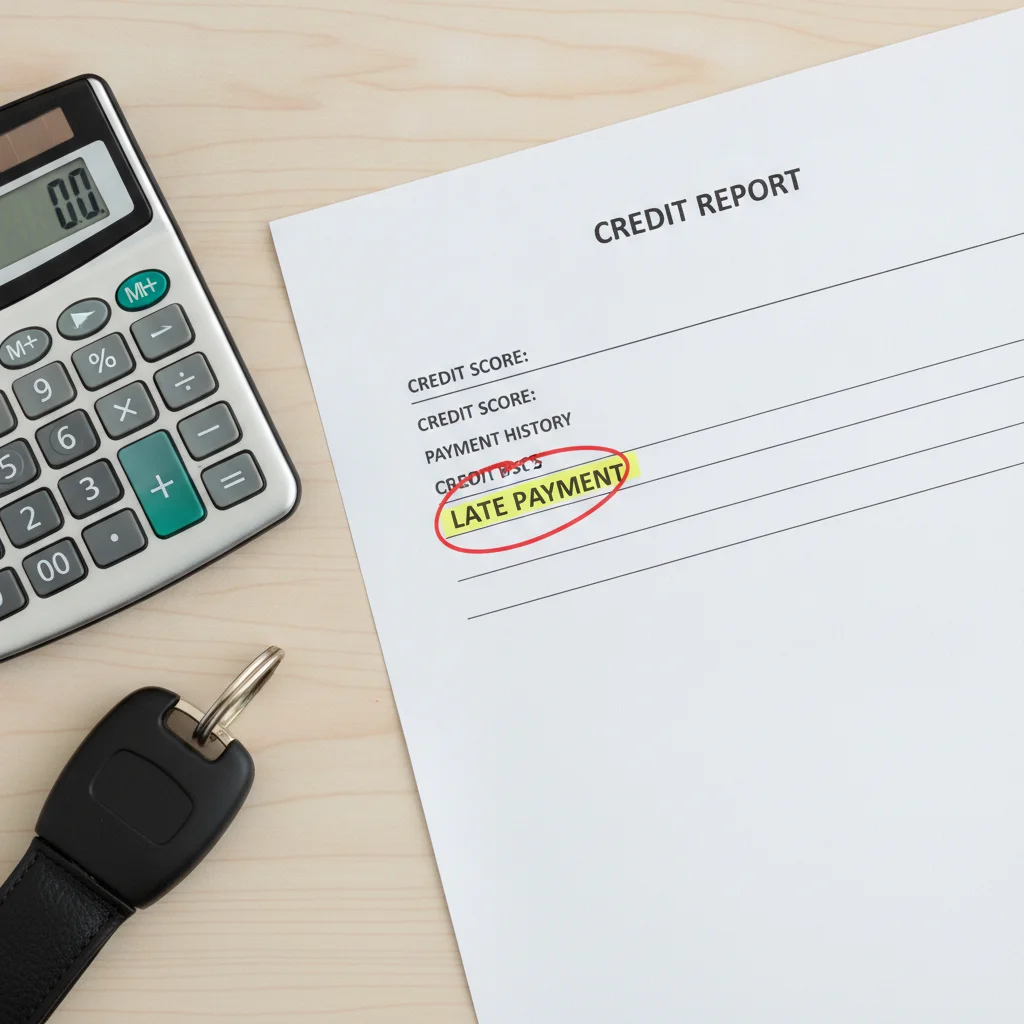
The credit score impact of a 30-day late payment varies based on your starting point, but for subprime borrowers it is particularly painful:
- Borrowers with scores in the 580–619 range can expect a drop of 50–80 points from a single 30-day late mark.
- The derogatory entry stays on your credit report for seven years from the date of the original missed payment.
- If the account continues to age unpaid, additional 60-day, 90-day, and 120-day late marks are added, compounding the damage.
50–100 pts
Typical credit score drop from one 30-day late payment
According to FICO score modeling data, the impact is most severe for borrowers with scores below 680 who have limited positive credit history.
7 years
How long a late payment stays on your credit report
Under the Fair Credit Reporting Act, most negative items including late payments remain on your credit file for seven years from the original delinquency date.
~25%
Subprime borrowers who experience a delinquency within 12 months
Industry data from the Consumer Financial Protection Bureau indicates roughly one in four subprime auto borrowers fall 30 or more days past due within their first year.
$300–$600
Typical repossession and auction cost charged to borrower
Lenders routinely add towing, storage, and auction fees to the deficiency balance owed after a vehicle is repossessed and sold, per standard loan contract terms.
10–15 days
Grace period length common in subprime auto contracts
Most subprime lenders offer shorter grace periods than prime lenders; review your specific loan contract to confirm the exact number of days in your agreement.
If you've been making on-time payments to build your credit score, a 30-day late mark can erase months of progress in a single reporting cycle. This is why the credit score impact of a missed payment deserves serious attention — it's not just a financial penalty, it's a setback to your long-term borrowing power.
It's also worth understanding how this interacts with the credit-building potential of the loan. As we cover in how a bad credit auto loan can actually rebuild your score, subprime loans can serve as credit-building tools — but only when payments are made consistently. A late report short-circuits that benefit entirely.
Days 30–90: Default, Collections, and the Repossession Window
After 30 days, your lender's approach typically shifts from reminder calls to formal collections activity. This phase is where subprime loan contracts diverge most sharply from prime loans — the default and repossession provisions tend to be more aggressive.
State Law Affects Your Repossession Rights
Repossession rules vary significantly by state. Some states — including California and Wisconsin — require lenders to send a right-to-cure notice before repossessing, giving borrowers a specific window to pay up. Others have no such requirement. Look up your state's repossession statutes or consult a consumer law attorney if you believe your lender acted unlawfully.
Starter Interrupt Devices Must Be Disclosed
Federal and most state regulations require lenders to disclose the use of GPS tracking and starter interrupt devices in the loan contract before you sign. If you have a subprime loan, search your contract for terms like 'payment assurance device,' 'starter interrupt,' or 'remote disable.' Understanding this provision before a crisis is far better than discovering it when your car won't start.
Deferral Isn't Free — It Costs Interest
When a lender grants a payment deferral, your missed payment moves to the end of the loan — but interest continues accruing on your outstanding balance throughout the deferred period. On a high-interest subprime loan, even one month of additional interest can add $50–$150 to your total cost. Deferrals are a valuable tool, but they're a cost, not a free pass.
Here's what the 30–90 day window typically involves:
Formal Default Notice
Many states require lenders to send a formal notice of default before they can repossess. This document, sometimes called a right-to-cure notice, tells you exactly how much you owe (including fees and accrued interest) and gives you a short window — often 10–20 days depending on your state — to pay the past-due amount and bring the account current.
Collections Escalation
Contact frequency increases. Calls may come from an internal collections department or a third-party collections agency. Under the Fair Debt Collection Practices Act (FDCPA), collectors must follow rules about when and how they can contact you — but these protections apply primarily to third-party collectors, not always to the original lender.
Repossession Authorization
Once the right-to-cure window closes without payment, the lender can authorize repossession. In most states, repossession can happen without advance warning — a recovery agent can legally take the vehicle from your driveway, a parking lot, or a public street at any time, day or night, as long as there is no breach of the peace.

One practical reality many borrowers don't anticipate: some subprime lenders install GPS tracking devices and starter interrupt devices on vehicles at the time of the loan. A starter interrupt device allows the lender to remotely disable the car's ignition if you fall behind on payments — even before formal repossession. If your contract includes this technology, falling behind on payments can literally mean your car won't start one morning.
This is also the period when common traps that slow down auto loan payoff become most relevant. Fees and interest accrued during a delinquency period can increase your payoff balance substantially, making it harder to catch up even when you're ready to.
What Happens During and After Repossession
Repossession is a legal process, but it moves quickly and feels abrupt. Understanding what happens before, during, and after it gives you a clearer picture of the full financial exposure you're managing.
During the Repossession
A recovery agent — sometimes called a repo man — arrives at whatever location the vehicle is parked and takes it. You typically receive no advance notice of when this will happen. Any personal belongings left in the vehicle should be returned to you upon request, though you'll generally need to arrange a time to pick them up from the lender or recovery company.
After the Repossession: The Deficiency Balance
After repossessing the vehicle, the lender will sell it — usually through a wholesale auto auction. The sale price is almost always below the vehicle's retail value. Here's where the financial pain extends beyond losing the car:
- If the auction sale price is less than your remaining loan balance plus repossession costs, you owe the deficiency balance.
- For example: You owe $14,000. The car sells for $9,500. Repossession and auction fees add $500. You now owe $5,000 even though you no longer have the car.
- The lender can pursue this balance through civil collections, which may result in a lawsuit, wage garnishment, or a judgment lien depending on your state's laws.
“Repossession isn't just about losing a car — it's about a cascade of financial consequences that can follow a borrower for years. The deficiency balance, the credit damage, the difficulty getting another vehicle loan — these compound in ways borrowers rarely anticipate when they sign.”
— Chi Chi Wu, Senior Attorney, National Consumer Law Center
Both the repossession and any resulting deficiency balance will appear on your credit report, each as separate derogatory entries. Combined with the late payment marks leading up to the repossession, the cumulative damage can push a subprime borrower's score into deep subprime territory — making future lending significantly harder and more expensive, as outlined in the real cost of borrowing with a low credit score.
Your Best Move: Call Before You Miss
Everything in this article describes what happens when you fall behind and don't reach out. The timeline looks very different if you call your lender before the missed payment occurs — or immediately after, while you're still inside the grace period.
Call Your Lender Before You Miss
If you know a payment is going to be late, call your lender before the due date — not after. Lenders are far more willing to offer hardship accommodations, deferrals, or modified schedules to borrowers who reach out proactively. Once you're in formal default, your options narrow considerably and the lender's posture shifts from customer service to collections.
Keep Grace Period Dates in Your Calendar
Set a calendar reminder five days before your grace period ends — not just on your payment due date. This gives you a secondary alert to act if your first payment attempt fails. Knowing your exact grace period end date means you always know the last possible moment to pay without triggering a late fee or starting the 30-day clock toward credit bureau reporting.
Subprime lenders deal with payment difficulties regularly. They have more to lose from repossession than you might think: repossession costs money, auction prices are unpredictable, and deficiency balances are notoriously hard to collect. A borrower who calls proactively is often a borrower they'll work with.
Options to Ask For
- Payment Deferral
- The lender moves your missed payment (or upcoming payment) to the end of the loan. You skip a month without going into default. Interest may still accrue during that time, so you'll pay slightly more overall — but your account stays current.
- Loan Modification
- A restructuring of your loan terms — sometimes extending the repayment period to lower the monthly payment. This costs more in total interest but can make payments manageable if your income situation has changed.
- Hardship Program
- Some lenders have formal hardship programs for borrowers experiencing job loss, medical issues, or other documented financial crises. These vary widely by lender and aren't always advertised — you have to ask.
When you call, be specific. Tell them what happened, when you expect to be able to pay, and what you're asking for. Vague conversations produce vague outcomes. Document every call: date, time, representative's name, and what was agreed.
State Law Affects Your Repossession Rights
Repossession rules vary significantly by state. Some states — including California and Wisconsin — require lenders to send a right-to-cure notice before repossessing, giving borrowers a specific window to pay up. Others have no such requirement. Look up your state's repossession statutes or consult a consumer law attorney if you believe your lender acted unlawfully.
Starter Interrupt Devices Must Be Disclosed
Federal and most state regulations require lenders to disclose the use of GPS tracking and starter interrupt devices in the loan contract before you sign. If you have a subprime loan, search your contract for terms like 'payment assurance device,' 'starter interrupt,' or 'remote disable.' Understanding this provision before a crisis is far better than discovering it when your car won't start.
Deferral Isn't Free — It Costs Interest
When a lender grants a payment deferral, your missed payment moves to the end of the loan — but interest continues accruing on your outstanding balance throughout the deferred period. On a high-interest subprime loan, even one month of additional interest can add $50–$150 to your total cost. Deferrals are a valuable tool, but they're a cost, not a free pass.
Understanding the full picture of what a subprime loan costs — before and after a late payment — is essential. See how interest rates and loan terms compound costs across different credit tiers to make sense of your total financial exposure.
Protecting Yourself Going Forward
If you've already missed a payment and navigated its consequences — or you're working to prevent the situation from recurring — here are the habits and safeguards that matter most for subprime borrowers specifically.

Set Up Automatic Payments
The most common reason for a missed payment isn't financial hardship — it's a forgotten due date. Automatic payments remove human error from the equation. If your lender offers a rate discount for autopay enrollment, take it. Even a 0.25% reduction adds up over a 48- or 60-month loan term.
Build a One-Month Payment Buffer
Having one month's car payment sitting in a dedicated savings account changes everything. If your income is disrupted, you have a buffer to buy time without going into default. This is especially important for subprime borrowers who may have less access to emergency credit.
Know Your Contract Terms Cold
Read the default, cure, and repossession provisions in your loan contract before you ever need them. Know your grace period length, your late fee amount, whether your lender uses starter interrupt technology, and what your state's repossession cure requirements are. This knowledge isn't scary — it's leverage.
Monitor Your Credit Monthly
Free credit monitoring through services like Credit Karma or your bank's app lets you see if a late report has been filed before you find out the hard way. If a report is filed in error — or if you brought the account current before Day 30 and the lender reported incorrectly — you have the right to dispute it with the credit bureau.
Managing a subprime loan well is genuinely difficult. The terms are tighter, the margins for error are smaller, and the consequences of slipping up compound faster. But understanding the timeline — from grace period through potential repossession — gives you the knowledge to respond quickly, negotiate effectively, and protect the credit score you're working hard to rebuild. That knowledge is exactly what separates borrowers who get through a rough patch and those who don't.

All claims are backed by peer-reviewed research. Sources on request.