


Key Takeaways
Why Buyers Fear the Credit Hit
I spent years in the finance office at two different dealerships, and I can tell you exactly how often buyers talked themselves out of pre-approvals: constantly. The reasoning was always the same — "I don't want to mess up my credit before I apply for the real loan." It sounds prudent. It isn't.
The fear is rooted in something real: hard inquiries do appear on your credit report and do affect your score. But the magnitude, the timing, and the strategy around them are widely misunderstood — and that misunderstanding has a dollar cost. Buyers who skip pre-approval often walk into a dealership blind, accepting whatever rate the finance manager offers because they have no benchmark. That can translate to hundreds or thousands of dollars in unnecessary interest over the life of a loan.
Let's get into what actually happens to your credit when you apply for pre-approval — and what doesn't.
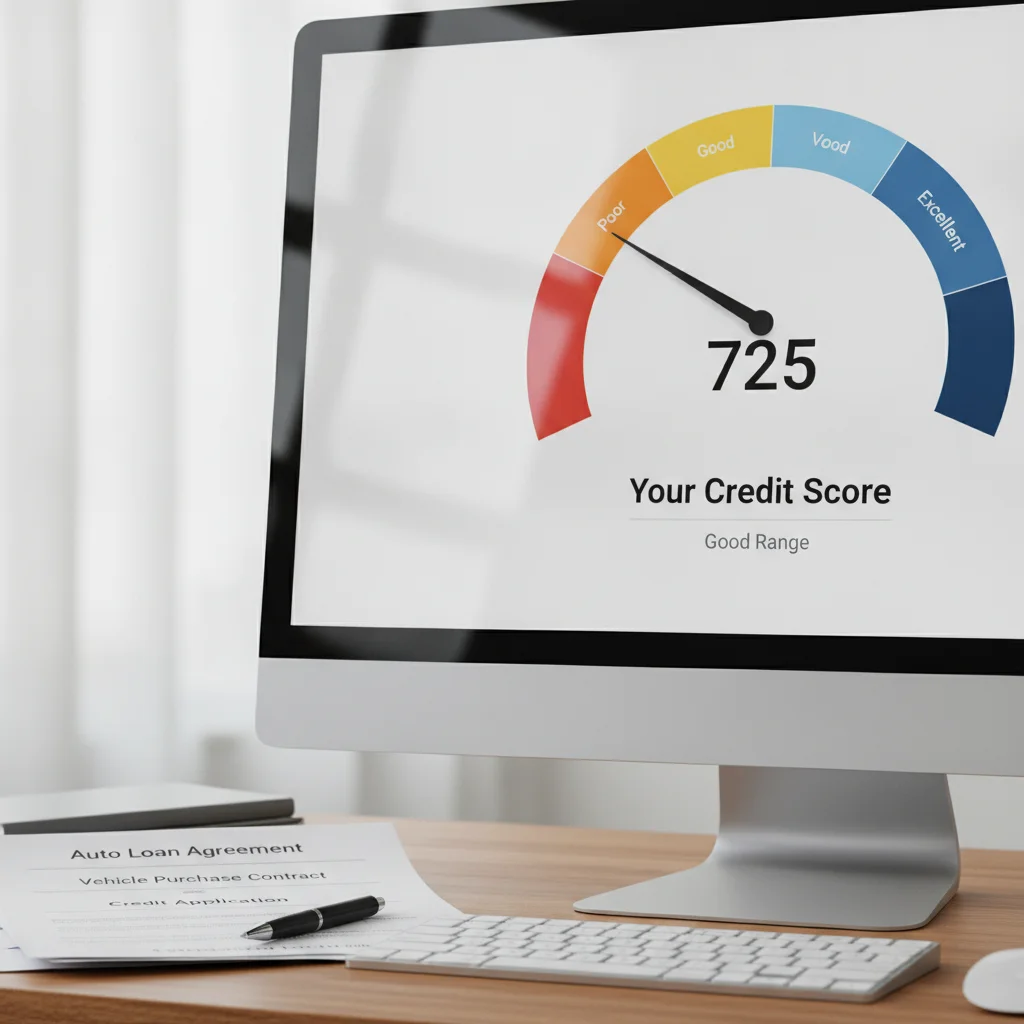
See our complete guide to auto loan preapproval for a deeper look at how the process works and what leverage it gives you at the dealership.
The Myths, Corrected
Below are the most common misconceptions I've heard from buyers — some learned from friends, some from financial forums, and a few that dealership F&I staff actively encourage because confusion benefits them. Each one gets a direct correction backed by how credit scoring actually works.
Myth
Getting pre-approved for a car loan will significantly damage my credit score.
Fact
A pre-approval triggers one hard inquiry, which typically reduces your score by 2–5 points — a minor, temporary effect that most lenders barely register.
Hard inquiries are one of five factors FICO weighs when calculating your score, but they carry only about 10% of total scoring weight. A single auto loan inquiry — the kind triggered by a pre-approval — generally moves a score 2–5 points. If your score is 720 today, it might read 716 after a pre-approval pull. At 716, you're still in the same rate tier with every lender. Nothing materially changes.
Compare that to the alternative: a buyer who skips pre-approval and accepts the dealer's first financing offer may be paying an interest rate 1–2 percentage points higher than they qualified for. On a $30,000 loan over 60 months, a 2-point rate difference costs approximately $1,600–$1,900 in additional interest. The inquiry costs you almost nothing. The lack of pre-approval can cost you thousands.
Myth
If I apply to multiple lenders, each application counts as a separate hit to my credit.
Fact
Credit scoring models specifically recognize auto loan rate shopping and group multiple inquiries within a defined window into a single scoring event.
This is the rate-shopping provision, and it exists in every major scoring model. Under FICO 8 — the version most lenders still use — all auto loan inquiries within any 14-day period are bundled and treated as one inquiry. Under FICO 9 and the specialized FICO Auto Score models, the window extends to 45 days. VantageScore applies a similar 14-day deduplication window.
This means applying to your credit union, your bank, an online lender, and your automaker's finance arm in the same week counts as one inquiry against your score — not four. The bureaus designed this intentionally to encourage responsible rate shopping. You're not penalized for being a smart consumer; the model is built around the expectation that borrowers will compare offers before committing.
Myth
A pre-approval inquiry stays on my credit report forever and keeps hurting me.
Fact
Hard inquiries remain on your report for two years, but their score impact diminishes rapidly after the first 12 months and is negligible well before the inquiry disappears.
Yes, the inquiry appears on your report for 24 months. But "appearing" and "hurting" are not the same thing. Scoring models weight recent inquiries heavily and older inquiries barely at all. By the time you've had your car loan for 12 months and have been making on-time payments, the inquiry that got you the loan is functionally invisible in your score calculations.
In fact, the auto loan itself — if you pay it consistently — becomes a positive force on your score over time. A new installment loan adds to your credit mix, and a history of on-time payments builds your payment history, which carries the heaviest scoring weight at roughly 35% of your FICO score. The inquiry that helped you get a better rate will be long forgotten in the math.
Myth
Soft credit checks and pre-qualification are the same as pre-approval — I can skip the hard pull.
Fact
Soft pulls and pre-qualification give you a rough estimate. Only a hard pull and formal pre-approval gives you a real, bindable rate offer you can bring to a dealer.
Many lenders and comparison tools now offer pre-qualification using a soft inquiry — meaning no credit score impact. These tools are useful for gauging where you stand before you shop seriously. But there's a critical limitation: soft-pull pre-qualifications are estimates, not commitments. The rate you see there is contingent on the lender verifying your income, the vehicle details, and your full credit profile via a hard pull.
When you walk into a dealership with a soft-pull estimate, the dealer's finance office knows it's not a real offer. They can ignore it, and they frequently do. A formal pre-approval letter with a specific APR and loan amount from a bank or credit union is what creates actual negotiating leverage — because it's a real offer the dealer has to compete with. The hard inquiry that comes with it is the cost of getting a real number, and as shown above, that cost is minimal.
Myth
I should wait until I find the perfect car before applying for pre-approval, to avoid any credit impact.
Fact
Waiting to apply until you're at the dealership eliminates your negotiating leverage and often forces you to accept less favorable terms.
This approach flips the entire negotiation dynamic against you. When you find financing at the dealership, the dealer controls both variables: the price of the car and the terms of the loan. That's a significant information and structural advantage for their side of the table.
Pre-approval lets you walk in knowing exactly what rate you qualify for independently. The dealer can either match or beat that rate (earning a small yield spread premium in the process), or you use your pre-approved lender. Either way, the rate ceiling is set before you sit down — not by the dealer. Getting pre-approved before you've chosen a specific vehicle is not only possible — it's often the smarter move strategically.
Myth
If my credit score is already good, pre-approval doesn't matter — I'll qualify for a good rate either way.
Fact
Even excellent-credit borrowers face dealer rate markups; pre-approval is how you ensure you're getting the rate your score actually earns you.
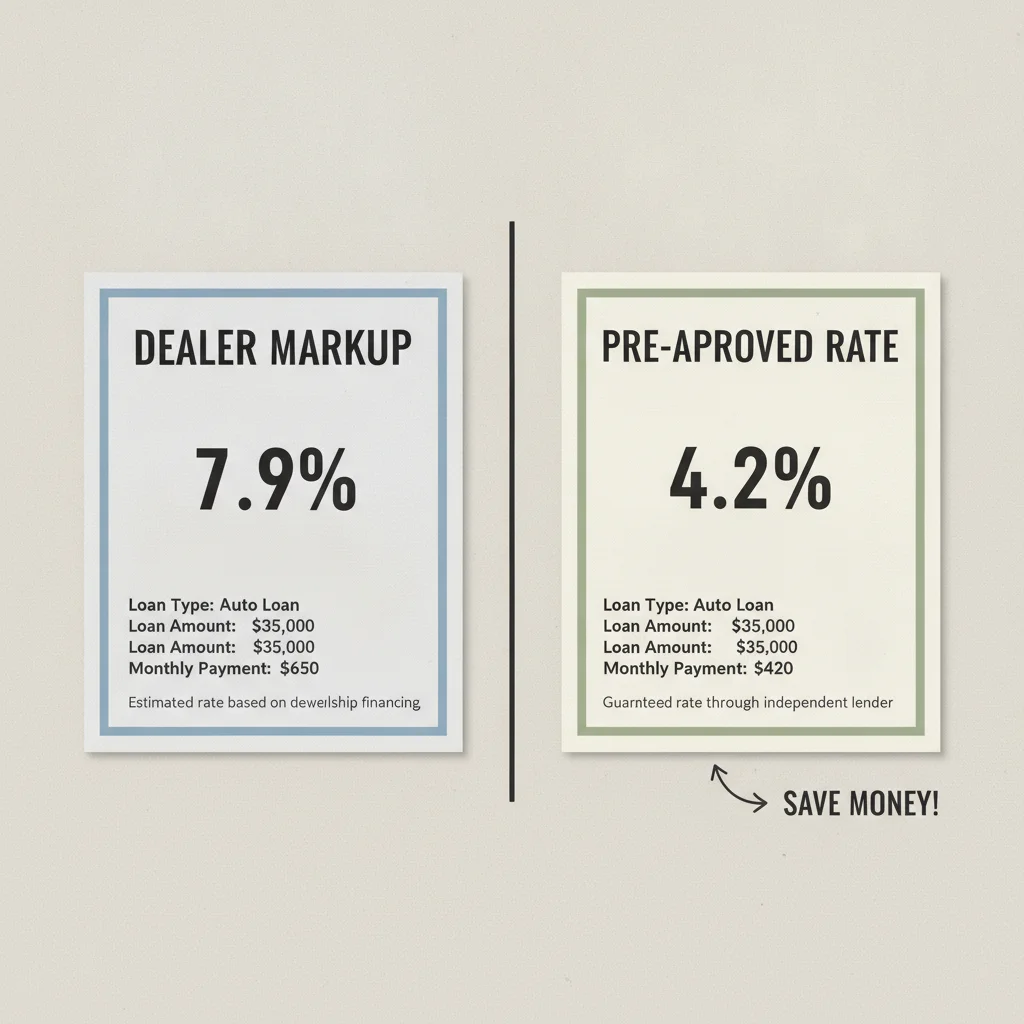
Here's something most buyers don't know: when a dealer arranges your financing through a third-party lender, the lender gives the dealer a buy rate — the minimum rate you actually qualify for. The dealer is then typically allowed to mark that rate up by 1–2.5 percentage points and keep the difference as profit. This is called the dealer reserve or finance reserve, and it's completely legal.
A buyer with a 740 credit score might genuinely qualify for 5.9% APR. The dealer might present them with 7.4% and pocket the difference over the life of the loan. The buyer never knows because they have no external benchmark. A pre-approval from a credit union at 5.9% is the benchmark. It's the number that forces transparency — and it only exists if you did the inquiry first. Good credit doesn't protect you from the markup. Pre-approval does.
2–5 pts
Typical score drop from one hard inquiry
According to FICO, a single hard inquiry lowers most credit scores by fewer than 5 points, with the effect diminishing significantly after 12 months.
45 days
Rate-shopping window under FICO 9
FICO 9 and FICO Auto Score models allow up to 45 days of auto loan inquiries to be counted as a single inquiry for scoring purposes.
1–2.5%
Typical dealer financing markup above buy rate
Consumer Financial Protection Bureau research found dealers routinely mark up lender-set buy rates by 1 to 2.5 percentage points as additional dealer profit.
$1,900+
Extra interest from a 2% rate markup on $30K loan
On a 60-month $30,000 loan, a 2-percentage-point rate increase adds roughly $1,900 in total interest compared to the qualifying rate.
35%
Share of FICO score tied to payment history
MyFICO confirms payment history is the single largest factor in FICO scores — far outweighing the 10% weight given to new credit inquiries.
How Credit Bureaus Actually Score Auto Inquiries
FICO and VantageScore — the two dominant scoring models — both include specific provisions for rate shopping on installment loans like auto loans. Under FICO 8 (still the most widely used model), all auto loan inquiries within a 14-day window are collapsed into a single inquiry for scoring purposes. Newer FICO models (FICO 9, FICO Auto Score) extend that window to 45 days. VantageScore uses a 14-day window as well.
What this means practically: if you apply to your credit union, two online lenders, and your bank in the same week, your score sees one inquiry — not four. The bureaus designed this deliberately because they want consumers to comparison shop. A buyer who shops lenders is behaving responsibly, not recklessly.
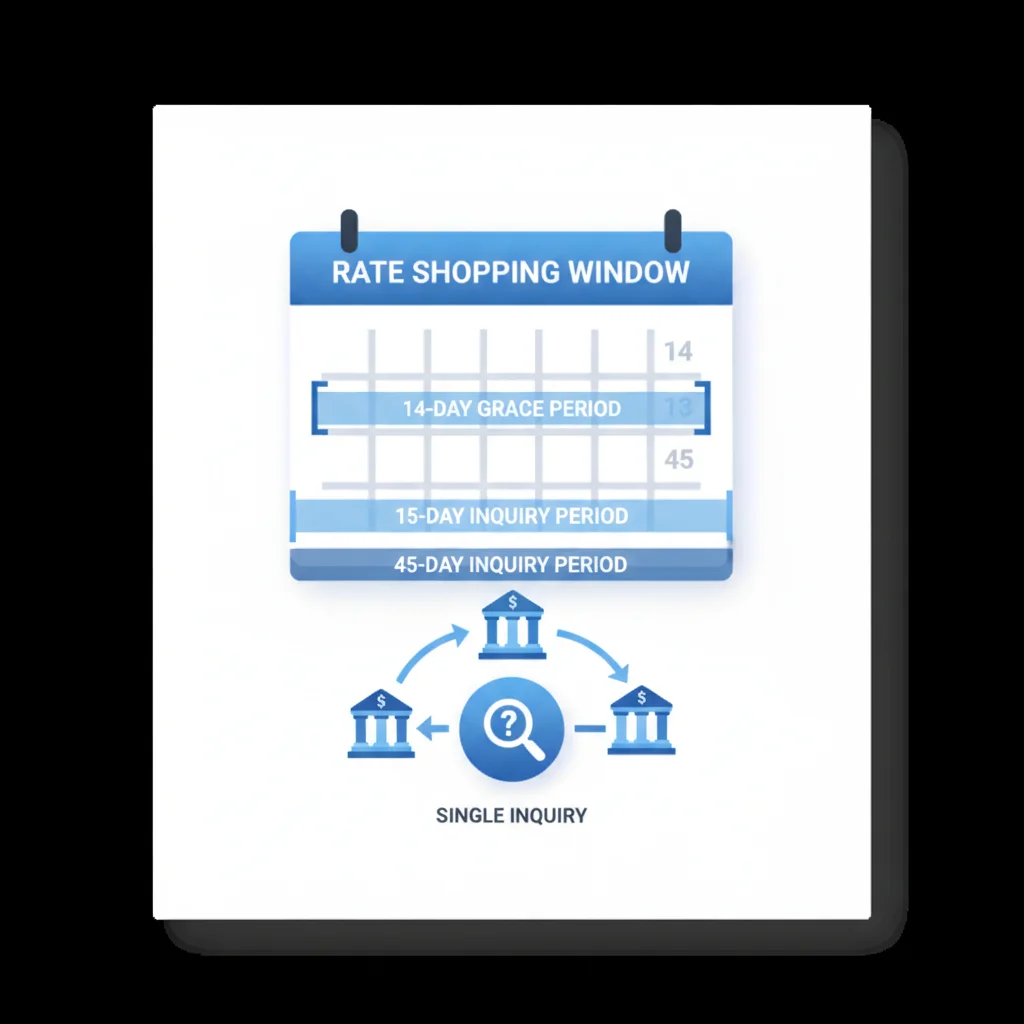
The inquiry itself falls off your credit report entirely after two years, and its impact on your score diminishes significantly after the first 12 months. For most borrowers, the practical effect on rate offers is negligible beyond the first few months.
Don't Apply for Unrelated Credit During This Window
Inquiries from credit cards, retail store accounts, or personal loans do not benefit from the auto loan rate-shopping consolidation rule. Each one counts separately. Avoid applying for any non-auto credit within 60 days of your car loan process — those separate inquiries add up and can affect the rate you're offered.
Pre-Qualification Is Not Pre-Approval
A soft-pull pre-qualification estimate looks similar on paper but carries no weight at the dealership. If you bring a pre-qualification to the finance office and present it as a competing offer, experienced F&I managers will know immediately it isn't binding — and will treat it accordingly. Only a formal pre-approval with a hard pull gives you genuine leverage.
Want a full breakdown of what lenders are actually evaluating when they pull your file? Here's what lenders look at before issuing a preapproval — credit score is just one piece.
The Real Credit Risk: What Actually Hurts Scores
If a 3-point inquiry drop isn't what buyers should worry about, what should they worry about? A few things that rarely get mentioned in the same breath as pre-approval:
- Opening new credit cards before your loan closes — each card is its own hard inquiry, and it also reduces your average account age and increases your available revolving utilization risk.
- Maxing out existing credit cards in the months before or during the loan process — utilization above 30% starts dragging scores down meaningfully.
- Missing a single payment on any existing account — a 30-day late payment can drop a score 60–110 points depending on where you started.
- Applying for unrelated credit (furniture financing, a new phone plan with a hard pull, store credit) during the same window as your auto loan shopping.
Keeping your credit score stable between pre-approval and loan closing covers exactly what to avoid in that critical window before you sign.
One Missed Payment Hurts Far More Than Any Inquiry
A single 30-day late payment can drop your credit score 60–110 points depending on your starting score — compared to 2–5 points for a hard inquiry. If you're concerned about protecting your score during the car buying process, focus obsessively on paying every existing bill on time. That matters orders of magnitude more than whether you applied to three lenders instead of one.
The pattern I saw repeatedly in the finance office: a buyer would protect their score obsessively from auto loan inquiries, then walk in having just financed a $3,000 vacation on a credit card. That card application alone did more damage than three pre-approval inquiries would have.
What Pre-Approval Actually Costs You vs. What It Saves
Let's put real numbers to this. Say you're financing $32,000 on a 60-month loan.
| Credit Tier | Typical APR (2024) | Monthly Payment | Total Interest Paid |
|---|---|---|---|
| Excellent (750+) | 5.9% | $617 | $5,020 |
| Good (700–749) | 8.5% | $656 | $7,360 |
| Fair (650–699) | 12.9% | $724 | $11,440 |
| Subprime (below 620) | 18.5% | $818 | $17,080 |
A buyer at the excellent tier who gets pre-approved and uses it to push back on a dealer's higher rate offer saves real money. A buyer who skips pre-approval and accepts whatever the dealer's financing desk produces — often marked up 1–2 percentage points above the lender's actual offer — pays that markup for 60 months.
The pre-approval inquiry costs you maybe 3 points temporarily. The markup costs you potentially $1,500–$3,000 in interest. There is no reasonable trade-off that favors skipping pre-approval to protect your score.
If you're ready to start the process, getting pre-approved for a car loan before you step on the lot walks you through every step from document gathering to comparing offers.
How to Shop Pre-Approvals Without Score Damage
The strategy is simple once you understand the rate-shopping window:
- Check your credit reports first (free at AnnualCreditReport.com) and dispute any errors before any lender pulls your file. An error on your report can suppress your score artificially — fix it before it costs you.
- Gather your applications in a tight window. Apply to all lenders you're considering within 14 days to ensure the inquiries consolidate. If you're not sure which lenders to use, target your primary bank or credit union, one online lender (like LightStream or PenFed), and potentially your automaker's captive finance arm if you're buying new.
- Compare the APR, not just the monthly payment. Dealers frequently stretch loan terms to make high-rate loans look affordable. A 72-month loan at 10% APR has a lower monthly payment than a 60-month loan at 6.5% APR — but you'll pay far more total and be underwater on the vehicle longer.
- Use your best pre-approval offer as your floor, not your ceiling. Bring it to the dealer's finance office. They may beat it, or they may not — but you've eliminated the information asymmetry the dealer normally exploits.
Several preapproval myths cost car buyers real money — including the belief that dealers won't honor outside financing. They will, and often must to close the deal.
Also worth reading: the pros and cons of getting preapproved before you know which car you want. If you're still in the browsing phase, there are good reasons to apply early — and a few caveats to be aware of.

Bottom line: the credit score concern around pre-approval is real in the narrowest technical sense and irrelevant in any practical financial sense. Shop lenders, use the window, and walk into that dealership with a number in hand. That's how buyers stop being at the mercy of the finance office and start being in control of the deal.
All claims are backed by peer-reviewed research. Sources on request.